
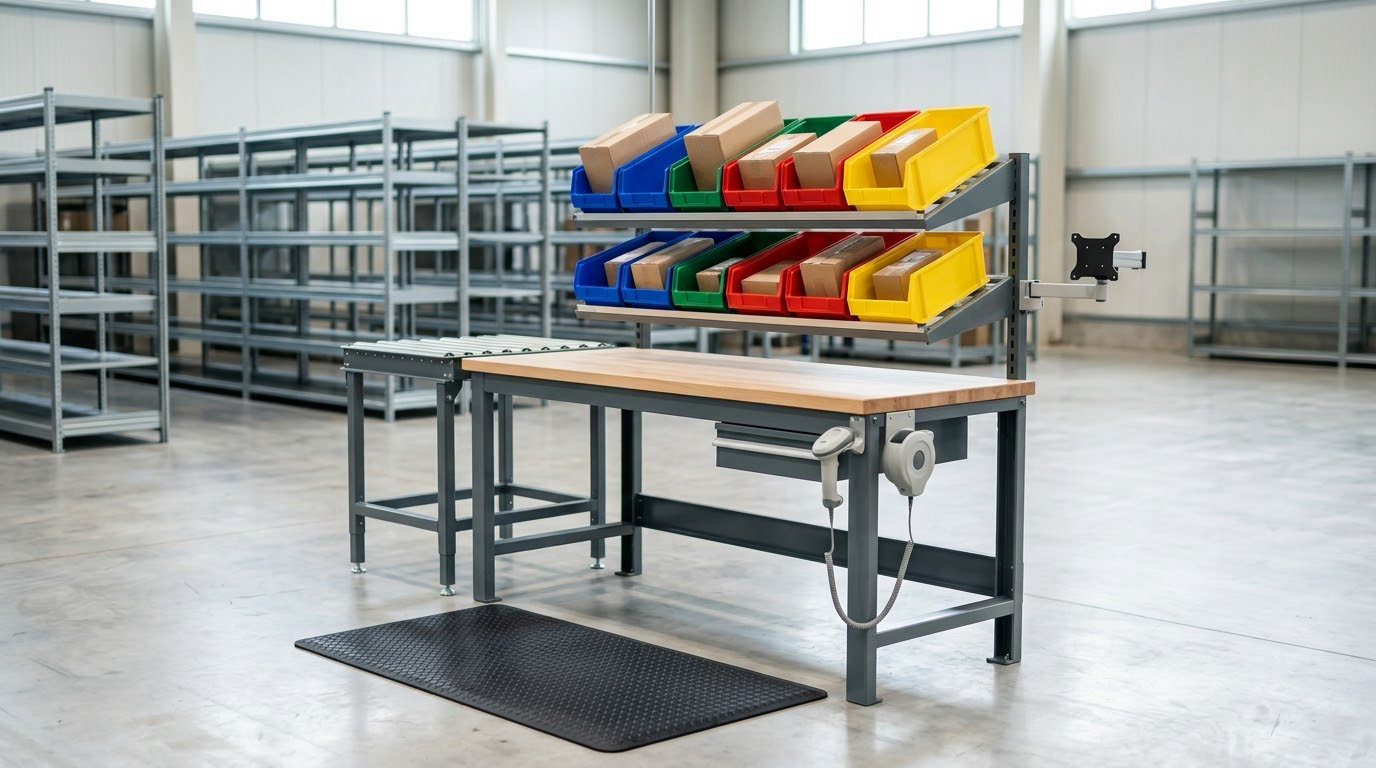
Warehouse picking ergonomics is the practice of designing picking work, from slotting and cart height to scanners and rotation, so that the task fits the person doing it. Good warehouse picking ergonomics keeps heavy items near waist height, cuts the number of reaches and twists per shift, and reduces the force needed to move a carton. That combination is what keeps pickers off the injury list, and it is the focus of this guide for safety managers, operations leads, and the pickers themselves.
I have walked enough pick faces to know the pattern. The operators who get hurt are rarely the ones doing something dramatic; they are the ones who bend to the bottom of a bin several hundred times a shift while a rate clock keeps moving.
Table of Contents
- What Is Warehouse Picking Ergonomics?
- Warehouse Picking Ergonomics: How to Reduce Musculoskeletal Risk
- What Should Employers Measure in a Picking Ergonomics Program?
- What Can Workers Do Between Picking Tasks?
- When Should a Worker Report Pain or Seek Medical Advice?
- Frequently Asked Questions
- How heavy should a warehouse picker be allowed to lift?
- What is the safest way to lift cartons in a warehouse?
- Are conveyor belts better than manual warehouse picking?
- How often should employers rotate warehouse picking tasks?
- Can ergonomic shoes reduce picking-related fatigue?
- What should a warehouse do if a worker reports back or wrist pain?
- Conclusion
What Is Warehouse Picking Ergonomics?
Warehouse picking ergonomics is the study and redesign of how goods are located, reached, lifted, carried, and placed so the work fits the body. It covers layout, slotting height, reach distance, load weight, grip force, tool weight, cart height, work rate, rotation, and technique. When those are matched to the person rather than to the layout, strain drops and output usually holds or improves.
Two terms carry most of the weight in this field. An ergonomic risk factor is any condition of the work that raises the chance of injury, and a musculoskeletal disorder, or MSD, is a condition affecting muscles, nerves, tendons, joints and supporting tissue. OSHA’s published examples of MSDs include carpal tunnel syndrome, tendinitis, rotator cuff conditions, epicondylitis, trigger finger, muscle strains, and lower back injuries.
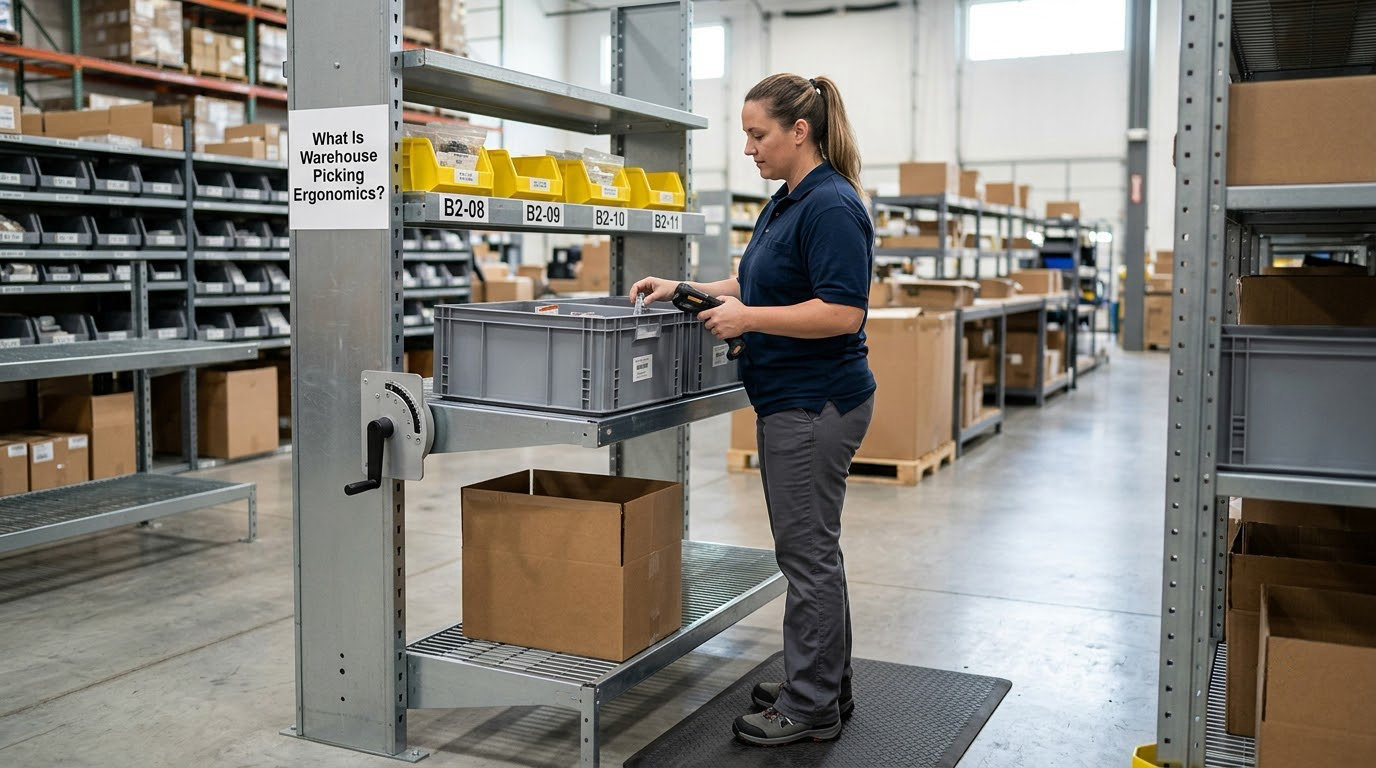
Five principles show up in almost every warehouse picking ergonomics program worth the name. Fit the work to the worker rather than asking the worker to fit the work. Keep the body in a neutral position. Reduce the force required. Cut repetition and awkward posture. And build in variation, so no single muscle group carries the whole shift.
One clarification matters here because it gets stated wrong all the time. OSHA does not have a general ergonomics standard and no enforceable lifting limits for most picking work; employers are held to the General Duty Clause, Section 5(a)(1) of the OSH Act, which requires a workplace free from recognized hazards likely to cause death or serious harm. OSHA also runs a National Emphasis Program on warehousing, which uses the General Duty Clause to direct enforcement at ergonomic hazards in distribution and fulfillment sites. If a picker quotes an OSHA “weight limit,” what they usually mean is their employer’s own policy.
Warehouse Picking Ergonomics: How to Reduce Musculoskeletal Risk
The most effective programs attack picking risk at its source: the work itself, not the posture of the worker performing it. Five risk factors drive most picking MSDs, and they can be reduced in a predictable order.
- Repetition. Thousands of identical reach-grasp-lift-scan cycles per shift, with little recovery time, create microtrauma that accumulates faster than tissue repairs.
- Awkward posture. Bent backs, stooping below the knee, twisting while carrying a load, and arms held overhead keep muscles working at a disadvantage.
- Force. Gripping, pulling, and lifting demands rise sharply when a tote is full, a lid is stuck, a carton is wedged, or a cart is too heavy to push easily.
- Overreach and low reaching. Anything stored at the floor or above shoulder height turns a normal pick into a stretch, a bend, or a shoulder shrug.
- Contact stress and tool load. A hard cart edge pressing into the thigh or hip, a scanner held for hours, or a cramped tote lip concentrated on the fingers.
From there, most sites work through the hierarchy of controls in order. Eliminate unnecessary picks by changing what a picker has to touch. Substitute lighter packaging and smaller case packs. Engineer the problem away with conveyors, lift tables, and carton flow. Then use administrative controls such as rotation, rest breaks, and rate limits. Personal protective equipment, gloves and supportive footwear, sits at the bottom because it protects one person at a time and never changes the task.
Slotting does more for picking ergonomics than any other single decision, because it decides how far a worker reaches every time they touch an item. The table below is a practical starting point; adjust the weights to what your people can actually handle safely.
| Storage height | Typical use | Load guidance | Pick frequency |
|---|---|---|---|
| Below knee | Heavy reserve pallets, bulk stock | Keep light; avoid routine picking here | Low, replenishment only |
| Knee to hip | Heavy cases and slow movers | Heaviest acceptable loads belong here | Moderate |
| Hip to shoulder (golden zone) | Fast movers, high-frequency SKUs, most piece picks | Light to moderate | High |
| Above shoulder | Light items only, ideally buffered | Light; never a heavy case | Very low |
Pairing matters as much as height. A heavy item does not need a fast-moving slot just because its velocity is high; if it does, put a small quantity in the golden zone and replenish from bulk below knee height. Fast movers in the golden zone, slow movers and heavy cases low, and nothing heavy above shoulder, is a decent rule of thumb.
How can a warehouse assess picking demands?
Observe real pick cycles instead of reading the job title. A picker on paper and the same picker on the floor are often different tasks. Watch several people across a full shift, including new hires and the fastest veterans, and record what actually happens: item weight, how many picks it takes to get one item, reach distance, grip force, travel time, twisting, posture, shift duration, and how much recovery time exists between tasks.
Formal tools help if you want numbers you can compare over time. The Revised NIOSH Lifting Equation estimates a lifting index for a two-handed lift, weighing load weight against horizontal reach, vertical height, distance travelled, trunk angle, and how often the lift happens. RULA scores upper-limb and posture risk in a few minutes, and REBA covers the whole body including a lifting component. WISHA’s lifting calculator is a simplified checklist used in several states, and Snook’s tables give percentile-based weight limits for pushing, pulling and carrying.
None of these replaces observation. They help you prioritise which tasks to redesign first, and they give you a number to re-check after you change something.
How can pickers reduce awkward reaching and twisting?
Keep frequent items inside a comfortable reach zone and set up the station so the spine stays neutral. Most discomfort in a pick face comes from three habits: reaching past the front edge of the rack, twisting to pull a tote out sideways, and carrying an awkward load while turning a corner.
Slide or tilt bins so the product sits at the front edge and slightly below shoulder height. Face the rack squarely before reaching in rather than reaching from an angle. Stage heavy cases in front of the pick path so the carry is short and straight. And if a bin sits at floor level, treat it as a replenishment location rather than a pick location.
One point worth raising with supervisors: tool fit is individual. A cart height, scanner weight, or glove that suits a six-foot worker can be wrong for a five-foot-two picker, and the ergonomic fix is useless when it was chosen without the person who has to use it all shift.
What equipment can reduce warehouse picking strain?
Equipment helps most when it removes the load, not just the walking. Tote carts and picking aids keep a load at waist height and reduce the carry distance. Shelf-level or carton flow racking and conveyor-fed pick modules bring the goods to the picker, which is the single largest ergonomic improvement available at any site.
Lift-assist devices, including vacuum and mechanical aids, take the weight out of oversized or awkward items. Height-adjustable platforms and lift tables raise the work surface to suit the individual rather than the other way around. Neutral-grip tools, powered pallet movers, and ring or wearable scanners replace the heavy handheld unit that sits in the palm for eight hours.
Match the equipment to the task. A lift table on a fast piece-pick line adds seconds per pick and gets bypassed, and a cart that is too heavy defeats its own purpose. Plan maintenance, inspect wheels and hydraulics, and retire equipment that no longer performs. New picker onboarding matters too: seasonal staff get the least training and the worst slot assignments unless someone assigns them deliberately.
How should employers train warehouse pickers?
Training works best when it is specific to the station. Cover body mechanics that fit the actual task: neutral wrist and trunk position, keeping the load close, avoiding twisting under load, and using a two-person or mechanical lift when an item is over the site’s weight limit. Show how to adjust carts, platforms, and workstations to their own height.
Train the equipment properly, not just how to turn it on. Show pickers how to use the lift-assist device, where the jigs and fixtures live, and what to do when a jam happens instead of climbing a ladder or reaching into a running conveyor.
Train the reporting path too. Pickers need to know that early reporting of discomfort is normal and will not cost them the shift, and supervisors need to know what to do with a report. Finally, train supervisors. A lead who pushes rate over a safe pick path will quietly undo every rule on the floor.
Ergonomic training lands badly on a new crew when the basics have not been covered first. Walk new hires through our 10 warehouse safety tips for new workers before slotting them onto a live pick path, then layer the ergonomic detail on top.
What Should Employers Measure in a Picking Ergonomics Program?
Measure the exposure and the outcome separately. Exposure numbers tell you whether the change reached the pick face; outcome numbers tell you whether it helped. Sites that track only recordable injuries often find out a year late, because strains and sprains are under-reported and frequently handled as medical visits rather than lost-time claims.
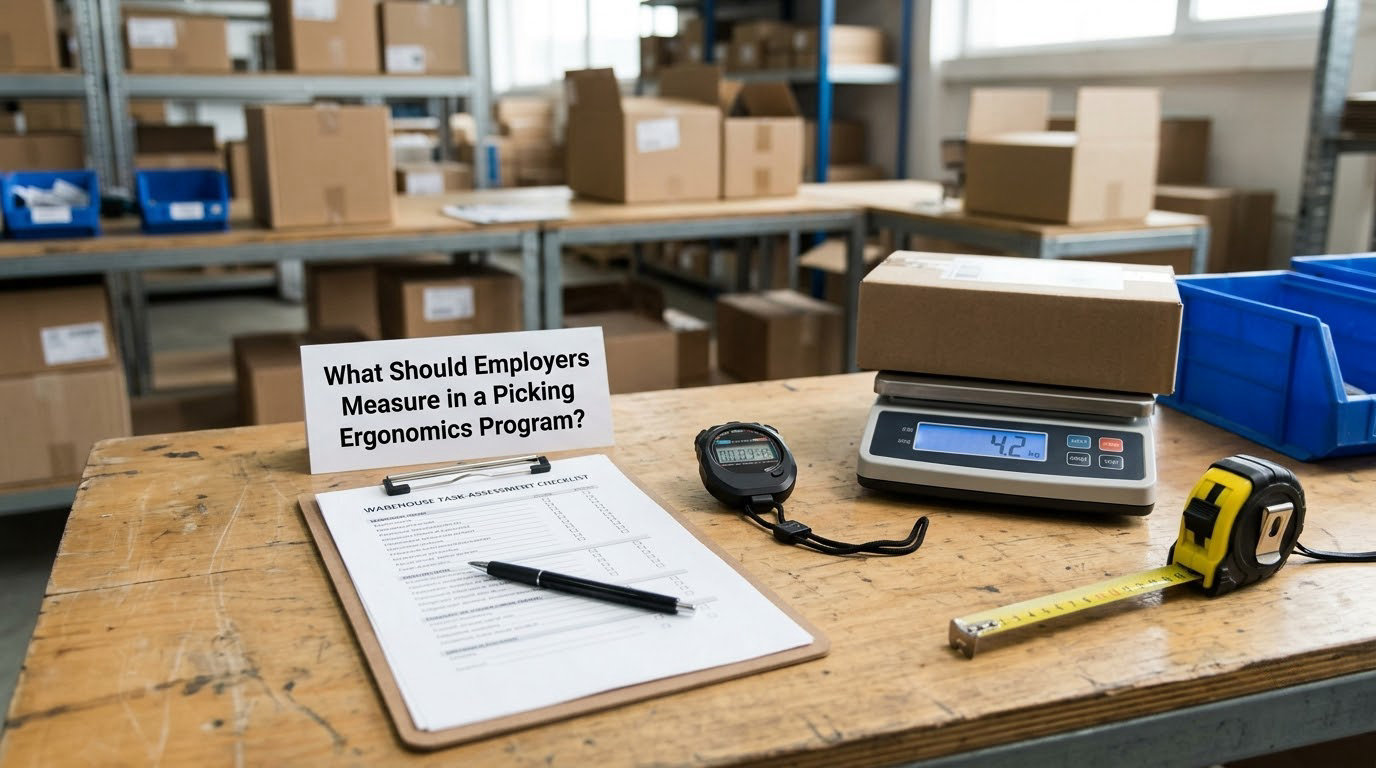
| Measure | Type | What it tells you |
|---|---|---|
| Task exposure: weight, reach, frequency per shift | Leading | Whether the physical demand actually changed |
| Repeat NIOSH, RULA or REBA scoring on the same task | Leading | Whether the redesign lowered the risk score |
| Equipment uptime and correct-use spot checks | Leading | Whether the control is actually being used |
| Training completion by role and shift | Leading | Coverage gaps, especially for seasonal staff |
| Near misses reported | Leading | How much unreported strain may exist |
| Short discomfort surveys, anonymous | Leading | Early signal across the whole workforce |
| Recordables, MSD cases, lost-time days, TRIR | Outcome | Whether injury rates are falling over time |
| Worker turnover in picking roles | Outcome | Whether the job is becoming harder to staff |
Re-score the same task on a schedule, because a slotting change or a new scanner can undo a year of work. Track turnover and staffing too: ergonomic work that makes a job survivable changes who stays, and that shows up long before the injury data does.
Protect worker privacy in any survey. Anonymous, short, and administered by someone outside the direct line of supervision gets more honest answers, and workers who believe feedback will be used against them will report nothing.
Label printing and packing are the other half of the shift, and both are screen jobs. Whoever works a pack station for hours faces the same monitor, keyboard, and chair problems as an office worker, so our office ergonomics checklist for desk workers transfers to a packing bench without much editing.
What Can Workers Do Between Picking Tasks?
Small habits compound over a shift. Change your posture every few minutes; a neutral spine is a range of positions, not a single pose to hold. Walk to the next pick rather than standing planted while a tote is assembled. Let your hands open and close loosely between picks instead of keeping fingers curled around a scanner grip.
Rotate between picking, packing, and replenishment when the shift allows it, and take short recovery periods rather than saving all your break for the end. Drink water, and take your gloves off periodically so your hands can cool down and your skin stays dry.
None of this replaces an ergonomic fix, and I would not suggest asking a worker to stretch their way out of a badly designed pick path. These habits help; design removes the cause.
Long hours on your feet wear down a body in ways that overlap heavily with picking strain, and the fixes are largely the same ones. Our ergonomics guide for cashiers and standing jobs covers posture variation, foot position, and anti-fatigue surfaces in more depth.
When Should a Worker Report Pain or Seek Medical Advice?
Report discomfort early. Pain that lingers, swelling that does not settle overnight, weakness, numbness, tingling, or reduced range of motion in a shoulder, wrist, hand, or back are all reasons to speak up rather than push through a shift.
Tell the supervisor, use the reporting path your site has, and ask for a workplace health assessment or a visit with an appropriate healthcare professional. This article is general information and cannot diagnose anything; a clinician is the right person to evaluate symptoms, and early evaluation usually means simpler, faster options.
Persistent symptoms also give you data. A pattern of wrist complaints on one pick line is an engineering problem, and it is much easier to fix before anyone has time off work.
Frequently Asked Questions
How heavy should a warehouse picker be allowed to lift?
There is no single OSHA weight limit for most warehouse picking, because no general ergonomics standard exists. Employers set their own limits, typically lower for repetitive or overhead work, and tools like the NIOSH lifting equation give a weight adjusted for reach, height, twisting, and frequency. Set the limit, train pickers on it, and provide a lift-assist device or a second person for anything above it.
What is the safest way to lift cartons in a warehouse?
Keep the load close to your body, lift with your legs, keep your back neutral and your head up, and avoid twisting while carrying. Approach the carton squarely instead of reaching from an angle, and slide it rather than jerking it free of a wedged position. If a carton is beyond your site limit or blocks your view, use equipment or a two-person lift instead of your back.
Are conveyor belts better than manual warehouse picking?
Conveyor and carton flow systems generally reduce strain because goods arrive at waist height at a fixed point, cutting travel, carrying, and reaching. They do not remove all risk, because picking from a moving line adds pace and shoulder load, and packaging stations can still demand awkward postures. Evaluate the whole system, including where the worker stands and how fast the line runs.
How often should employers rotate warehouse picking tasks?
Rotate often enough that no muscle group is loaded continuously, which in many operations means every 30 to 60 minutes between physically demanding tasks. Rotation is a useful administrative control, but it works best alongside engineering changes; a worker who rotates between two equally heavy pick paths gains little. Track discomfort surveys to check whether rotation is actually reducing reported pain.
Can ergonomic shoes reduce picking-related fatigue?
Supportive footwear can reduce fatigue in the feet, knees, and lower back on long shifts, particularly on hard concrete or when standing for extended periods. It helps most when paired with anti-fatigue mats, varied posture, and a properly set cart height. Footwear does not address the underlying reach, height, and weight problems in a pick face, so treat it as one layer rather than a solution.
What should a warehouse do if a worker reports back or wrist pain?
Treat the report as a signal about the task, not only about the person. Record the task, weight, and location involved, offer an appropriate healthcare referral, and review the pick path for reach, force, and repetition issues in the same week. Where several reports come from one station, treat it as a redesign trigger and involve the picker in testing any change.
Conclusion
If you do one thing this month for warehouse picking ergonomics, observe a single representative pick from first reach to last place. Write down its heaviest item, its longest reach, its tightest twist, and how many times it repeats in an hour. Fix the worst of those, involve the picker who does that task in testing the change, and re-score it a month later before adding more training.
Ergonomics in the warehouse is not a poster or a toolbox talk. It is the accumulated result of where you put things, what you make people carry, and whether they get a say in it.