
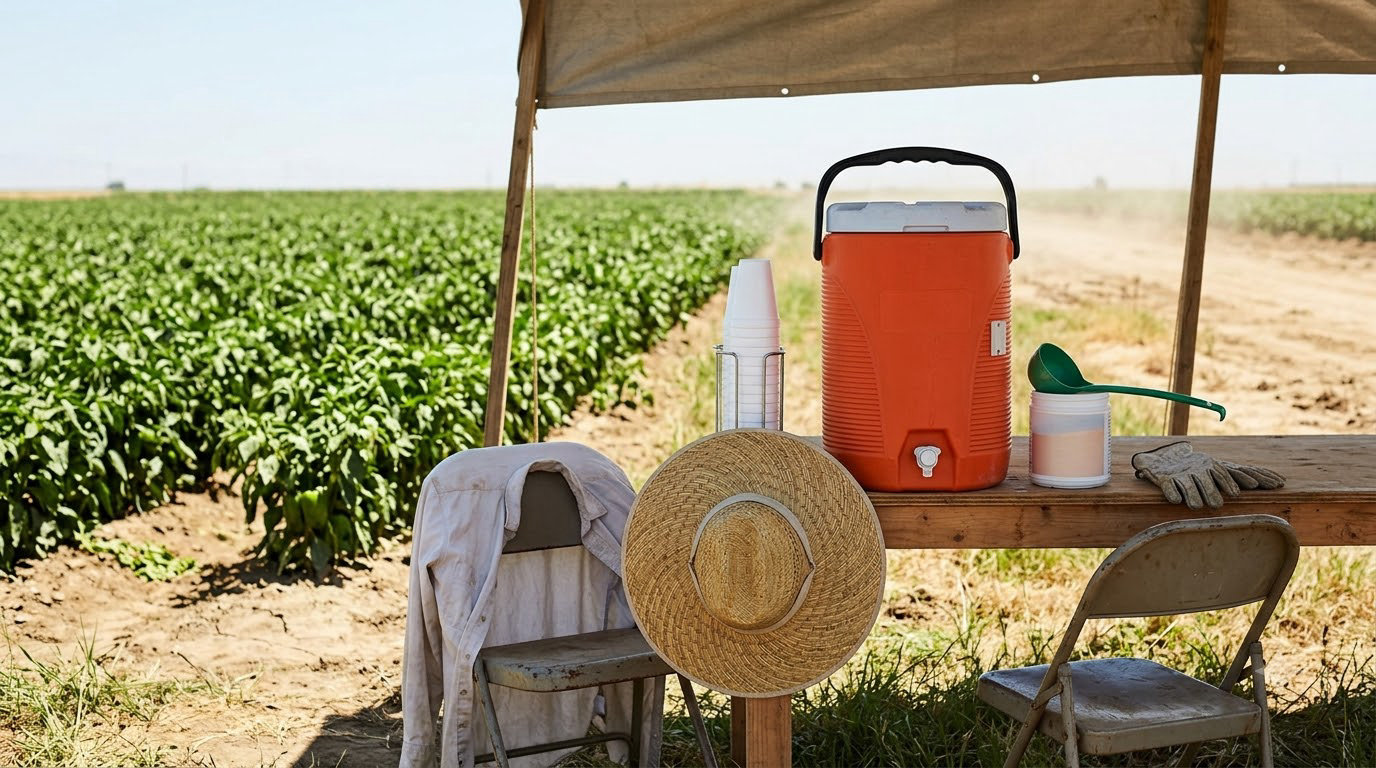
Agricultural worker heat safety means the practices, supplies, and emergency procedures that keep field workers from suffering heat exhaustion, heat stroke, and other heat illness during outdoor work. Most of that work runs on four things: water, rest, shade, and gradual acclimatization. This guide lays out how to set those up before the hot season and how to respond when something goes wrong anyway.
The stakes are not hypothetical. The Bureau of Labor Statistics figures cited by the University of Vermont agricultural labor program show roughly 43 farmworker heat deaths per year averaged over 2011 through 2021, and 55 in 2023 alone. Peer-reviewed work on agricultural workplace exposure has put the heat-related death rate for agricultural workers at about 20 times that of the rest of the U.S. civilian workforce. Agriculture also leads every occupation in the number of workers’ compensation claims filed for heat illness.
Much of that risk traces back to how farm work is organized rather than to the weather alone. Heavy physical labor runs for long hours, breaks get scheduled around harvest windows instead of heat levels, protective clothing traps heat, and a share of the workforce arrives from places where bodies are not used to this kind of exposure. If you are writing your rules from scratch, our guide on how to write a workplace health and safety policy covers the documentation side, and this one covers the heat-specific controls.
Table of Contents
- What You Need
- Step-by-Step: Build a Heat Safety Program
- Common Mistakes
- Frequently Asked Questions
- What temperature is too hot for agricultural workers to work in?
- Is it safe to work in 90-degree heat?
- Can a worker refuse to work in dangerous heat?
- How much water should a worker drink during a shift in heat?
- Does wearing a respirator or pesticide PPE increase heat risk?
- What should an employer document after a heat-related incident?
What You Need
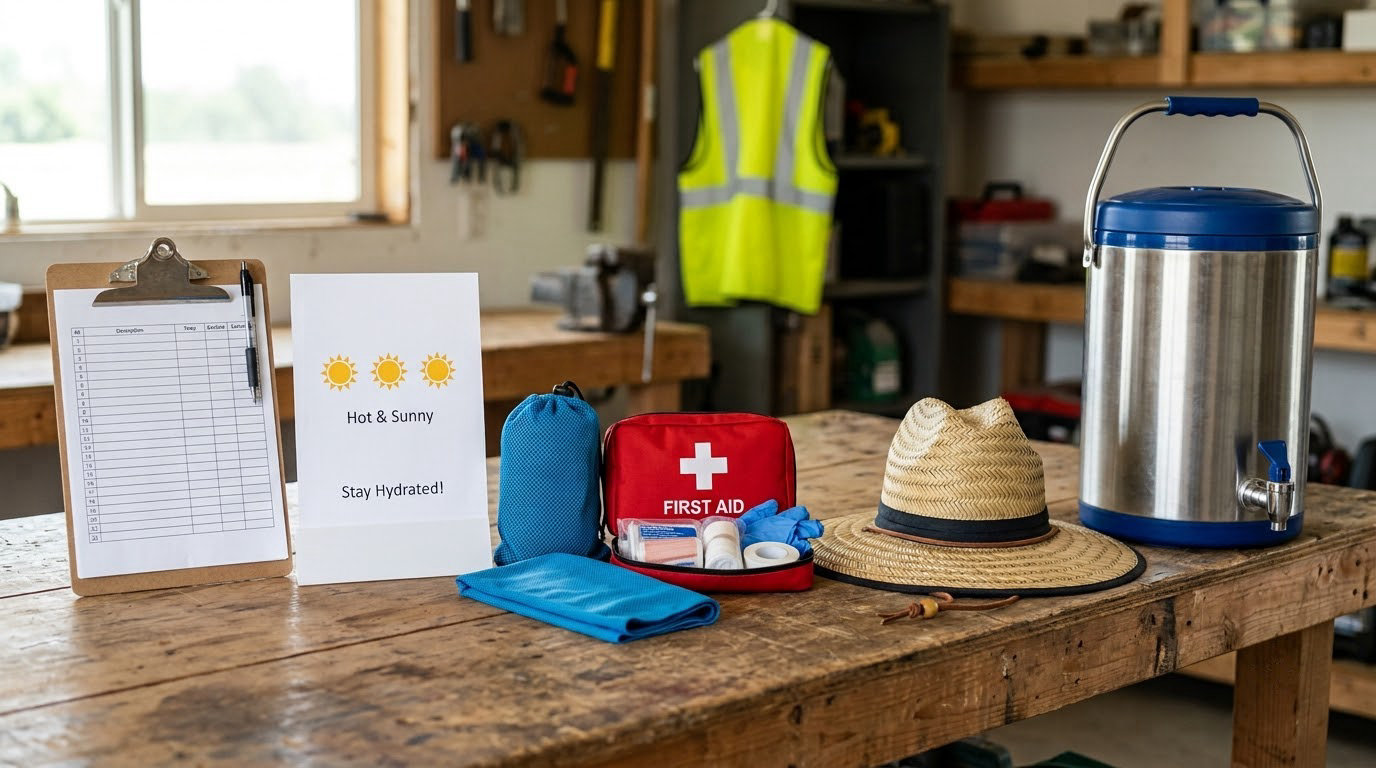
Assemble these before the first hot shift, not during it. Running to find a cooler after a worker has stopped sweating is how preventable incidents happen.
- Heat risk information. A reliable forecast source for the fields you manage, a thermometer or heat index reading taken on site, and access to wet bulb globe temperature data if you work in orchards, vineyards, or dense canopy where humidity runs high.
- Drinking water. Enough cool water for every worker on shift, in containers that hold their temperature, plus a way to keep reserves cold through the afternoon.
- Shade and cooling. A shaded or air-conditioned rest area that every worker can reach quickly, seating, and fans or other cooling equipment for the hottest hours.
- Communication. Charged cell phones or radios for the supervisor and crew, and a clear method for calling emergency services from a field with poor reception, such as a designated caller and a known location or mile marker.
- Training materials. Symptom cards in the languages your crew actually speaks, a buddy-check system, and a written response procedure supervisors can follow without stopping to think.
- Emergency resources. A stocked first aid kit, ice or cold packs, an emergency contact list, and a route to the nearest medical facility for each field you work.
Two items people routinely skip: a backup plan for when the power goes out and the well pump stops, and the address or mile marker of the field so an ambulance can find a crew that has already stopped working. Put both in the written plan before the season starts.
Step-by-Step: Build a Heat Safety Program
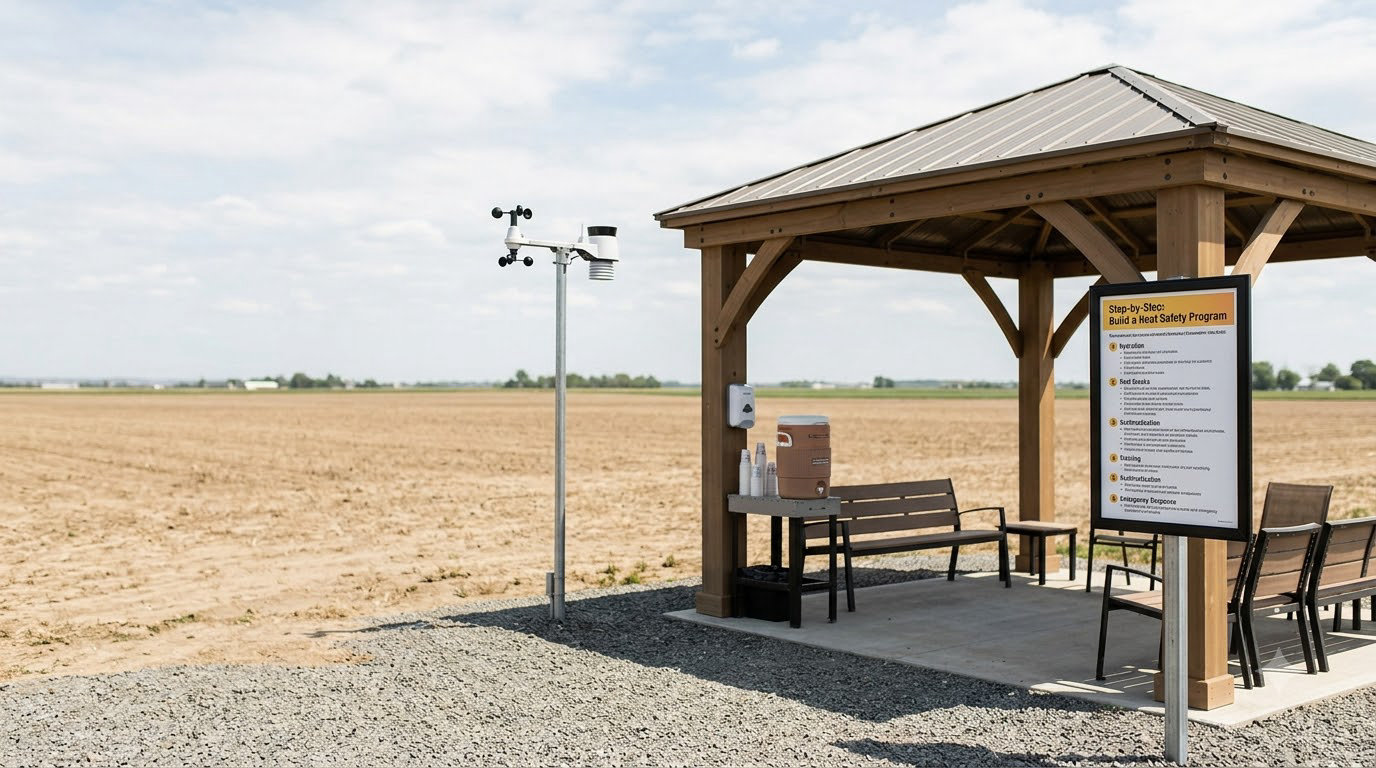
Step 1: Assess Heat Risks and Work Conditions
Heat risk is not the number on the thermometer. It is the number plus humidity, direct sun exposure, workload, clothing, how long the task runs, and whether the worker is acclimatized. A light task at 88 degrees in dry air is a different proposition from the same temperature in 70 percent humidity under full sun.
Walk each field and each task. Note where there is no natural shade, which rows block wind, how far a worker must walk to reach water, and which jobs require chemical protective gear or a respirator. Then sort the tasks into three groups: light, moderate, and heavy, the way NIOSH guidance does, because heavy work generates far more internal heat than light work at the same temperature.
Step 2: Schedule Work Around Excessive Heat
Move the heaviest work to the early morning and move it off the afternoon peak. Where a crop demands daytime labor, shorten the shift block, add recovery periods, and rotate crews so no single worker does continuous heavy work hour after hour.
Seasonal timing matters too. Plant and prune early, harvest around the edges of the day, and treat pesticide application as a high-heat-load task that needs its own schedule. If a heat advisory or excessive heat warning is issued, decide in advance what work stops and who makes that call, because supervisors will not make that decision well in the moment.
Step 3: Provide Water, Shade, and Cooling Support
Keep cool drinking water within reach of every worker for the entire shift, not available only at break time. A common field guideline is roughly one cup, about 8 ounces, every 15 to 20 minutes, which works out to a quart per hour for a worker in heavy heat. That is a starting point, not a cap: a worker who is thirsty is already behind.
Watch for the two failure modes supervisors report most often. Water that sits far enough away that workers skip it, and water that tastes so warm or so flavored that people drink less than they need. Refill stations also need a real rest area close enough to use, and rest that is genuinely unpaid and uninterrupted where state law requires it.
Shade should be close to the work, big enough for the whole crew at once, and available during the hottest hours rather than folded away after lunch. Evaporative cooling works best in dry heat and does much less in humid conditions, where the air will not let sweat evaporate. In high humidity, an enclosed space with air conditioning or a fan is worth more than an open canopy. The same scheduling and acclimatization logic from cold stress prevention for outdoor workers applies here in reverse, since both risks are driven by exposure duration and inadequate recovery time.
Step 4: Train Workers to Recognize Heat Illness
Everyone on the crew trains on the same four subjects: what each condition looks like, how to say “I am not okay” without embarrassment, how to check a coworker, and who gets called. Training fails in the field when it is delivered only in English, only in writing, or only once at season start.
Deliver it verbally through a supervisor or crew leader who speaks the crew’s language, use visual symptom cards rather than text-heavy handouts, and repeat it during the first week of every new worker’s arrival. U.S. agricultural crews commonly include Spanish, Haitian Creole, Mixteco, and Hmong speakers, and low-literacy design is not optional. If your safety culture makes workers afraid to speak up, the training has not landed; our piece on how to build a safety culture at work covers that gap.
Step 5: Monitor and Respond to Symptoms
Heat illness climbs a ladder, and the earlier you catch it the simpler the response. Heat rash shows up as red clusters of bumps in skin folds. Heat cramps come as painful muscle spasms during or after heavy work. Heat syncope is a faint or near-faint, often the first serious warning sign. Heat exhaustion brings heavy sweating, headache, nausea, dizziness, clammy skin, weakness, and sometimes mild confusion. Heat stroke is the emergency: body temperature is very high, skin may be hot and dry or wet, the person is confused, slurred, unconscious, or seizing.
Supervisors act in a fixed order. Move the worker out of the sun into shade or an air-conditioned space immediately. Call 911 right away for confusion, fainting, seizures, or suspected heat stroke, and start cooling while waiting: cool or cold wet cloths on the neck, armpits, and groin, cold water poured or sprayed over the skin, fan the skin aggressively, and keep cooling until help arrives or the person is fully conscious. Do not give fluids to someone who is confused or unconscious. For heat exhaustion, have the worker lie down in a cool place, loosen clothing, give cool water in small sips if fully alert, and expect recovery within about an hour. If symptoms do not improve, escalate to emergency services.
Write down what happened: the conditions, the task, the symptoms, the response, and the outcome. That record is what drives the review in Step 6.
Step 6: Review and Improve the Program
Review after every heat incident and every near miss, plus at set points: before each season, whenever a new crop or task changes the workload, when a new worker joins, and when the forecast pattern shifts earlier into the season than expected.
Bring workers into the review. They will tell you that the water station is too far, that the shade does not cover the last row, or that the afternoon block is too long to finish safely. Fold those findings into the written policy version so the next supervisor inherits the fix. Farmers who run a formal heat injury and illness prevention plan report fewer surprises mid-season than those relying on memory, and documentation also protects the operation when an inspector or a claims adjuster asks questions later.
Common Mistakes
Relying on water alone. Water matters, but water plus rest beats water alone. A worker who drinks continuously still overheats without recovery periods in shade.
Long unbroken work blocks. Eight straight hours of heavy picking on a July afternoon is the pattern behind most field heat incidents. Break the shift into work-rest cycles.
Water that is present but rationed. If workers are told to bring their own or can only drink on break time, the supply exists on paper and not in practice.
Shade that is symbolic. One chair for a ten-person crew, or shade available only after the hottest hours, is not an access point.
Treating symptoms informally. A dizzy crew member who sits down for five minutes and goes back to work has had no assessment and no documented event.
Overlooking new and returning workers. A worker with ten days of experience has more heat risk than one with ten years. Acclimatization takes roughly a week or two, and returning workers lose that adaptation quickly.
Confusing heat exhaustion with heat stroke. Exhaustion means cool the person and watch them. Stroke means call 911 and cool immediately. Waiting to see which one it is costs minutes that matter.
No plan for power or water failure. A pump that stops or a cooler that empties mid-shift needs a prearranged backup, not a phone call.
Two habits pay for themselves quickly. Keep a second person at each crew who knows the emergency protocol in case a supervisor is the one who goes down, and check in with workers at a set time rather than waiting for someone to volunteer that they feel ill.
Frequently Asked Questions
What temperature is too hot for agricultural workers to work in?
There is no single temperature, because humidity, workload, clothing, and acclimatization change the risk. Use the heat index for outdoor conditions and the wet bulb globe temperature for work in canopy, where humidity runs high. NIOSH guidance maps risk to workload type, so heavy work needs controls at lower readings than light work. Set your own trigger for extra water, added breaks, and schedule changes before the season, then use that number consistently.
Is it safe to work in 90-degree heat?
Ninety degrees of dry-bulb temperature is not the number that matters, because the same reading feels very different at 30 percent humidity than at 75 percent. Check the heat index for your location, which combines temperature and humidity, and assume heavy field work carries a higher risk than light work at any reading. If the index is high, shorten work blocks, add recovery breaks in shade, rotate crews, and schedule strenuous tasks early.
Can a worker refuse to work in dangerous heat?
Federal OSHA has not issued a final heat-specific standard, so rights come from a patchwork of state rules, the general duty clause, and anti-retaliation protections. California and several other states have specific outdoor heat standards with water, shade, and rest requirements that apply to most employers including small ones. In every state, a worker may refuse work they reasonably believe is dangerous, and no one should be punished for raising a safety concern. Get local legal advice for your state before anyone relies on this.
How much water should a worker drink during a shift in heat?
A common field guideline is about one cup, roughly 8 ounces, every 15 to 20 minutes, which works out to about a quart per hour during heavy work in high heat. Treat that as a floor rather than a limit, because thirst is a late signal and heavy sweating loses salt as well as water. Keep cool water within reach of the worker at all times, not only at breaks, and offer electrolyte drinks for shifts longer than a couple of hours in heavy heat.
Does wearing a respirator or pesticide PPE increase heat risk?
Yes, and significantly. Chemical protective clothing and respirators add layers that slow heat loss and moisture evaporation, and the effort of working while suited raises the metabolic heat load. Early entry, when a worker enters a field before the pesticide re-entry interval has expired, adds chemical exposure to that same heat stress. Plan extra rest breaks, schedule application and early entry for cooler hours, and add cooling time before a worker puts the gear back on.
What should an employer document after a heat-related incident?
Record the weather conditions and heat index, the task the worker was doing, the exact symptoms and when they started, the time of the emergency call, the cooling steps you took, and the outcome. Note any witness statements and whether the worker recovered on site or went to a clinic. Keep near misses too. This record supports medical care, tells you what to fix, and protects the farm when a claim or inspection follows.
Start with the one change you can make this week: put cool water within reach of every worker for the full shift and schedule recovery breaks around the heat, not around the harvest schedule. Get water, rest, and shade right and most agricultural worker heat safety problems disappear before they start.