
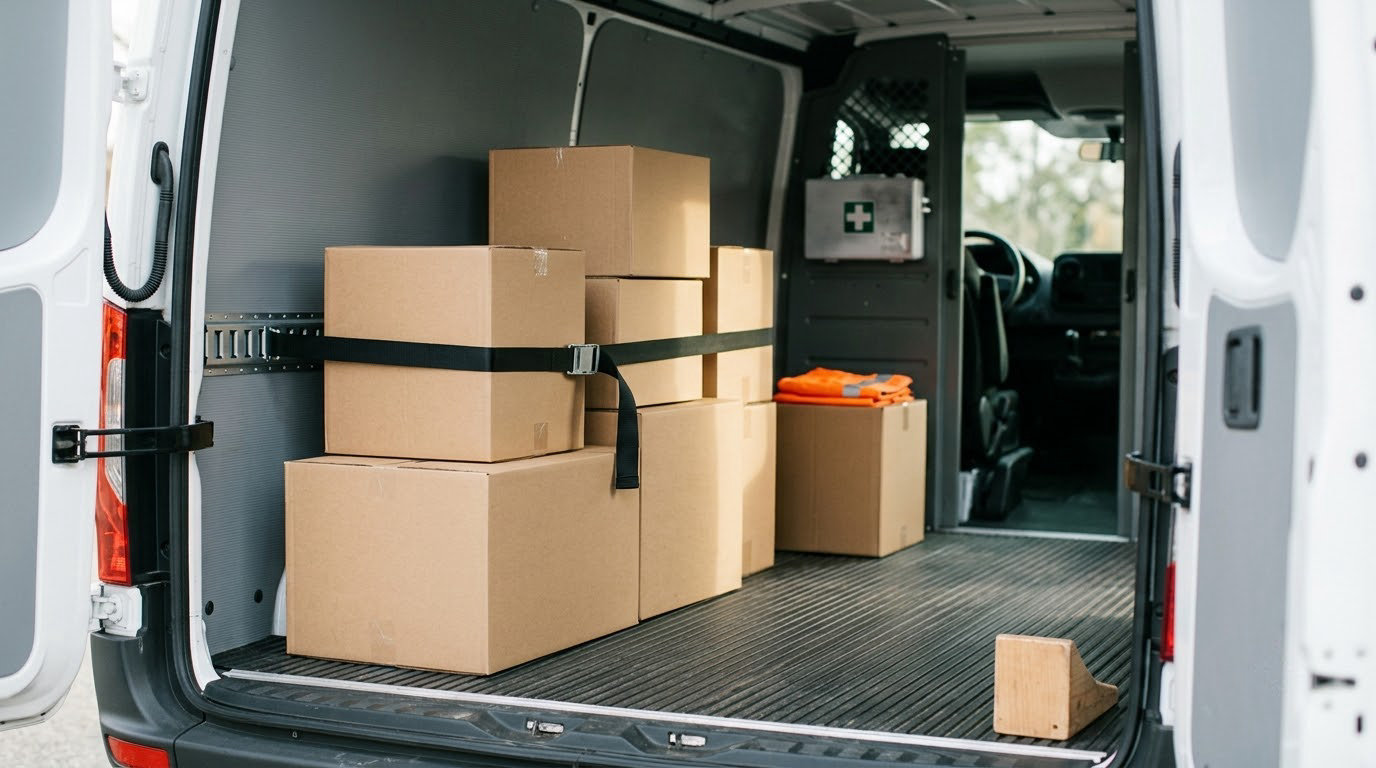
Delivery driver safety tips come down to a short set of habits applied at the right moment: inspect the vehicle before you accept it, plan the route before you pull out, keep the phone down while the van is moving, and know what to do when a delivery address feels wrong. This list covers all twelve in the order most drivers meet them, from the pre-shift walkaround to the near-miss report you file afterwards.
It is written for US couriers, restaurant and grocery delivery drivers, package drivers, and the fleet supervisors who put them on the road. Where employer policy or a state rule covers the same ground, the policy is what you follow. These delivery driver safety tips are a floor, not a ceiling.
Table of Contents
- Delivery Driver Safety Tips at a Glance
- 1. Complete a Pre-Shift Vehicle Inspection
- 2. Plan Routes Before Starting
- 3. Adjust Driving for Traffic and Weather
- 4. Wear a Seat Belt and Stay in Position
- 5. Keep Sightlines and the Cab Clear
- 6. Use Safe Loading and Unloading Habits
- 7. Park Before Using a Phone or Device
- 8. Control Fatigue and Take Real Breaks
- 9. Protect Your Body Between Stops
- 10. Know the Vehicle’s Blind Spots
- 11. Respond Safely to Collisions and Hazards
- 12. Report Hazards and Near Misses Early
- Frequently Asked Questions
- Are delivery drivers responsible for inspecting their vehicles?
- What is the safest way to lift and carry delivery packages?
- Can a delivery driver legally use a phone while driving?
- What should I do after a minor delivery vehicle collision?
- How can employers reduce fatigue-related driving risks?
- Why should delivery drivers report near misses?
- Conclusion: Start With the Highest-Risk Task
Delivery Driver Safety Tips at a Glance
The table below condenses the whole checklist. Use it to pick the tips that match your shift, rather than reading top to bottom on a dark driveway at six in the morning.
| Safety action | When to use it | Risk it controls |
|---|---|---|
| Walk-around vehicle inspection | Before the first stop | Brake, tire and light defects |
| Route and time-budget planning | Before leaving the yard | Speeding, abrupt lane changes |
| Weather and traffic adjustments | Continuously, on the road | Loss of traction and visibility |
| Seat belt and seated position set | Every drive, every vehicle | Ejection in a crash |
| Clear windshield, mirrors and cab | Start of shift and after loading | Blocked sightlines, loose cargo |
| Load planning and assisted lifts | Loading and at every door | Back strain, dropped parcels, falls |
| Park before using any device | Any time the van is moving | Distracted driving |
| Real breaks and shift rotation | Every few hours of driving | Microsleeps and fatigue errors |
| Ergonomics, footwear, stretching | Between stops | Repetitive-strain and balance injuries |
| Blind spot and clearance checks | Before every turn or lane change | Collisions with cyclists and pedestrians |
| Priority-based incident response | Crash, breakdown, unsafe scene | Secondary injuries, confrontation |
| Prompt hazard and near-miss reporting | Same shift, ideally same day | Repeat incidents, lost evidence |
How to Use These Delivery Driver Safety Tips
Pick three before a shift, two while driving, and the rest when something goes wrong. Triage is the point: you cannot inspect a tire, plan a route, and manage fatigue at the same time, so decide which one matters at that moment.
Several of these are also employer-side practices. If you supervise drivers, the job hazard analysis step by step is how you turn this list into documented tasks with an owner, and how to build a safety culture at work covers why drivers stop reporting when nothing ever changes.
1. Complete a Pre-Shift Vehicle Inspection
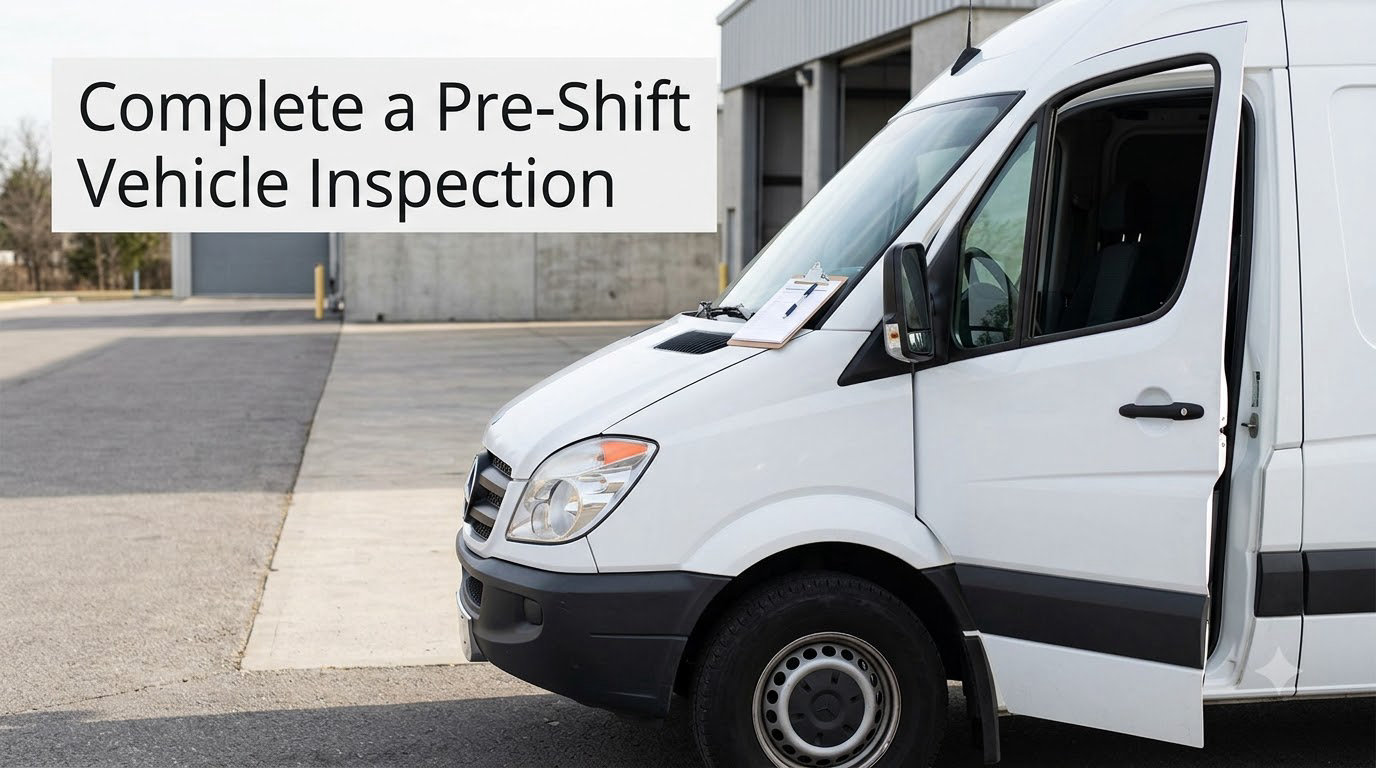
The most useful safety habit on this page happens in about four minutes, before the engine is warm. Walk the vehicle, not just the dashboard: the warning light tells you the problem already exists, the walkaround is how you catch it early.
Check tire pressure and tread, and look for cuts or bulges in the sidewall. Check brakes by pressing the pedal and confirming the vehicle does not creep. Confirm headlights, brake lights, turn signals and hazards work. Clean the windshield, mirrors and rear camera lens, since a dirty pane at night is the same as a narrow one. Top off washer fluid, and check oil, coolant and fuel.
Record what you find in writing, on the employer’s Daily Vehicle Inspection Report if there is one, and report defects before you accept the vehicle. A tire with a cord showing or a brake pedal that sinks is a take-it-out-of-service item, and telling dispatch is what stops the next driver from finding it instead of you.
2. Plan Routes Before Starting
Enter the route, the stops and the fuel plan before you move. Time pressure is the mechanism behind most shortcut decisions, so a realistic schedule is a safety control rather than an administrative one.
Check for construction zones, weight or vehicle restrictions, toll lanes you would rather avoid, and where you are legally able to park. Prefer routes with clear pedestrian access and lighting over the fastest one, and add a few minutes of buffer for the loading dock you have never used before.
Some experienced couriers build their routes around risk rather than distance: they stay out of rush-hour commute bands, away from large event release times, and clear of casino and bar districts late at night. That habit costs a few minutes and removes predictable sources of confrontation.
3. Adjust Driving for Traffic and Weather
Conditions change faster than the schedule does, so re-evaluate them when the forecast does, not when the first puddle appears. Rain reduces grip well before it looks dangerous, and standing water hides potholes and lane markings.
Slow down and add distance in rain, fog, snow, ice, high wind, darkness and dense traffic. In fog, use low beams and follow the road markings rather than the vehicle ahead, since drivers’ red tail lights blur into a smear at low speed. In heat, watch tire pressure, carry water and treat heat exhaustion as an emergency, not a nuisance.
Some conditions are a reason to stop, delay the route or pull over. If visibility is near zero, the road is iced over, or a severe weather warning covers your area, delaying is the safe call. Say so early rather than explaining afterwards.
4. Wear a Seat Belt and Stay in Position
A belt is the single control that keeps you in the vehicle and in position behind the wheel, and it takes two seconds. Buckle before the van moves, not after the first intersection.
Set the seat so your legs reach the pedals with a slight bend and your back is supported, then adjust the steering wheel so your hands rest at the lower corners. Adjust mirrors once and leave them alone. Reducing unnecessary reaching and twisting keeps you seated and attentive, which is the whole point.
5. Keep Sightlines and the Cab Clear
Sightlines fail quietly, then all at once. Clean the inside of the windshield too, since that is where fog and glare collect, and check that no phone mount, dash device or rearview obstruction blocks the view down the passenger side or over the rear shoulder.
Keep the cab clear of anything that can move under hard braking. Secure the load, stow tools and loose equipment, and check the load height and weight distribution rather than packing to the roof line. For lifting specifics, the manual material handling risk factors guide covers the strain mechanics in more depth.
6. Use Safe Loading and Unloading Habits
Most injuries in this job are not crashes. They happen in the cargo bay, at the threshold and in the stairwell, and they cluster around heavy, awkward or unstable loads.
- Split a load into lighter units where you can, and push or slide rather than carry when the path allows.
- Use a parcel cart or dolly for runs of more than a few steps, and take ramps and elevators when a building offers them.
- Keep the stack below the line of sight, keep heavy items low and near the bulkhead, and stop stacking when parcels start leaning.
- Ask for help with water heaters, tires, furniture, or anything a customer offers to help carry. Two-person lifts are faster than a back claim.
If a customer wants you to take an item upstairs that you cannot carry safely, decline the item. A returned parcel is an inconvenience; a back injury ends the career.
7. Park Before Using a Phone or Device
Delivery apps create a real bind, because the order cannot be paused while the vehicle is moving. The answer is not to work around the distraction, it is to make the phone physically unavailable while driving.
Pull into a legal, safe parking spot, set the parking brake, and only then check the app, navigation, messages or a camera. Mount the phone above the dash line and out of the driver’s hand, turn on do-not-disturb so calls do not pull your eyes off the road, and enter the next destination while parked.
A hands-free call is still a cognitive distraction, and holding the phone in your lap while riding is the same risk in worse form. A single delivery that runs late is a support ticket. A collision ends the shift and possibly the driving.
8. Control Fatigue and Take Real Breaks
Drowsy driving does not feel like falling asleep. It feels like a long, unremarkable stretch of road where you cannot quite remember the last mile, and it can happen well before you would call yourself tired.
Watch for yawning, heavy eyelids, drifting in your lane, missed turns, and restlessness. When any of those show up, stop in a safe place and rest. Caffeine and energy drinks are not a substitute for sleep; they can mask the signs while the impairment continues.
Build real breaks into the shift rather than skipping them, rotate routes when the same time of day keeps catching you in the same traffic, and keep the vehicle cool enough to stay alert. If fatigue is a recurring problem, the schedule and the workload are the issue, and that is a conversation to have with your employer rather than something to absorb alone.
9. Protect Your Body Between Stops
Each stop means entering, rising, carrying, crouching and climbing. Do it the same way two hundred times and the small mechanics matter more than the big movements.
Face the vehicle, use the steps and the grab handle, and lead with your legs when getting in and out. Carry loads close to your body, keep them below eye level, and avoid twisting under load; turn with your feet instead. Take a short stretch and a drink of water during a safe stop, especially in the first few hours of the shift.
Wear closed-toe, supportive, non-slip footwear and a high-visibility layer for roadside and night stops. Treat this as comfort and injury prevention, not as treatment for an existing condition, and see a clinician if pain persists instead of working around it.
10. Know the Vehicle’s Blind Spots
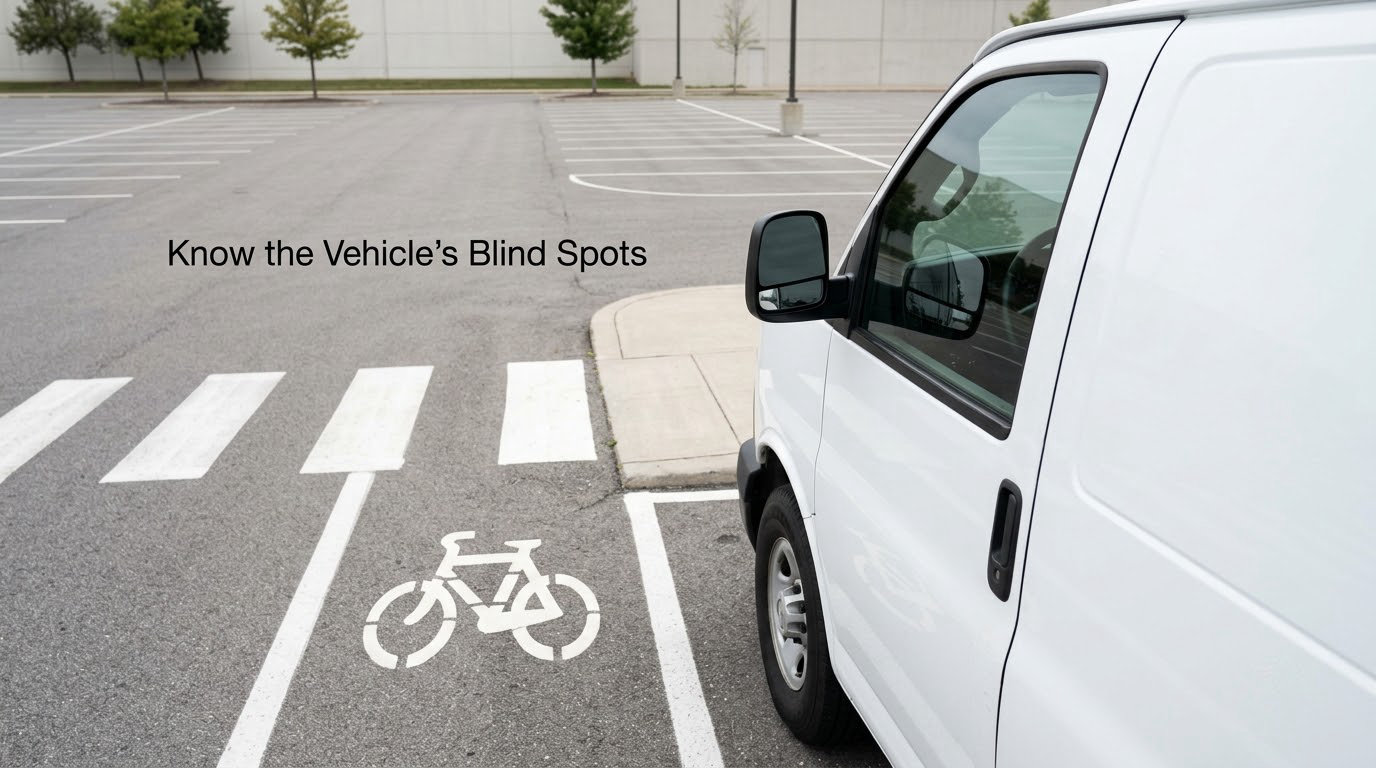
Couriers change lanes and pull away from curbs far more often than ordinary traffic, and that is exactly where blind-spot collisions with cyclists and pedestrians happen. Set your side mirrors to give you a view over your shoulder with a small overlap, and re-check them when you switch vehicles.
Do a shoulder check every time you change lanes, merge, turn across a bike lane, or pull away from a curb. At corners, slow to walking pace so you can see past your own nose. Back up with your mirrors rolled down and your head turned, and use a spotter or a camera when one is fitted.
Assume a cyclist, e-bike rider or pedestrian will be in the space you just checked. Most are invisible in a mirror because they are low, fast and directly beside the vehicle.
11. Respond Safely to Collisions and Hazards
The first priority after any collision, breakdown or unsafe scene is getting yourself and anyone else out of harm’s way, not assigning blame. Work down this order.
- Stop, signal and move to safety if the vehicle can be moved without creating a second hazard. Otherwise switch on hazards and get out to the shoulder.
- Check for injuries in yourself and in others, and call emergency services for anyone seriously hurt or for a blocked, high-traffic or unstable scene.
- Notify your employer or dispatch, and if you are a contractor, the platform’s incident line, as soon as you are safe.
- Document the scene with photographs, note the time, location, weather, vehicles involved and witnesses, and keep any dash cam or app incident clip.
- Do not argue, do not admit fault and do not leave the scene. Let the insurer, the employer and the police handle the formal process.
Take a photo of your own vehicle’s damage and license plate before it is moved if it is safe to do so. For a low-speed yard bump with no injuries, the same documentation habit makes the claim straightforward.
12. Report Hazards and Near Misses Early
A near miss is free information: something went wrong and nobody was hurt this time. Delivery driver safety tips only improve if the same event gets written down, because an unreported near miss becomes the next driver’s incident.
Report damaged infrastructure, an unsafe loading area, aggressive road conditions, a vehicle defect, an injury or a near collision to your supervisor or platform the same day. State the date, time, location, what happened, and what you saw. Stick to facts and what you observed rather than assigning blame, and keep a copy for yourself.
Documentation is also what supports a workers’ compensation claim or an insurance claim later. If your employer has no reporting process, a written note with a timestamp is better than nothing at all.
Frequently Asked Questions
Are delivery drivers responsible for inspecting their vehicles?
Usually yes. Most employers expect a pre-trip check every shift, and many require it on a Daily Vehicle Inspection Report. That covers tires, brakes, lights, mirrors, fluids, steering and warning indicators. Your employer owns the repairs and the vehicle; you own the check and the report. Document every defect before you drive away, and tell dispatch if something is unsafe rather than deciding on your own that it is fine.
What is the safest way to lift and carry delivery packages?
Keep the load close to your body, below eye level, and use a cart or dolly whenever the carry is more than a few steps or includes stairs. Slide and push instead of carrying where the path allows. Ask for help with heavy or awkward items instead of attempting a solo lift, and refuse items you cannot handle safely. Most delivery injuries are strains and falls rather than crashes.
Can a delivery driver legally use a phone while driving?
State law generally prohibits holding a phone while driving, and several states go further by restricting any use unless the device is mounted hands-free. Employers and platforms usually add their own stricter rules, and those are the ones you are held to. A mounted phone is still a cognitive distraction. The safest practice is to park, set the brake and only then check the app, a message or the camera.
What should I do after a minor delivery vehicle collision?
Move to safety first, switch on hazards if the vehicle is stationary in traffic, and check whether anyone is injured. Call emergency services for serious injuries or an unsafe scene. Then notify your employer or the platform incident line, photograph both vehicles, the surrounding traffic and your own damage, and note the time, location, weather and witnesses. Do not admit fault or argue at the scene, and keep the claim number.
How can employers reduce fatigue-related driving risks?
Cap shift length and driving time, schedule real breaks rather than nominal ones, and avoid scheduling the longest routes at the end of a shift. Rotate routes so the same driver does not hit the same congestion at the same hour every day, and let drivers refuse a delivery that would force unsafe driving. Monitoring telematics for speeding, harsh braking and excessive hours helps, but only if drivers trust that reporting fatigue will not cost them income.
Why should delivery drivers report near misses?
Because a near miss is the cheapest data you will ever get. A curb strike with no contact, a load that nearly fell, or a route that exposed you to a truck turning across your lane tells you where the next serious injury will happen. Reports only improve conditions if they reach someone who can act on them, and a same-day factual record is also the strongest support you will have for a claim later.
Conclusion: Start With the Highest-Risk Task
These delivery driver safety tips work because they are small and repeatable. Start with the highest-risk task before your next shift: walk the vehicle, check tires and brakes, plan a route that is not the fastest one, and ask honestly how tired you are.
Then keep the phone down, keep the sightlines clear, and write down anything that nearly went wrong. Questions about your own vehicle, workload or workplace should go to your supervisor, your safety officer or your occupational health provider, not to a search engine.