
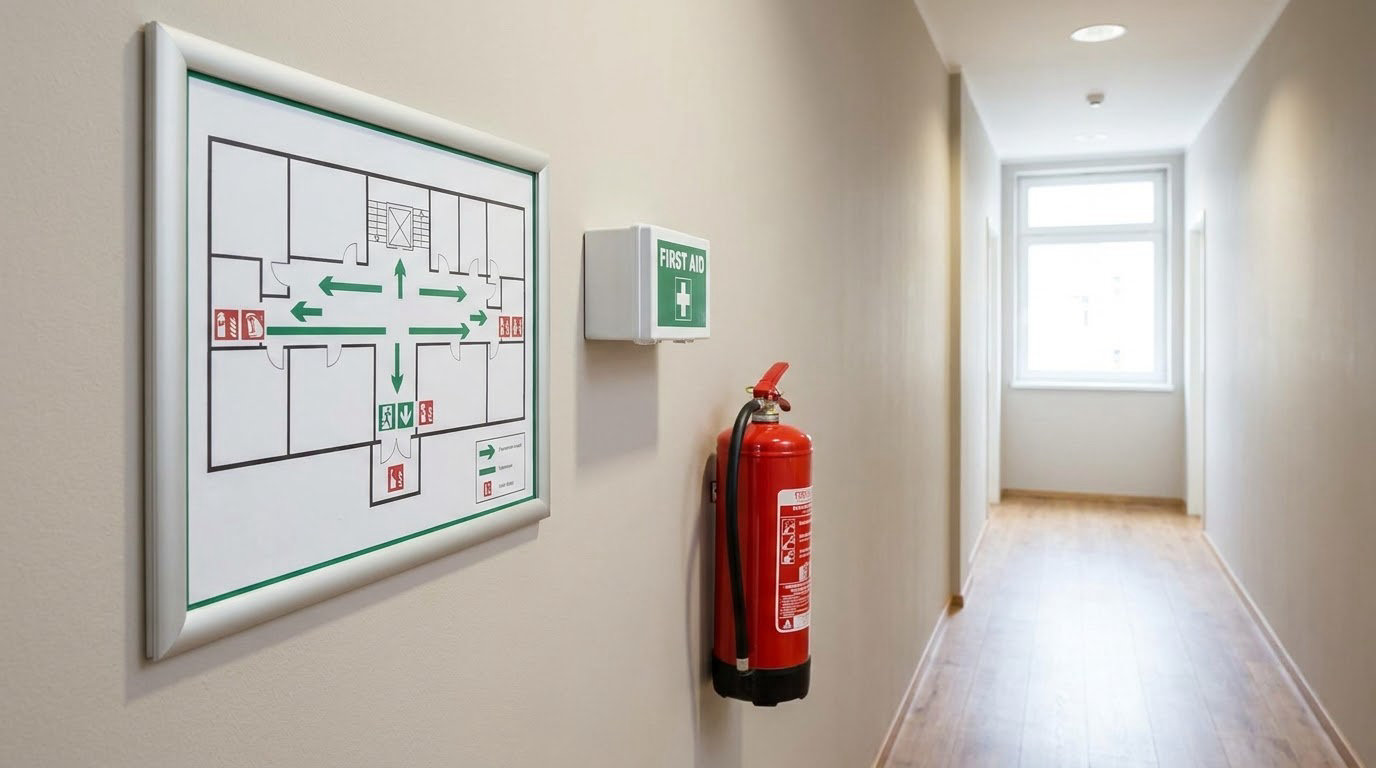
An emergency action plan is a written document that tells staff what to do, where to go, and who is responsible when something goes wrong at work: how to report it, how to evacuate or shelter in place, how everyone gets accounted for, and who handles rescue and medical duties. To learn how to write an emergency action plan, work through seven steps in order, from the hazard assessment through the after-action review. Most US employers fall under 29 CFR 1910.38, which is the standard to cite as you build it.
I have read enough emergency plans to know where they usually fall apart. They are complete on paper, full of job titles nobody holds, evacuation routes that end at a door nobody uses, and emergency contacts for people who left two years ago. The plans that work were walked through with the people who have to follow them.
Our guide to writing a workplace health and safety policy covers the wider document set an emergency action plan sits inside, and it is worth reading both together.
Table of Contents
- What You Need
- Step-by-Step: How to Write an Emergency Action Plan
- Step 1: Define the emergencies covered
- Step 2: Establish authority and responsibilities
- Step 3: Map evacuation routes and assembly points
- Step 4: Write notification and accountability procedures
- Step 5: Add emergency-specific instructions
- Step 6: Build communication and recovery procedures
- Step 7: Test, train, and maintain the plan
- Common Mistakes
- Frequently Asked Questions
- What is the OSHA standard for emergency action plans?
- What are the minimum elements an emergency action plan must include?
- How long should an emergency action plan be?
- How often should an emergency action plan be reviewed?
- Do remote and hybrid workers need to be in the emergency action plan?
- What is the difference between an emergency action plan and an emergency response plan?
- Conclusion
What You Need
Gather this before you type a single word. A plan written without it is guesswork with a header on it.
- A hazard and scenario list. What can realistically happen here? Fire, medical events, severe weather, chemical exposure, violence, utility failure, structural problems. Include the hazards that come from neighbours: a nearby refinery release, a flood zone, a rail line.
- Current floor plans for every area people occupy, including basements, storage, mezzanines and parking structures.
- Your alarm and communication inventory. How does an employee learn something is wrong: fire alarm, PA system, text alert, mass notification, radio? Note what happens when cell service or the internet is down.
- External contact numbers. Fire department non-emergency line, police, EMS, poison control, local emergency management, gas and electric utility shutoff numbers, building management, your alarm monitoring company.
- Internal emergency response personnel with real names and job titles, including a backup for each. Names change; the plan should not rot.
- Response equipment on hand. Fire extinguishers and their locations, first aid kits, AEDs, trauma and spill kits, flashlights, radios, and any personal protective equipment responders will need.
- Population data. Headcount by floor and shift, plus contractors, visitors, temporary staff, and employees who need assistance during evacuation.
- Adjacent plans. Your building’s or campus’s emergency plan, and the fire marshal or property manager’s requirements for tenants.
Keep all of it in one binder or shared drive folder with a version number and a date. A plan that lives in someone’s inbox is not a plan.
Step-by-Step: How to Write an Emergency Action Plan
Seven steps, in this order. Each one feeds the next, and skipping ahead is how gaps appear.
Step 1: Define the emergencies covered
Start with the scenarios your site can actually produce, not a generic list. For most offices that means fire, medical emergency, severe weather, utility loss, suspicious package and active threat. A manufacturing plant adds chemical release, confined space and machinery entrapment. A clinic adds infectious exposure and patient evacuation.
For each scenario, write one line on who declares it, who is told first, and how employees find out. An emergency that nobody has the authority to declare is an emergency that sits unclaimed for several minutes.
How to check it worked: each scenario names a trigger and an initial action. If a scenario needs two pages to describe, it is not an emergency action plan procedure yet.
Step 2: Establish authority and responsibilities

Build a chain of command with real names against each role, not titles alone. A plan that says “the safety manager will coordinate” fails the moment that person is on holiday.
Assign at minimum: who activates the plan and calls emergency services, who leads evacuation, who performs rescue or medical duties, who runs accountability at the assembly point, who handles communications with employees and media, who decides on shelter-in-place versus evacuation, and who authorises re-entry. Give each role a named backup.
Job titles do not travel. Names do, and they go stale, so build a monthly habit of confirming the roster.
How to check it worked: every role has a current name, a backup, and a phone number that reaches them on a weekend.
Step 3: Map evacuation routes and assembly points
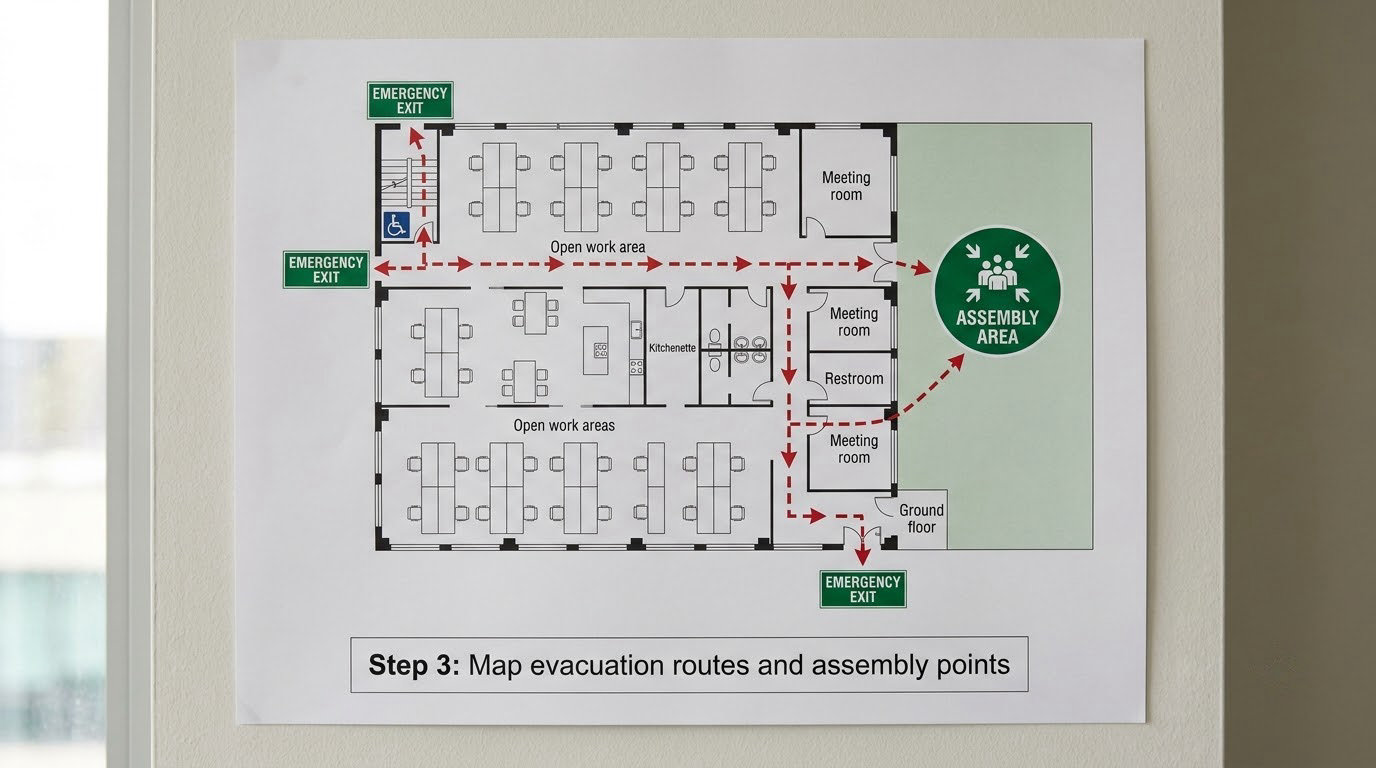
Mark a primary and an alternate route from every occupied area, on posted floor plans at eye level, not in a drawer. Routes must stay lit and unobstructed, and each one must end somewhere real.
Place assembly points far enough from the building to be clear of falling debris, glass and smoke, and upwind of any release point. Give yourself a second assembly point for when the first is unreachable. Add shelter-in-place areas for scenarios where leaving is more dangerous: tornado, chemical release outdoors, active threat.
Then handle accommodation honestly. Assign helpers for employees who need assistance, and state which refuge areas or equipment exist for people with mobility, hearing or vision needs. Our cold stress prevention plan for outdoor workers covers a related exposure question in detail.
How to check it worked: walk each route. If it crosses a locked door, a parked car, or a smoke-filled stairwell, redraw it.
Step 4: Write notification and accountability procedures
This is the step most plans treat as one bullet, and it is one of the most frequently cited deficiencies. Accountability after evacuation is where an orderly response turns into a search.
Document four things. How an employee reports an emergency: pull alarm, dial 911 first, then internal line, and never delay calling emergency services to notify a supervisor. Who calls 911 and from where. How leaders notify staff and what the message says. And how headcount happens.
For accountability, name the person who brings the roster to the assembly point, name the backup, and explain how visitors, contractors, temporary staff, night-shift staff and remote or hybrid workers get counted. Remote workers need their own check-in rule, because most plans assume everyone is inside the building.
How to check it worked: the roster shows a floor-by-floor and shift-by-shift count, and the plan says what happens when a name is missing.
Step 5: Add emergency-specific instructions
Write one short block per scenario from Step 1. Keep each to a page or less, written as instructions rather than policy prose.
- Fire: pull the alarm, evacuate by the nearest safe route, do not use elevators unless the plan says they are designated, report to the assembly point, no re-entry.
- Medical emergency: call 911 first, send someone for the AED and first aid kit, clear space, keep the route open for responders, note the employee’s name and location.
- Severe weather: shelter-in-place procedure by building zone, interior room away from windows, or evacuate to a designated safe area. Note who decides and how long you wait before moving.
- Hazardous substances: isolation distance, upwind assembly point, when not to attempt a rescue, and when to call the fire department hazmat team rather than handling a spill yourself.
- Violence or an active threat: run-hide-fight or call-to-action language your organisation has actually trained, plus a reporting path that does not require approaching the person.
- Utility disruption: shutoff locations for gas and electricity, elevator behaviour, what equipment stays on, and how you confirm it is safe to restore.
Keep scenario blocks to the page. A plan nobody reads under pressure is decoration.
Step 6: Build communication and recovery procedures
Communication fails first. It assumes power, signal and working phones, and emergencies routinely take all three.
Document the emergency contact list with primary and backup numbers, the notification tree for who tells whom in what order, and the backup methods: radios, megaphones, printed call sheets, a battery-powered PA, a designated person who drives to alert staff in another building. State who speaks to media and who families contact, and where reunification with family happens.
Recovery is where most plans stop. Cover what must be reported and to whom, who inspects the building before anyone returns, and who has the authority to authorise re-entry. Add the human side: after a serious incident, managers need a plan for talking to affected staff, and our guide to supporting employee mental health at work has a proven structure for that conversation.
How to check it worked: the plan has an answer for “phones are down and the power is out.”
Step 7: Test, train, and maintain the plan
A plan that has never been walked through is a hypothesis. Distribute it, train on it, then test it.
Training should cover what to do, who to call and where to go, refreshed when the plan changes, when someone joins, and on the schedule your industry expects. Drills should escalate: start with a tabletop walkthrough of a scenario, then a full evacuation drill, then a drill with an element that complicates it, such as an employee needing assistance or a blocked exit.
Run drills at different times, including a shift start or an overnight handover, because those are when plans are thinnest. Record the outcome in an after-action review: what happened, what did not, who owns the fix, and by when. Real plans get walked through with the team rather than quietly filled in, which is exactly what the after-action review forces you to do.
Set a review date and put it on a calendar. Review the plan when staff, layout or leadership change, after every incident, and at least annually.
How to check it worked: the last drill produced a written list of corrective actions with owners and dates, and the plan’s version number changed because of them.
Common Mistakes
These are the errors that turn a document into a liability.
- Roles written as job titles with no names. Fix: a name and a backup for every role, confirmed monthly.
- One exit route per floor. If that route is blocked, people improvise. Fix: a marked alternate for every occupied area.
- Assembly point behind the hazard. Plumes and wind do not care about your muster location. Fix: move it upwind and add a second.
- No accountability step. Fix: a named person, a roster and a defined action for a missing name.
- Emergency contacts a year out of date. Fix: verify the whole list every quarter, even if nothing changed.
- Unrealistic evacuation timing. A target nobody can meet teaches people the plan is decorative. Fix: time a real walk-through and set the target from what you measured.
- No accessible evacuation provision. Fix: helpers, refuge areas and equipment named in writing.
- Visitors and contractors left out of the count. Fix: a sign-in process that feeds the roster.
- Never drilled, or drilled once a year on the same quiet day. Fix: drill at varied times and document the findings.
- Plan buried in a shared drive. Fix: a printed copy at each floor’s alarm panel plus a wall map at eye level.
If you are starting from a blank page, borrowing a standard structure is normal and sensible, then adapting it hard enough that it is genuinely about your site is what separates a working plan from a downloaded file.
Frequently Asked Questions
What is the OSHA standard for emergency action plans?
The standard is 29 CFR 1910.38, which requires a written emergency action plan with specific minimum elements whenever another OSHA standard applies to your workplace. Employers with more than 10 employees must keep it in writing; those with 10 or fewer may communicate the content orally, which is the small-business exception people ask about most.
What are the minimum elements an emergency action plan must include?
Under 1910.38(c) the plan needs a procedure for reporting a fire or other emergency, a procedure for emergency evacuation including the type of evacuation and the exit route assignments, a procedure for employees who remain to operate critical plant operations before evacuating, a procedure to account for all employees after evacuation, and a procedure for employees performing rescue or medical duties. Notification, contact and follow-up detail is expected on top of that list.
How long should an emergency action plan be?
Long enough to be usable in an emergency, which usually means roughly four to eight pages plus posted floor plans and contact attachments. Anything much longer belongs in supporting documents the plan links to. Judge length by one test: can a person who has never seen it find their exit route, the alarm and their role in under a minute?
How often should an emergency action plan be reviewed?
At minimum once a year, and immediately after any incident, drill, renovation, change of staff or change of leadership. A good trigger is a scheduled quarterly contact-list check and a full annual review of the whole document. Record the review date and version number on the cover so anyone picking it up can see whether it is current.
Do remote and hybrid workers need to be in the emergency action plan?
Yes, at least as a communication and accountability rule. Most plans only cover people inside the building, which leaves a growing share of your workforce undefined in a real event. State how hybrid staff are counted when the building evacuates, who contacts them, and what remote workers must do if an incident affects the office they would otherwise travel to.
What is the difference between an emergency action plan and an emergency response plan?
An emergency action plan is about the first minutes: get people out, account for them, and keep responders safe. An emergency response plan covers the organisation performing the technical response, which means trained personnel, protective equipment and coordination with outside agencies. Most employers need the first. Facilities that deploy their own response team, handle hazardous materials or run a plant process usually need both.
Conclusion
Start with the emergencies specific to your workplace, not a generic template. List the scenarios, name the people who will act on each one, and put a date on the calendar for the first tabletop walkthrough. A plan that has been tested with your own staff is worth more than a more thorough one sitting unread in a folder. This guide is current as of 2026; check your state and local fire code requirements alongside the federal standard, since they can be stricter.