

A paid sick leave policy is a written rule that tells employees how much paid time they earn for illness, how it accrues, what they may spend it on, how to ask for it, and what happens when it runs out. Design one by mapping your worksites to their governing law first, then choosing an accrual model, coverage list and documentation rule you can actually administer.
Most employers get this wrong in one of two directions: too vague to enforce, or written by copying a template from a company in a different state. Working out paid sick leave policy how to design one comes down to a short list of decisions that have to be made in order, so this guide walks through them, shows the accrual arithmetic, and gives you a structure you can hand to counsel or your payroll provider. Last reviewed September 2026; state and local rules change, so treat the numbers below as a starting snapshot rather than legal advice.
Table of Contents
- What You Need
- Step-by-Step: Paid Sick Leave Policy How to Design One
- Paid Sick Leave Policy How to Design One: Define the Policy’s Purpose and Scope
- Choose Accrual and Eligibility Rules
- Set Leave Amounts and Payout Rules
- Define Eligible Uses and Documentation Rules
- Create a Simple Request and Notice Process
- Check U.S. Compliance and Leave Interactions
- Get Approval, Publish and Train Managers
- Review the Policy and Measure Its Impact
- Common Mistakes
- Frequently Asked Questions
- How much paid sick leave should an employer provide?
- Is there a federal paid sick leave requirement for private employers?
- Does paid sick leave have to be available to part-time employees?
- Can an employer require a doctor’s note for every sick day?
- How does paid sick leave interact with FMLA and other protected leave?
- Must an employer pay out unused sick leave when an employee leaves?
- Conclusion
What You Need
Before you draft a sentence, gather six things. Each one either decides a policy term or tells you who has to sign off.
- A worksite list. Every city and state where an employee regularly works, including remote workers whose home is in a different state. Local ordinances can override state law, and they are the part most employers miss.
- Workforce data. Headcount by location, full-time versus part-time versus temporary or seasonal workers, average hours per week, and your payroll frequency.
- Your current benefit stack. Existing PTO banks, any short-term disability coverage, and whether anyone is covered by a collective bargaining agreement.
- Payroll constraints. Whether your system can track a leave balance per employee per accrual period, and whether it supports partial-day deductions.
- Staffing tolerance. How many people can be out on a given day before coverage breaks, which sets whether partial-day leave is workable.
- Decision-makers. The owner or executive who approves the cost, the HR or operations lead who administers it, and employment counsel for the compliance pass.
If you already have an employee handbook, that is the natural home for the policy. A standalone document is easier to distribute and to update when local law changes.
Step-by-Step: Paid Sick Leave Policy How to Design One
Paid Sick Leave Policy How to Design One: Define the Policy’s Purpose and Scope
Start by writing one sentence that says what the policy is for: paid, job-protected time away from work for the employee’s own health needs, preventive care, and certain family care obligations. Everything after that sentence is mechanism.
Scope means three decisions. Who is covered: which employees, at which locations. What counts as a qualifying reason: illness, injury, medical appointment, preventive care, mental health appointment, caring for a family member, and in some jurisdictions school or childcare closure, quarantine, and safe leave related to domestic violence or a workplace safety threat. And how the policy relates to other leave: whether it sits alongside FMLA, state paid family leave, disability benefits, or workers’ compensation, or replaces them.
Check that scope against reality before moving on. If the policy says sick leave is available to full-time staff only, and you employ part-timers in a jurisdiction that requires coverage, the policy is wrong on its face. Forum threads about sick leave are full of exactly that story, where hourly staff learn the policy applies to them in practice but not on paper.
Choose Accrual and Eligibility Rules
Most U.S. paid sick leave laws are built on accrual: the employee earns a minimum amount as they work, and the employer may grant more. Four structures cover almost every employer.
Accrual per hours worked. The most common statutory model. One hour per 30 hours worked is the dominant rate; one hour per 40 hours worked appears in a few places. Do the math end to end: a part-time employee working 20 hours a week earns roughly 1.6 hours of sick leave per week under a 1-per-30 rule, which rounds to about 83 hours over a full year before the cap. A full-time employee at 40 hours a week earns roughly 1.33 hours per week, about 69 hours a year. Both then hit whatever annual cap applies.
Front-loaded grant. The full annual amount lands in the employee’s balance on the first day of the plan year. Simpler to administer, no payroll accrual math, and the annual cost is fixed whether people use it or not. If your industry has unpredictable absence, front-loading is easier to budget.
Combined PTO bank. Sick, vacation, and personal time merge into one balance. Employee-friendly and popular with small teams, but it carries a real legal trap described below.
Hybrid. Front-load a small base, then accrue more for tenure or hours. Used by employers who want a guaranteed floor without losing the accrual structure that statutes expect.
State your eligibility rules explicitly: a waiting period (if any, and note that many jurisdictions cap how long a waiting period may be), whether part-time and temporary workers earn at the same rate per hour worked, whether seasonal workers are covered, and how a new hire’s first partial accrual period is prorated. Silence here is what generates disputes, not clarity.
Set Leave Amounts and Payout Rules
Decide how much to grant, then write down what happens to the balance. The amount decision has three reasonable defaults and no universal legal requirement above your local floor.
| Policy structure | How it works | Strength | Weakness | Suits |
|---|---|---|---|---|
| Unlimited paid sick leave | No cap, no tracked balance | Simple to state, removes all ceiling anxiety for employees | Hard to budget, still policed by attendance patterns, easy to promise and hard to sustain in a bad year | Small professional firms with strong coverage and predictable short absences |
| Generous fixed grant | A set number of days a year, front-loaded | Easy to administer, clear for employees, no accrual math | Fixed cost whether used or not, can fall below a state floor as your workforce changes | Employers in jurisdictions with no mandate, and any team that values predictability |
| Accrual-based | One hour per 30 or 40 hours worked, capped annually | Scales with workload, matches the statutory default, protects part-timers proportionally | Needs payroll tracking, and the balance is invisible until someone checks | Multi-state employers and any workforce with part-time or seasonal staff |
This table compares policy design options, not legal requirements. The floor that binds you is whichever rule applies at each worksite.
Then handle three separate questions that employers routinely bundle together. Carryover: what happens to unused hours next year, and is there a carryover cap. Payout at separation: whether accrued but unused sick leave is paid out when someone leaves. The bundling trap: folding sick leave into a combined PTO bucket can attach vacation-style payout-at-separation obligations to hours employees thought were sick leave, because several states treat a bundled policy as vacation for payout purposes. This one produces real back-pay claims, so decide it deliberately rather than by default.
Also write the exhaustion rule. What happens when the balance hits zero: unpaid leave, a referral to FMLA or state protected-leave processes, a documented conversation with HR, or an automatic shift to unpaid status after a set number of hours. Employees search hardest for this sentence and, oddly, employers most often leave it out.
Define Eligible Uses and Documentation Rules
List the qualifying reasons in plain language. Your own illness, injury, or medical condition; medical and dental appointments; preventive care and routine checkups; mental health counseling; caring for a family member; and, where your governing law requires it, school or childcare closure, a public health quarantine, safe leave for domestic violence or stalking, and time to address a workplace safety threat.
Define “family member” instead of leaving it to interpretation. The broadest workable definition covers a spouse, domestic partner, child, parent, sibling, grandparent, grandchild, and in many jurisdictions any legal ward or in-law. Forum complaints about caregiving leave almost always come down to someone being told a person they care for did not qualify. Write the list down.
Separate sick leave from other protections in the same paragraph. FMLA and state paid family leave cover longer, serious conditions with job protection; the Americans with Disabilities Act governs accommodations and medical restrictions; the Pregnant Workers Fairness Act governs pregnancy-related accommodations. Paid sick leave is not any of those, and conflating them confuses everyone reading the policy.
Set a reasonable documentation standard. Self-certification for short absences, a medical note only when the absence runs three consecutive workdays or more, and no documentation request that would expose the underlying diagnosis. Some states limit which medical details you may request. Protect confidentiality: leave the medical document sealed with HR, share only what the manager needs to schedule coverage, and keep records separate from the personnel file.
Include an exception: when an employee cannot obtain documentation, or when waiting for it would delay treatment, ask for a phone verification or a statement from a provider, and never refuse leave while the request is pending. That single sentence removes most of the paperwork fights.
Create a Simple Request and Notice Process
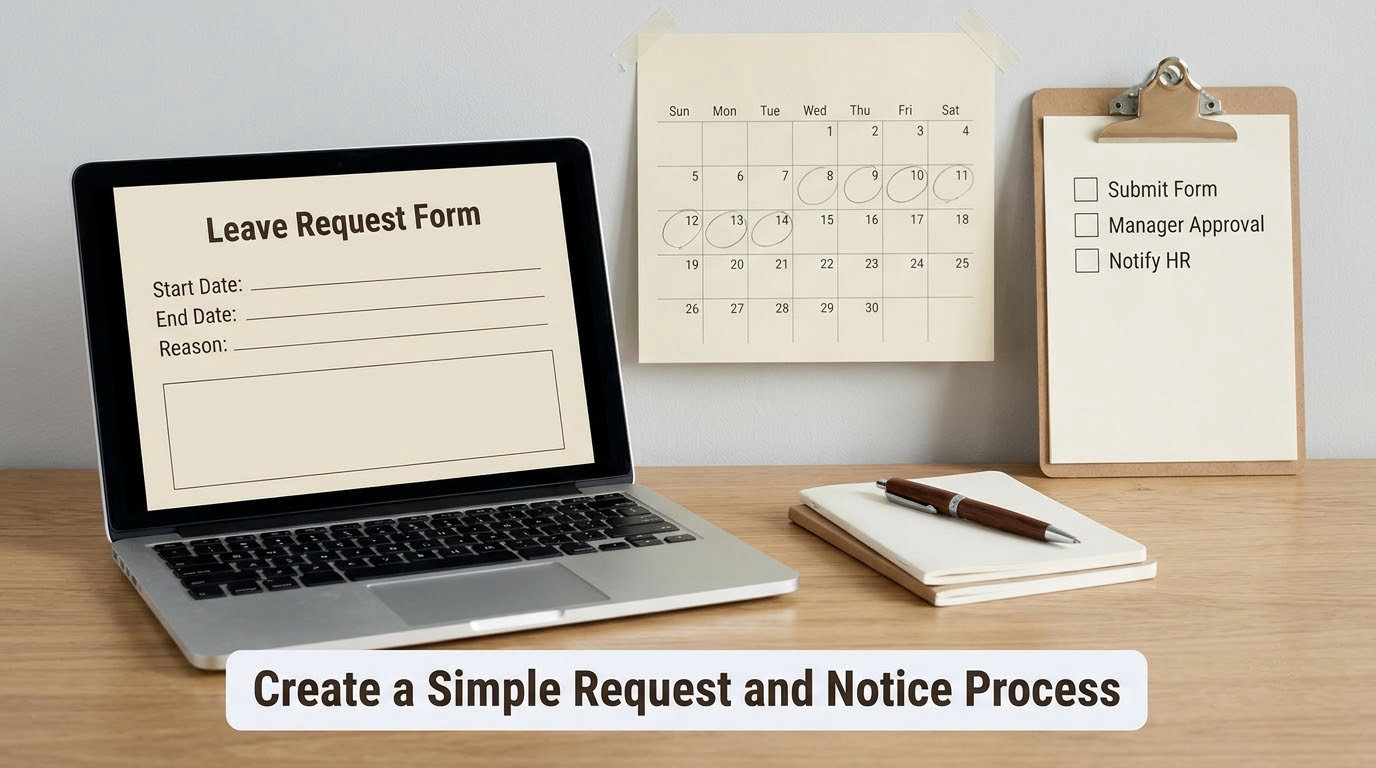
The request process should fit in four lines. Where the employee sends it (a form, an inbox, a call if they are too unwell to type). How early to tell you, with a fallback for unplanned illness. How quickly you will respond. And what happens next.
Give yourself one business day to acknowledge a request and three to decide, then hold to it. Predictable turnaround is what keeps absence disputes from becoming grievances.
For extended or repeated absences, define an escalation path in writing. When does HR get involved, when does the employee’s leave move to an unpaid status, when do you check whether FMLA or a state protected-leave program applies, and who reviews the case. Apply the path the same way to every employee. An hourly worker and a salaried manager following different rules is the single most reliable way to turn a leave policy into a discrimination complaint, and the pattern shows up repeatedly in employee-side discussions about sick leave policing.
Set the notice expectations too. Jurisdictions that mandate paid sick leave generally require a posted notice and often require the policy text itself in the handbook or on the intranet.
Check U.S. Compliance and Leave Interactions
As of 2026, no federal law requires private employers to provide paid sick leave. The Family and Medical Leave Act gives eligible employees up to 12 weeks of unpaid, job-protected leave for serious family or medical reasons, and the ADA and PWFA govern accommodations and pregnancy-related accommodations. That is the federal floor, and it is not the same thing as paid sick time.
Below that, states and cities set the real requirements. This snapshot shows the pattern most mandates share; verify each figure against the current statute for your own worksites before you rely on it.
| Jurisdiction | Typical accrual rate | Annual cap | Carryover | Who is covered |
|---|---|---|---|---|
| California | 1 hour per 30 hours worked | 5 days a year | Accrued unused sick time generally carries over, subject to state limits | Employees working in California, with separate state and local rules |
| Washington State | 1 hour per 30 hours worked | 40 hours a year | Balance carries over, up to a statutory maximum | Nearly all employees |
| Colorado | 1 hour per 30 hours worked | 48 hours a year | Up to 48 hours carries over | Employees in Colorado, with final-pay rules that reduce the benefit for some workers |
| Massachusetts | 1 hour per 30 hours worked | 40 hours a year | Up to 40 hours carries over, plus a 7-day cap on carryover in some years | Nearly all employees, including some small-employer exemptions by tenure |
| New Jersey | 1 hour per 30 hours worked | 72 hours a year | Unused sick time carries over for the calendar year | Employees in New Jersey |
| Chicago, Illinois | 1 hour per 30 hours worked | 40 hours a year | Up to 80 hours carried over into the following year | Employees who work at least 80 hours per 2-week period within city limits |
| New York City | 1 hour per 30 hours worked | 56 to 64 hours a year, tiered by employer size | Balance carries over, capped | Employees who work more than 40 hours per month in the city |
| Maine, Nevada, Oregon, Hawaii, Minnesota, Maryland, Delaware, New Mexico, Connecticut, Rhode Island and others | Most use 1 hour per 30 hours worked | Varies, commonly 40 to 64 hours | Varies, most allow carryover with a cap | Broad coverage of full-time, part-time and temporary employees |
The recurring rules across these jurisdictions: partial-day increments are standard, the accrual clock runs on hours actually worked, carryover is capped rather than unlimited, and part-time and temporary employees are in scope. Notice posters come with the law in most of them.
Have qualified employment counsel or a knowledgeable HR professional confirm the final version. Requirements vary by state and city and change over time, and this is exactly the point where a paid sick leave policy turns into a liability question rather than an HR question. A two-hour review before publication is cheap insurance.
Get Approval, Publish and Train Managers
Convert the policy into an employee-facing document in plain language, one to two pages. Cover: who is eligible, how much they earn and how, what they can use it for, how to request it, what documentation looks like, carryover and payout, and the exhaustion rule. Put a one-page summary next to it for the break room and the onboarding packet.
Then handle the part that decides whether the policy works: managers. A policy your supervisors do not understand gets applied by instinct, and instinct is inconsistent. Give them a short script covering the four questions they will actually be asked: how much does she have left, is this covered, what documentation do I need, and who do I escalate to when it runs past the balance.
Before publishing, confirm this checklist:
- Managers received the policy and a training session, and the date is recorded.
- Every employee has acknowledged receipt in writing, with the acknowledgment date on file.
- Payroll is set up to track the balance per employee and deduct partial days correctly.
- The worksite notice is posted wherever your governing law requires it.
- HR holds the process for medical documentation, sealed and separate from personnel files.
- The escalation path has a named owner, not a department.
That last point matters more than it looks. An escalation path that lives with “HR” gets answered differently depending on who is in the room that day.
Review the Policy and Measure Its Impact
Put the policy on a review cadence: quarterly for the first year, then annually, plus an event-driven review whenever you add a worksite or a state changes its law. Assign the tracker to a named person. Laws that require paid sick leave keep being added and amended, and a policy that quietly falls below a new floor is a statutory violation, not a technicality.
Track a small set of leading indicators: request volume, average hours used per employee, the gap between hours accrued and hours taken, request-to-decision turnaround, how often the exhaustion rule is reached, and how many employees report understanding the rules. Monitor the data at an aggregate level and never tie usage rates to an individual employee. Absence patterns tracked per person, combined with medical details, are how a legitimate leave becomes a retaliation claim.
Watch the accrued-versus-used gap. Owners are often surprised that employees hold three weeks of unused sick leave they never touch, and that most of the cost is sitting in the balance, not in the paychecks. Managers can nudge people to use the benefit they have, and a policy nobody uses delivers nothing. Employee-side threads show the same thing from the other end: people who would happily stay home for a fever are unsure whether they are allowed to.
Common Mistakes
Copying another employer’s policy. A policy written for a California firm with a 40-person office fails the moment you add a Chicago location. Fix: rewrite from your own worksite list, not from a template you liked.
Vague qualifying language. “Serious health condition,” “family emergency,” and “personal reasons” are not definitions. Ambiguity gets read against the employer. Fix: enumerate the qualifying reasons and define family member by name.
Over-documenting. Demanding a doctor’s note for a one-day cold is the fastest way to push employees toward unprotected absences and to draw a complaint. Fix: self-certify short absences, require documentation only after three consecutive workdays or at a defined threshold, and never request a diagnosis.
Ignoring stronger local law. A generous state rule will not save you from a municipal ordinance with a higher cap. Fix: write the policy to the strictest requirement at each worksite, and where a location has its own rule, say so in an appendix.
Inconsistent manager enforcement. Two supervisors applying the same policy differently is the pattern employee-side forums keep describing, and it is a fair-treatment problem before it is a legal one. Fix: written acknowledgment, annual training, and the consistency checklist above.
Confusing paid sick leave with unpaid protected leave. Treating FMLA time as if it draws down the paid balance wastes job-protected leave and creates recordkeeping confusion. Fix: separate tracks in the policy and in the payroll system.
Changing the policy before someone leaves or asks for leave. Reducing a balance, raising the documentation threshold, or tightening eligibility right before an employee’s departure or an extended leave request reads as retaliation and creates real exposure. Fix: make changes prospectively, apply them to everyone, and document the business reason independently of any individual case.
No rule for what happens when leave runs out. The silence is what turns a policy question into a grievance. Fix: write the exhaustion path, including unpaid status, FMLA and state protected-leave referral.
Folding sick leave into PTO without deciding about payout. Bundling is convenient and popular. In several states it also attaches vacation-style payout obligations to hours that were never called vacation. Fix: get a clear answer on payout before you merge the banks, not after an employee leaves with a balance.
Frequently Asked Questions
How much paid sick leave should an employer provide?
Most small employers grant somewhere between 3 and 8 paid sick days a year, front-loaded or accrued at one hour per 30 to 40 hours worked. The right number for you is the highest of your state floor, any local ordinance, and the amount your workforce and coverage plan can absorb. Treat published benchmarks as a starting point rather than a requirement, and check the law at every worksite you operate in.
Is there a federal paid sick leave requirement for private employers?
No. As of 2026, no federal law requires private employers to provide paid sick leave. The Family and Medical Leave Act gives eligible employees up to 12 weeks of unpaid, job-protected leave, and the ADA and PWFA govern accommodations, but neither creates a paid benefit. Paid sick time comes from state law, local ordinance, or your own policy, which is why the worksite audit is step one.
Does paid sick leave have to be available to part-time employees?
In most jurisdictions that mandate paid sick leave, it does. The standard test is employees who work a minimum number of hours within a set period, and part-time, temporary, and on-call staff routinely fall inside that threshold. Excluding them from your policy is one of the most common drafting errors, and it is easy to spot from the outside. Cover them per hours worked rather than at a flat full-time rate.
Can an employer require a doctor’s note for every sick day?
Usually not without cause. Reasonable policies commonly rely on self-certification for short absences and require a medical note only after a defined trigger, such as three consecutive workdays or more. Several states also limit which medical details you may request. Requiring documentation for every absence tends to reduce honest reporting and create more risk than it removes.
How does paid sick leave interact with FMLA and other protected leave?
They run on separate tracks. Paid sick leave is a short-term, generally no-fault benefit for illness, appointments, and certain caregiving. FMLA is unpaid, job-protected leave for serious health or family reasons, and state paid family leave programs replace some of that time with partial wage replacement. Your policy should say whether sick leave is deducted before or after an FMLA designation, and should never consume job-protected leave.
Must an employer pay out unused sick leave when an employee leaves?
It depends on the law and on your design. Most mandates permit a cap on carryover and do not require a payout of accrued sick time, though some states differ. Folding sick leave into a combined PTO bucket can change the answer, because several jurisdictions treat a bundled policy as vacation for payout purposes. State the rule in writing, and confirm the specific requirement for each state where you employ people.
Conclusion
Start with your worksite list and pull the governing requirement for each one; that single audit determines most of the policy’s terms. Then choose an accrual model, write the eligible uses and documentation rule in plain language, and write the exhaustion rule most policies forget.
Have someone qualified review the draft before you publish it. That single hour protects the balance you have already spent designing it, and it is the step most employers skip.