

Menopause support at work means the policies, adjustments and everyday workplace practices an employer puts in place so people going through perimenopause or menopause can manage symptoms without it harming their health, their output or their career. In practice it looks like temperature control at your desk, flexible start times, a quiet room, protected time for medical appointments and a manager who knows how to respond when someone raises it. It is not medical treatment, and no employee should have to hand over private health details to access it.
Most of the practical work happens in ordinary systems you already run: your flexible working policy, your health and safety risk assessment, your sickness absence process and your manager training. That framing matters, because the alternative is a policy that exists on paper and goes unused.
Table of Contents
- What Is Menopause Support at Work?
- Why Menopause Support at Work Matters
- A Practical Framework for Menopause Support at Work
- How Should Managers Respond When an Employee Mentions Menopause?
- What Can Employers Do Beyond Individual Accommodations?
- How Can Employers Build a Menopause-Friendly Workplace Culture?
- How Do You Measure Whether Workplace Menopause Support Is Working?
- Frequently Asked Questions
- Do employees have to disclose medical details to request menopause support at work?
- Is menopause support only for employees who are actively experiencing symptoms?
- What workplace accommodations are commonly requested during menopause?
- Should employers provide a specific medical benefit or treatment?
- Can menopause support apply to remote and hybrid employees?
- How can managers support employees without giving medical advice?
- Conclusion: Start With Clear, Flexible Workplace Support
What Is Menopause Support at Work?

Menopause is a health transition, and a predictable one. Menopause itself is defined as twelve months without a menstrual period. The stage beforehand, perimenopause, is when most people notice symptoms, and it can start in the late thirties and run for several years.
Premature ovarian insufficiency, usually defined as menopause before the age of forty, has separate clinical guidance and often needs a different conversation with an occupational health clinician.
So when we say workplace support, we mean three separate things, and it helps to keep them apart. First, adjustments: changes to the working day or environment that reduce the impact of symptoms. Second, recognition: managers who know the symptoms exist and respond without embarrassment. Third, routes to help: occupational health, an employee assistance programme, or a clinician the employee chooses.
What it is not is a diagnosis, a treatment plan, or a monitoring programme. Employers do not assess symptoms, suggest hormone replacement therapy, or keep notes on who is going through it. Anything medical belongs with a qualified clinician, and any question about whether support is appropriate legally belongs with an employment lawyer in the relevant jurisdiction.
Anyone can be affected. Most data and most policy assumes a female workforce, and that is largely accurate, but people going through earlier or later menopause, people with intersex variations, and people whose symptoms overlap with other conditions often fall outside the assumption. Colleagues, partners and allies who want to help typically find no guidance at all, which is why a good policy states plainly who it covers.
Why Menopause Support at Work Matters
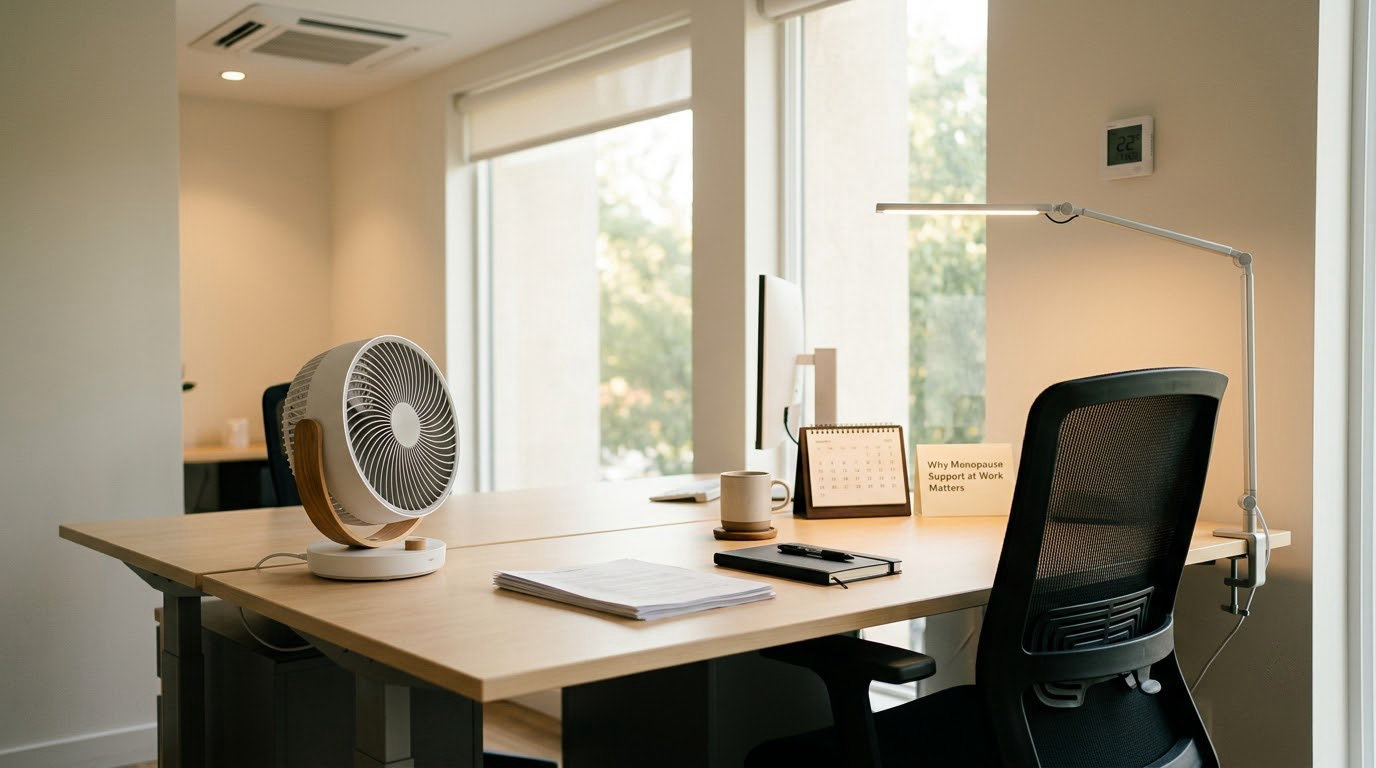
The reason this lands on HR desks is timing. Perimenopause often begins at the exact point where people hold senior roles, run teams and make decisions. Symptoms arrive during the years when experience is most valuable and hardest to replace.
The workplace makes several symptoms harder than they need to be. Meeting rooms are warm and poorly ventilated. Uniforms and dress codes are fixed. Breaks are scheduled around other people. And the symptom people find hardest to describe, brain fog, has no visual signal at all, so a dip in performance reads to a manager as disengagement.
Mapping symptoms to work tasks is more useful than listing them:
| Symptom people report | Where it shows up at work |
|---|---|
| Hot flushes and night sweats | Warm meeting rooms, layered uniforms, disrupted sleep before early shifts |
| Brain fog and memory lapses | Client calls, safety-critical decisions, written follow-ups, learning new systems |
| Fatigue | Long meetings, late-afternoon focus, commuting after a poor night |
| Low mood and anxiety | Team leadership, high-pressure deadlines, speaking up in large groups |
| Heavy or irregular bleeding | Unexpected breaks, proximity to restrooms, travel days |
| Joint and muscle discomfort | Standing roles, manual handling, repetitive tasks |
The scale of the workforce effect is large. Global projections put the number of women experiencing menopause at around 1.2 billion by 2030, and the McKinsey Health Institute has framed the resulting gap in women’s health as a macroeconomic issue measured in the trillions by 2040. Catalyst survey work has found a high share of employees want their employer to do more about it, which tells you the demand is already in your building.
Employees on r/Menopause and r/humanresources describe a consistent pattern: symptoms are invisible and episodic, so performance dips get misread, and small requests get interpreted as being difficult. The result is that people push through until something breaks, then approach a manager in crisis rather than early. Employers who normalise the topic in policy language, rather than in one awareness webinar, are the ones employees say they trust.
A Practical Framework for Menopause Support at Work
A workable framework has seven parts. You do not need all of them on day one, but the order matters: the cheapest, least intrusive adjustments come first, and the review process keeps the whole thing honest.
- Prevention and awareness. Share plain information about perimenopause and menopause through your intranet or newsletter. Name it as a life stage your workforce already contains, rather than a specialist medical topic.
- Flexible work options. Make it routine to consider adjusted hours, remote or hybrid working, part-time hours or job share, using the process you already run for other health-related adjustments.
- Physical working conditions. Address temperature, ventilation, seating, restroom access and rest space. Most of these are one-off costs absorbed by facilities teams.
- Manager conversations. Train managers to respond well and give them a short script, so the conversation does not depend on an employee’s courage.
- Employee resources. Signpost occupational health, your employee assistance programme, and external clinical services. Include colleagues and partners, not only the person experiencing symptoms.
- Privacy. Assure people that requesting a workplace adjustment does not require them to disclose a diagnosis, and that what they share stays with the people who need to know.
- Review. Set a date to revisit the policy and the adjustments offered, using real usage data rather than enthusiasm.
What Workplace Adjustments Can Help?
The adjustments people ask for most often are modest. Here is how the common ones compare by who they help and what they take:
| Adjustment | Who it helps most | Effort |
|---|---|---|
| Desk fan or personal cooling | Anyone with hot flushes, especially in shared offices | Minimal |
| Temperature and ventilation changes | Whole teams in warm meeting rooms or sites | Low, usually a facilities request |
| Flexible start and finish times | People with disrupted sleep or heavy mornings | Low if your policy already allows it |
| Remote or hybrid working | Symptoms worsened by office heat, travel or commuting | Moderate, depends on the role |
| Dress code or uniform flexibility | Staff in customer-facing, healthcare or uniformed roles | Low |
| Step away from a meeting flexibility | People managing pain, bleeding or overheating | Low |
| Protected time for medical appointments | Anyone under a care plan or seeing a specialist | Low |
| Adapted or reduced duties | Safety-critical, client-facing or cognitively demanding roles | Moderate, needs a proper conversation |
| Part-time hours or job share | Anyone needing sustained recovery time | Moderate |
| A named quiet rest space | Teams across the whole workplace | Low, often a re-use of an existing room |
Note what is missing from that list: nothing here asks for medical details. An employee can say they need to work flexibly or need the room cooler, and the request stands on its own. If a role genuinely cannot be adjusted remotely, the answer is a conversation about which other adjustments fit, not a refusal.
How Should Managers Respond When an Employee Mentions Menopause?
Most managers say they would handle this well and then freeze when it happens. A six-step response removes the need to improvise, and it takes about ten minutes to walk through in team meetings.
1. Listen without diagnosing. Let the person finish. Do not offer an explanation of their symptoms, a guess at a diagnosis, or reassurance that it will pass. You are a manager, not a clinician.
2. Ask what would help at work. The most useful question is specific: what would make your day more manageable? That keeps the conversation about the job rather than the body.
3. Explain the options that exist. Walk through the adjustments available under your normal policy, including flexible hours, remote working, temperature changes and time for appointments. Say what the process is and who approves it.
4. Avoid the trap of over-accommodating. Agree something proportionate, put it in writing, and set a review date. An open-ended arrangement with no review point creates friction later.
5. Record only what is necessary. Note the adjustment, its start date and its review date in the same way you record any workplace adjustment. Do not write a medical history into a personnel file.
6. Refer personal health questions onward. Point the employee to occupational health, their own clinician, or an employee assistance programme. The Menopause Society publishes workplace consensus recommendations, and NICE publishes menopause guidance, both useful signposts rather than workplace instructions.
Two phrases are worth retiring. One is the wellness round of emails that treats the topic as a lifestyle choice; the other is anything implying a person’s capability has dropped. Employee forum threads make the second point repeatedly, and it lands badly with senior staff in particular.
What Can Employers Do Beyond Individual Accommodations?
Individual adjustments fix individual problems. They do not change the conditions that generate them, which is why the wider actions matter.
Write a short policy. One page is enough. It should name menopause and perimenopause as adjustment categories, list what is available, state that no diagnosis is required, and say who to contact. A policy nobody can find in a search of the intranet is a policy that does not exist.
Train managers on recognition and response, not on symptoms. The relevant skills are listening, avoiding assumptions, knowing the adjustment catalogue and handling a confidential request correctly. Half an hour with a real script beats a two-hour webinar on the physiology.
Point people at occupational health and your employee assistance programme, and be honest about their limits. Forum threads about HR practice repeatedly make the same point: an employee assistance programme is built for short-term crises, not for a health transition that lasts years, so use it as one route among several rather than the default answer.
Run a health and safety angle as well. In the UK, the Health and Safety at Work Act 1974 sits alongside the Equality Act 2010, and reasonable adjustments may sit on either footing depending on how severe an employee’s symptoms are. Occupational health referral is the mechanism that converts a vague concern into a documented, proportionate adjustment.
Keep legal review in the loop, particularly for absence recording. One HR practitioner on r/humanresources raised exactly this concern before rolling out a policy: get an employment lawyer to review how menopause-related absence is categorised and how sick pay triggers apply, before it affects anyone’s pay. In the United States the frame is the ADA and EEOC guidance, with additional state-level rules; in the EU and Australia, national equality and health and safety frameworks apply. The detail changes, so the review does too.
How Can Employers Build a Menopause-Friendly Workplace Culture?
Culture is what decides whether the policy gets used. An adjustment nobody feels safe requesting is decoration.
Start with leadership visibility. If senior people mention their own experience of any health adjustment without drama, permission to speak becomes easier for everyone else. Several employee accounts describe senior colleagues managing this privately out of fear that vulnerability will be read as reduced capability, which is exactly the culture problem a policy is meant to solve.
Communicate as a normal life stage rather than a specialist condition. People recognise it. The tone risk is that a heavily medicalised announcement, or one aimed at women only, can read as either intrusive or patronising. Forum discussion shows real disagreement on this among employees themselves, and the resolution is usually to describe the policy as available to anyone who needs it.
Protect privacy visibly. Tell people what is recorded, who sees it, and what is not. Confidentiality assurances are the trust signal employees rank highest, ahead of any wellbeing content you commission.
Offer the same dignity to allies. Colleagues and partners frequently want to help and have no language for it. A short note in the policy covering how to respond to a colleague, and how not to press for details, costs nothing and removes an awkwardness that currently lands on the person with symptoms.
Watch the backfire risks. A badly designed policy can reinforce the idea that the affected employees are unstable, can be read as favouritism, or can split a team over whether it is needed at all. Naming those risks in advance, and designing the policy around ordinary workplace systems rather than a special category, is the better defence.
How Do You Measure Whether Workplace Menopause Support Is Working?
If you cannot measure it, you cannot honestly say whether it worked. The constraint is that the data you can safely collect is thinner than the data you would like.
Measure uptake, not identity. How many adjustments were requested, granted and reviewed, split by department or site. How long did approval take. Which adjustments get requested most. None of that requires knowing who is menopausal.
Run anonymous surveys. Ask whether people know the policy exists, whether they would feel safe raising it with their manager, and whether they know where to find the adjustment list. Anonymous engagement surveys can carry one or two menopause questions without creating a health register.
Track the 45 to 55 cohort indirectly. Voluntary turnover, time in role and application rates for internal roles in that age band are aggregate measures that reveal retention pressure without identifying anyone.
Watch absence data for accuracy, not volume. One recurring complaint on r/humanresources is that menopause-related absence is recorded badly, which damages both pay and any later evidence. Check that your coding is right before drawing conclusions from the numbers.
Ask managers how confident they feel. A short pulse question before and after training gives you a usable before-and-after signal, and it tells you whether the training landed.
Collect qualitative feedback in open text, because it surfaces what a policy missed. Keep it anonymous and thematic. And do not build a dashboard of identifiable health information: that creates a confidentiality problem far larger than the insight it produces.
Frequently Asked Questions
Do employees have to disclose medical details to request menopause support at work?
No. The usual design is that an employee requests a workplace adjustment, and the employer agrees to it without requiring a diagnosis or medical records. If an adjustment is more substantial, an employee may voluntarily agree to an occupational health referral, where a clinician assesses fitness for work rather than treating the underlying symptoms. Managers should never write medical detail into a personnel file, and should record only the adjustment, its start date and its review date.
Is menopause support only for employees who are actively experiencing symptoms?
No, and treating it that way narrows it unnecessarily. Support should be available to anyone in perimenopause or menopause, including people with mild or intermittent symptoms, people on treatment with few side effects, and colleagues, partners and carers who also need flexible arrangements. Keeping eligibility broad also avoids the problem of employees tracking symptoms to qualify, and it covers people who would rather not disclose anything at all.
What workplace accommodations are commonly requested during menopause?
The most common requests are a desk fan or personal cooling, changes to the working environment such as ventilation or seating, flexible start and finish times, remote or hybrid working, dress code or uniform flexibility, stepping out of a meeting when needed, protected time for medical appointments, and adapted duties or part-time hours. Most employers already have a process for at least half of these under their existing health adjustment or flexible working policy.
Should employers provide a specific medical benefit or treatment?
That is a clinician’s decision, not an employer’s. A workplace should not recommend, supply or monitor any treatment, including hormone replacement therapy or supplements. What an employer can usefully do is signpost employee assistance programmes, occupational health and independent clinical services, and make sure attending appointments during working hours is straightforward. The Menopause Society and NICE both publish guidance aimed at patients rather than employers.
Can menopause support apply to remote and hybrid employees?
Yes, though the adjustments look different. Remote workers may need flexibility around meeting-free blocks, control over lighting and temperature at home, and equipment that supports comfort during longer stretches of work. Hybrid workers often need cooling and seating at both locations. Shift and frontline staff may get less from remote working but more from ventilation, uniform flexibility, and being able to take a short break without explaining why.
How can managers support employees without giving medical advice?
Managers support employees by working on the job, not the health. Listen, ask what would help during the working day, describe the adjustments available, agree something proportionate with a review date, record only the adjustment, and refer any personal health question to occupational health or the employee’s own clinician. Offering an opinion about symptoms, treatment or whether things will improve is both unhelpful and, in some roles, a risk.
Conclusion: Start With Clear, Flexible Workplace Support
You do not need a programme to start. The first five moves take weeks, not budget: read your existing flexible working and health adjustment policies and see whether they already cover this ground, fix the temperature and ventilation in the rooms people complain about most, give managers a short response script and the adjustment list, publish one page that says no diagnosis is required, and check that absence is being recorded correctly.
Then set a review date and use the measures outlined above. If you are an employee rather than an employer, the practical version of the same advice is to ask for the specific adjustment, in writing, without volunteering a diagnosis, and to raise it early rather than in crisis. A quiet, flexible, documented response is what most people in r/Menopause say they were looking for and rarely got.
Last reviewed October 2026. This article is general workplace guidance, not medical advice. Symptoms, treatment options and legal rights vary by individual and by country, so personal health questions belong with a qualified clinician and jurisdiction-specific legal questions with an employment lawyer.