

Supporting an employee with migraine works best when it starts with a private conversation about function, not a diagnosis. Ask which work conditions make symptoms worse, agree on a small set of adjustments, and check back a few weeks later. That whole process takes about an afternoon to set up. Below is how to support employees with migraine in seven steps, plus the mistakes that quietly undo the whole thing.
Table of Contents
- What You Need to Support Employees With Migraine
- Step-by-Step: Build a Practical Migraine Support Plan
- Step 1: Create a confidential way to discuss workplace needs
- Step 2: Identify triggers and tasks that worsen migraine symptoms
- Step 3: Agree on reasonable workplace accommodations
- Step 4: Adjust workload and communication during migraine episodes
- Step 5: Support timely access to appropriate health care
- Step 6: Check in without pressuring the employee
- Step 7: Review and improve the plan regularly
- Common Mistakes Managers Make With Migraine
- Frequently Asked Questions
- Do I need to know the employee’s diagnosis to make an adjustment?
- What should I write down, and what must stay out of the file?
- What if performance issues appear alongside the migraine condition?
- How much detail should I share with the wider team?
- When should I involve HR, occupational health, or an employee assistance programme?
- Conclusion: Start With One Private Conversation
What You Need to Support Employees With Migraine
You need four things: a private slot in the calendar, a copy of your own leave and attendance rules, a written note of what the employee asked for and what you agreed, and a review date. That is genuinely it.
Two points about consent come first. An employee does not have to give you a diagnosis, a doctor’s note, or any medical detail to ask for a workplace adjustment — they can describe what they can and cannot do comfortably. And you should tell them, out loud, where the information will go before they say anything: usually a confidential note with HR, sometimes a line in a plan document, rarely anything the wider team sees.
Before the conversation, skim your remote work policy, your sick time rules, and anything your organisation offers through an employee assistance programme. When you already know the boundaries, the meeting becomes a planning session instead of a series of surprises.
Step-by-Step: Build a Practical Migraine Support Plan
The seven steps below run in the order they usually work. The point of the sequence is that support should follow the employee’s own functional limitations and existing care plan, not a universal checklist copied from a listicle. Two people with the same diagnosis may need completely different adjustments.
Step 1: Create a confidential way to discuss workplace needs
Start somewhere private and off the record: a closed door, a walk outside, a scheduled call. Never raise it in the open-plan floor, in a team channel, or in front of the employee’s peers.
Ask what would make their work easier. “What help would improve your work this month?” is a better opening than a request for their medical history. Take notes afterwards on the operational facts — what was asked, what was agreed, when it starts — and put the notes where only you and HR can reach them.
You will know the conversation worked when the employee can name at least one concrete change they want, and can tell you in their own words how the information will be handled. If they are still asking whether you need proof, answer that question directly rather than leaving it hanging. Most of how to support employees with migraine lives in this first step.
Step 2: Identify triggers and tasks that worsen migraine symptoms
Map the work conditions, not the person. The usual suspects are flickering or glare-prone lighting, strong smells, background noise, heat, long screen stretches, deadline pressure, skipped meals, and broken sleep from early starts or shift changes.
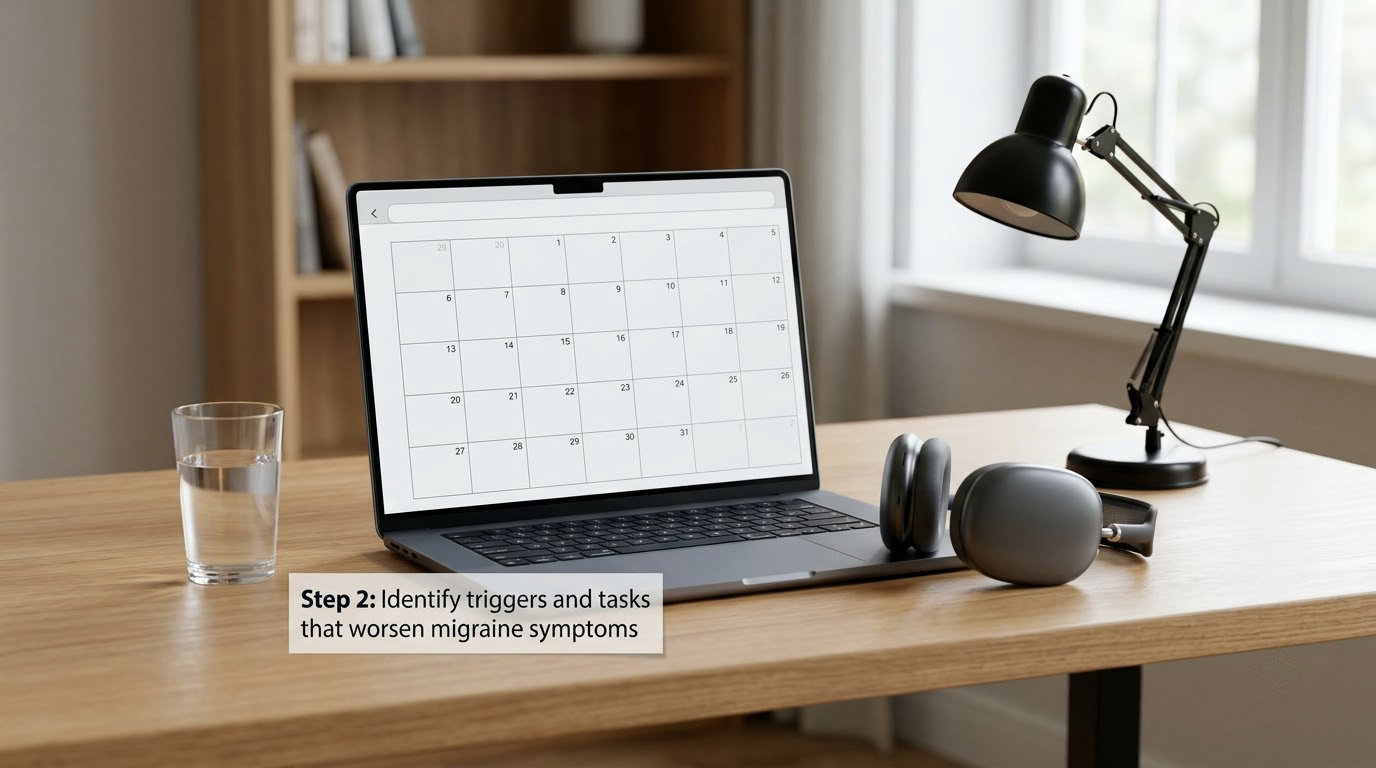
Keep the exercise descriptive rather than diagnostic. You are cataloguing conditions, not working out why someone gets migraine. A designer who sits under a flickering panel for six hours a day and who also gets flare-ups in deadline weeks has given you two work conditions to change, not a diagnosis.
Try one change and measure it loosely. Move the desk away from the window, add a task lamp and an anti-glare filter, and check in two weeks later on how many headache days they had and whether deadlines still landed. The American Migraine Foundation workplace resource is a sensible place to send an employee who wants to understand their own triggers before a meeting with you.
Step 3: Agree on reasonable workplace accommodations
Agree only on changes tied to a stated functional need, and check each one against your own workplace rules before you promise it.
The adjustments managers most often reach for: a flexible start and finish time, remote work on the days the employee flags as high risk, batching two or three focus blocks instead of scattering meetings across the day, screen and lighting changes, access to a quiet room, camera-off or written-summary alternatives for long meetings, flexible break timing, predictable shift patterns, and a shared no-scent norm instead of a one-person exception.
Then check whether they are working. Two weeks after the change, ask one question: did anything get easier, and what got in the way? Write down what you tried, what happened, and what you will change. That record is what turns a favour into something the employee can rely on next time the team reshuffles.
Step 4: Adjust workload and communication during migraine episodes
Agree the fallback before it is needed, so nobody has to negotiate their way through an attack while ill.
Cover four things: which tasks can slip by a day, who picks up urgent work if the employee cannot, how a client or a class or a shift gets communicated, and what “reduced capacity” looks like for that week. The employee chooses how much is shared. A line like “covering a personal matter, back Thursday” is enough for most situations and protects them from having to explain anything to colleagues.
A template that works: “No need to reply. The [task] can move to Friday, and I will pick up the [other piece]. If it is easier to hand over to [colleague], that works too — whatever keeps it on track.” Then confirm the arrangement actually meets the business need, because a fallback that quietly creates rework for the rest of the team will not survive the month.
Step 5: Support timely access to appropriate health care
Your job is to remove the practical obstacles between the employee and their own clinician — not to have an opinion about their treatment.
Share what is factual and available: how the health plan covers neurology visits, how the leave process works, what the employee assistance programme offers, whether appointments can be booked outside core hours, and how much notice a call-out normally needs. Do not suggest a diagnosis, a medication, a dose, or a treatment. If an employee asks you medical questions, the honest answer is that you are not the right person and here is who is.
One safety line belongs here. New, severe, or unfamiliar symptoms — a headache unlike the person’s usual pattern, or sudden weakness, confusion, vision loss, or a fever with a stiff neck — should be assessed urgently by a qualified health professional rather than managed with a desk adjustment.
Step 6: Check in without pressuring the employee
A short private check-in every few weeks is enough. Two questions, five minutes, no form.
Ask whether the adjustments are helping and whether the priority has changed. The employee decides how much they share, including nothing. Resist asking whether they have had an attack this month, and resist “any update?” in front of others.
Some signals mean a more formal process is due: the adjustments were tried and made no difference, the employee wants something outside your authority, absences are clustering around predictable weeks, or the employee asks you to stop making the effort. Route those to HR or occupational health rather than improvising.
Step 7: Review and improve the plan regularly
Put a date in the calendar the same day you agree the plan. Four to eight weeks for the first review, then quarterly if things are stable.
Review four things: whether the functional need is still the same one you started with, whether the arrangements are still confidential, whether the workload is sustainable, and whether the job itself has changed enough to invalidate the plan. If a role has shifted, the plan needs rewriting rather than defending.
Document the operational adjustments only — flexible hours, remote days, room access — and keep medical detail out of the personnel file and out of team announcements. When a plan has been refined once or twice, the written version is the thing that protects the employee when a manager changes.
Common Mistakes Managers Make With Migraine
Most of these are well-intentioned. Fix them the same way: name the mistake, replace it with the specific behaviour that works.
Diagnosing or minimising. “You just need water and a screen break” is an assumption about someone’s neurology. Replace it with “what would help right now?” and follow that answer.
Asking colleagues for the story. A general note that a colleague is unwell is fine; asking a team to speculate about someone’s health is not. The detail is the employee’s to share, or nobody’s.
Treating every case the same. Episodic and chronic migraine, vestibular migraine, and migraine that appears as a secondary condition after an injury or illness behave differently. Support what this person can actually do this month.
Promising what you cannot deliver. An adjustment you cannot fund or authorise becomes a broken promise with a health condition attached. Say “I need to check and come back to you by Thursday” instead.
Recording more than you need. Detailed notes about symptoms belong with the employee and their clinician. Your file needs the adjustments and the dates.
Ignoring the access barrier. A perfect plan in a portal nobody can log into, or a screen setting buried three menus deep, is not an accommodation. If the adjustment is hard to use, it will not survive a busy month.
Two habits make the rest easier. Write the plan down and keep it with HR, and take team-wide decisions where you can — sensible lighting, no strongly scented products in shared spaces, meeting breaks that let people move — so one person’s need stops looking like an exception. That is also what colleagues of someone with migraine tend to find most useful, according to guidance published for employers and coworkers by The Migraine Trust.
Frequently Asked Questions
Do I need to know the employee’s diagnosis to make an adjustment?
No. You are entitled to ask whether the employee has a medical condition that affects work, and they are not required to give you detailed records. Ask what the functional limitation is, which tasks are affected, and roughly for how long. The operational answer is what you need to adjust; the diagnosis is between the employee and their clinician.
What should I write down, and what must stay out of the file?
Write down the request in functional terms, the adjustment you agreed, the start date, and the review date. Keep symptoms, treatment details, and anything the employee told you in confidence out of the personnel file. Managers routinely share accommodation status as need to know only, such as coverage planning, and nothing more.
What if performance issues appear alongside the migraine condition?
Apply the same standard you would apply to anyone, and do it separately from the health conversation. Focus on output, deadlines, and the agreed adjustments rather than on attendance as a proxy for commitment. If a medical factor may be affecting performance, involve HR early, because the interactive process and any leave entitlement may still be open.
How much detail should I share with the wider team?
Share what colleagues need in order to cover the work, and no more. A line such as covering a colleague who is off sick is usually sufficient. If the employee has agreed to intermittent or reduced hours, the team needs the schedule, not the reason. Route any questions about the person to HR so the employee does not become the answer.
When should I involve HR, occupational health, or an employee assistance programme?
Bring in HR when the request is medical, when the adjustment needs a policy or benefits change, or when performance concerns exist. Occupational health helps when the functional impact is unclear or changing. An employee assistance programme can offer short confidential counselling on managing a chronic condition, and employees can self-refer without telling their manager anything.
Conclusion: Start With One Private Conversation
The first step is a private, employee-led conversation about what their work needs, not about their diagnosis. From there, run a small documented trial of two or three adjustments, check in a few weeks later, and put the next review in the calendar. If support for employees with migraine works as a routine rather than an emergency, most of it costs one conversation.
Employers, rules, and entitlements vary by country and change over time, so check your own policies and take advice from HR or a qualified professional before acting on anything specific.