
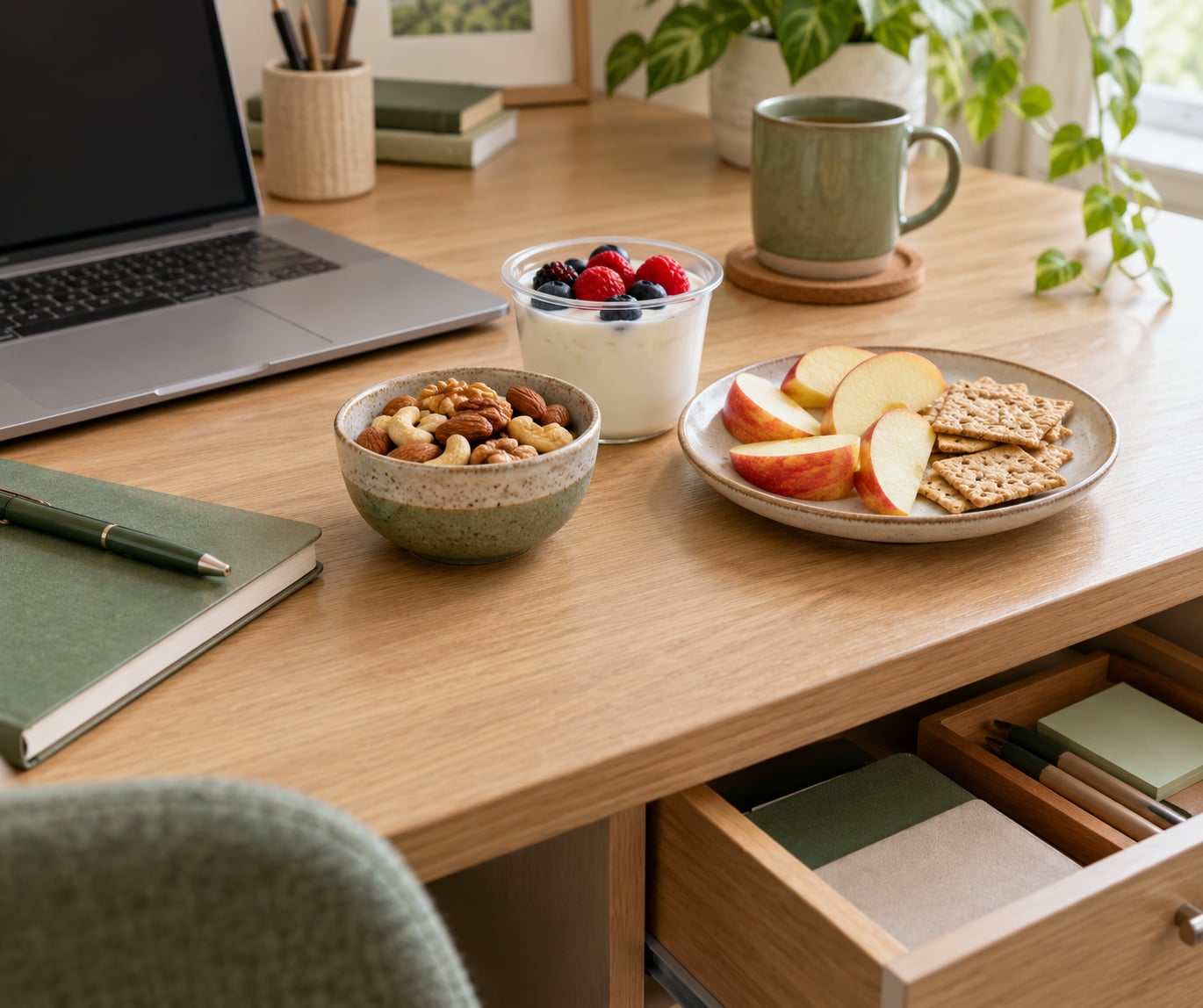
The healthy snacks to keep at your desk are the ones that combine protein, fiber and unsaturated fat in a portion you can eat with one hand: portioned nuts and seeds, plain Greek yogurt with fruit, whole-grain crackers with hummus, apple slices with peanut butter, homemade energy bites, string cheese, dark chocolate with pretzels, air-popped popcorn, rice cakes with avocado, and roasted chickpeas. Every pick below lasts through a normal workday, and most need no refrigeration at all.
Snacking is not the problem. The 3pm vending machine run is the problem. Most office snacks are built from refined flour and added sugar, which spikes blood glucose and drops it just as the afternoon gets hard. A snack built from protein, fiber and fat gives you a steadier curve and takes about ten minutes.
There is a storage layer to this, too. Half the useful choices are shelf-stable, the rest need an office fridge kept at or below 40°F. Knowing which category a snack falls into matters more than people expect, especially if you are rebuilding what is in your drawer. If your building has no kitchen at all, the [healthy vending machine options for the workplace](https://workhealthresearchnetwork.org/healthy-vending-machine-options-for-the-workplace/) are worth a look as a backup.
What follows is general nutrition information for healthy adults. If you are managing diabetes, a food allergy, IBS or any other medical condition, ask your doctor or a registered dietitian what fits your plan.
Table of Contents
- Healthy Snacks to Keep at Your Desk at a Glance
- 1. Mixed Nuts with Unsalted Seeds
- 2. Plain Greek Yogurt with Fresh Fruit
- 3. Whole-Grain Crackers with Hummus
- 4. Apple Slices with Peanut Butter
- 5. Protein Energy Bites
- 6. String Cheese with Whole-Grain Crackers
- 7. Dark Chocolate with Pretzels
- 8. Unsweetened Popcorn
- 9. Rice Cakes with Avocado or Hummus
- 10. Roasted Chickpeas
- Frequently Asked Questions
- What are the best healthy snacks to keep at my desk?
- How can I keep desk snacks fresh without a refrigerator?
- Are nuts and nut-butter snacks suitable for a shared office?
- What can I eat at my desk if I am trying to avoid added sugar?
- How much snack should I have during a workday?
- Are healthy desk snacks allowed under workplace food policies?
- Conclusion
Healthy Snacks to Keep at Your Desk at a Glance
| Snack | Main benefit | Best storage | Personal drawer or shared office |
|---|---|---|---|
| Mixed nuts with seeds | Protein, unsaturated fat, vitamin E | Airtight tin, no fridge | Personal drawer |
| Plain Greek yogurt with fruit | High protein, calcium | Office fridge, below 40°F | Both, labelled with your name |
| Whole-grain crackers with hummus | Fiber plus healthy fat | Crackers airtight; hummus chilled | Shared office |
| Apple slices with peanut butter | Fiber, vitamin C, healthy fat | Slices in citrus water, fridge | Personal drawer |
| Protein energy bites | Carbohydrate plus protein and fat | Airtight container, fridge optional | Personal drawer |
| String cheese with crackers | Protein and calcium | Fridge until use | Office fridge |
| Dark chocolate with pretzels | Antioxidants plus a salty crunch | Airtight wrapper, no fridge | Personal drawer |
| Unsweetened popcorn | Whole grain, high volume | Airtight canister or jar | Personal drawer |
| Rice cakes with avocado or hummus | Complex carbohydrate, potassium | Cakes airtight; topping chilled | Both |
| Roasted chickpeas | Plant protein, fiber, crunch | Airtight jar, no fridge | Personal drawer |
Two columns deserve a note. The shared office column assumes a floor where someone else is dealing with your allergies, your crumbs and your sound level. And the fridge row assumes your workplace actually has one; if it does not, the four shelf-stable rows are your working list.
1. Mixed Nuts with Unsalted Seeds
A portioned nut and seed mix is the most forgiving desk snack there is, because it needs nothing but a drawer. A small container holding roughly 30 grams — about a quarter cup — of almonds, walnuts, cashews and pumpkin or sunflower seeds gives you protein, mostly unsaturated fat and a decent amount of magnesium, which many people come up short on.
Unsalted matters more than people expect. Salted mixes are easy to overeat precisely because they make you reach for another handful, and the sodium adds up across a week of vending visits. Choose dry-roasted rather than fried, and skip anything coated in sugar or yogurt.
The practical part is portioning. I buy a large tin, then divide it into small containers on Sunday and stack a week of them in the drawer. Without that step the tin itself becomes the serving size, which is rarely the size you meant. Keep the container closed, and keep it away from your keyboard — nut crumbs find their way into everything.
Walnuts and flaxseed are the two worth hunting for if you care about omega-3 fats; almonds bring vitamin E and are usually the best value in the mix.
2. Plain Greek Yogurt with Fresh Fruit
Plain Greek yogurt is the highest-protein option on this list and the only one where a spoon counts as portion control. A single-serve tub runs roughly 15 to 20 grams of protein, and the protein is what holds your appetite steady until dinner.
Buy plain, then add your own sweetness. Throwing a few berries or half a banana in at the office works better than most flavored varieties, which often carry more added sugar than the fruit they are sold with. If you are watching sugar strictly, a cinnamon sprinkle over unsweetened yogurt does more than you would expect.
Storage is the whole question here. Keep it at or below 40°F until you eat it, and use it within the window your workplace refrigerator allows — cut fruit in yogurt will not hold its texture overnight in a warm room. If the fridge is shared, write your name on the tub; there is nothing more demoralizing than opening a well-labeled yogurt to find someone else’s spoon in it.
Two small cups beat one large one, too. The second cup becomes tomorrow’s snack and stops you eating the whole tub because it was open.
3. Whole-Grain Crackers with Hummus
Crackers plus hummus is a combination that works because the two halves fix each other’s weaknesses. A whole-grain cracker supplies fiber and a slow carbohydrate; hummus supplies fat and protein that slow down how quickly that carbohydrate is absorbed.
Read the cracker label and look for whole grain or whole wheat as the first ingredient, plus at least 2 to 3 grams of fiber per serving. Skip the buttery, sharply salted varieties, which tend to be refined flour with salt on top.
Hummus is easy to portion into the little cups that come in a tub, which stops the “just a little more” problem that ends with a third of the container gone. Two tablespoons is a normal portion and roughly 2 grams of fiber on its own.
Store the crackers in their original sleeve or an airtight container so they stay crisp; humidity from an open office is what turns them soft within a day. Keep the hummus in the fridge. For the twelve-hour shift crowd who want crunch with zero prep, roasted chickpeas further down this list do the same job without either item going warm.
4. Apple Slices with Peanut Butter
An apple is the desk snack people already know how to buy, and pairing it with a measured spoonful of peanut butter turns a piece of fruit into an actual snack. The fiber and vitamin C come from the apple, and the fat and protein from the peanut butter are what keep the sugar in that apple from arriving all at once.
Two practical tricks make this work. Toss the slices with a little lemon or orange juice and they hold their color for hours. And do not use the peanut butter jar at your desk — dip into a small container each day instead, because the amount you actually eat is the amount you portioned.
That last habit matters for anyone trying to manage their weight, since peanut butter is one of the most calorie-dense things in a desk drawer and a casual knife-swipe can be two or three times a snack.
One caution: this is a nut product, so it needs to be somewhere you have thought carefully about allergies and preferences. Sunflower seed butter behaves the same way in a sandwich and is the usual swap when nuts are off the table. Check with your workplace about food rules before you set up a nut butter station — more on that below.
5. Protein Energy Bites
Energy bites are the snack people make when they get tired of buying snack bars that taste like compressed cardboard. They are also the easiest option to control, because you decide what goes in them and how large they come out.
A basic recipe is rolled oats, a sticky binder such as dates, tahini or peanut butter, and a mix of seeds, plus cocoa powder or cinnamon if you want them sweet. Pulse it in a food processor, roll into balls the size of a walnut, and chill for an hour so they firm up.
Portioning healthy snacks to keep at your desk for the week
Two or three bites is a snack. That sounds obvious, but a batch of homemade balls makes it easy to eat five without noticing, so the container is where the discipline has to live.
- Roll them small and count them into daily containers, so the whole week is visible in the fridge door.
- Keep the batch in the fridge, where they stay firm and last about a week, or freeze extras and move two or three to the fridge each Sunday morning.
- Line the container with parchment or wax paper, otherwise they fuse into one solid block.
- With oats and nut butter in the mix, plan on nut allergies in the office and label the container clearly.
Dates are the sweetening here, not added sugar, so these suit people avoiding refined sugar as long as the rest of your day is not already date-heavy.
6. String Cheese with Whole-Grain Crackers
String cheese is a grab-and-go pairing that solves the afternoon problem without any prep and without a crumb problem, which is why it keeps showing up on lists of desk-friendly snacks. One stick delivers around 6 to 8 grams of protein and a good chunk of calcium, and it takes about ten seconds to eat.
Pair one or two sticks with two or three whole-grain crackers so the snack has some carbohydrate to go with it, and you have a combination that holds far longer than crackers alone. That is the same protein-plus-complex-carbohydrate pairing as the apple and peanut butter, just with a different texture.
Cheese is perishable, so string cheese lives in the fridge at or below 40°F until you eat it, and it travels in the small insulated bags that fit in a desk drawer. Cut the wrapper seam before you open it; the sound of a foil corner being torn during a call is exactly the kind of small office irritance nobody wants to explain.
The cracker problem is staleness. Store them in an airtight container or a sealed bag, and if you buy the big family-size box, split it into weekly containers on the same day you do the nuts.
7. Dark Chocolate with Pretzels
Sometimes the craving at 3pm is for sweet and salty, not for protein, and fighting that with a bowl of baby carrots rarely works. A small portion of dark chocolate with low-sodium pretzels satisfies the actual craving while still giving you fiber from the pretzel and cocoa flavanols from the chocolate.
Portion it before you sit down. Around 20 grams of dark chocolate, roughly four small squares, is the usual serving size people use, and pairing it with a small handful of pretzels keeps the total moderate. Buy 70% cocoa or darker if you want it to taste less sweet; milk chocolate tends to drive the craving loop straight back to the vending machine.
Two notes worth taking seriously. Pretzels are a salty processed snack and sodium adds up fast, so check the label and look for a low-sodium variety if you eat them daily. And dark chocolate is a common allergen, so it belongs in a closed drawer rather than an open bag on the shared counter.
This pairing travels better than anything else here. It does not wilt, does not need ice, and survives a hot car in a way that yogurt never will.
8. Unsweetened Popcorn
Popcorn is unusual among desk snacks because volume is its main selling point. A 3-cup serving of air-popped popcorn is around 90 calories and about 3 grams of fiber, so you eat something substantial without much going in.
Air-popped or lightly seasoned is the version to buy. Butter and heavy coatings multiply the calories several times over, and most flavored varieties drenched in oil or sugar are closer to candy than to a whole-grain snack.
For the desk, the trick is to avoid loose popcorn. It scatters, it gets into keyboards, and the sound during a video call is genuinely difficult to defend. An airtight glass jar or a canister means you scoop from the container, and a wide-mouthed lid keeps the mess at the opening rather than across your desk.
You can also season your own at home. Melted butter with a little smoked paprika or nutritional yeast keeps it savory; cinnamon and a small amount of cocoa bring a sweet option that uses no added sugar.
Chewing noise is the one drawback. If you take a lot of calls, this is the one to save for days you are heads-down at your desk.
9. Rice Cakes with Avocado or Hummus
Rice cakes are the cheapest, most compact crunchy base on this list, and they are the reason a desk drawer can look empty and still hold a complete snack. Choose brown rice or a multigrain cake, where the label lists whole grain first; the white versions are mostly starch with very little fiber.
Spread half an avocado with a pinch of salt and lemon, or use hummus, and you have fiber, healthy fat and potassium on a base that is shelf-stable. Avocado browns fast, so bring it whole and cut it at your desk, or squeeze lemon juice over the slices and keep them in the fridge if you prepare ahead.
A practical serving is two cakes with a thin layer of topping. That combination makes you rethink whether you even need the crackers.
For anyone planning snacks that go beyond the desk — a review meeting, a client visit, a workshop morning — the [12 healthy meeting food ideas for modern workplaces](https://workhealthresearchnetwork.org/healthy-meeting-food-ideas/) expand on this and cover portioning for a room rather than one person. If your office discourages eating at your workstation, taking a short break elsewhere is a reasonable adjustment, and the desk setup guide on [preventing back pain at your desk](https://workhealthresearchnetwork.org/how-to-set-up-your-desk-to-prevent-back-pain/) covers the posture side of eating in the same position all day.
10. Roasted Chickpeas
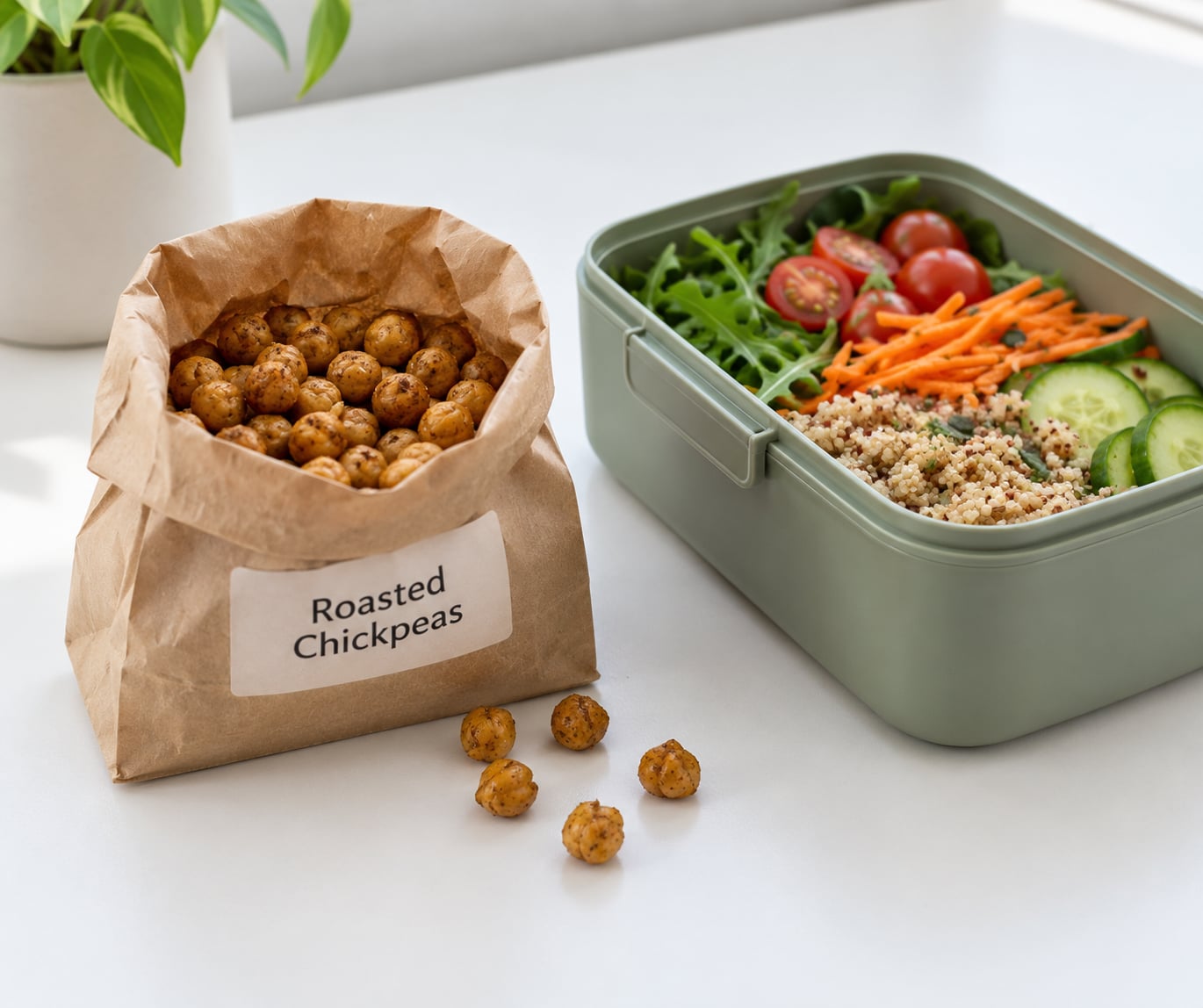
Roasted chickpeas are one of the easiest snacks to fall in love with, because they deliver plant protein, fiber and crunch without being sweet at all. About a quarter cup has roughly 6 grams of protein and 5 grams of fiber, which puts them ahead of most chips on every measure that matters for a snack that has to hold you until dinner.
Buy them dry roasted or lightly seasoned rather than fried in heavy oil. Look at the sodium per serving too, since plain and flavored versions can differ by a wide margin, and a heavy rosemary or smoked paprika seasoning gives you most of the flavor without the salt load.
Storage is the one weak point. Chickpeas go stale in open air within a few days, so store them in an airtight jar rather than the bag they came in, and count out a serving into a smaller container each morning. That jar also solves the problem of other people helping themselves, which is the most commonly reported frustration about any snack kept in a shared space.
They are crunchy, which makes them a poor choice during calls. They are also genuinely filling in a way most snacks are not, so they often end a 3pm craving on their own.
Frequently Asked Questions
What are the best healthy snacks to keep at my desk?
The strongest all-round choices pair protein, fiber and unsaturated fat in a single-hand portion: portioned nuts and seeds, plain Greek yogurt with fruit, whole-grain crackers with hummus, apple slices with peanut butter, homemade energy bites, string cheese, dark chocolate with pretzels, air-popped popcorn, rice cakes with avocado, and roasted chickpeas. Pick two or three that suit your storage situation rather than all ten.
How can I keep desk snacks fresh without a refrigerator?
Buy shelf-stable items and protect them from air and humidity. Nuts, roasted chickpeas, popcorn and dry crackers all go into airtight containers or jars, and you refill them from a bulk tin each week. Dark chocolate keeps fine in its wrapper. Keep cut fruit, yogurt, hummus and dips at or below 40°F, and skip anything perishable if your office has no fridge at all.
Are nuts and nut-butter snacks suitable for a shared office?
It depends on the room. Nuts, peanut butter and nut-based energy bites are among the most common allergens, and even a trace amount can be serious for a colleague, so make sure before you set up a nut station. Ask what already gets eaten in the break room and keep your portions labelled and closed, or simply store them in your own drawer.
What can I eat at my desk if I am trying to avoid added sugar?
Unsalted nuts and seeds, plain Greek yogurt with whole fruit, air-popped popcorn, boiled eggs, raw vegetables with hummus, string cheese, avocado on a rice cake, and roasted chickpeas are all naturally sugar-free as purchased. Check labels anyway, since flavored yogurt, granola bars, dried fruit with added sweetener and flavored nuts often carry sugar. Dates in homemade energy bites sweeten without added sugar.
How much snack should I have during a workday?
For most adults one or two snacks during a workday is enough, which is roughly 100 to 250 calories each depending on how long the gap to your next meal is. Eating every couple of hours from lunch to close tends to take in more than you need without making you feel better. Judge it by whether the snack fixes the hunger, not by the clock, and adjust with a doctor or registered dietitian if your needs are unusual.
Are healthy desk snacks allowed under workplace food policies?
Usually, but the rules are written down and vary. Many employers ask that only shelf-stable, clearly labelled food goes in a shared fridge, and some restrict eating in customer-facing or clinical areas. Odor-free, crumb-free choices such as string cheese with crackers, popcorn and nuts are the easiest to defend in a shared space. If you are unsure, ask your manager or facilities team before setting up.
Conclusion
Start with two snacks, not ten. The simplest pairing that covers almost every workday is a portioned nut and seed mix plus something you can eat with a spoon, and the two should sit in different storage categories so you are not relying on a fridge that may not be there.
Pick them on three questions: does it survive until you eat it, does it travel quietly, and can you portion it before the hunger arrives. Once those three are answered, the choice is easy, and the afternoon 3pm problem stops being a daily negotiation.