
Learning how to stay awake at work without coffee is mostly about fixing the cause of the slump rather than pushing through it. Water, daylight, movement, paced breathing and a short planned rest cover most workdays, and you can build the whole routine in about five minutes of setup. The one thing none of it fixes is a genuine sleep debt, so this guide ends with when a clinician is the right call.
The advice here is general information for workplace alertness. If you have a medical condition, take medication, or work in a safety-sensitive role, talk to your own clinician or occupational health team about what applies to you.
Table of Contents
- What You Need
- Step-by-Step: How to Stay Awake at Work Without Coffee
- Step 1: Check the Cause of Your Sleepiness
- Step 2: Get Natural Light and a Movement Break
- Step 3: Hydrate and Choose a Light Snack
- Step 4: Use Controlled Breathing
- Step 5: Change the Work Pattern
- Step 6: Cool the Room and Improve Ventilation
- Step 7: Take a Short Rest or Nap
- Step 8: Protect Tonight’s Sleep
- Step 9: Know When Avoiding Coffee Is Not the Answer
- Common Mistakes
- Frequently Asked Questions
- How can I stay awake at work when I did not sleep enough?
- What is the fastest way to become more alert without coffee?
- Does drinking cold water really help you stay awake?
- Are energy drinks a safe alternative to coffee at work?
- Can chewing gum improve alertness during a long meeting?
- When should persistent daytime sleepiness be discussed with a doctor?
What You Need
None of this requires a purchase. You need a water bottle you can actually see from your desk, a clock or phone timer, enough floor or corridor space to move for a few minutes, and access to daylight, whether that is a window or a walk outside.
A quiet place for a short rest helps if your workplace has one, such as a car, a break room, or a quiet corner of a shared office. Add a notebook or a single line on your task list so a two-minute reset still lands you back on track.
Step-by-Step: How to Stay Awake at Work Without Coffee
Step 1: Check the Cause of Your Sleepiness
Start by asking where the fatigue comes from, because the fix depends on it. Six hours in a chair, a warm stale room, a boring spreadsheet and a heavy lunch are four different problems wearing the same face.
Note the pattern. Sleepiness that arrives every afternoon at the same time is usually the natural circadian dip, while sleepiness that shows up after a bad night, during stress, or alongside snoring, morning headaches or unrefreshing sleep deserves a conversation with a clinician. So does sleepiness that appears suddenly or keeps getting worse.
Step 2: Get Natural Light and a Movement Break
Pair daylight with movement. Ten minutes outside, or standing near a window with your face toward the light, gives your eyes and body clock a signal stronger than any desk lamp. Then walk for two or three minutes, ideally outdoors rather than around the office floor.
Keep the break safe. Skip ladders, loading docks, traffic lanes and any task where a short lapse in attention has real consequences. You will know it worked if your posture loosens and the next task takes less staring at it. On a night shift, do the same thing in reverse: bright, cool light while you are working, dark glasses on the commute home so the morning light does not end your sleep window early.
Step 3: Hydrate and Choose a Light Snack
Mild dehydration shows up as dullness, headache and irritability long before you feel thirsty, so keep water within arm’s reach and drink through the shift rather than in one large go at the end.
If you are genuinely hungry, pick something with protein, fibre or fat, such as nuts, yogurt, cheese, eggs or vegetables with hummus. A heavy or sugar-heavy meal sends energy into digestion and tends to produce the after-lunch dip people are trying to outrun.
One thing to keep straight: hydration helps a tired feeling caused by thirst, and it does not replace sleep. Cold water feels sharper than room-temperature water, mostly because of the sensation and any small rise in alertness from the splashing, not because cold water adds energy to your bloodstream.
Step 4: Use Controlled Breathing
Breathe in through your nose for a count of four, hold for four, breathe out through your mouth for a count of six, and repeat for one to two minutes. The long exhale is the useful part; it slows your breathing rate and settles the physical part of a stress response.
Another simple version: inhale for four, hold for four, exhale for four, pause, repeat. Stop immediately if you feel dizzy, light-headed or short of breath, and skip long breath holds if you have any heart or lung condition. If you want the full picture of nervous system techniques, breathwork is covered alongside other stress tools in our guide to how to reduce stress at work without quitting.
Step 5: Change the Work Pattern
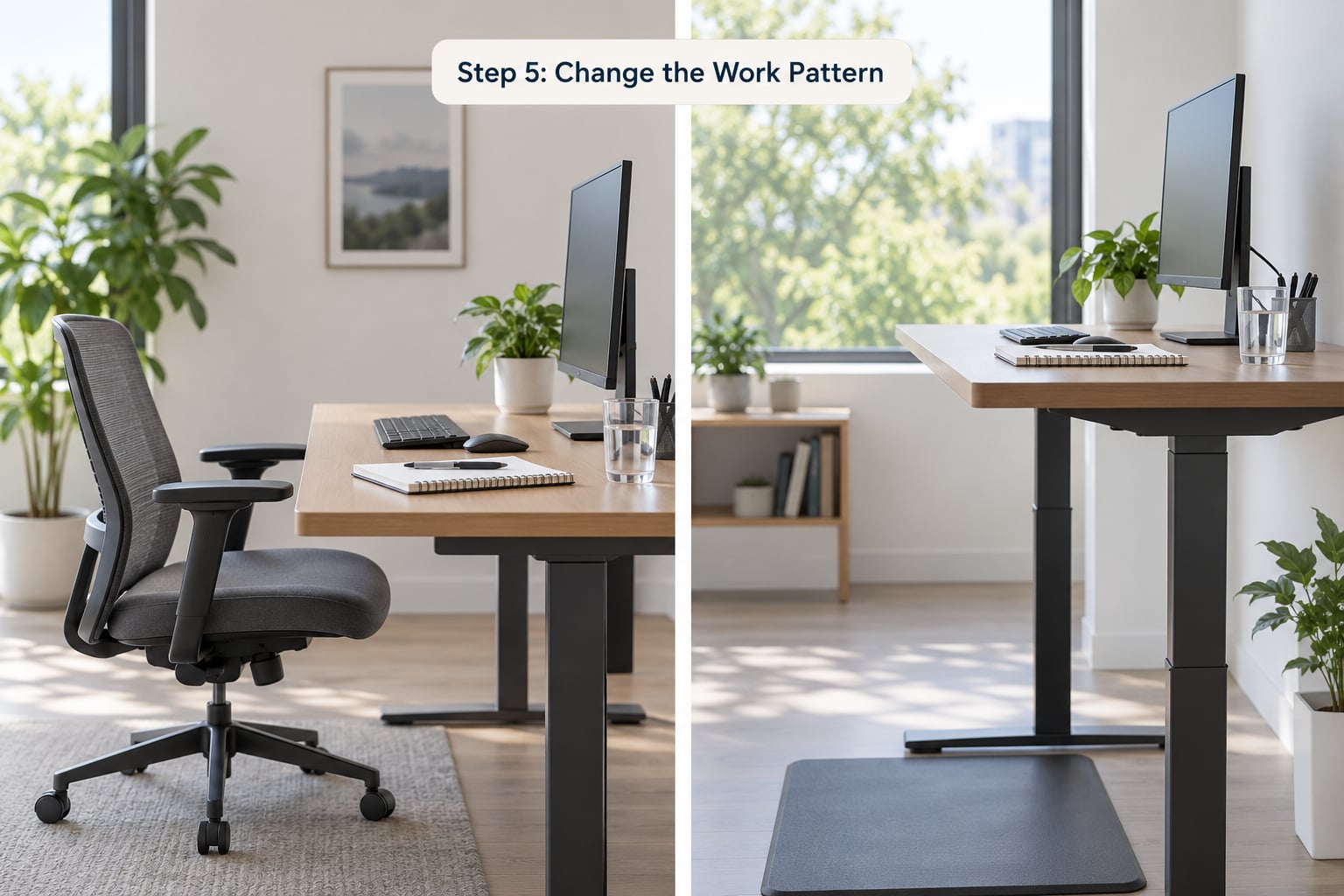
Monotony tires the brain faster than volume does. Change posture, switch task order, stand up for the next twenty minutes, move a task you normally do at your desk to a different location, or change what your eyes are focusing on every few minutes.
Short, deliberate transitions between tasks help more than a random scroll. Our guide to reducing sedentary behavior at work covers desk setup and how much sitting is reasonable over a working day, which matters because long stretches in one position slow circulation and make a heavy head feel heavier.
Step 6: Cool the Room and Improve Ventilation
A warm room makes everyone slower. Where you control the thermostat, aim for a setting you can comfortably work in, loosen restrictive clothing, and refresh the air with an open window or a run of ventilation when the building allows it.
Stale, recirculated air with a heavy carbon dioxide load is a real part of the afternoon fog, and a ten-second change of air can do more than another stimulant. A cool splash on the face and the back of the hands is a fast, cheap version of the same idea, which is why shift workers rate cold water on the face and wrists as their quickest desk-friendly fix.
Step 7: Take a Short Rest or Nap
Keep a rest to twenty minutes or less, and set an alarm you cannot ignore. Short is the whole point: long or late naps send you into deep sleep, and waking from deep sleep brings sleep inertia, that foggy twenty minutes that makes a short nap counterproductive.
Timing matters too. Mid-afternoon before about 3 p.m. suits most people on a day schedule. After that, a rest may cost you the night, and on night shift it may not be practical at all.
Before you drive home or start anything dangerous, give yourself ten to fifteen minutes to fully wake. Safety forums keep raising the same point with night shift workers: being technically awake at the end of a shift is not the same as being safe to operate a car or a machine. If you are that tired, arrange a ride.
Step 8: Protect Tonight’s Sleep
The fastest way to make tomorrow easier is to make tonight predictable. Keep the same sleep and wake times, including at weekends, since a schedule that swings by several hours leaves your body clock guessing.
Cut back on alcohol in the evening, keep the room dark and cool, and stop scrolling in bed, because screen light and stimulation both delay the onset of sleep. If you are cutting caffeine back, take it out of your routine gradually; sudden withdrawal can leave a headache and heavier fatigue than before.
Shift workers have a harder version of this problem, and it is worth reading in detail. Our guide to shift work sleep problems and how to fix them covers light timing, meal timing and post-shift recovery.
Step 9: Know When Avoiding Coffee Is Not the Answer
Be honest about the limit of these nine steps. They manage alertness; they do not repair a chronic sleep deficit, and they cannot correct a condition that causes sleepiness on its own.
See a clinician if you regularly feel sleepy during the day despite enough time in bed, wake up gasping or with a dry mouth, snore loudly, have morning headaches, struggle to stay awake while driving or in quiet meetings, or notice sleepiness building over weeks. Snoring and witnessed breathing pauses point toward sleep apnea, which is common in working adults and treatable. Iron deficiency, thyroid problems, medication effects and diabetes can all present this way too.
Workers in transport, construction, healthcare and emergency services should treat daytime sleepiness as a safety signal, not a personal failing. Many employers run fatigue risk assessments, and using one is a better move than quietly self-medicating.
Energy drinks are not the swap you want. They often layer caffeine, sugar and stimulants in a serving whose caffeine content people underestimate, and the crash that follows is usually worse than what coffee gives you. Same goes for unregulated stimulants and over-the-counter stay-awake products.
Common Mistakes
Reaching for a sugary snack to fix a slump. The spike and the drop arrives an hour later, usually right when you need to concentrate. Protein, fat or fibre holds steady instead.
Switching to energy drinks without checking the caffeine content. A single large can can carry more caffeine than several cups of coffee. Read the label, and treat the sugar and mixing with alcohol as separate risks.
Sitting in one position for hours. Standing up for two minutes every half hour is a small change that keeps circulation and attention moving.
Using eye drops to fix tired eyes. Drops are for dry or irritated eyes, not for tiredness itself. The screen is the cause; use the 20-20-20 habit, which means every 20 minutes look at something about 20 feet away for 20 seconds.
Normalizing heavy daytime sleepiness. Accepting it as part of a busy season is how apnea, iron deficiency and thyroid problems go unnoticed for years. Track your sleepiness for a few weeks and mention it at a checkup.
Frequently Asked Questions
How can I stay awake at work when I did not sleep enough?
You cannot fully replace sleep, but you can take the edge off a rough night. Get daylight and a walk within your first hour, drink water, eat a snack with protein or fibre, and take movement breaks every 30 minutes or so. Keep the same bedtime tonight. If poor sleep is happening several nights a week, treat it as a problem to solve rather than something to push through.
What is the fastest way to become more alert without coffee?
A cool splash on your face and the backs of your hands, followed by two or three minutes of brisk movement and a large glass of water, is the quickest option most people report. Slow paced breathing for a minute or two adds a steadying effect that a caffeine hit does not. None of these last more than fifteen minutes, so pair them with a real break from sitting.
Does drinking cold water really help you stay awake?
Cold water is refreshing and gives you a brief lift of alertness, which is why people rate it as a quick fix. The effect comes from the sensation and from taking a proper pause to drink, not from the temperature changing your body chemistry. Room-temperature water works just as well for fixing mild dehydration, which is the actual cause of the dullness hydration can relieve.
Are energy drinks a safe alternative to coffee at work?
Not really, even where they are legal and regulated. A large can can contain more caffeine than several cups of coffee, plus a large dose of sugar, and the combination is often followed by a sharper drop in energy. They also carry real risks for heart rhythm and sleep when stacked together or mixed with alcohol. Water, a walk and daylight are the safer swap.
Can chewing gum improve alertness during a long meeting?
It can help a little, mostly because chewing keeps your jaw and attention engaged and gives you something to do during a dull stretch. Peppermint is the version most people prefer. It is not a substitute for a real break, and chewing constantly for hours can bother your jaw or cause bloating, so keep it to the stretches where it genuinely helps.
When should persistent daytime sleepiness be discussed with a doctor?
Bring it up if you feel sleepy during the day despite getting enough hours in bed, or if you snore, wake gasping, wake with headaches, or fall asleep during quiet moments such as a meeting or a red light. Heavy sleepiness that builds over weeks deserves the same attention. A clinician can check for sleep apnea, iron deficiency, thyroid problems and medication effects, many of which are treatable.
Start tomorrow with the three that need nothing: a full water bottle in front of you, ten minutes of daylight early, and a movement break every half hour. Add paced breathing and a twenty-minute rest once those feel automatic, and keep an eye on your sleep timing rather than on your caffeine intake.
Track how sleepy you actually are for two or three weeks. If it stays high despite these changes, that is useful information to bring to a clinician rather than something to push harder against.