
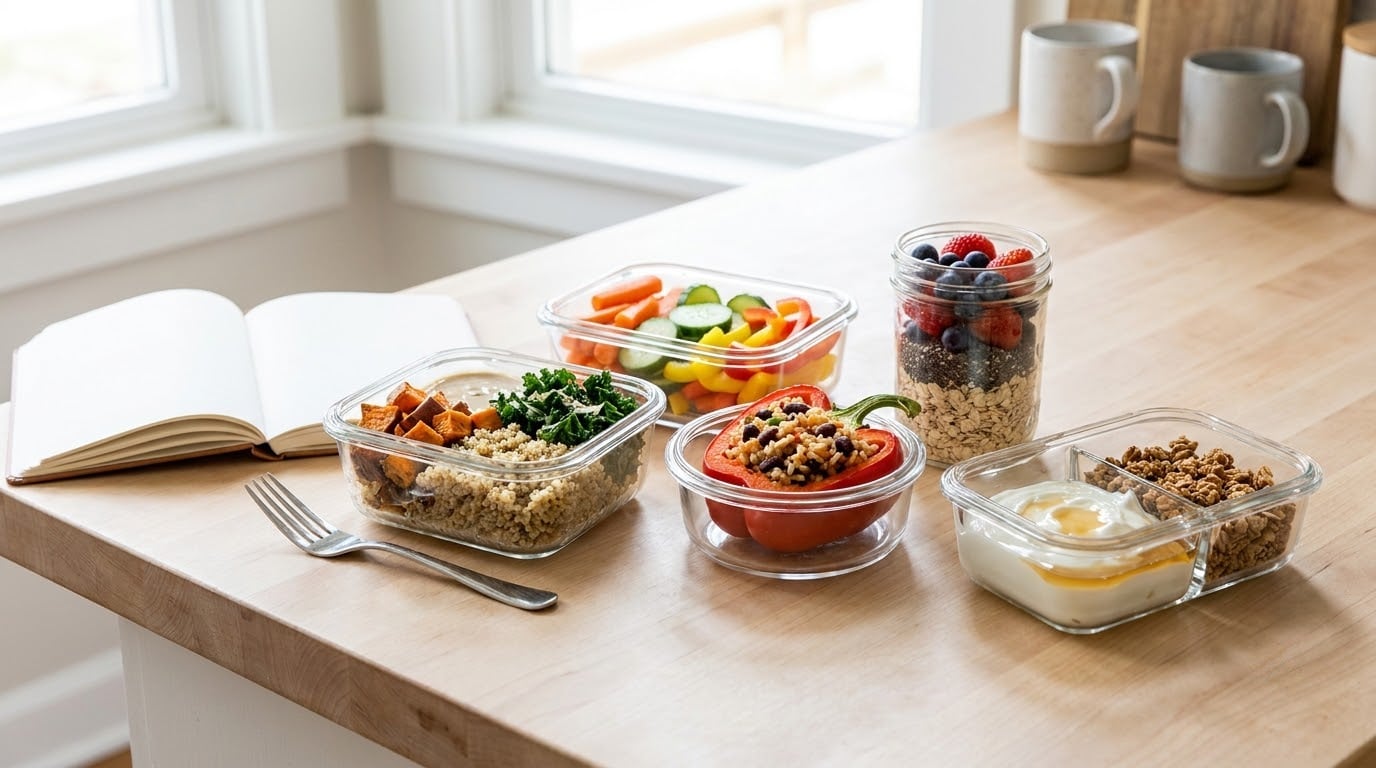
Meal prep ideas for the work week work best when you cook two or three dishes once, portion them into airtight containers, and eat them Monday through Thursday. Most prepped lunches stay fresh and safe in the fridge for three to four days, so plan a quick midweek top-up cook instead of prepping all five days at once.
That is the whole method, really. Batch a protein, batch a grain or base, chop enough raw vegetables for several meals, and assemble. The rest is packing and food safety.
Most people I know who keep this up are not cooking seven days’ worth of food on Sunday. They prep Monday through Wednesday, then cook something fresh on Thursday night for the last two days. It avoids the soggy Thursday lunch that quietly kills a whole week’s enthusiasm.
Before the list, one practical note for anyone planning lunches around a shared office kitchen: 12 healthy meeting food ideas for modern workplaces covers what works in a room where other people are eating nearby. Odor and mess matter more than people expect.
Table of Contents
- Meal Prep Ideas for the Work Week at a Glance
- 1. Overnight Oats Cups for Breakfast
- 2. Chicken Burrito Bowls
- 3. Turkey and Hummus Sandwiches
- 4. Mediterranean Pasta Salad
- 5. Sheet-Pan Chicken and Vegetables
- 6. Lentil and Vegetable Soup
- 7. Stuffed Bell Peppers
- 8. Tuna and White Bean Snack Boxes
- 9. Chicken and Veggie Quesadillas
- 10. Yogurt, Fruit and Granola Snack Boxes
- Frequently Asked Questions
- Conclusion
Meal Prep Ideas for the Work Week at a Glance
| Dish | Best workday use | Prep time | Storage guidance | Equipment note |
|---|---|---|---|---|
| Overnight oats cups | Breakfast before a 9am start | 10 minutes | Fridge 4 days, no reheating | Wide-mouth jars or lidded cups |
| Chicken burrito bowls | Warm lunch on a microwave day | 45 minutes | Fridge 3-4 days, components kept separate | Two-compartment container |
| Turkey and hummus sandwiches | Cold lunch, no microwave | 10 minutes | Fridge 3 days, keep in the cold | Snap-lock box with ice pack |
| Mediterranean pasta salad | Cold lunch that improves over the week | 20 minutes | Fridge 4-5 days, holds best after day two | Container with a separate dressing cup |
| Sheet-pan chicken and vegetables | Warm lunch, batched for several days | 40 minutes | Fridge 3-4 days or freeze half | Oven-safe or microwave-safe dish |
| Lentil and vegetable soup | Warm lunch and shift work | 35 minutes | Fridge 3-4 days, freezer 2-3 months | Wide-mouth jar or thermos |
| Stuffed bell peppers | Lunch that travels upright | 50 minutes | Fridge 3-4 days, reheat 165°F | Individual container per pepper |
| Tuna and white bean snack boxes | No-reheat lunch, low effort | 10 minutes | Fridge 3 days, eat cold | Box with separate cracker compartment |
| Chicken and veggie quesadillas | Warm lunch with a short reheat | 30 minutes | Fridge 3-4 days, freeze up to 2 months | Flat container so they do not fold |
| Yogurt, fruit and granola boxes | Light lunch or afternoon supplement | 10 minutes | Fridge 3 days, keep granola separate | Multi-compartment box |
Read that table as a picking guide rather than a ranking. If your office has no microwave, four of these still work cold. If you have a hot meal most days, the sheet-pan and quesadilla options do the heavy lifting.
1. Overnight Oats Cups for Breakfast
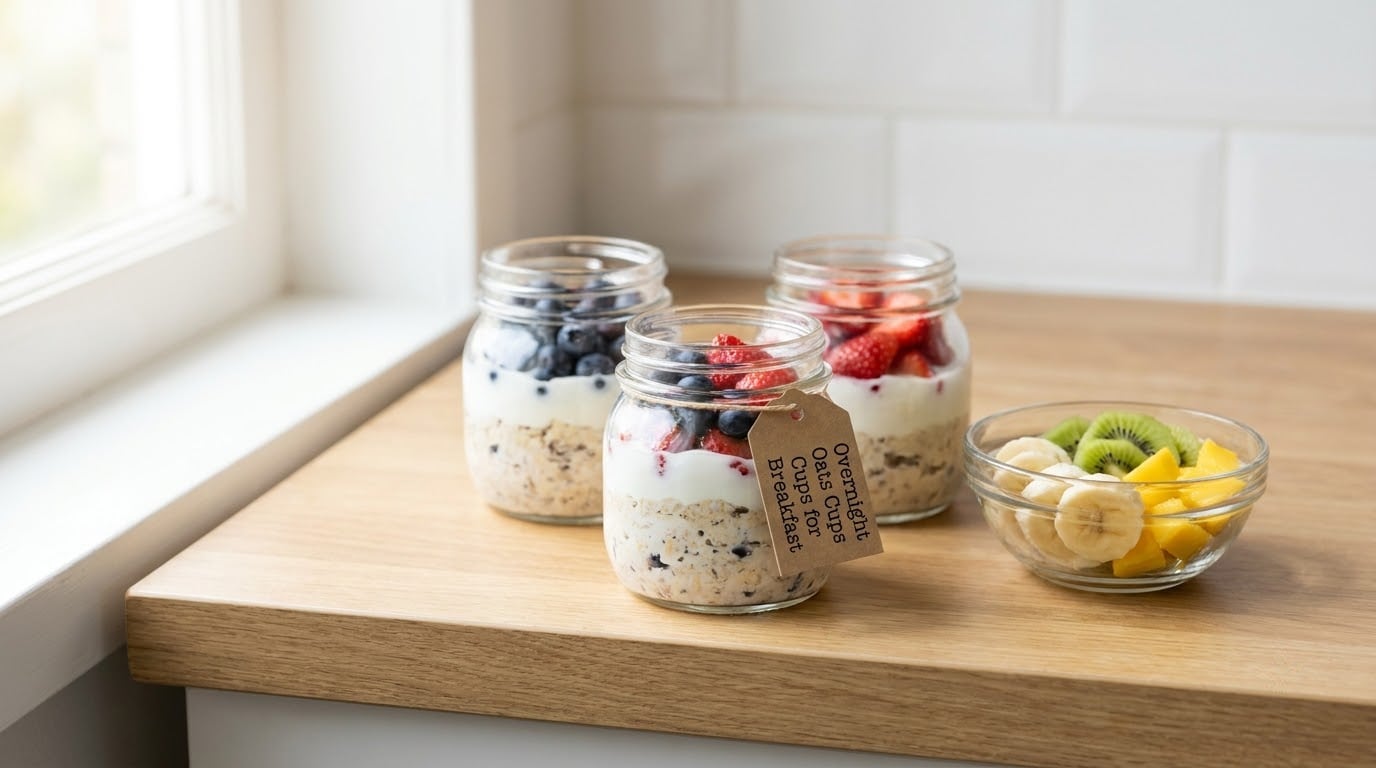
Overnight oats are the easiest breakfast prep because there is no cooking at all. Combine half a cup of rolled oats with milk or yogurt in jars, stir in a sweetener, and refrigerate overnight. Top with fruit and seeds in the morning, or layer them so the fruit sits on top and stays out of the wet base.
Keep jars refrigerated and eat them within four days. Fruit that releases juice, like berries or chopped apple, makes the bottom layer soggy after a couple of days, so add those fresh rather than on Sunday if you want day-four oats that still have texture.
Chia, flax, and pumpkin seeds travel well and do not need refrigeration themselves, so they are the add-ins to use when a jar will sit in a bag for a few hours before you eat it. Sliced banana does not travel, but a whole banana carried alongside does.
What Makes These Meal Prep Ideas for the Work Week So Useful?
Six things decide whether a dish works on a workday, and every option in this list is judged against the same six.
Prep time. If a recipe takes more than an hour of Sunday time, it will not survive a busy weekend. Everything here takes under an hour for a full week of portions.
Refrigeration. Most offices have a shared fridge, and shared fridges are crowded and inconsistent. Dishes that stay safe and good at room temperature for a few hours give you flexibility on days you cannot find a spot.
Reheating. Some jobs have a microwave, some do not. A lunch that must be hot is a lunch you will skip when the line is long.
Portability. Soups leak, crisp things go soft, and anything with a strong smell gets a reputation in a shared space. Containers with dividers solve more problems than people expect.
Dietary fit. Somebody in the house may be vegetarian, dairy-free, or gluten-free, and building the base from scratch makes it easy to swap one component rather than cooking a second meal.
Budget. Beans, lentils, eggs, and frozen vegetables carry most of the volume. Chicken and beef carry the protein. Mixing the two keeps a week of lunches from getting expensive.
Portion size is the piece most people get wrong. If you are tracking calories or managing your weight at work, weight management support at work covers how to size meals so you are not hungry by 3pm. As a rough baseline, most adults do better with a lunch that has a palm-sized protein, a fist-sized grain or starch, and two fists of vegetables.
2. Chicken Burrito Bowls
Burrito bowls are the workhorse of work week meal prep because the components keep separately. Cook a batch of rice, roast a tray of chicken, and chop peppers, onions, corn, and black beans. Everything goes into the same container, but nothing sits in a dressing or sauce that will turn it to mush by Wednesday.
Poultry has to reach 165°F (74°C) at its thickest point, checked with an instant-read thermometer in the thickest part of the breast. Let the chicken cool uncovered for under two hours before you refrigerate it, and put it in shallow containers so it cools fast rather than staying warm in the middle.
Pack the salsa in a small separate cup and add it when you eat. Cheese goes on at the desk, not at home, so it does not make the rice wet overnight. Cilantro and lime go on last for the same reason.
3. Turkey and Hummus Sandwiches
This is the no-cook option for people who work in places without a microwave. Sliced turkey, hummus, and sturdy vegetables on a thick slice of bread or a tortilla takes about ten minutes to assemble for the whole week.
Soggy bread is the only real failure mode, and it comes from three things: too much sauce, too-wet vegetables, and packing too early. Hummus goes on the bread, not on the turkey. Dry vegetables like cucumber, bell pepper, and shredded carrot hold up better than tomato and lettuce. Pack the sandwich last, right before it leaves the house.
Keep it refrigerated until you eat it. Turkey and hummus are both perishable, so a lunch that sits at room temperature all morning is not a good idea. An insulated bag with a cold pack solves the commute and the hours before the office fridge opens.
4. Mediterranean Pasta Salad
A chilled pasta salad built on chickpeas, olives, cucumber, cherry tomatoes, red onion, and feta improves over a few days in the fridge, which makes it the opposite of most prepared salads. Day two is usually better than day one.
The trick is the dressing. A vinegar-based dressing with olive oil, lemon, oregano, and garlic holds up for four to five days. Creamy dressings made with mayo or sour cream thicken and dull within a day or two. Either way, pack the dressing on the side and toss at lunch.
Rinse the pasta under cold water after draining so it stops cooking, then let it chill fully before you pack it. Warm pasta goes into a container with a lid, and you get condensation on the lid and on everything else by lunchtime.
5. Sheet-Pan Chicken and Vegetables
One pan, one oven, and several workday portions. Cut chicken thighs or breasts and a mix of sturdy vegetables, season, and roast at 425°F until the chicken hits 165°F (74°C). Thighs are more forgiving than breasts because the internal temperature is less likely to overshoot while the vegetables finish.
This is the one to freeze. Roast a double batch, refrigerate three portions, and freeze two on a sheet pan first so they freeze flat, then transfer them to a container. Frozen portions last two to three months and thaw overnight in the fridge.
Reheat until steaming hot all the way through, not just until the edges are warm. A microwave plate browns unevenly, so turn the pieces halfway through reheating.
6. Lentil and Vegetable Soup
A vegetarian soup is the cheapest high-volume batch in this list, and it does the most work on a shift. Brown lentils with onion, carrot, celery, canned tomatoes, and stock, then simmer 25 to 30 minutes. A bay leaf and a spoonful of cumin at the end do more than an hour of simmering.
Cool it fast. Ladle it into shallow containers or a wide jar so the heat escapes, then refrigerate within two hours of cooking. USDA guidance puts cooked leftovers at three to four days in the fridge, and soup is no exception.
Soup freezes well in single portions. Leave a finger of room at the top, cool it fully before freezing, and thaw overnight in the fridge rather than on the counter. For shift work, a wide-mouth thermos filled with hot soup holds temperature well through a long morning.
7. Stuffed Bell Peppers
Halve a batch of bell peppers, fill them with brown rice, beans, diced vegetables, and a lean protein, then bake until the peppers soften. Beans and brown rice make a filling vegetarian version that needs nothing added.
These travel upright better than almost anything else on this list. Put each pepper half in its own small container with a wedge of cheese added at the office, and there is no sauce to leak and nothing to fall apart when the bag tips.
Cool the peppers uncovered for no more than two hours before refrigerating. Reheat to 165°F (74°C) because the filling contains cooked rice and beans, both of which carry a real risk when kept warm and eaten late.
8. Tuna and White Bean Snack Boxes
Mix canned tuna with rinsed white beans, diced celery, red onion, a spoon of olive oil mayo or plain yogurt, and a squeeze of lemon. Spoon it over crackers or whole-grain bread in a box with a divider.
Nothing here needs reheating, which makes it the fastest lunch in the list to put together. Assemble it in under ten minutes for five days, and keep it refrigerated until lunch.
Two things to know. Drain the beans properly, because trapped water makes the mix thin and it will soak the crackers. And keep the fish separate from the fruit or cut fruit if you are packing one box for two people, since tuna next to ripe fruit is an unhappy smell by 1pm.
9. Chicken and Veggie Quesadillas
Cook a batch of shredded chicken, sauté peppers and onions, and layer both with cheese on flour tortillas. Fold and pan-seam or bake until crisp, then let them cool before cutting into wedges.
Store them flat in a container, never stacked, because a folded quesadilla goes soft in a bag. They reheat well in a dry skillet for three or four minutes on medium heat, or about a minute in a microwave, and the skillet version keeps the tortilla crisp.
Reheated quesadillas must reach 165°F (74°C) in the center because of the chicken filling. They also freeze for up to two months, separated by parchment, which makes them a useful backup lunch on a week when your prep goes sideways.
10. Yogurt, Fruit and Granola Snack Boxes
A snack box built from Greek yogurt, cut fruit, granola, and a protein add-on like nuts, seeds, or a spoonful of peanut butter works as a light lunch, a breakfast, or something to eat at 4pm before a long meeting block.
Pack the granola in a separate compartment or a small bag and add it at eating time. Granola softens within hours sitting against yogurt, and there is no way to bring it back once it does.
Choose fruit that holds its shape, so berries, grapes, and melon rather than a cut apple or banana. Those two turn to paste in an hour and pick up the smell of the yogurt.
If you are packing lunches into a shared kitchen or a company fridge, this is also the easiest dish to make polite. No heat, no strong aroma, no utensils to wash. It is the safest thing to bring when the room is small.
Frequently Asked Questions
How many days can I meal prep for work?
Most cooked meals kept in the fridge stay safe for three to four days, which covers Monday through Thursday. Prepping all five days works only if you freeze the last two portions on the day you cook. Keep prepped food at or below 40°F (4°C), use it within four days, and reheat leftovers to 165°F (74°C).
What foods travel best for a workday lunch?
Whole, sturdy items hold up best: grain bowls with components kept separate, bean salads, whole-grain sandwiches with dry fillings, yogurt boxes, and snack boxes built from crackers, fruit, and cheese. Avoid anything crisp that needs reheating to stay good, creamy dressings, and cut fruit. Packing a divider and a cold pack solves most leaking and temperature problems.
Can I prepare meals without reheating them?
Yes, and for many people it is the smarter approach. Cold options include turkey and hummus sandwiches, Mediterranean pasta salad, tuna and white bean boxes, overnight oats, and yogurt and granola snack boxes. These are the lunches to rely on when your workplace has no microwave, when the break room queue is long, or when a 12-hour shift leaves you eating at a desk.
How do I keep packed lunches safe at work?
Refrigerate within two hours of cooking, cool food in shallow containers rather than deep ones, and keep your fridge at or below 40°F (4°C). Bacteria multiply quickly between 40°F and 140°F, so do not leave perishable food out for more than two hours. Carry an insulated bag with a cold pack when the office fridge is far away or unreliable. Wash containers with hot soapy water before each refill.
What meal-prep options work best for shift workers?
Dense, high-volume foods that need no reheating work best on long shifts: burrito bowls, lentil soup in a thermos, stuffed peppers, quesadillas cut into wedges, and nut or seed-based snack boxes. Portion for the whole shift rather than a single meal. Keep a bottle of water within reach, since hydration on long shifts gets overlooked far more often than food does.
Storage temperature is the part people skip, and it decides whether the rest of the plan works. If your workplace fridge is unreliable or your break is thirty minutes from the nearest kitchen, knowing why water access at work matters for worker health gives you a sense of how basic infrastructure gets judged in shared workplaces, and the same reasoning applies to cold storage.
Conclusion
Start with one or two dishes, not ten. Pick the burrito bowl and the tuna and white bean box, run them for a week, and see which ones you actually get tired of.
Check your refrigeration situation before you commit, because that single fact rules out several options and shapes the rest. Then buy ingredients that get reused: cooked chicken becomes quesadilla filling, a big pot of rice feeds bowls and stuffed peppers, and one tray of roasted vegetables shows up in two lunches.
Two hours of Sunday cooking gets you most of the way through Monday to Thursday. That is the whole trick.