
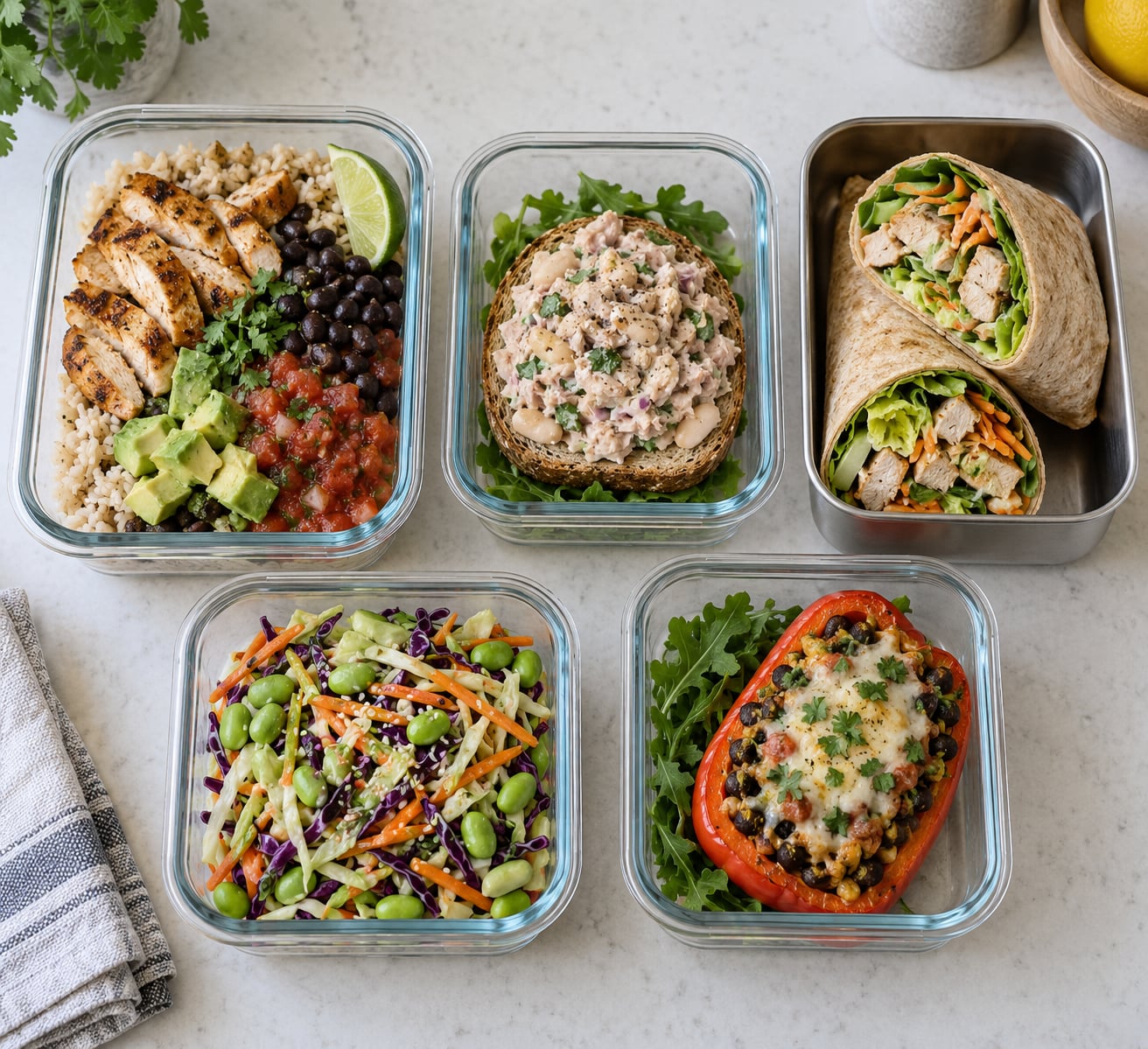
The best high protein lunch ideas for work are the ones you can assemble fast, pack cold, and eat at a desk without a microwave. Most of the options below hit 30 to 40 grams of protein, hold up for three to four days in the fridge, and taste good either warm or straight from the container. Pick two for your first week rather than all twelve.
Protein does most of the work of keeping you full through a long afternoon. It triggers satiety hormones such as GLP-1 and PYY, and spreading protein across the day supports muscle protein synthesis better than saving it all for dinner. That matters whether your afternoon is meetings or a warehouse floor.
If your workplace also runs shared meetings, our healthy meeting food ideas for modern workplaces cover the potluck and snack-table version of the same problem.
Table of Contents
- High Protein Lunch Ideas for Work at a Glance
- 1. Chicken Burrito Bowls
- 2. Tuna and White Bean Toast Cups
- 3. Greek Yogurt Chicken Salad Wraps
- 4. Lentil and Goat Cheese Salad
- 5. Shredded Chicken Quesadilla
- 6. Edamame Power Slaw
- 7. Egg and Chickpea Salad Wraps
- 8. Turkey and Hummus Snack Box
- 9. Miso Salmon Rice Bowl
- 10. Tofu Vegetable Pasta Salad
- 11. Cottage Cheese and Chicken Pita
- 12. Black Bean and Cheese Stuffed Peppers
- Frequently Asked Questions
- How much protein should I eat at lunch?
- How do I get 40 grams of protein at lunch without a microwave?
- How long does high protein meal prep last in the fridge?
- What high protein lunches work when there is no microwave?
- Can I get enough protein at lunch on a vegan diet?
- What is a good high protein lunch for losing belly fat?
- Conclusion
High Protein Lunch Ideas for Work at a Glance
| Lunch | Main protein | Prep | Reheat | Stores | Best fit |
|---|---|---|---|---|---|
| Chicken burrito bowl | Chicken thigh or breast | 25 min cook, 5 min assemble | Optional | 4 days | Flexible, mixed diets |
| Tuna and white bean toast cups | Canned tuna | 10 min, no cook | No | 3 days | No microwave, no fridge |
| Greek yogurt chicken wraps | Chicken plus yogurt | 15 min | No | 3 days | Light lunches, hot afternoons |
| Lentil and goat cheese salad | Lentils | 20 min cook | No | 4 days | Vegetarian, desk lunches |
| Shredded chicken quesadilla | Chicken plus beans | 20 min | Yes, 90 seconds | 4 days | Cold offices with a microwave |
| Edamame power slaw | Edamame | 15 min | No | 3 days | Crisp, crunchy, plant-forward |
| Egg and chickpea wraps | Eggs plus chickpeas | 15 min | No | 3 days | Budget lunches, no dairy |
| Turkey and hummus box | Turkey plus hummus | 10 min | No | 3 days | Assembly-only, varied eaters |
| Miso salmon rice bowl | Salmon | 30 min cook | Yes, gently | 3 days | Batch cooking Sunday |
| Tofu vegetable pasta salad | Tofu and edamame | 25 min | No | 4 days | Vegan, no microwave |
| Cottage cheese chicken pita | Cottage cheese plus chicken | 5 min | No | 2 days | Short prep, same-day eating |
| Black bean stuffed peppers | Black beans plus cheese | 40 min cook | Yes, 2 minutes | 4 days | Vegetarian, batch portions |
Two notes before you start. Cook poultry to 165°F (74°C) and fish to 145°F (63°C) before it goes in the container, and treat Thursday as a no-cook day, because most of these are best within three days of cooking. Long shifts or hot work sites raise the case for extra water through the afternoon, which is why water access at work and why it matters is worth reading alongside this list.
1. Chicken Burrito Bowls
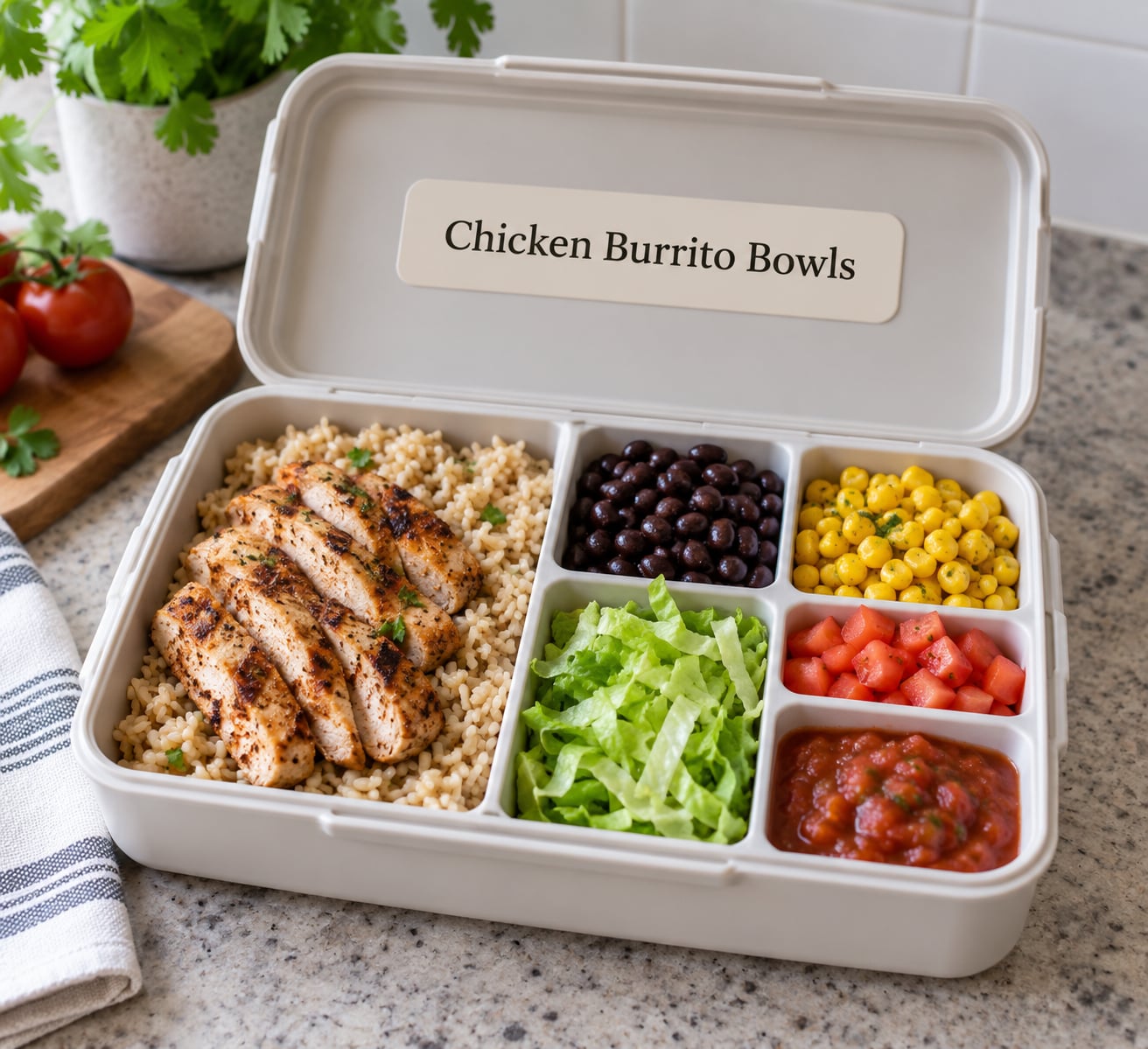
A burrito bowl is the most forgiving lunch to build because almost every component is sturdy. Roast a tray of chicken thighs at 400°F (205°C) for about 25 minutes, then portion with brown rice or quinoa, black beans, corn, shredded lettuce, tomato, and salsa. The thighs stay moist through the workweek, which breast slices do not always manage.
Assembly takes about five minutes: rice first, beans next, then the chopped vegetables, with salsa and any yogurt-based sauce packed in a small lidded cup. Mix the sauce with a spoon of water before packing so it stays drizzle-able after three hours in a fridge.
Store the salsa and lettuce separately from the rice. Wet rice goes gluey, and the lettuce wilts against hot chicken. A bowl like this lands somewhere between 35 and 45 grams of protein depending on the chicken portion, and it travels in a single container.
2. Tuna and White Bean Toast Cups
This is the lunch to build when there is no fridge, no microwave, and maybe no microwave queue at noon. Drain one can of tuna and half a can of rinsed white beans, then stir in chopped celery, a squeeze of lemon, dill or parsley, black pepper, and a spoonful of Greek yogurt or tahini for moisture.
The white beans are the trick. They soften the tuna’s dryness and add fiber, so the mixture stays spoonable for hours without turning to paste. Season it twice: once while mixing and once again just before you eat.
Pack the mix in a leakproof cup with two or three slices of whole-grain toast on the side. Adding the toast at eating time is what keeps it from going soggy by 11am. This lands near 30 grams of protein per cup and needs no reheating at all.
3. Greek Yogurt Chicken Salad Wraps
Swap mayonnaise for plain Greek yogurt and a wrap stops feeling heavy by the middle of the afternoon. Stir diced chicken with yogurt, chopped grapes or cucumber, celery, a little mustard, and pepper. The yogurt gives you the protein and the tang without the oil load of a mayo-based salad.
Build it the night before, then wrap each one in parchment or a silicone wrap sleeve. Cut the wrap in half and lay the pieces flat in the container with a folded napkin underneath, which keeps the filling from pushing out when you pick it up.
Watery packing has one fix: salt the cucumber and grapes first, let them sit ten minutes, and drain them. Combined with the chicken and yogurt, you get roughly 30 to 35 grams of protein per wrap, served cold, which suits people whose office kitchen runs warm.
4. Lentil and Goat Cheese Salad
Lentils are the workhorse of the vegetarian options here. Cook a batch of beluga or green lentils in salted water for about 20 minutes, then dress them while they are still warm so they absorb the flavor instead of sitting in it.
Layer greens at the bottom of a wide jar, then lentils, chopped cucumber and bell pepper, a crumble of goat cheese or feta, and pumpkin seeds. Shake the lemon vinaigrette into a separate small container and add it when you are ready to eat. Dressing on the bottom of the jar is the fastest way to turn a salad into limp salad.
This one travels well for four days and sits in the 30 gram neighborhood with a generous cheese portion. It also scales quietly, which makes it a good choice for anyone following a workplace weight management plan that needs high-volume, filling lunches.
5. Shredded Chicken Quesadilla
A quesadilla survives a fridge better than a sandwich because the tortilla seals the filling in. Use a whole-grain tortilla, keep the layer thin, and fill with shredded chicken, black beans, diced peppers, reduced-sodium salsa, and a small amount of cheese. A heavy filling turns it into a soggy triangle by Wednesday.
For a batch, cook three or four at a time in a dry skillet over medium heat, about two minutes per side, until the cheese melts and the outside browns. Let them cool on a rack before closing the container so steam does not soften the tortilla.
Cut them into wedges rather than halves, and pack the salsa on the side. At the office, microwave on high for 60 to 90 seconds; the shell will soften slightly, which is normal and usually improves on day one. Expect about 35 grams of protein per filled tortilla.
6. Edamame Power Slaw
Shredded cabbage is the base here, and it does something rice and lettuce cannot: it stays crunchy for three days in the fridge. Toss it with blanched edamame, shredded carrots, scallions, sesame seeds, and a dressing of lime juice, ginger, a touch of soy, and a little sesame oil.
Keep the dressing separate and the slaw undressed until you eat it. Cabbage and edamame are sturdy on their own, so even a light dressing poured over the top at lunchtime keeps everything crisp rather than soggy.
Shelled edamame carries about 18 grams of protein per cup, which puts this bowl at roughly 20 grams on its own. Double the edamame, add shredded chicken or a boiled egg, and you are at 30. This is the lunch I would pick for a hot office or a commute that runs long.
7. Egg and Chickpea Salad Wraps
Hard-boiled eggs and canned chickpeas make a fast, dairy-free combination that needs almost no cooking. Chop four eggs, mash half a can of chickpeas with them, then fold in chopped red onion, celery, a spoonful of Greek yogurt or tahini, salt, pepper, and smoked paprika.
Batch it for three or four lunches at once and pack it in a whole-grain wrap or a small pita. Fill pitas just before eating so they do not crack; wraps hold better overnight and travel in a bag without a container.
Eggs plus chickpeas land around 25 to 30 grams of protein per serving, and the combination covers more of the amino acid profile than either food does on its own. Keep it in the fridge and eat it within three days, and use a separate cold pack if your container will sit in a locker or a car.
8. Turkey and Hummus Snack Box
Some days a box beats a bowl because there is nothing to heat and nothing to spill. Build it with rolled turkey slices, hummus in a small cup, cut vegetables, whole-grain crackers, and a piece of fruit. Hummus counts as part of the protein here rather than a dip, so use a full quarter cup.
Balance it so the box has all three parts: protein from turkey and hummus, something crisp from the crackers and carrots, and something sweet from the apple or orange. A box of crackers with no protein is a snack, not a lunch, and you will be at a vending machine by three.
Keep the hummus under the fruit so moisture does not soften the crackers, and add the cut vegetables in a separate small container. Pack the whole thing with a cold pack if there is no fridge. This is the fastest option here to put together, roughly five minutes, with about 30 grams of protein.
9. Miso Salmon Rice Bowl
Salmon is the highest-protein item in this list and also the least forgiving of rough reheating. Bake fillets at 400°F (205°C) for 10 to 12 minutes until they flake, then portion over brown rice with edamame, cucumber, and carrots, and dress with a miso-lime sauce mixed from white miso, lime juice, and a little rice vinegar.
Batch cook rice and salmon on Sunday, then eat Monday through Wednesday. To reheat without drying out the rice, cover the bowl loosely with a microwave-safe lid or plate, add a tablespoon of water, and warm on medium for a minute and a half. Skip the covered plastic wrap, which steams the salmon and dries the fish further.
A salmon portion puts this bowl at 35 to 45 grams of protein, which is the highest in the list. Eat it the same day if you can, and keep the fish refrigerated until it goes in the microwave.
10. Tofu Vegetable Pasta Salad
Cold pasta salad has a bad reputation because most versions are pasta and mayonnaise. Baked tofu changes the math: cube extra-firm tofu, toss it in cornstarch and a little smoked paprika, and roast at 425°F (220°C) for about 25 minutes until the edges crisp.
Cool the pasta under cold running water so it stops cooking, then dress it with toasted sesame oil, rice vinegar, soy, a touch of honey or maple syrup, and grated ginger. Fold in the tofu, broccoli florets, peppers, and leafy greens. Greens go in last, right before eating, so they do not wilt in the container.
This travels beautifully cold and needs no microwave, which makes it the default for shared kitchens with one temperamental microwave. Tofu and edamame together push the bowl past 25 grams of protein, and wheat-free pasta or a legume-based pasta keeps it gluten-free.
11. Cottage Cheese and Chicken Pita
Half a cup of cottage cheese carries around 14 grams of protein, which makes it the fastest protein base in this entire list. Spoon it into a whole-wheat pita, add sliced chicken, thin cucumber, tomato, and greens, then season with pepper, dill, or a little za’atar.
Salt the cucumber slices in a separate container during the commute and add them at your desk. Wet bread is the only failure mode here, and it comes almost entirely from undrained tomatoes or cucumber, not from the cottage cheese.
Because the pita is assembled the same day, this is the lunch for people who do not want to cook anything the night before. It sits around 30 grams of protein, takes five minutes, and travels well if you keep the wet ingredients in a separate cup. This one is a same-day lunch rather than a meal-prep container, and that is the tradeoff for the speed.
12. Black Bean and Cheese Stuffed Peppers
Stuffed peppers work as a meal-prep base because they reheat in two minutes and travel without a separate grain. Halve four bell peppers, roast the halves for 15 minutes, then fill with cooked quinoa or brown rice, black beans, diced tomatoes, corn, chopped spinach, and shredded cheese.
Bake the filled peppers at 375°F (190°C) for about 20 minutes until the cheese bubbles. Cool them fully before putting lids on, because condensation inside the container is what turns a good pepper into a soggy one.
One pepper half runs about 25 to 30 grams of protein with cheese, and two halves make a full lunch. Refrigerated they keep four days; reheat a single half for two minutes on high in the office microwave, with a splash of water in the dish so the rice does not dry out. Freeze the extras flat if you cook a double batch.
Frequently Asked Questions
How much protein should I eat at lunch?
Most people do well with 30 to 40 grams of protein at lunch. That lands at roughly a quarter to a third of a typical daily intake and spreads protein evenly across three meals, which supports muscle protein synthesis better than loading it all at dinner. A lunch of 30 grams usually means about a cup of chicken, a can of tuna, or half a cup of Greek yogurt plus another protein source.
How do I get 40 grams of protein at lunch without a microwave?
Combine two protein sources in one container. A cup of tuna with half a cup of white beans reaches 35 to 40 grams and needs no heating. Shelled edamame adds about 18 grams per cup, Greek yogurt about 14 grams per half cup, and a hard-boiled egg about 6 grams, so two of those together clears 40 grams cold.
How long does high protein meal prep last in the fridge?
Cooked poultry, rice, and beans generally keep three to four days refrigerated at or below 40u0026deg;F (4u0026deg;C). Cooked fish and seafood are best eaten within two days, even when properly chilled. Most packed lunches in this list are at their best from day one through day three, which is why a simple no-cook backup is useful for Thursday and Friday.
What high protein lunches work when there is no microwave?
The no-reheat options here include tuna and white bean toast cups, Greek yogurt chicken wraps, lentil and goat cheese salad, edamame power slaw, egg and chickpea wraps, the turkey and hummus box, cold tofu vegetable pasta salad, and the cottage cheese chicken pita. Each one keeps between 25 and 35 grams of protein and stays stable for three hours unrefrigerated in an insulated bag.
Can I get enough protein at lunch on a vegan diet?
Yes, and pairing plant proteins closes most gaps. Lentils and rice, chickpeas and whole-wheat pita, or edamame and quinoa each cover the amino acids the others are lower in. The edamame power slaw, stuffed peppers, and tofu pasta salad in this list each reach 25 to 30 grams of protein per serving without any animal products.
What is a good high protein lunch for losing belly fat?
Lunches built on protein, fiber, and volume work well, because fullness comes from all three rather than from calories alone. The lentil and goat cheese salad and the edamame power slaw both lean heavy on volume and fiber while staying around 30 grams of protein. Portion is what moves the number, so adjust the grain portion rather than cutting the protein.
Conclusion
Start with one lunch you can batch cook and one you can assemble in five minutes, then rotate. Keep dressings, salsa, and wet vegetables in separate cups, and treat Thursday and Friday as no-cook days.
Keep your workplace fridge and food-safety rules in mind, and check with a registered dietitian if a specific condition or dietary restriction shapes what you can eat. If you want a plan that goes beyond lunch, our 8-step weight management plan for the workplace covers the daily habits that make these lunches work.