
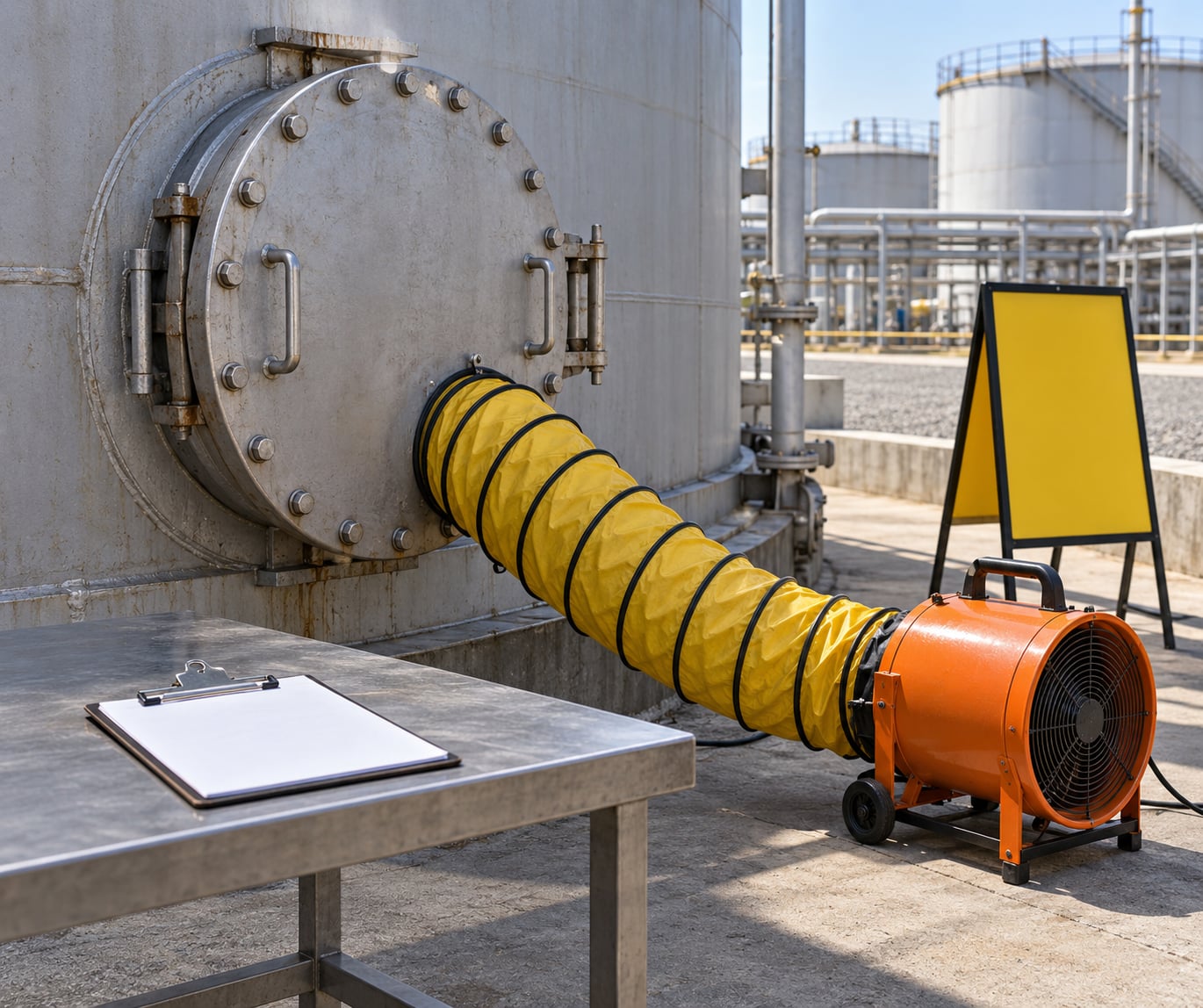
If your crew is about to enter a tank, a manhole, a silo or a vault, the confined space entry permit requirements are the gate that decides whether entry is allowed at all. A permit is a written authorization that says, on one page, which space you are entering, what is inside it, what has been done to control the hazards, who is going in, and how someone gets them out if it goes wrong. Federal OSHA requires that permit for any space meeting the confined space definition that also has one of four serious hazards, and the permit must be filled out and signed before anyone crosses the boundary.
The reason the paperwork matters so much is that confined space fatalities cluster around would-be rescuers. When an entrant collapses, the instinct is to climb in after them, and that single decision has killed more people than the original hazard. A permit forces a plan for retrieval before the shift starts, and a supervisor with the authority to stop work when conditions change.
This guide walks through what belongs on the permit, how the space gets prepared and tested, who signs and who can cancel, what rescue readiness has to look like, and how the permit gets closed out and filed. It follows the federal standard for general industry, 29 CFR 1910.146, and notes where construction work under 29 CFR 1926 Subpart AA differs.
Table of Contents
- What Are Confined Space Entry Permit Requirements?
- What Must the Confined Space Entry Permit Include?
- How Should Employers Prepare the Space Before Entry?
- How Is the Atmosphere Tested and Monitored?
- Who Can Authorize Entry or Cancel a Permit?
- What Happens During Confined Space Entry?
- What Rescue and Emergency Procedures Are Required?
- How Should Employers Close Out a Confined Space Entry Permit?
- How Can Employers Build a Compliant Permit Program?
- Frequently Asked Questions
- Is an entry permit required for every confined space?
- What atmospheric tests are required before confined space entry?
- How long is a confined space entry permit valid?
- Can a supervisor enter a permit-required space without an attendant?
- What rescue capability is needed before entry begins?
- When must a confined space entry permit be canceled or suspended?
- Conclusion
What Are Confined Space Entry Permit Requirements?
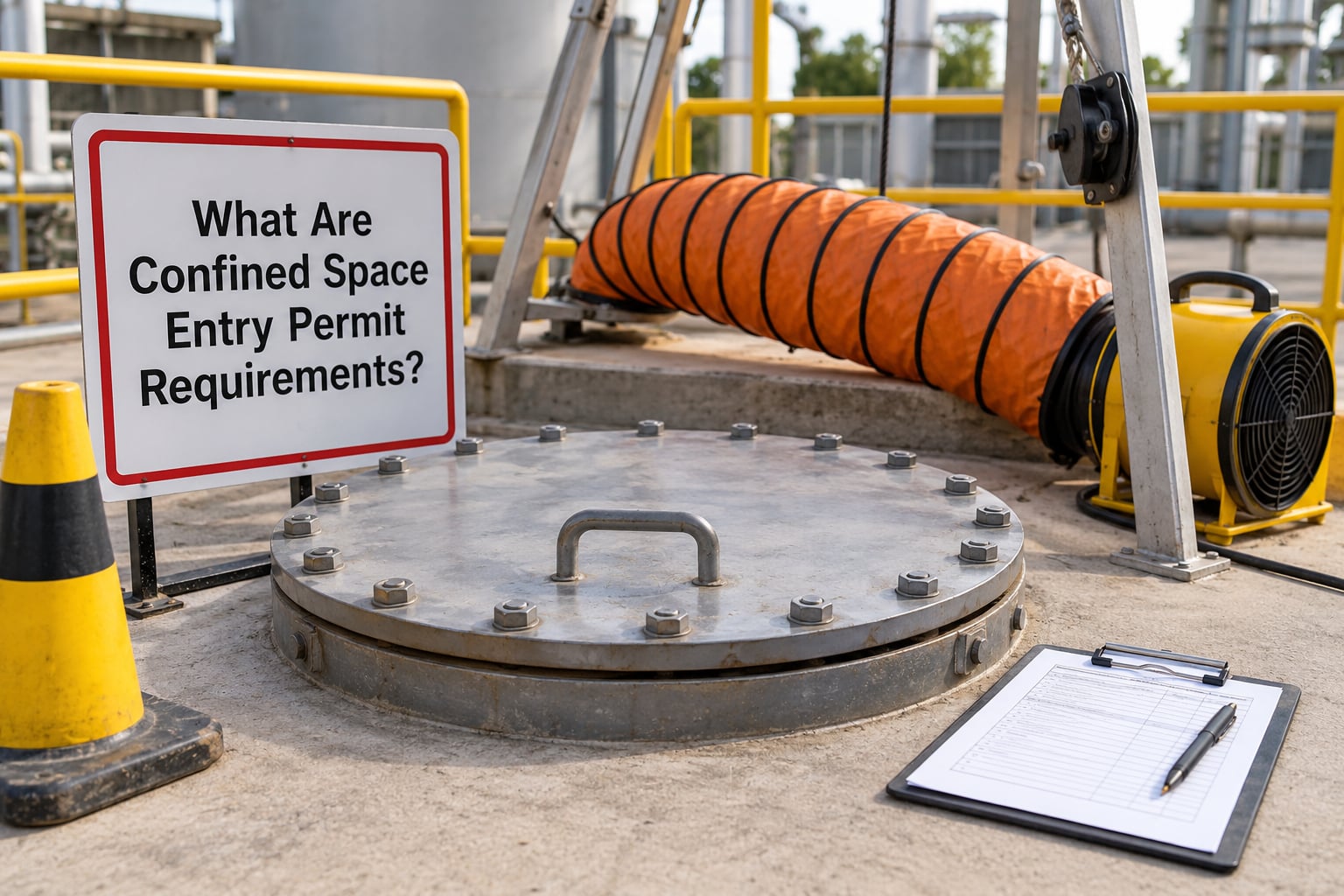
Confined space entry permit requirements start with a definition most employers get wrong. Under 1910.146, a confined space must meet all three of these criteria: it is large enough and configured so an employee can bodily enter and perform assigned work, it has limited or restricted means of entry or exit, and it is not designed for continuous employee occupancy.
A space that meets all three becomes permit-required when it also has one of four characteristics:
- It contains, or has the potential to contain, a hazardous atmosphere.
- It contains material with the potential for an entrant to be engulfed by or trapped in it.
- It has an internal configuration such that an entrant could be trapped or asphyxiated by inwardly converging walls or by a floor which slopes downward and tapers to a smaller cross-section.
- It contains any other recognized serious safety or health hazard.
If none of those four apply, the space is a non-permit confined space. It still needs an entry procedure and atmospheric testing, but it does not need the full permit. The distinction matters because the permit system is not paperwork bureaucracy bolted onto a job. It is the mechanism that forces hazard identification, isolation, testing, monitoring and rescue planning to happen before a body is exposed to the hazard.
The permit also has to match reality. OSHA treats a permit as invalid the moment conditions in the space change in a way the permit does not describe. A new chemical introduced into the tank, a ventilation fan that fails, a second employer sending a crew in with different equipment, or a scheduled hot work task all invalidate the existing authorization and force cancellation.
What Must the Confined Space Entry Permit Include?
A permit is a record of verified conditions, not a form someone fills out in the office the night before. The core fields below cover what inspectors look for and what your crews need in the moment. Most companies capture them in a single form with a top section for pre-entry data, a middle section for roles and controls, and a bottom section for closeout.
The 14 fields that satisfy confined space entry permit requirements
- Space identification. Location, name or number, and a description of the internal configuration and known dimensions.
- Purpose of entry. The specific task, so readers know whether cleaning, inspection, repair or hot work is happening.
- Planned duration and shift. Start time, expected completion, and whether work continues across a shift change.
- Known hazards. Atmospheric, engulfment, configuration, energy and any other recognized hazard.
- Atmospheric test results. Instrument used, calibration and bump test status, readings for oxygen, flammability and each contaminant, with times and initials.
- Isolation and lockout information. Which lines, valves or electrical sources were isolated, by what method, and the locations of lockout devices.
- Protective measures in place. Ventilation equipment, blinding and double block and bleed, blank flanges, lining, drains and lighting.
- Entrants. Names of everyone authorized to enter, with their PPE and respiratory protection.
- Attendant. Name of the person stationed outside, and their position and communication method.
- Entry supervisor. Name of the person verifying and signing the permit.
- Communication plan. Radio channel, phone or wired line, and how the attendant reaches the crew if primary communication fails.
- Rescue arrangement. Method, equipment, trained responders and whether outside emergency services are pre-notified.
- Emergency contacts and location of nearest aid. Numbers, addresses and directions for responders.
- Authorization signatures and times. Entry supervisor sign-off to activate the permit, plus cancellation signatures at closeout.
Two details get missed constantly. First, the signature is what activates the permit; an unsigned permit is not a valid permit. Second, contractors may use their own permit and their own attendant, but the host employer still has to inform them about the space, its hazards and any site-specific conditions, and must make sure a permit-required space stays permit-required on site even if nobody works under the host’s own program.
| Element | Permit-Required Confined Space | Non-Permit Confined Space |
|---|---|---|
| Entry permit required | Yes, full written permit signed before entry | No, entry procedure and testing still apply |
| Atmospheric testing | Before entry, in defined order, documented on the permit | Before entry, following the same testing principles |
| Continuous monitoring | Required, with a designated attendant | Required while work continues in the space |
| Isolation of hazardous energy | Required and documented | Required wherever energy or process hazards exist |
| Rescue plan | Pre-planned and verified before entry begins | Capability available for the foreseeable hazards |
| Retrieved entrant duty | Retrieval or hoist required when a hazard would require an unprotected person to enter | Depends on the hazard assessment |
How Should Employers Prepare the Space Before Entry?
Preparation happens before anyone touches a permit, and the sequence matters because testing an atmosphere that is still being contaminated gives you a reading that is already stale. Work through the shutdown, isolation, cleaning and ventilation steps in order, then test last.
1. Shut down and lock out equipment
Stop the process. Agitate or drain the vessel where needed, and isolate electrical, mechanical, hydraulic, pneumatic and thermal energy. Employers already running a formal lockout tagout procedure should apply that same discipline inside the space, since the permit has to record which sources were isolated and how.
2. Break the lines
Physical isolation beats an administrative lock. Blind a flange or install a blank, or double block and bleed a line with two closed valves and a bleed valve opened and locked. A closed valve alone is not isolation, because a single gate valve can leak.
3. Clean and purge
Remove residues, sludge, stored product and anything that could release vapor. Many vessels get cleaned in place to avoid confined space work entirely, and that is a better plan whenever the schedule allows.
4. Ventilate
Mechanical ventilation should move at least four air changes per hour in most permit programs, with airflow directed from the clean opening toward the worker. Bring lighting rated for the space, and make sure the blower runs continuously rather than cycling.
5. Test and document
Test in the defined order with calibrated direct-reading instruments, record each reading with a time and a name, and confirm the readings hold steady across the full length and depth of the space. Only then does the permit get signed.
6. Remove remaining hazards and verify
Set up guards and covers over openings adjacent to walkways, clear access paths, position the retrieval equipment, and confirm the entry conditions match what the permit describes. A broader health risk assessment for employees is a useful upstream step, because it surfaces the tasks and exposures that drive which hazards end up on the permit.
How Is the Atmosphere Tested and Monitored?
Testing follows a fixed order and always starts with oxygen, because an oxygen-deficient reading is what proves the instrument responds and tells you the atmosphere is safe to approach. Testing flammability second and toxicity third follows the same logic: you want to know the fuel level before you raise the sensitivity on contaminant sensors.
| Test | Order | Acceptable for entry | Action on failure |
|---|---|---|---|
| Oxygen | 1 | 19.5% to 23.5% | Evacuate, ventilate, retest |
| Flammability (LEL) | 2 | Below 10% of the lower explosive limit | Evacuate, find and stop the source, retest |
| Toxic contaminants | 3 | Below the applicable permissible exposure limit, and below any IDLH value | Upgrade respiratory protection or change the plan |
| Multiple levels | After each above | Same limits at top, middle and floor | Retest after any change in conditions |
Two readings deserve more caution than most crews give them. The 19.5% oxygen floor is a legal minimum, not a comfortable one, and anything approaching it should prompt a closer look at what is consuming the oxygen. And gases stratify, so a reading taken at the entrance tells you very little about a 30-foot tank with a sump at the bottom.
Bump test, calibrate, document
Each instrument gets a bump test with a known concentration before entry and a full calibration on the schedule the manufacturer and your program require. The person testing records the instrument, the calibration gas and the readings, then signs. Monitoring runs continuously while anyone is inside, and the attendant needs a backup instrument they can compare against the primary one.
Know your action levels
Set warning and alarm points before entry rather than reacting to the alarm. A good program warns at or above 19.5% oxygen and at or above 10% LEL, and orders evacuation before the instrument’s alarm level. Emergency escape breathing equipment goes inside whenever the atmosphere could become immediately dangerous to life or health.
Who Can Authorize Entry or Cancel a Permit?
Confined space work runs on three assigned roles plus a rescue capability, and the authority moves with the role. Only the entry supervisor activates or cancels a permit, and only the attendant or entry supervisor can order evacuation, but anyone who sees an uncontrolled hazard has the standing duty to call for the work to stop.
| Role | Where they are | What they authorize |
|---|---|---|
| Entry supervisor | Outside, may enter and exit during the entry | Signs and activates the permit, cancels it, approves changes, removes entrants from the permit |
| Attendant | Stationed outside for the entire entry | Keeps entrants tracked, monitors conditions, orders everyone out, calls rescue |
| Entrant | Inside the space | Performs the assigned work, monitors own condition, exits immediately when told |
| Rescue capability | Readied outside or on call | Retrieves entrants; must be able to perform a rescue without putting an unprotected person at risk |
At multi-employer sites, the host employer shares information about the space and its hazards with every contractor, and each contractor keeps control of its own crew, attendant and equipment. Where two employers could affect each other’s spaces, the host has to coordinate those actions. Safety managers who build a broader total worker health approach usually find the permit program fits better once these roles are named as real job assignments rather than extra duties bolted onto a foreman.
What Happens During Confined Space Entry?
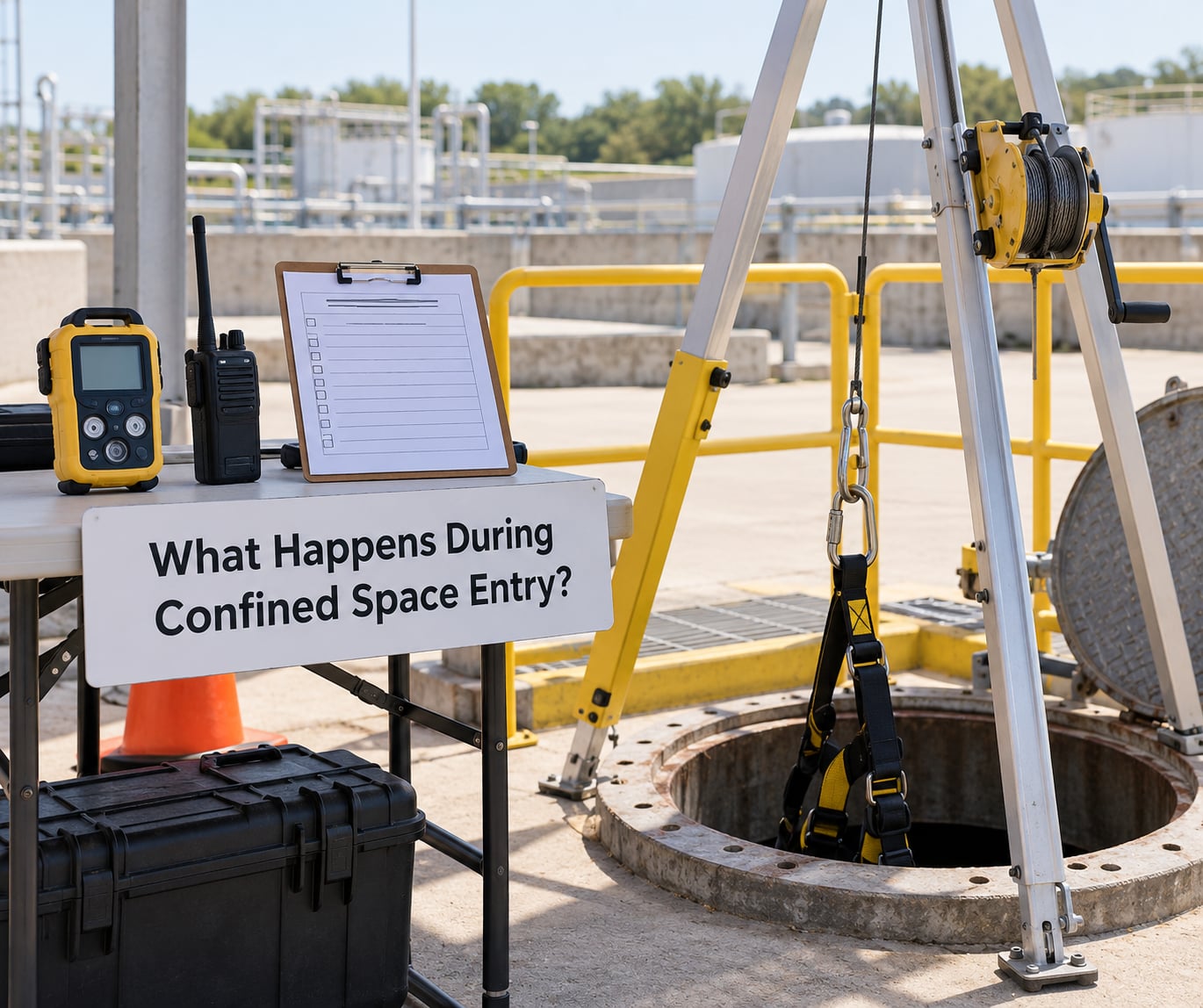
Once entry begins, the permit becomes a live document rather than a piece of paper on a clipboard. The attendant stays at the entrance for the whole entry, keeps the entrant roster current, and is the only channel between the crew and the outside.
Attendant duties that matter most
The attendant tracks everyone in and out, maintains communication, verifies that the atmosphere and conditions stay acceptable, and controls who else approaches the space. The rule most often broken in the field is simple and absolute: the attendant does not abandon their post. Not to help with a task outside, not to carry a tool in, not to look inside a different space. That single habit is the reason rescue efforts turn into multiple fatalities.
Track people, not head counts
A sign-in sheet with names gets updated every time someone enters or exits. Many programs put a marker or tag on a board for each entrant so the count is visible from a step back, which is faster when the unexpected happens.
Plan for the shift change
Work that crosses shifts usually needs a new permit, a new briefing and a new attendant handoff. The outgoing attendant hands over the roster, the current readings, the outstanding conditions and any open deviations, and both attendants sign the transfer. A reclassification can also happen during an entry: if all hazards are eliminated, a permit space can be reclassified as non-permit, and that decision has to be documented on the permit before anyone continues working under the old authorization.
Cancel when conditions change
Loss of ventilation, a failed monitor, an unplanned chemical reaction, a new hazard, an injury, a change in the work, or an alarm sends the permit into cancellation. Everyone exits, the hazard gets addressed, the atmosphere is retested, and a fresh permit is issued if work resumes.
What Rescue and Emergency Procedures Are Required?
The permit has to name a rescue method before entry starts, and the method must match the hazard. Relying on a public fire department to arrive in time is not a rescue plan, because those crews are usually not trained or equipped for confined space retrieval and may not be able to reach the site quickly. Where outside emergency services are used, they have to be informed in advance of the entry, the location and hazards, and given the access they will need.
The choice comes down to one question: would rescuing this person require putting an unprotected person into the hazard zone?
Non-entry rescue is the default
Retrieval from outside, with no rescuer entering the space, is the preferred method. A tripod or davit with a winch and a full-body harness attached to a retrieval line works for tanks, manholes and vaults where a straight hoist is possible. A retrieval system is required whenever an entrant would have to enter an IDLH atmosphere to reach another entrant.
When a ladder is not enough
Self-rescue with a fixed or portable ladder is acceptable in a narrower set of conditions: the hazard is one where the atmosphere will not suddenly become lethal, the entrant can reach the exit unaided, and the design of the space means there is no engulfment risk and no converging walls. A manhole with a hazardous atmosphere that can go IDLH in seconds does not qualify, and neither does a hopper with an internal taper. Field crews regularly try to rationalize a ladder into service here, and it is the single most dangerous shortcut in the program.
Verify the capability, do not assume it
Non-entry and entry rescue differ sharply. Entry rescue requires a trained team with their own permit, atmospheric testing, PPE and a supervisor, and it is a last resort. Whatever method you pick, confirm before entry that the equipment has been inspected, the trained responders are actually on site, the communication path works, and a practice drill has been run on that specific space.
How Should Employers Close Out a Confined Space Entry Permit?
Closeout is where permits get sloppy, and it is also where the record that proves the job was run correctly gets created. Do it with the same discipline as entry.
- Account for every entrant by name and confirm the space is empty.
- Stop equipment and shut down ventilation only after everyone is out and confirmed.
- Remove residue, and restore lines, valves and equipment that were isolated for the entry.
- Have each lockout owner remove their own device under the lockout tagout procedure so nobody is surprised by a live line.
- Record any incident, near miss, alarm event or deviation while it is still fresh.
- Have the entry supervisor cancel the permit, date and sign it, and note that all entrants have been accounted for.
- Collect the permit with its readings and roster, and retain it with the site records.
Many company programs set a 12-hour validity limit on a single permit and keep canceled permits for a year, which gives supervisors a reason to re-verify conditions on long jobs rather than working off a signature from shift one. State plan jurisdictions and company policy can differ, so check what applies to your sites.
How Can Employers Build a Compliant Permit Program?
A permit program survives on paperwork and training discipline, and both are easier to fix than the hazards are to eliminate. This checklist is what a functioning program has in place:
- A written program that identifies spaces, lists permit-required ones, and describes hazard control, permit issuance, monitoring, rescue and training.
- A real space inventory covering tanks, silos, vaults, pits, hoppers, ducts, bins, sewers, manholes and vessels, with a plan for spaces that cannot be entered and must be sealed or labelled.
- Forms that match the standard, including the 14 fields above, a deviation section, a reclassification section and a cancellation block.
- Training with hands-on verification for entrants, attendants and entry supervisors, including rescue drills, plus refresher triggers after a change in procedure, an incident, or a lapse in frequency your program sets.
- Equipment inspection routines for monitors, calibration gas, tripods and winches, retrieval lines and harnesses, blowers and escape breathing equipment.
- Contractor coordination that shares space information, identifies who supplies the attendant, and keeps the space classified as permit-required on site.
- Audits and records that sample canceled permits, verify readings were documented and signatures present, and treat a blank field as a finding.
- A review cycle at least annually, using near misses, rescues and newly identified spaces as the input.
Most audit findings trace back to the same few things: blank hazard fields, readings recorded without times, an attendant who had no defined position, and a permit that was never canceled at closeout. Train against those four and the record holds up.
Frequently Asked Questions
Is an entry permit required for every confined space?
No. A permit is required only for a permit-required confined space, which is a space meeting all three OSHA confined space criteria that also contains or could contain a hazardous atmosphere, could engulf an entrant, has an internal configuration that could trap or asphyxiate someone, or holds another recognized serious hazard. A space that meets the three criteria but none of these four stays a non-permit confined space and needs an entry procedure and atmospheric testing, but not the full written permit.
What atmospheric tests are required before confined space entry?
Test in a fixed order with calibrated direct-reading instruments: oxygen first, flammability second, toxic contaminants third. Oxygen must read between 19.5 percent and 23.5 percent, flammability below 10 percent of the lower explosive limit, and each contaminant below its permissible exposure limit and below any IDLH value. Test at multiple levels in vertical spaces, and repeat the tests whenever conditions in the space change or work resumes after a break.
How long is a confined space entry permit valid?
The federal standard does not set a fixed duration, so validity comes from your written program and state plan requirements. Many company programs cap a single permit at 12 hours and require a new one for the next shift, along with a fresh briefing and attendant handoff. Longer or unusual entries should be covered by a site-specific rule rather than left to the judgment of whoever is holding the clipboard.
Can a supervisor enter a permit-required space without an attendant?
The attendant is required for the entire duration of the entry and may not be relieved by anyone who takes on other duties. The entry supervisor is allowed to enter and exit during the entry to perform duties such as inspecting, but the attendant still has to remain stationed outside and keep everyone accounted for. Only the entry supervisor can sign the permit, and only the entry supervisor, the attendant, or anyone who sees an uncontrolled hazard can order an immediate exit.
What rescue capability is needed before entry begins?
The permit must name a rescue method that matches the hazard before anyone enters, and the employer must have the equipment, trained responders and communications to carry it out. Non-entry rescue with a tripod, davit and full-body harness is the preferred method, and a retrieval system is required whenever rescue would otherwise require an unprotected person to enter. Public fire departments can support a plan but must be notified in advance and cannot be the only plan.
When must a confined space entry permit be canceled or suspended?
Cancel the permit when conditions change so that it no longer describes the space: loss of ventilation, a failed or uncalibrated monitor, an alarm, an unplanned chemical reaction, a new hazard, an injury or near miss, or a change in the planned work. Everyone exits, the hazard is corrected, the atmosphere is retested in order, and a new permit is issued before work resumes. The entry supervisor signs the cancellation and the closed permit is retained with the site records.
Conclusion
If you take one action from this guide, make it the space inventory. Walk your site with the three-part definition and the four hazard characteristics in hand, mark every tank, vessel, vault, pit, manhole and hopper, and label the ones that must be sealed permanently. Everything else, the permit form, the testing discipline, the rescue plan and the training, hangs off that list.
Then standardize the permit itself, so the fields, the readings, the signatures and the cancellation block look the same on every job, and train supervisors to suspend work the moment conditions drift from what the permit describes. Confined space entry permit requirements are not paperwork for its own sake. They are the last control standing between a bad day and a fatality, and the best program is the one that has already decided who signs and who says no.