
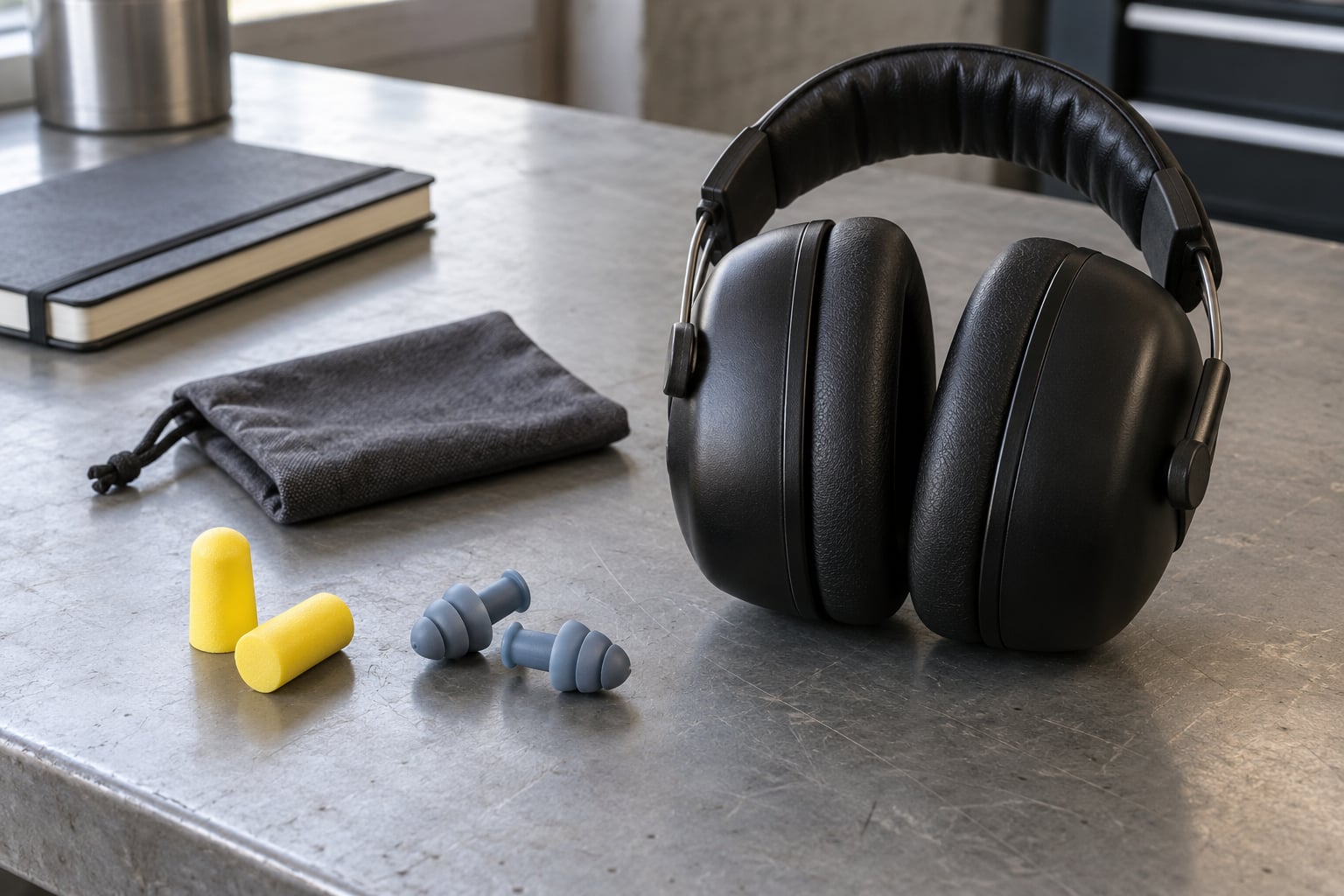
When you compare ear plugs vs ear muffs for noise protection, one thing decides it: can you keep the seal for a full shift? Ear plugs block sound inside the ear canal and carry the highest rated noise reduction, but that rating only holds if the plug is fully seated and your hands were clean when you put it in. Ear muffs seal soft cushions around the ears, which is much easier to do correctly and much easier to keep on, though they leak decibels when glasses arms, a hard hat, or facial hair break the seal. Neither one wins by default. The right pick follows your measured exposure, the rest of your PPE, and whether you will actually keep the protection in your ears for eight hours.
OSHA’s noise standard, 29 CFR 1910.95, kicks in at an 85 dBA 8-hour time-weighted average. It requires a hearing conservation program once a worker is exposed at that level, and it requires hearing protection when exposure goes past the 90 dBA 8-hour permissible limit. NIOSH recommends a lower exposure limit, 85 dBA with a 3 dB exchange rate. Whichever number your site uses, the selection question is the same: which protector gets the sound in front of you down far enough, and which one will still be on at hour seven.
Table of Contents
- Ear Plugs vs Ear Muffs for Noise Protection at a Glance
- Noise Reduction and Protection Ratings
- Comfort, Fit, and Long-Shift Wear
- Glasses, Facial Hair, PPE, and Communication
- Durability, Maintenance, and Workplace Practicality
- Which Should You Choose?
- Frequently Asked Questions
- Conclusion: Start With a Workplace Noise Assessment
Ear Plugs vs Ear Muffs for Noise Protection at a Glance
The table below compares the two formats on the criteria that decide them on a worksite. Read the right-hand columns as tendencies rather than rules, because the device, the fit, the exposure level, and consistent use all matter more than the format name.
| Factor | Ear plugs | Ear muffs |
|---|---|---|
| Protection type | In-ear, blocks sound at the ear canal | Over-ear, seals cushions around the ear |
| Typical labelled NRR | 26 to 33 for industrial foam plugs | 20 to 33 for passive muffs, most sit lower |
| What depends on | Correct insertion depth and clean hands | Cushion condition and a continuous seal |
| Time to put on | Seconds, once you have the technique | A few seconds, one motion |
| Comfort over a long shift | Low profile, but pressure and irritation are common | Cooler than expected, but hot, bulky, and sweaty |
| Works with safety glasses | Yes, no interference at all | Often leaks unless the cushions are thin or worn over the arms |
| Works under a hard hat or helmet | Yes | Frequently conflicts with the suspension and the brim |
| Facial hair under the seal | Not a problem | Stubble breaks the cushion seal |
| Hearing aid users | Usable with a compatible plug | Conflict with behind-the-ear aids and earmould moulds |
| Hearing alarms and instructions | Poor, unless you take them out | Passive muffs are poor, electronic muffs handle it |
| Portability | Fits in a pocket, one pair per shift | Cushioned headband, needs a case |
| Maintenance | Disposable by the shift, or washed if reusable | Clean cushions, watch the band and the seal |
| Best workplace scenarios | Moderate and variable noise, hot or mobile work, masks and respirators | Steady high noise, quick donning, new and untrained staff |
Both formats are approved under the same standard, both are labelled in decibels, and both can be worn together. The comparison is not about which label is higher. It is about which device your crew will seal correctly on a bad day, in the middle of a July shift, with gloves on.
Noise Reduction and Protection Ratings
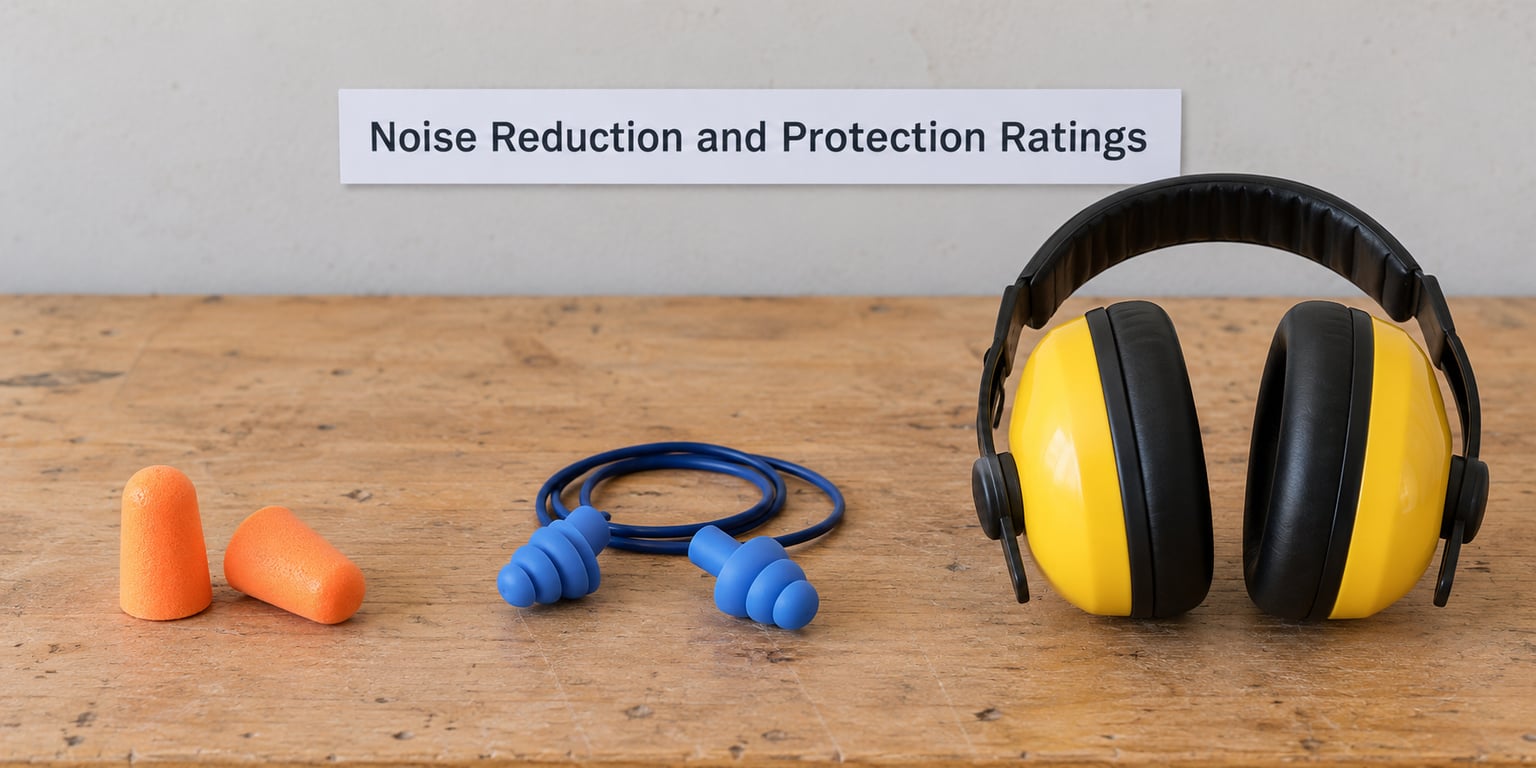
A Noise Reduction Rating is a single number derived from laboratory testing of a protector, in decibels. The EPA requires hearing protectors to be labelled with an NRR, and the figure appears on the packaging and often on the protector itself. It measures attenuation in a lab, with a trained subject, a correctly fitted device, and an ideal seal. That is the best case, not the expected case.
Two adjustments matter in the field. OSHA’s method subtracts 7 dB from the NRR to convert the lab measurement to a workplace estimate, and NIOSH applies a 50 percent derating when estimating real-world protection. Field studies consistently find that worn attenuation lands well below the label, especially for ear plugs, because a partly collapsed foam plug or a premoulded plug in the wrong size is not the object that was tested.
Impulse noise changes the picture again. Steady machinery noise can be handled with a single well-fitted protector. A hammer blow, a nail gun, or a rifle shot is short and sharp, and brief peaks cause damage that averages hide. NIOSH recommends keeping exposure at or below 115 dBA even with protection, and OSHA caps impact noise at 140 dB peak. Above roughly 100 dBA, most safety programs call for double protection.
| 8-hour average exposure | What US rules expect | Reasonable protector choice |
|---|---|---|
| 85 dBA | Hearing conservation program, audiometric testing, protection provided | Muffs, or plugs if the worker prefers them |
| 90 dBA | Permissible limit reached, protection required above it | High-NRR plugs, or muffs rated for the level |
| 100 dBA and above | Engineering and administrative controls plus protection | Double protection, plugs under muffs |
| 115 dBA and above | Exposure limited even with protection | Double protection and task rotation |
Ear plugs vs ear muffs: what the protection ratings mean
Plugs usually carry the higher number, and real-world figures for both formats sit well below their labels. That gap is the reason a claim of 37 NRR on a passive muff deserves scepticism, and it is why a request for third-party test data is a reasonable thing to put to a supplier before you buy a crate.
You will also see the same muff carry two different ratings, because ANSI S12.42 and the OSHA method do not compute the number the same way. The identical pair can be printed as 37 under one standard and 34 under the other. That is a labelling difference, not a quality difference, and it explains a lot of conflicting product claims.
Do not subtract a rating from your measured exposure yourself and call the result safe. Selection has to account for exposure duration, the exchange rate your program uses, and the fit of the specific worker. Earmuff seal testing and ear plug fit testing exist for this reason. If you already have hearing loss or tinnitus, protection is still worth wearing, and an audiologist should set the target rather than a number on a box.
Comfort, Fit, and Long-Shift Wear
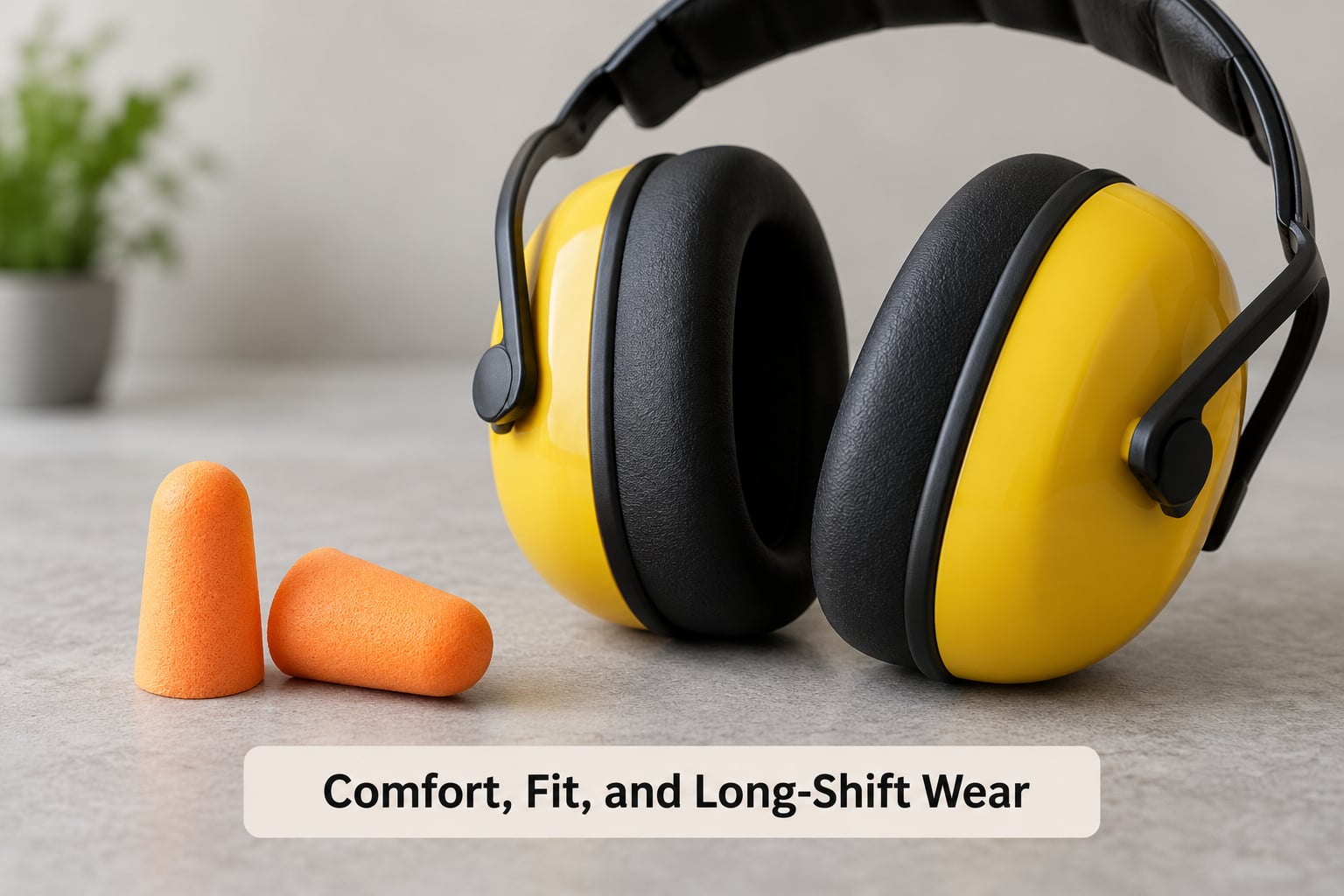
Comfort decides whether protection gets worn, and a protector that comes off after an hour provides nothing. Plugs are light and nearly invisible under a hard hat, but they fail in predictable ways. Foam that gets squeezed on the way to your ear, rolled too thin, or pushed in only halfway will not seal. Hands that are dirty or gloved will wreck a plug that would otherwise be fine.
The step that fixes most plug problems is the full roll. Roll the plug into a thin cylinder, reach back and pull the top of the ear up, insert the narrow end, hold it in place for around a minute while the foam expands, and then check the seal with a low sound level. Getting this right takes practice, which is why training matters more than brand here. For a reusable silicone or premoulded plug, the common failure is a wrong size, which shows up as pressure or a hollow feeling rather than as a leak you can hear.
Muff problems look different. The failure mode is a cushion that no longer compresses evenly, from age, sun, or repeated contact with oils and solvents. A cushion that has gone hard, cracked, or flattened gives you a seal you can see but not hear. Headbands on lower-cost models also stretch and snap, and a band that loses tension stops the cups pressing in properly.
Two adjustments fix most of that. Thin gel or silicone cushions seal better and are easier with glasses. And workers who struggle with a band that pulls too hard can move to a model with a wider adjustment range or a helmet-mounted attachment. None of that beats proper fitting instruction, though, and a seal check should be part of the shift, not just the first morning.
Glasses, Facial Hair, PPE, and Communication
Safety glasses are the number one real-world reason a muff underperforms. A spectacle arm that runs under the cushion lifts it off the skin, and the gap lets low-frequency sound straight through. Options in rough order of preference: thin gel or silicone cushions, low-profile slim cups worn so the arms pass outside the seal, a banded protector that sits at the back of the skull, or a good ear plug instead.
Facial hair is the same seal problem in a different place. Stubble under the cushion blocks the airtight seal, and the result is not gradual, it is dramatic. In food processing, clean rooms, and paint or chemical environments where facial hair is already restricted, plugs sidestep the issue entirely.
Half-mask and full-face respirators add their own pressure. A full-face mask’s head harness often runs through the same territory as a muff headband, and loose straps can pull a cup away from the head. Plugs win that combination. So do helmets, hard hats, bump caps, and winter hoods, which muffs physically cannot sit under.
Communication is the quiet safety issue. Passive muffs block alarms, warning signals, radios, and supervisors, and workers who cannot hear a machine warning take the protector off. Electronic muffs exist for that: they limit steady noise while letting speech and alerts through, and some models pair with radios. Hearing aid users have their own conflicts, since behind-the-ear aids and moulds occupy the space a muff needs. With those users, an audiologist can fit compatible protection rather than guessing.
Durability, Maintenance, and Workplace Practicality
Disposable foam plugs are designed for a single shift. They degrade from handling, skin oils, and pocket lint, and a plug that has been squeezed flat and kept in a loose pocket is much weaker than a fresh one. That makes plugs a recurring consumable, but a cheap and simple one: hand out a pair per shift, a pair per visitor, and a dispenser near the noise source so nobody has an excuse.
Reusable silicone, premoulded, and custom moulded plugs cost more and pay back over months, as long as they are actually cleaned. A reusable plug that lives in a dirty locker is a hygiene problem, not a saving. Plugs are never shared, and workers with ear surgery, a perforated eardrum, or a current ear infection should ask a clinician before using inserted protection.
Around machinery, corded plugs are the safer option, because a dropped ear plug is a lost body part. Metal detectable and high-visibility plugs help in food, forestry, and rail work for the same reason.
Muffs need maintenance rather than replacement. Wash or wipe cushions, let them dry fully before storing, keep them out of direct sun and away from solvents, and check the band tension and the pivot pins. Replace cushions the moment they harden or crack, since that is a seal failure that looks fine. Budget for a case, because dropping a muff on concrete is the most common way a good one gets ruined.
Hot, dusty, wet, and mobile work all change the answer. Muffs trap heat and sweat in summer and hang up in a pocket badly on a ladder. Plugs are small enough to carry in a pocket and survive a drop. On the other hand, plugs in a dirty or wet environment are miserable to insert with cold, gloved hands, and that is where muffs earn their keep. If you cannot keep either one clean, that is a maintenance problem to solve before it becomes a protection problem.
Which Should You Choose?
Use your measured exposure first, preferences second. For steady noise in the 85 to 95 dBA range where the crew will wear something all day, muffs are usually the safer operational choice, because the fit is fast and consistent, and a new hire can be protected in ten seconds. For higher levels, for short and unpredictable peaks, or where a full seal must hold, high-NRR plugs are the stronger tool.
Choose plugs when the noise is moderate or changes through the day, when the work is hot, dusty, wet, or on the move, when the crew wears respirators, helmets, or hearing aids, or when the site simply needs the cheapest reliable option per shift. Choose muffs when the noise is steady and high, when workers move in and out of a noisy zone repeatedly, when training time is short, or when the site wants the visual signal that a worker is protected.
Choose electronic muffs when people need to hear instructions, alarms, or radio traffic while protected. Use double protection, plugs under muffs, above roughly 100 dBA, for very high or uncertain exposure, and for impulse noise such as shooting ranges, where a single device is rarely enough.
If fits keep failing, change the type rather than telling people to try harder. Banded, or bone-conduction, protectors are the compromise option for people who must wear glasses or a helmet, since they apply pressure to the skull rather than sealing around the ear. And where a worker cannot seal a plug, a custom moulded plug from an audiology lab is reported by long-shift users to be dramatically more comfortable and more reliable than foam.
Whatever the format, run it as a program rather than a purchase. Measure the exposure, choose protection rated for it, fit train, and check seals. Where a hearing conservation program applies, follow the requirements in 29 CFR 1910.95 for monitoring, audiometric testing, and record keeping, and let workers choose between at least two protector options. If your written program needs a starting point, our guide to how to prevent hearing loss from workplace noise covers the monitoring and training steps in more detail.
Frequently Asked Questions
Can I wear ear plugs all day at work?
Yes, most workers wear ear plugs for a full shift without problems, provided you wash your hands before inserting, roll the foam thin, and hold it in place until it fully expands. The common complaints are pressure and ear soreness from a plug that is too large or not seated deeply, which usually means the wrong size or a poor technique rather than a reason to stop wearing them. Replace disposable plugs daily, keep reusable plugs clean, and ask a clinician about inserted protection if you have had ear surgery, a perforated eardrum, or an active ear infection.
What noise reduction rating should I choose for workplace noise?
Pick a rating based on your measured 8-hour average exposure, not on the biggest number you can find. The OSHA action level is 85 dBA and the permissible limit is 90 dBA as an 8-hour time-weighted average, with NIOSH recommending a 3 dB exchange rate. Because the label is a laboratory best case, OSHA’s field method subtracts 7 dB and NIOSH applies a 50 percent derating. Let a qualified safety professional make the selection so the protector matches the level and the duration rather than the marketing.
Are ear muffs better for workers who wear glasses or facial hair?
Usually not, out of the box. Spectacle arms that sit under the cushion and stubble under the seal both break the airtight seal around the ear, and that gap erases much of the rated protection. Gel or silicone cushions, slim low-profile cups, or a banded protector that seals at the back of the skull solve most of it. Facial hair is harder to work around, and in jobs with hair restrictions, ear plugs are the cleaner answer.
How do I know when ear plugs or ear muffs need replacing?
Plugs go when they stop sealing, which usually means damaged foam, dirt and oils on the surface, or a reused disposable that has been handled too much. Muffs go when the cushions harden, crack, or flatten, when the headband loses tension, or when the pivot pins strip. Test both: a cup must not leak when pressed gently against the head, and a plug must sit fully seated with no sound on the other side. Replace cushions rather than waiting for the seal to fail on a loud day.
What should employers do if hearing protection feels uncomfortable?
Treat discomfort as a program problem, not a discipline problem, because protection that gets removed provides no protection at all. Offer at least two approved options, such as disposable plugs and over-ear muffs, and let workers choose. Provide fit training, cover a range of cushion and plug sizes, and make replacement supplies easy to reach. Under 29 CFR 1910.95, employers must make hearing protection available to exposed workers and provide training on its proper use and limitations, and the same habits matter even outside a regulated program.
Conclusion: Start With a Workplace Noise Assessment
On ear plugs vs ear muffs for noise protection, the honest summary is short. Muffs usually win for easy, repeatable protection in steady high noise and for anyone who needs to get protected fast. Plugs usually win on rated noise reduction, on comfort in heat and under other PPE, and on jobs that move around. Above roughly 100 dBA, or where the exposure is uncertain, the answer is both.
Start by measuring the noise rather than by picking a product. Then select protection rated for that level and duration, check the seal or the fit on day one and periodically after, and fix the first sign of an uncomfortable or leaking protector. Run it as a written plan with training and follow-up, the way you would handle a fall protection plan for another hazard on the same site. Protection only counts while it is in your ears.