
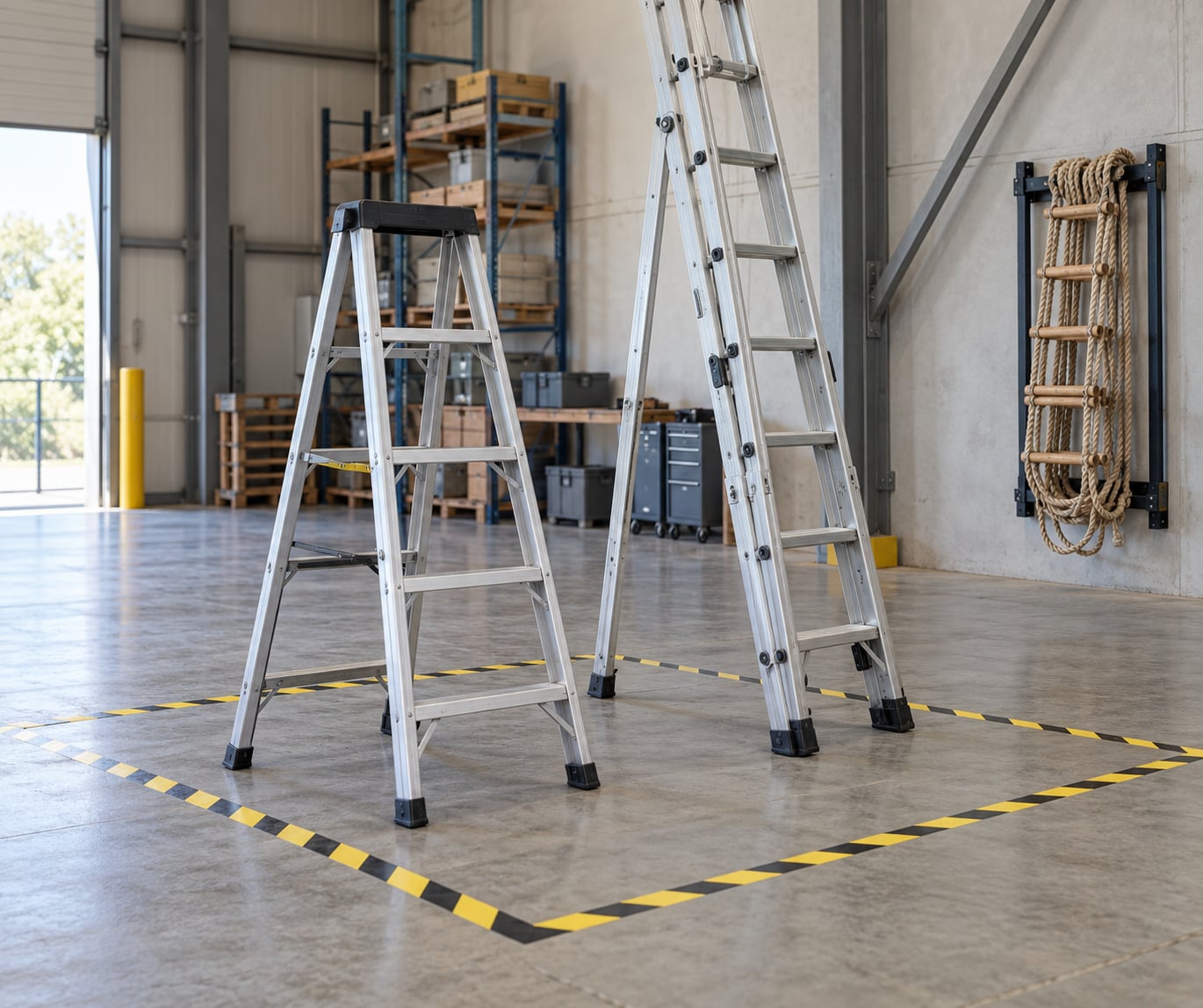
Good ladder safety tips for work come down to a handful of decisions made before the first rung is climbed: the right ladder for the task, a fresh inspection, a stable setup at the correct angle, and a body position that keeps three points of contact at all times. Those four failure points account for the large majority of ladder injuries on job sites.
The scale is worth knowing. The Consumer Product Safety Commission reports roughly 90,000 emergency-room visits and about 300 deaths each year in the United States from ladder accidents, and the American Academy of Orthopedic Surgeons counted around 500,000 treated ladder injuries in 2023. Ladders are ordinary equipment, which is exactly why they get used carelessly.
This list is written for the people who actually have to make those calls: construction crews, warehouse pickers, electricians, HVAC installers, painters, and facility maintenance staff, plus the supervisors who sign off on their training. It reflects the practices codified in OSHA 1910.23 for general industry and 1926.1053 for construction.
Table of Contents
- Ladder Safety Tips for Work at a Glance
- 1. Choose the Right Ladder for the Job
- 2. Inspect the Ladder Before Every Use
- 3. Check the Load Rating and Working Load
- 4. Set Up on Stable, Level Ground
- 5. Maintain the Three Points of Contact
- 6. Face the Ladder and Keep Your Belt Between the Rails
- 7. Use a Stable Work Platform
- 8. Keep the Area Below and Around the Ladder Clear
- 9. Use Fall Protection When Required
- 10. Set Up for Weather, Lighting, and Surfaces
- 11. Train Workers to Work Safely Around Ladders
- 12. Report Problems and Replace Equipment Promptly
- Frequently Asked Questions
- What to Do on Your Next Shift
Ladder Safety Tips for Work at a Glance
Each row below is a decision you can make in under a minute. The last column is the part supervisors can actually observe from the ground, which makes it useful for a toolbox talk or a spot check.
| Practice | When it applies | What you should see |
|---|---|---|
| Match ladder to task | Every job, before you open the equipment room | Correct type and duty rating for the height and load |
| Pre-use inspection | Every single use, by the person using it | Clean, straight, legible label, sound feet |
| Load check | When hauling tools or materials | Combined weight under the rating plate value |
| Level, stable base | Every setup, indoors and out | All four feet bearing, spreaders fully open |
| 4:1 angle | Every extension ladder setup | Base 1 foot out for every 4 feet of height |
| Three-point contact | Every climb, in both directions | Two hands and one foot, or two feet and one hand |
| Face the ladder | Every climb and descent | Body square to the rungs, belt between the rails |
| Correct platform height | Any reaching or hands-on work | Feet on a rung or step below the top cap |
| Clear exclusion zone | Before setup and while working | No doors, traffic, vehicles or stored loads nearby |
| Fall protection when required | Where the height or the task triggers it | Approved system in use before ascending |
| Weather and lighting check | Outdoor and low-light work | Dry surface, visible footing, work stopped if not |
| Training and retraining | Before first use and after any change | Records showing hands-on instruction |
1. Choose the Right Ladder for the Job
Match the ladder type to the task instead of defaulting to whatever hangs in the closet. A stepladder is for indoor, short-duration work where you need a stable platform with all four feet planted. An extension ladder is for reaching an outdoor wall or roof edge, and it needs a 4-to-1 setup angle. A platform ladder gives you a standing surface with a guardrail for extended overhead work.
Height matters as much as type. Standing on the top three rungs of a step ladder is where many falls start, because the higher you climb the narrower the base becomes under your weight.
When should you skip the ladder entirely?
Switch to a mobile elevating work platform or scaffold when the work is above roughly ten feet, lasts more than an hour in one position, or requires heavy materials. Ladders are the right tool for light, short, mobile tasks. Holding a paint bucket and a roller on a step ladder for half an afternoon is a scaffold job.
2. Inspect the Ladder Before Every Use
Inspect the ladder yourself before every use, not just when it comes back from the rack. Nobody else has touched it since your last shift, and a bent rung or a cracked rung can appear overnight.
- Check the identification label is present and readable. A missing label means you cannot verify the duty rating.
- Look at the feet and shoes for wear, clogging, or a cracked or missing rubber tip.
- Run your hand along the side rails for dents, bends, corrosion, or cracked fiberglass.
- Check rungs, steps, and cleats are straight, evenly spaced, and firmly joined to the rails.
- Confirm spreader bars and locking hinges or cams engage and hold.
- For rope ladders, check the rope, knots, and the condition of the plastic or aluminum rungs.
- Check platform ladders for a sound deck, intact guardrails, and a working gate.
- Confirm the rope and pulley system on extension ladders is intact and the rope is not frayed.
- Look for sharp edges, burrs, or metal slivers that could cut or slip a hand.
- On wood ladders, press the joints between steps and rails and check for decay or soft spots.
Any ladder that fails a point goes out of service immediately. If your site needs a repeatable version of this list, our tool safety inspection checklist applies the same pass-or-fail logic to other equipment.
3. Check the Load Rating and Working Load
Total the weight of the worker, the tools, the materials, and anything hanging on the ladder, then compare it with the duty rating stamped on the rating plate. Exceeding that rating is unsafe no matter how brief the task feels.
| Duty rating class | Maximum working load | Typical use |
|---|---|---|
| Type I | 200 lb | Light duty, single tradesperson with hand tools |
| Type II | 225 lb | Medium duty, heavier users |
| Type IA | 250 lb | Industrial duty, fiberglass ladders for electrical work |
| Type IAA | 375 lb | Extra heavy duty, multiple workers or heavy materials |
| Special rating | Up to 500 lb | Rated by the manufacturer for unusual loads |
A Type IA fiberglass ladder is a common upgrade on industrial sites because it holds a higher rating than an aluminum Type I of similar size and is nonconductive. Aluminum weighs less and is the better choice when you are not near energized parts.
4. Set Up on Stable, Level Ground
Set the base on a firm, level surface that bears weight on every foot. On uneven ground, the leveling feet on a step ladder can help, but they are not a fix for a slope or a soft patch. Move to a better spot instead of wrestling the ladder into place.
For an extension ladder, position the base one foot out from the wall for every four feet of working height. That gives roughly a 75-degree angle, which is the geometry that keeps the ladder from sliding out from the top. Open every spreader bar and confirm the locking hinges actually engage.
Two more setup hazards catch crews out constantly. Doors swing into the work area, so block or prop them open before climbing near one. And an extension ladder needs its feet tied off or otherwise secured at the top when the work area cannot be reached without overreaching.
5. Maintain the Three Points of Contact
Keep two hands and one foot, or two feet and one hand, in contact with the ladder whenever you climb or descend. The rule exists because your hands are your balance system, and a worker with one hand on a rung and a tool in the other has no margin left.
Descending is more dangerous than ascending. Coming down you cannot see the rung below as clearly, your body weight shifts forward, and tired hands grip less well. Slow down on the way down and confirm each rung before loading it.
6. Face the Ladder and Keep Your Belt Between the Rails
Climb facing the ladder. Turning your body sideways or reaching behind you to grab a shelf puts your center of gravity outside the frame of the ladder, and the ladder moves to follow.
Keep the belt buckle between the side rails at all times. When your hips drift outside the rails you are leaning, and the ladder shifts under you. The fix for anything out of reach is to move the ladder, not to stretch.
Overreaching is so common because it feels faster than repositioning. It is also one of the leading causes of ladder falls, and workers with more experience are often the ones doing it.
7. Use a Stable Work Platform
Stand on a step or rung, never on the top cap of a stepladder and never on the top two steps of an extension ladder. The cap is designed to hold a person against the wall, not to carry a worker’s weight overhanging the rails.
For a long task, work from a platform ladder or an aerial lift instead of climbing up and down repeatedly. Position the platform so your work happens at chest height with your belt inside the rails, and use the tool tray or a tool lanyard instead of a free hand for hardware.
8. Keep the Area Below and Around the Ladder Clear
A ladder that looks stable from the top can still be knocked over by something at ground level. Clear the area of people walking past, forklifts, pallet jacks, parked vehicles, swinging doors, and stacked materials before you climb.
Lone working at height deserves its own thought. If nobody can see you fall, you should not be on a ladder alone. Set up a check-in, keep a phone within reach, and have someone on the ground aware of the task and the duration.
9. Use Fall Protection When Required
A ladder is not a fall protection system. It does not arrest a fall, it only delays it, and falling from the same height with an unrestrained ladder is often worse than not falling.
Employers may need guardrails, a personal fall arrest system, or a compliant scaffold once the work exceeds the ladder’s practical limits, based on the height, the condition, and the leading edge involved. Under OSHA 1910.23 and 1926.1053, the employer is responsible for the system, the equipment, and the training to use it, not the worker.
If your site treats ladder work as a routine task but has no written fall protection plan, that gap usually shows up in an inspection long before anyone asks about it.
10. Set Up for Weather, Lighting, and Surfaces
Stop work when the surface or the light makes safe footing impossible. Wet, icy, muddy, or freshly waxed floors, fresh paint, and gravel all defeat the shoes and the feet designed for them.
Wind is the outdoor version of the same problem. A tall extension ladder catches it like a sail, and a gust can tip a ladder with a person on it. High wind, lightning, and poor visibility are straightforward reasons to postpone the task and reschedule it.
For night and low-light work, bring proper task lighting rather than working from a headlamp alone. Most slips happen because nobody could see the tread they were about to step on.
11. Train Workers to Work Safely Around Ladders
Training has to be hands-on, not a slide deck and a signature sheet. A new worker should demonstrate setup at the correct angle, three-point contact climbing, and the top-step rule on the actual equipment they will use.
Cover the topics crews most often skip: the 4:1 rule, what counts as the top step, how to tag a defective ladder, how to handle tools without breaking contact, and when to stop and call for a different platform. Retrain when equipment, procedures, or tasks change, and after an incident involving a ladder.
New and temporary workers need the same standard of instruction as everyone else. Our guide to running a safety orientation for temp workers covers how to get that first session to stick.
12. Report Problems and Replace Equipment Promptly
Tag a defective ladder Dangerous, Do Not Use, remove it from the work area, and tell your supervisor the same shift. Tagging it without removing it is how damaged ladders come back into circulation.
Keep a record of the tag, the defect, the date, and who reported it. That record is what stops a piece of equipment from reappearing after a repair, and it gives the employer the data to justify replacement.
Pressure to finish the job is the reason broken equipment stays in service. If you are handed a damaged ladder, you can stop and report it without it counting against your record, and the replacement should never be the thing that waits.
Frequently Asked Questions
What are ladder precautions?
Ladder precautions are the checks made before and during use: pick the right ladder type and duty rating, inspect feet, rails, rungs, hardware and labels, set up on level ground with the base one foot out for every four feet of height, keep three points of contact, keep your belt between the rails, stay off the top cap, and clear the area below. Stop work in wind, rain, ice or poor light.
At what angle should a ladder be set up for safe working?
Position the base of an extension ladder one foot out from the base of the wall for every four feet of height, which produces roughly a 75-degree angle. Some workers also place the top three inches below the roof edge for safer transition. Check the angle again if the ladder is repositioned or the ground settles.
Can you stand on the top step of a stepladder?
No. Standing on the top cap or top step of a stepladder is prohibited because the cap is not designed to carry a worker’s weight and the narrower base makes a slip almost certain. Move the ladder so the work happens on a rung below the top. The same rule applies to the top two steps of an extension ladder.
How far above a landing should a ladder extend?
For access to a fixed landing, the side rails should extend at least three feet above the landing surface. Where that is impractical, OSHA allows other secure grab points such as a handrail, but the ladder still needs to be secured so it cannot slip. Set up before ascending, never from the ladder itself.
Do employers have to provide ladder safety training?
Yes. OSHA 1910.23 for general industry and 1926.1053 for construction require employers to make sure each employee who uses a ladder is trained in the correct use, inspection, and placement of that equipment. Training must be repeated when the equipment, the work environment, or the hazards change, and after any ladder-related incident.
What should I do if a ladder at work is visibly damaged?
Stop using it. Tag it Dangerous, Do Not Use, remove it from the work area so nobody can grab it, and report it to your supervisor that shift. Do not attempt your own repair with tape, wire, or a spare rung. Record the defect and the report so the ladder stays out of service until it is repaired to standard or replaced.
What to Do on Your Next Shift
Start with the inspection. Walk to the equipment area, run the ten-point check on the ladder you are about to use, and tag anything that fails. It takes about a minute and it is the step that catches the failure before a worker is on it.
Then set up the way you would want the next person to set it up: spreaders open, base at the 4-to-1 angle, clear ground beneath, three points of contact on the way up. Safety habits on a ladder are mostly the first sixty seconds of the task, and the habits that get ignored are usually the ones nobody has watched for.
For supervisors, the durable version of these practices is a program rather than a poster. Building that is covered in our guide to building a safety culture at work.