
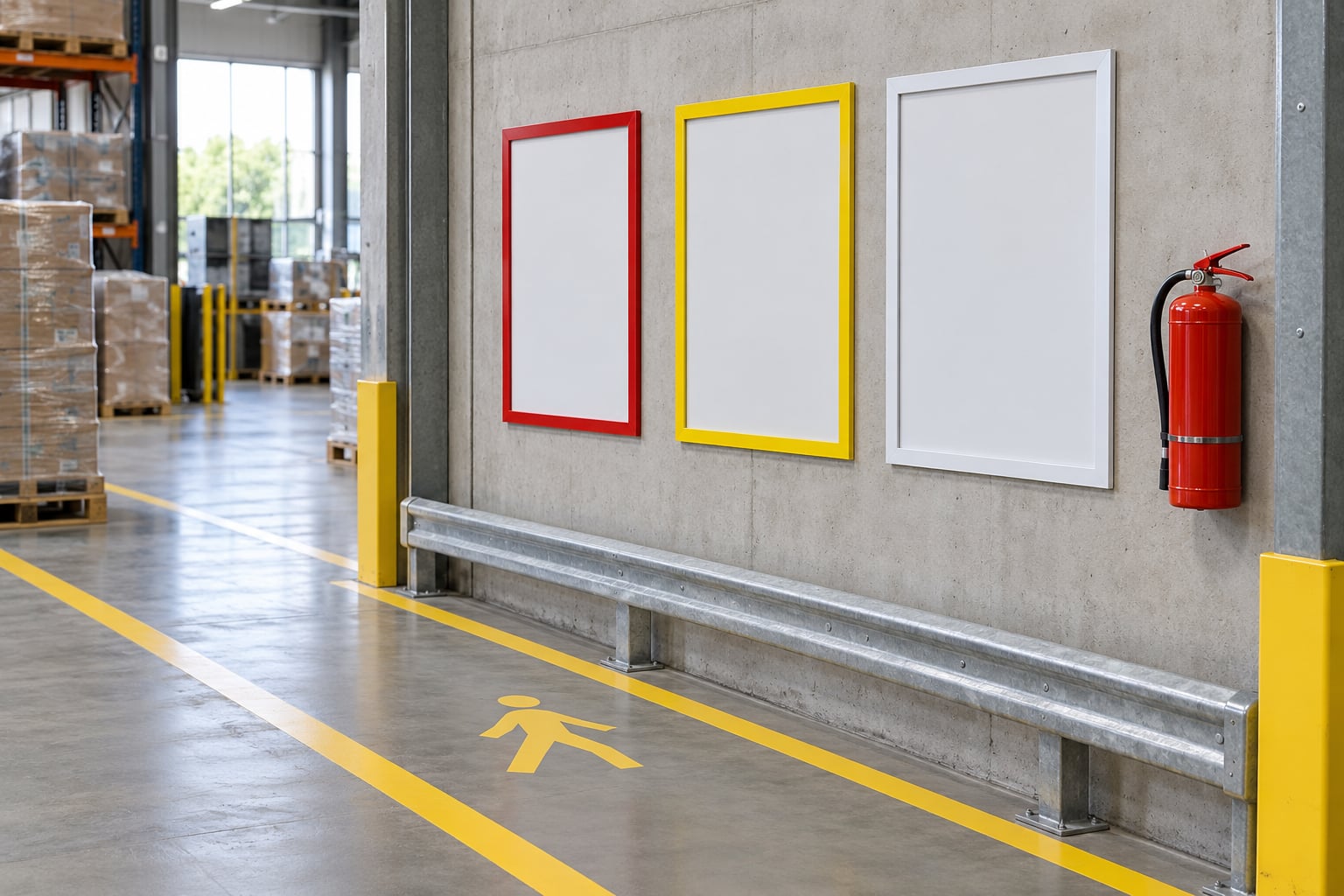
The strongest workplace safety poster ideas each carry one instruction, tied to one hazard, and hang exactly where somebody is about to get that decision wrong. Generic motivational signage rarely changes behaviour; a hazard-matched message at the point of work does. Below are 12 poster concepts you can adapt for an office, warehouse, plant floor or construction site, with what goes on the page, why it earns its space, and where it belongs on the wall.
One thing to settle before you print anything: a poster supplements the controls and training you already have. Safety professionals tend to be blunt about that. Posters reinforce a conversation you have already had, such as safety training employees actually remember, and they never replace it.
Table of Contents
- Workplace Safety Poster Ideas at a Glance
- 1. High-Visibility Hazard Alert Poster
- 2. PPE Check-before-You-Start Poster
- 3. Emergency Exit and Assembly Point Poster
- 4. Hazard Reporting Poster That Names the Action
- 5. Ergonomic Workstation Poster
- 6. Chemical and Sanitation Safety Poster
- 7. Heat and Cold Stress Reminder Poster
- 8. Ladder and Elevated Work Poster
- 9. Warehouse and Forklift Safety Poster
- 10. Incident Reporting and Near-Miss Poster
- 11. Manual Handling and Ergonomics Poster
- 12. Safety Improvement and Speak-Up Poster
- Frequently Asked Questions
- What makes a workplace safety poster effective?
- Where should workplace safety posters be placed?
- Do safety posters replace required signs or employee training?
- How often should workplace safety posters be updated?
- How can employers make safety posters accessible?
- How do you know whether a safety poster is working?
- Start With Your Highest-Risk Area
Workplace Safety Poster Ideas at a Glance
Every concept below solves a different problem, so match the row to your site rather than picking the row that looks best. The placement column matters as much as the message: a correct instruction hung in the wrong corridor gets read once and forgotten.
| Poster concept | Best worksite | Primary hazard | Employee action | Placement |
|---|---|---|---|---|
| High-visibility hazard alert | Loading dock, plant floor | Pinch points, swinging loads | Stop and check before crossing | Dock door, machine guard |
| PPE check-before-you-start | Construction, manufacturing | Task without correct protection | Run the 5-point check | PPE store and time clock |
| Emergency exit and assembly | Any facility | Delayed evacuation | Alarm, exit, assemble, wait | Exits, lobbies, stairwells |
| Hazard reporting | Office and shop floor | Unreported damage or near miss | Report within the shift | Kiosk, time clock |
| Ergonomic workstation | Office, hybrid, home | Awkward posture, screen height | Adjust, then move often | Desks, copy rooms |
| Chemical and sanitation | Lab, kitchen, custodial | Splash, wrong glove, no ventilation | Label, SDS, compatible glove | Chemical store, sink |
| Heat and cold stress | Warehouse, kitchen, outdoors | Heat illness, cold stress | Water, rest, buddy check | Dock door, locker room |
| Ladder and elevated work | Construction, facilities | Falls from ladders | Inspect, set, climb, descend | Ladder rack, roof access |
| Warehouse and forklift | Distribution centre | Struck-by, blind corner | Stay in lanes, make eye contact | Aisle ends, mirrors |
| Incident and near miss | Whole site | Repeat incidents | Stop, secure, notify, record | Break room, supervisor station |
| Manual handling | Receiving, healthcare, hospitality | Strain and sprain | Test load, lift neutral, team lift | Receiving dock, supply room |
| Speak-up and improvement | Whole site | Silence after a near miss | Speak up or report it | Entry, break room, intranet |
1. High-Visibility Hazard Alert Poster
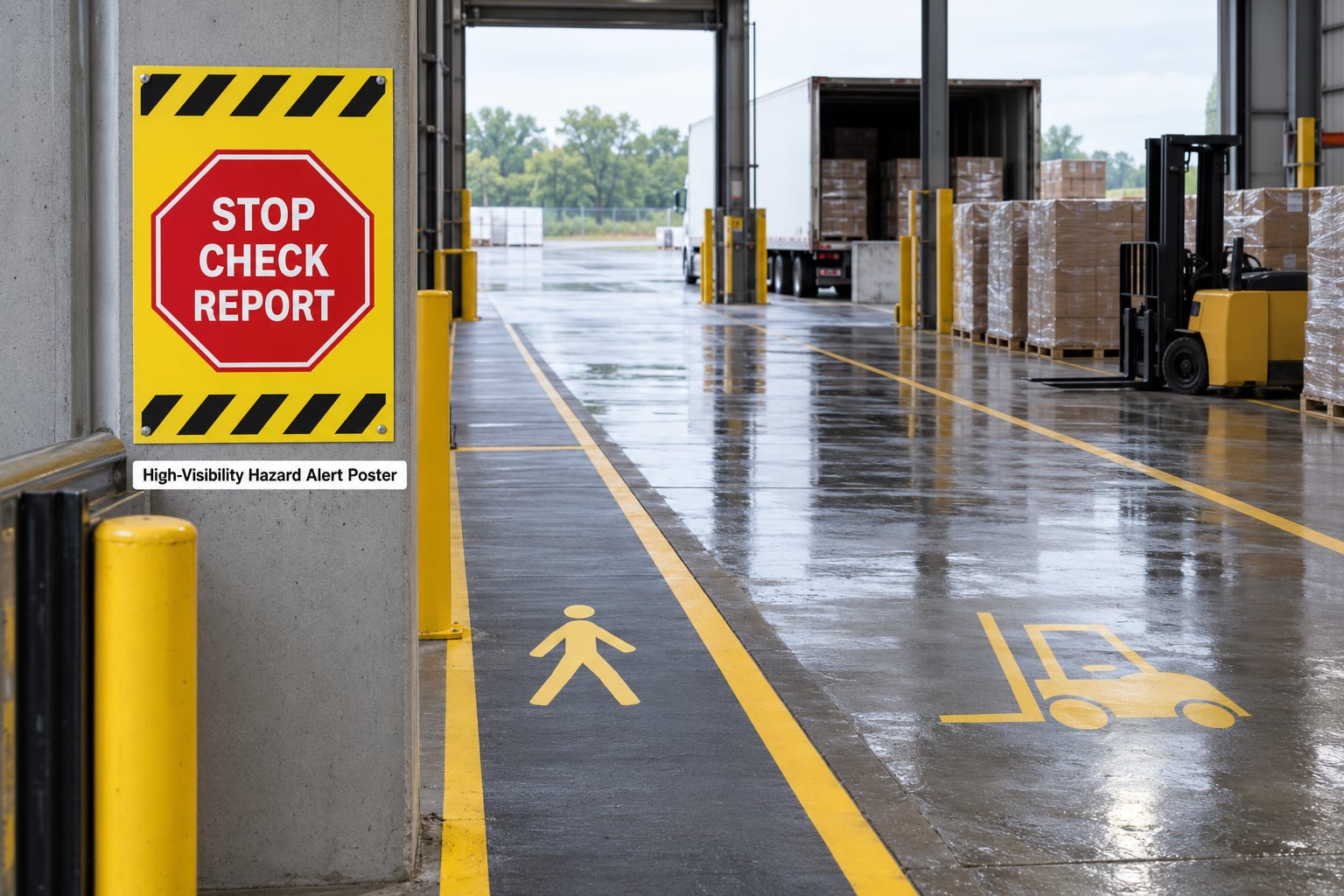
This poster names one specific hazard, the danger level, and the action to take, in about 25 words total. Anything longer gets skimmed and half of it gets missed.
At a loading dock, that means trailer restraints, dock plates and the gap between trailers, with a named person to call and a clear instruction not to step into a swinging load path. Reflect your actual risk assessment rather than borrowing alarming imagery from a stock library: a picture of a mangled hand nobody at your site has ever seen does less work than a photo of the specific pinch point you documented last quarter.
2. PPE Check-before-You-Start Poster
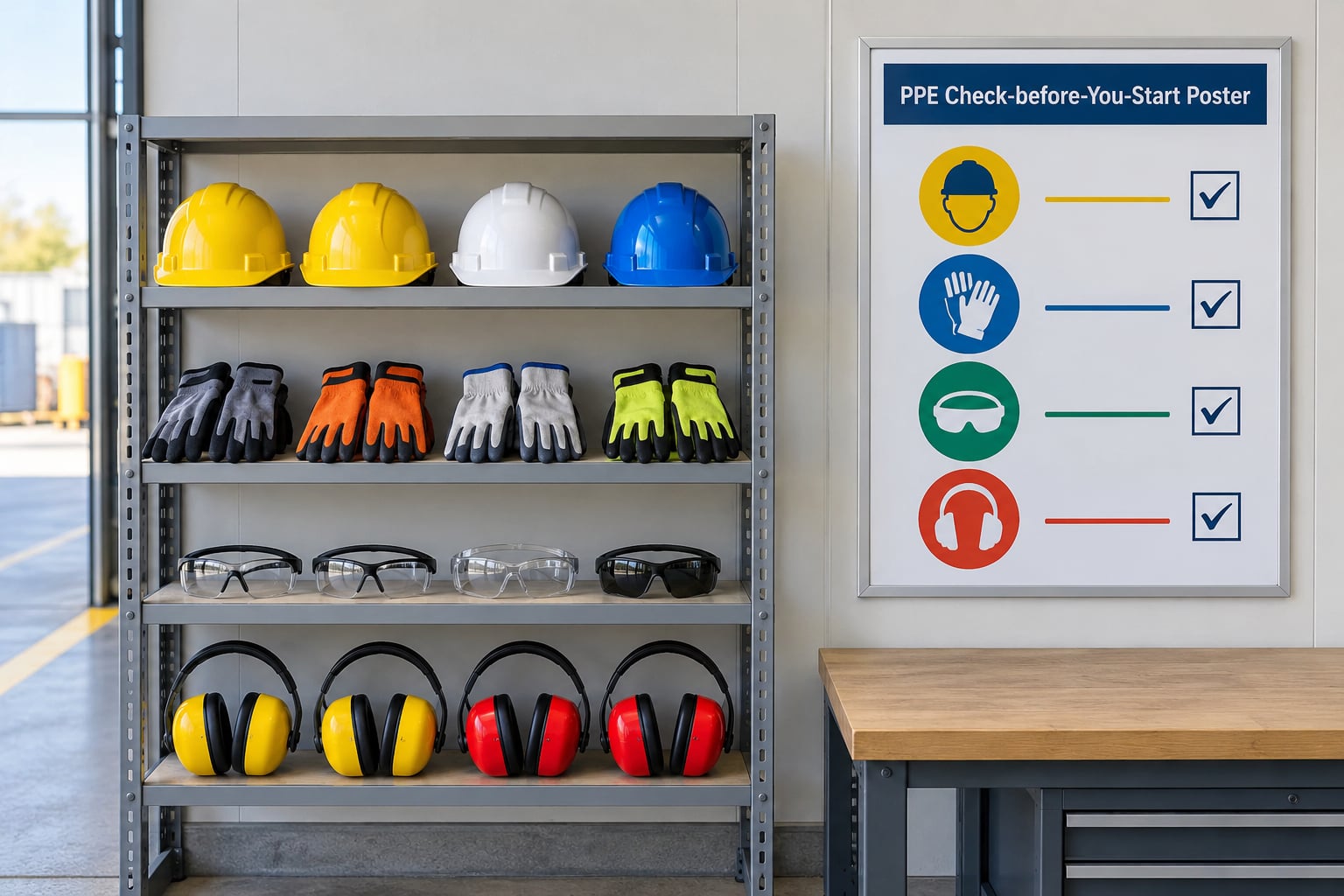
A PPE poster works best when it turns equipment selection into a fixed routine instead of a reminder to think. Five checkboxes beat a paragraph every time: helmet secured, eye protection, hearing protection, task-appropriate gloves, and footwear with toe protection where the site requires it.
Keep it specific to the task at hand. On a manufacturing line, cut-resistant gloves for a blade change and chemical-resistant gloves for a solvent cleanup are not interchangeable, and a generic poster that shows both invites the wrong choice. Mount it at eye level on the wall beside the PPE storage point, where the gloves and glasses actually come out, so the check and the gear happen in the same glance.
3. Emergency Exit and Assembly Point Poster
An evacuation poster is a map with four steps attached: what the alarm sounds like, which exit to use from this location, where to assemble, and who to look for there. Number the steps and keep the map simple enough to read from two metres away.
The critical detail is that it matches your facility. A poster borrowed from a generic template will not show your stairwell, your fire door release or the gate your crew assembles behind, and in a real evacuation people default to the map in front of them rather than the plan in a binder. In an office, a compact version works: four numbered lines per floor, your assembly point address, and two emergency contacts that someone actually answers. If your procedures are not written down yet, start with our guide to writing a workplace health and safety policy before anything goes on the wall.
4. Hazard Reporting Poster That Names the Action
The most useful reporting poster answers four questions on the page: what to report, how to report it, where to submit it, and what happens after. Most reporting posters fail at question four because they stop at a phone number and an email address.
Use a real example to make it concrete. A machine guard that was off for two minutes, a frayed sling, a spill nobody saw the start of: each one becomes a picture and a single sentence. Tell employees the timeframe, for example before the end of the shift, and name the response, such as a same-day acknowledgement and a documented decision. When people in this field talk about workplace safety poster ideas, the reporting poster is the one they keep coming back to, because reporting behaviour is the whole point.
Keep the tone neutral. Anything that sounds like a threat turns a quiet near miss into a silence.
5. Ergonomic Workstation Poster
An ergonomics poster works when it shows the adjustment, not the perfect posture. Screen near arm’s height, feet supported or feet flat, elbows close to the body, and a short line about changing position more often than holding one “correct” position for hours.
How to adapt workplace safety poster ideas for hybrid teams
A single seated figure will not fit everyone, and posting one anyway is how you end up with a poster that quietly irritates the shorter half of your team. Build the poster around the adjustment instead: screen height, chair or sit-stand setup, foot support, wrist neutral rather than bent, and a phone or headset reminder for people working off-site. Pair the picture with a movement cue people will actually take, such as a two-minute break every half hour tied to an existing meeting rhythm rather than to the clock on the wall.
6. Chemical and Sanitation Safety Poster
This poster covers the sequence a worker follows around any cleaning agent or industrial chemical: read the container label, find the safety data sheet, put on a glove compatible with that specific product, confirm ventilation, know where the nearest eyewash is, and escalate a spill to the right person.
A janitorial operation is a good test case. Same building, same corridor, three different products used within an hour, and the temptation to grab whatever is under the sink. One caution: do not reproduce chemical symbols, pictograms or mixing instructions from memory. Transcribe them from the manufacturer’s label and safety data sheet on site, and have someone qualified check the poster before it goes up.
7. Heat and Cold Stress Reminder Poster
A seasonal stress poster pairs the preventive habits with symptom recognition and escalation, because hydration reminders alone stop working the moment somebody feels dizzy. Water, rest in shade, acclimatization in the first week, and a buddy who checks on you.
The three examples that differ most: in a warehouse, schedule the break around the loading queue rather than around a fixed clock; in a kitchen, watch the line cook near the range during a service rush; on an outdoor crew, build the acclimatization ramp into the first week of the season. List the warning signs plainly, then end with the instruction people need: stop work, get to a cool place, and get medical help if symptoms do not improve quickly. In cold conditions the same poster flips to frostbite risk, warming breaks and dry clothing.
8. Ladder and Elevated Work Poster
An elevated-work poster covers four things in order: inspect the ladder before use, set it at the correct angle, keep three points of contact while climbing, and never stand on the top step or the top cap. Add overhead-line awareness for any ladder work near power lines.
Employers must adapt the poster to the ladders, lifts and platforms actually on site, because the hardware ranges from a household folding step ladder to an articulating boom. Get the setup angle right for the equipment you have, state the fall-protection threshold your own programme uses, and put the poster where the ladders are stored so it is read at the moment of retrieval. When you compare workplace safety poster ideas against your current wall, this is the category where generic clip art does the most damage, since it usually shows a ladder set up wrong.
9. Warehouse and Forklift Safety Poster
A forklift poster marks the pedestrian lanes, names the blind corners where sightlines fail, and states the operator’s obligations: horn at intersections, lights on, seat belt fastened, and no riders. The pedestrian half of the poster matters just as much, because the person on foot cannot see the corner any better than the operator can.
Place these at aisle ends, at every corner where a truck can appear unexpectedly, and on the mirror posts where they exist. A distribution centre illustration: a poster facing the pickers at aisle 12 reminding them that a loaded pallet travels about a truck’s length before it stops. The poster supplements operator training, your traffic rules, floor markings and physical barriers. It does not replace them, and a poster on its own will not fix a badly designed traffic flow.
10. Incident Reporting and Near-Miss Poster
Build this one around four actions: stop, make the area safe, notify the right person, record what happened. Four steps, four verbs, and enough room for a small tear-off card or a QR code to the reporting form.
Distinguish the two terms in plain language on the poster itself: an incident is something that caused harm or damage, a near miss is one that could have. The slip-and-fall example makes it concrete, an employee steps on a wet floor near the time clock, no injury, and it is still reported. Remove blame from the wording entirely. Posters that read as an accusation teach people to say nothing, which is the opposite of what the poster is for.
11. Manual Handling and Ergonomics Poster
A manual handling poster demonstrates the sequence, not the pose: test the load before lifting, keep it close, lift with neutral posture, ask for a second person when the load is heavy or awkward, and clear the route first.
Tailor it to the job. In a receiving area that means a staged pallet and a clear path before anything is picked up. In healthcare it means the transfer technique your own policy requires. In hospitality it means loaded bus tubs and the question of how many trips is reasonable. Leave space for the instruction that early pain reporting gets an assessment, because most manual handling injuries are reported late, and finish with a caution about body-position diagrams: a photograph of a perfect lift is not a guarantee that nobody gets hurt.
12. Safety Improvement and Speak-Up Poster
A campaign poster turns hazard recognition into a habit and gives people somewhere to put what they notice. Recognition prompts, a question worth asking, and a real channel with a response time attached.
A hospitality example: a poster near the staff door reading that a blocked fire exit or a missing pan lid on the pass is reportable by anyone, to anyone, with no argument. Publish a realistic channel, including an anonymous option that a small business can actually maintain, and state the commitment on the poster: every report gets a response within a stated number of days. Keep it specific enough to support your reporting culture, because a generic speak-up poster with no visible follow-through teaches people the channel is decorative.
Frequently Asked Questions
What makes a workplace safety poster effective?
An effective poster carries one message, names the behaviour it wants, and is placed where that behaviour happens. It uses a signal word people recognise, a short instruction of roughly 25 words or fewer, and a picture that matches the real hazard at your site. It also repeats. Posters that change monthly keep earning attention, while the same unchanged sheet on the wall for three years becomes wallpaper.
Where should workplace safety posters be placed?
Put each poster at eye level, at the point of decision rather than in a corridor nobody uses. Good locations include beside the PPE storage point, at time clocks and entry areas, at aisle ends and blind corners, near chemical storage and eyewash stations, and on the wall by exits. Avoid locker rooms and high or low placements, and never cover a poster with another poster.
Do safety posters replace required signs or employee training?
No. OSHA 29 CFR 1910.145 sets requirements for safety signs and tags, and construction signs fall under 1926.200. Those required signs are a compliance matter with colour and wording conventions. Posters are communication: they reinforce a procedure after someone has been trained. The Job Safety and Health: It’s the Law poster is the one employers are confident must be displayed. Posters never substitute for training, and they do not replace required signs.
How often should workplace safety posters be updated?
Rotate the campaign message monthly so the wall keeps earning attention, and review every poster against your current procedures at least twice a year. Check monthly for fading, peeling, glare and damage, because a coffee-stained printout loses credibility as fast as it loses contrast. When a procedure, an exit route, an assembly point or a contact number changes, update that poster the same week rather than at the next rotation.
How can employers make safety posters accessible?
Keep the language plain and below a reasonable reading level, because your workforce is often multilingual. Pair a pictogram with short text rather than relying on words alone, use high contrast between background and lettering, and print the minimum letter height for the viewing distance. Provide a translated version for crews that need it, and place digital or audio versions where literacy or vision makes a printed sheet unusable.
How do you know whether a safety poster is working?
You will not know from the poster alone, so pair it with a behaviour measure. Run safety observation cards on the specific behaviour the poster targets, such as a proper PPE check or a clear pedestrian lane, and compare counts before and after the campaign. Watch near-miss reports too: a healthy rise after a reporting-focused poster usually means trust, not deterioration. Ask people on shift what they remember from the poster three months in.
Start With Your Highest-Risk Area
Pick the area with the greatest credible risk, not the area with the emptiest wall. Then: bring in the safety lead and the people who work there, check every instruction on the draft against your current procedures, pilot it in one spot, ask the crew what they noticed, and revise before you print a run. A structured safety audit checklist for a small business helps you rank those areas in the first place. Repeat the cycle monthly and your wall stops being a compliance exercise and starts doing work. Workplace safety poster ideas are easy to find; matching them to your actual hazards is the part that pays off.