
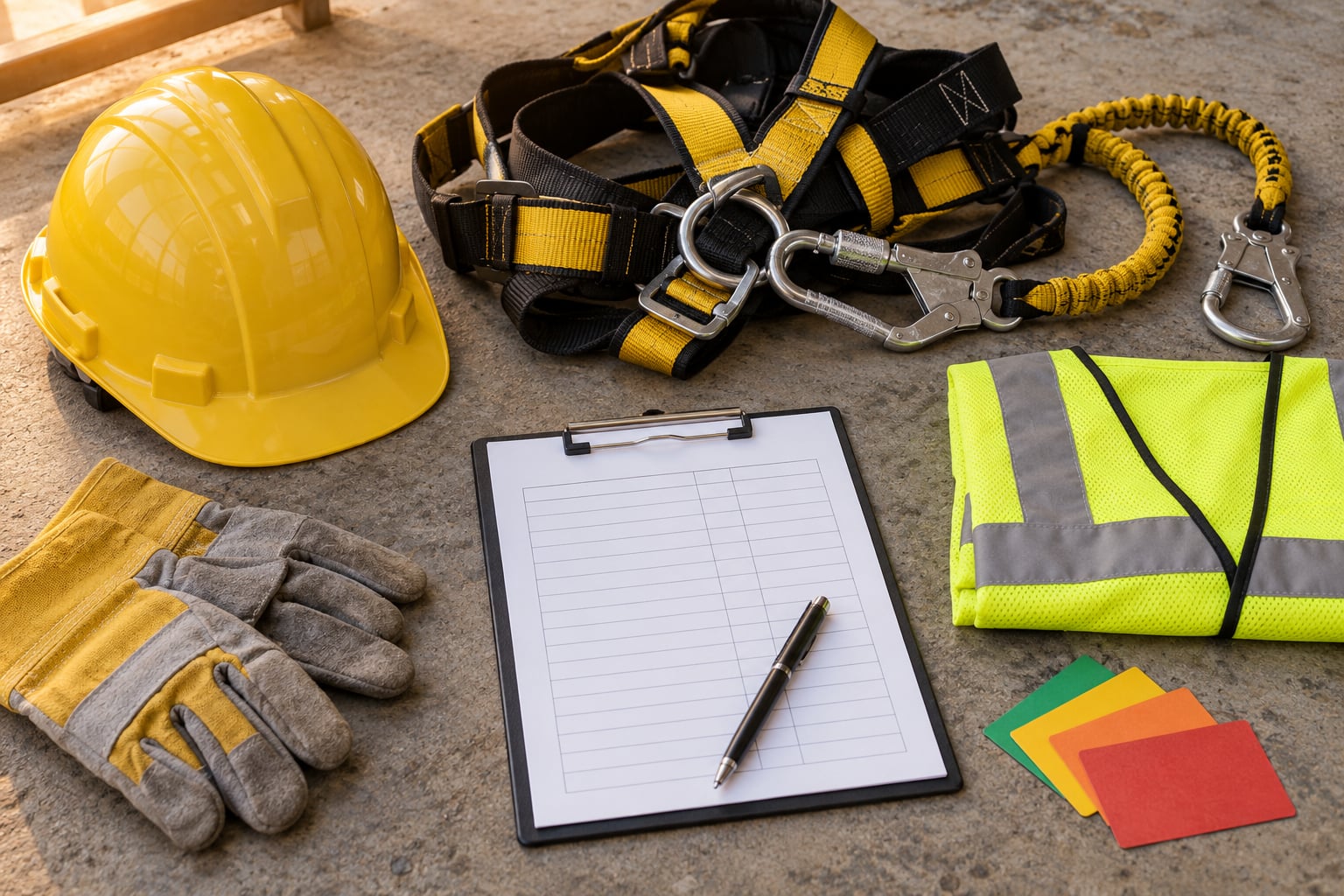
Toolbox talk topics for construction work best when they match the job happening today: one hazard, one crew, ten minutes, and a supervisor who asks questions instead of reading a list. The ten topics below cover the hazards that kill and injure the most workers on site, and each one comes with a short way to run the conversation so it stays practical.
The crews I have seen take this seriously are not the ones with the longest safety program. They are the ones where the crew lead can name one thing that changed this morning because of a talk. Pick a topic, walk to the actual work area, and let the workers tell you what they see.
Table of Contents
- 10 Best Toolbox Talk Topics for Construction at a Glance
- 1. Fall Protection and Working at Height
- 2. Housekeeping, Trips, and Slips
- 3. Forklift and Mobile Equipment Safety
- 4. Electrical and Temporary Power Safety
- 5. Excavation, Trenching, and Underground Hazards
- 6. Tool, Equipment, and Power-Line Awareness
- 7. Heat, Cold, Weather, and Worker Hydration
- 8. Chemical, Dust, and Silica Exposure
- 9. Manual Lifting, Ergonomics, and Musculoskeletal Injury Prevention
- 10. Emergency Response, Incidents, and Near Misses
- Frequently Asked Questions
- Conclusion
10 Best Toolbox Talk Topics for Construction at a Glance
| Topic | Risk it addresses | Best audience | Discussion activity |
|---|---|---|---|
| Fall protection and working at height | Falls from ladders, scaffolds and elevated slabs | Every crew working above ground | Walk one ladder and one anchor point, then ask what gets checked before use |
| Housekeeping, trips and slips | Slip, trip and fall hazards on cluttered ground | All trades, especially finish and interiors crews | Name the three worst spots on site and assign a cleanup before lunch |
| Forklift and mobile equipment | Struck-by and crush injuries around equipment | Concrete, steel, logistics and operators | Walk a planned pedestrian route and flag where sightlines disappear |
| Electrical and temporary power | Shock, arc flash and damaged temporary systems | Electricians, finish crews, anyone using temp power | Locate the nearest GFCI and rehearse how a damaged cord gets reported |
| Excavation, trenching and underground hazards | Cave-in, utility strike and water intrusion | Sitework, utility and foundation crews | Point out today’s excavation and confirm the protective system and egress |
| Tool, equipment and power-line awareness | Cuts, amputation and overhead line contact | Carpentry, concrete and landscaping crews | Demonstrate a pre-use check on a saw or grinder in front of the crew |
| Heat, cold, weather and hydration | Heat illness, cold stress and weather-driven changes | All outdoor crews, seasonally | Review the day’s shade, water and rest schedule against the forecast |
| Chemical, dust and silica exposure | Silica, solvents, adhesives and dust inhalation | Concrete cutting, demolition, painting and finishing | Find the safety data sheet binder and ask how new products get communicated |
| Manual lifting and ergonomics | Strains, sprains and repetitive injuries | Laborers, formwork and material handlers | Narrate one awkward lift and redesign it together with the crew |
| Emergency response, incidents and near misses | Delayed response and unreported close calls | The whole site, including office staff and visitors | Rehearse the alarm signal and who calls for help from where |
1. Fall Protection and Working at Height
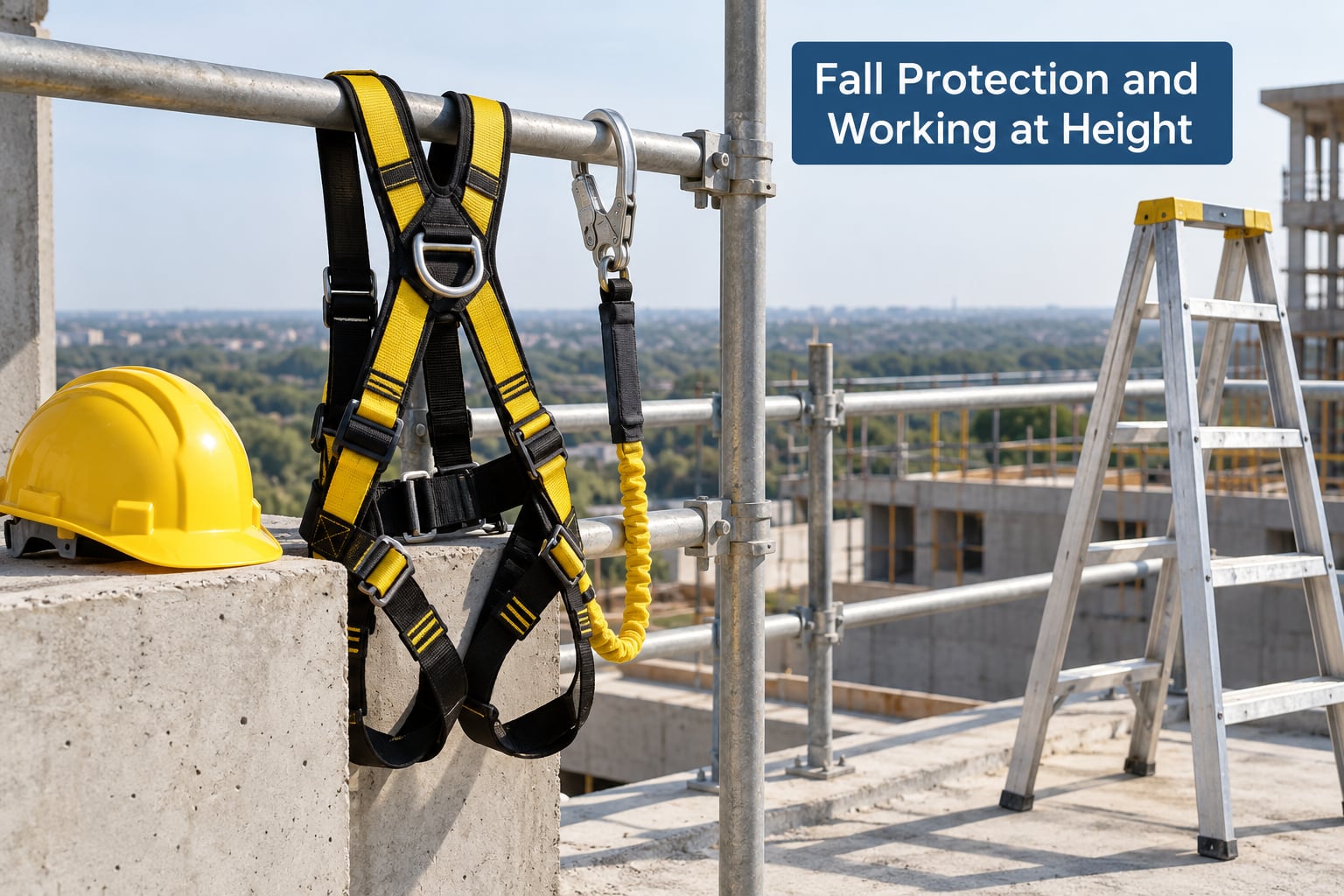
Falls are the deadliest hazard in construction, and OSHA’s fall protection rules in 29 CFR 1926.501 require protection at unguarded edges of six feet or more. Start the talk at the edge, not in the trailer. Ask the crew to point out every place on today’s work area where someone could fall six feet, then walk the most obvious one together.
Cover three things: ladders inspected before use with the base level and tied off where required, scaffolds erected and inspected by a competent person with fall protection for every worker above the lower guardrail, and fall arrest gear checked for cuts, burns, stretched webbing and expired labels.
The common failure is not ignorance. It is the belief that a five-minute task is not worth hooking up for. Ask what percentage of the day’s work is above six feet, and you usually find the answer is higher than anyone expected.
How to run a toolbox talk topic for construction in ten minutes
- Identify one height-related hazard at the actual work area, in the first two minutes.
- Ask the crew what controls they use there and what has gone wrong in the past.
- Review the site procedure and where the fall protection plan is posted.
- Confirm who workers call when conditions change, such as weather or a damaged anchor.
- Record attendance and any corrective action someone raised.
2. Housekeeping, Trips, and Slips
Housekeeping is the least glamorous topic on this list and one of the most effective, because 29 CFR 1926.25 makes the employer responsible for keeping work areas clean, orderly and free of trip hazards. Most of the hazards are created within an hour of the cleanup that fixed them.
Walk the site and point at the specific problems: extension leads and hoses crossing walkways, stacked material narrowing an access path, offcuts and packaging in circulation routes, a damaged floor or a lifted tile, and debris collecting at the base of a ladder or in a stairwell.
Ask what the cleanup standard is at shift end and who verifies it. Then ask what the rule is when a trade finishes ahead of schedule and leaves material staged in the walkway. That second question usually gets a better answer than the first.
3. Forklift and Mobile Equipment Safety
Struck-by incidents on construction sites are usually caused by poor separation between pedestrians and mobile equipment, not by operators making wild mistakes. Talk about the physical separation first: designated walkways, crossing points, and what happens when a pedestrian has no route that avoids the equipment lane.
Then cover operator authorization, which is a legal requirement, not a preference. Only trained and authorized operators should run forklifts, skid steers or telehandlers, and a daily pre-use inspection on tires, forks, hydraulics and the horn belongs to the start of the shift.
Finish with load stability and communication. Loads raised high block sightlines, driving with forks low reduces impact energy but not all of it, and nobody should assume an operator can see a crouched worker behind a stack of pipe. Back alarms and spotters are not substitutes for keeping people out of the lane.
4. Electrical and Temporary Power Safety
Temporary power causes trouble because it feels temporary, so it never gets the same discipline as permanent installation. The questions worth asking are simple: are cords intact, are connections protected, is everything properly grounded, and who is authorized to work on it?
Damaged or improvised cords, daisy-chained extension cords, missing covers on boxes, and generators sitting in standing water should be reported the moment they are seen. Ground fault protection belongs on construction temporary power, and resetting a tripped GFCI without finding out why it tripped is a repeated exposure.
Lockout and tagout under 29 CFR 1910.147 applies during servicing or modification of energized equipment. The talk is a good place to confirm the site energy control procedure and who the authorized employee is. Nobody should ever work on a circuit that has not been positively identified.
5. Excavation, Trenching, and Underground Hazards
Excavations deserve their own talk because the hazard is invisible until the wall moves. Under 29 CFR 1926.651, protective systems such as sloping, shoring or shielding are required for most excavations at five feet or deeper, and the site must have a competent person to inspect them.
Cover the practical items: utility locations marked before digging, access and egress within a reasonable distance of workers in the trench, spoil placed a safe distance from the edge, and water pumped or otherwise managed so the wall does not saturate.
Be direct about the one rule that does not bend. No one enters an unprotected excavation, no matter how quick the task is. Ask who the competent person is for this site, ask what daily inspection covers, and ask what happens to the inspection when rain soaks the soil.
6. Tool, Equipment, and Power-Line Awareness
Circular saw kickback, a grinder that bursts, and a scissor lift that drifts into a line are all preventable with the same habit: a real pre-use check before the first cut of the day. Guards in place, switches functional, correct blade or accessory fitted, cord undamaged, no missing handles.
Talk about matching the tool to the task. A cut-off wheel rated for a grinder is not safer on an angle grinder, and an accessory from a different brand or diameter is not a fit no matter how well it seems to mount.
Overhead clearance deserves its own minute, especially for concrete boom pumps, dump trucks, scrapers and boom lifts. Anyone working around power lines needs to know the minimum approach distance, who owns the line, and what has to be de-energized first. Stopping a job because a condition is unsafe is the expected outcome, not a complaint.
7. Heat, Cold, Weather, and Worker Hydration
Seasonal topics get better engagement than generic ones, and heat is the clearest example. Warn signs of heat illness can look like tiredness or irritability: heavy sweating, headache, dizziness, cramps, nausea, and confusion in the later stages.
Review where cool water is, who controls the rest and shade schedule, and how acclimatization works for new and returning workers. Small frequent sips beat a large drink at lunch, and electrolyte drinks make sense for heavy work in sustained heat. Supervisors have to watch for symptoms in coworkers, not just self-reporting, because the person least likely to say they feel unwell is often the one in trouble.
Winter needs the same treatment. Layering that keeps a worker warm but flexible, warming breaks for short tasks in the cold, and attention to wet clothing and frostbite signs on early-morning concrete and steel work. Set the thresholds before the weather turns, not on the morning the forecast changes.
8. Chemical, Dust, and Silica Exposure
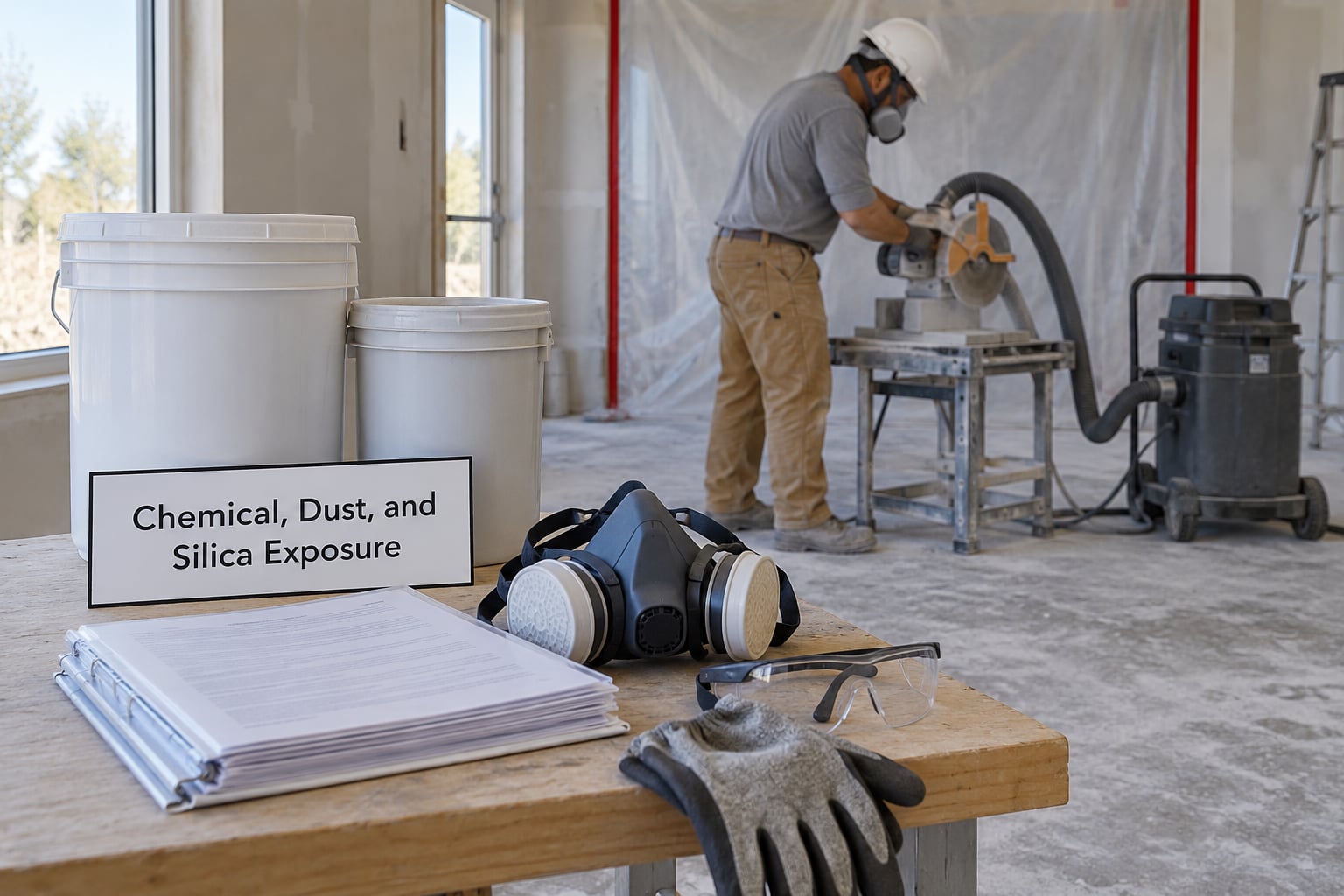
Cutting concrete, grinding, demolition and sandblasting can put respirable crystalline silica into the air, and 29 CFR 1926.1153 sets exposure limits and require a written exposure control plan. Most crews still think of dust as a nuisance until someone on the crew develops a cough that will not clear.
Paint, solvents, adhesives, fuels and coatings add a second exposure category. Workers need to know where the safety data sheets are kept and what they say about ventilation, gloves, respirators and first aid after exposure.
The controls hierarchy is worth saying out loud: eliminate the exposure or substitute a less hazardous product, then use water, mist or HEPA-filtered vacuum capture at the source, then measure to confirm the exposure, and only then rely on respiratory protection. A mask on a dusty grinder with no capture at the source protects far less than people expect.
9. Manual Lifting, Ergonomics, and Musculoskeletal Injury Prevention
Back injuries and sprains build up slowly and then end a career. The talk works best when it stays on the mechanics rather than on fitness advice: bend the knees, keep the load close, avoid twisting under load, and split anything that is too heavy or too awkward for one person.
Team lifting is the practical answer for awkward loads like sheet goods, rigid duct and pipe. Agree the count, agree who leads, and agree what happens when someone loses grip mid-move. Lifting technique training helps, but redesigning the task removes more strain than any technique.
Ask the crew which motions hurt today. Repetitive work such as tying rebar, hand screeding, hammering and overhead finishing deserves a closer look at tool weight, job rotation and material placement. Encourage early reporting of discomfort so it gets treated as a signal about the work, not a personal failing, and point anyone with persistent pain toward the site medical provider rather than a coworker. Our guide to reducing strain in construction goes deeper on task redesign.
10. Emergency Response, Incidents, and Near Misses
Most sites have an emergency plan on a binder that nobody has opened. Rehearse it instead: how the alarm sounds, who calls for help, which address and gate the ambulance should use, where the first aid kit and AED are, and who is authorized to perform CPR.
Then talk about near misses. Safety professionals describe the value simply: a near miss is free information about a hazard that has not caused harm yet, and a site that hears about near misses gets that information early. Crews need to know that reporting one carries no blame and that acting on a report is the point.
Close with stop-work authority. Everyone has it, in writing, and using it does not threaten anybody’s job. After any incident, run the talk while the memory is fresh, cover what was reported, what changed and what stayed open, and make sure subcontractors on the site hear the same version. Wellbeing after a serious event on site is worth a separate conversation; our construction worker mental health support piece covers that.
Frequently Asked Questions
How long should a construction toolbox talk be?
Five to fifteen minutes is the working range, and ten is a good target for a pre-shift talk. Long enough to cover one hazard, ask two questions and record what was decided, short enough that nobody is standing in the sun or cold waiting. If you need more than fifteen minutes, that is a safety meeting or a training session rather than a toolbox talk.
Are toolbox talks required by OSHA?
OSHA does not name toolbox talks directly, but several obligations are met by holding them. 29 CFR 1926.21 covers safety training and instruction, and 29 CFR 1926.20 requires an accident prevention program. Topic-specific rules for fall protection, excavation, scaffolding and electrical work also assume workers know the hazard. Written records of attendance give you evidence the program exists.
How do you keep crews from just signing the sheet?
Move the talk to the work area instead of the trailer, ask a question the crew can answer from their own experience, and use a real event from your site or your trade. Pencil whipping usually means the talk felt irrelevant. Sign-in becomes meaningful when workers can name one thing that changed as a result of it.
What should I do after an incident or near miss?
Run the conversation while the event is still fresh, keep it factual, and stay with what was observed rather than assigning blame. Confirm what immediate control went in, what follow-up is open, and who owns it by when. Near misses follow the same path. Give every subcontractor on site the same version so the message does not drift between trades.
How often should toolbox talk topics change?
Daily talks should follow the work, so the subject shifts constantly. Track the larger themes on a monthly cycle instead, which spreads seasonal and compliance topics across the year without repeating. For a calendar approach, our list of safety meeting topics for monthly meetings covers how to structure recurring sessions on top of the daily brief.
What is the 20-20-20 rule in construction safety?
The 20-20-20 rule is best known as an eye habit for screen work: every 20 minutes, look at something about 20 feet away for 20 seconds. Some construction sites adapt the shape of the rule to breaks instead, using intervals of 20 minutes of work, 20 seconds of movement, and water often enough to stay ahead of thirst. Confirm the version used on your site.
Conclusion
Start tomorrow with the topic that matches today’s hazard, not the one that is easiest to find on a list. Walk to the work, ask what the crew sees, cover the standard, and record who was there plus anything that needs fixing.
Two habits turn a toolbox talk from paperwork into protection. Change the topic when the work changes, and close the loop on anything raised, so people learn that speaking up leads somewhere. The crews that keep this up do not feel like they attend more meetings. They feel like fewer things go wrong without explanation.