

A behavior based safety program explained in plain terms is a structured way of watching what people actually do at work, giving feedback on the safe and unsafe choices they make, and fixing the conditions that push people toward risk. It is a management system, not a training module and not a spying exercise.
Most employers get into this after a close call. An operator skips a pre-lift check because the forklift queue is backed up. Nobody is hurt that week, but everyone in the room understood what almost happened. A behavior based safety program is the response that treats that near miss as useful data rather than bad luck.
This guide walks through what the approach is, how the observation cycle works, what belongs in a real program, and where it goes wrong. It is written for safety managers, HR leads and owners who need to make a decision, not for consultants selling a branded method.
Table of Contents
- What Is a Behavior-Based Safety Program?
- How Does a Behavior-Based Safety Program Work?
- What’s the Difference Between Behavior-Based and Traditional Safety Programs?
- What Should a Behavior-Based Safety Program Include?
- What Behaviors Should You Focus On?
- How Do You Introduce Behaviors Without Creating a Blame Culture?
- How Can You Measure Whether the Program Works?
- What Are the Limitations and Risks of Behavior-Based Safety?
- Frequently Asked Questions
- What is a behavior based safety program?
- What are the 7 steps of the behavior-based safety process?
- What is an example of a behavior-based safety program?
- Does behavior based safety lead to blame culture and employee surveillance?
- How do you measure whether a behavior-based safety program works?
- Can a small company implement behavior based safety?
- Conclusion
What Is a Behavior-Based Safety Program?
A behavior based safety program is a system for identifying the specific actions that cause or prevent injuries, observing those actions in the real work environment, and feeding what you learn back into how work is planned, staffed and equipped.
The unit of analysis is behavior, not attitude. Instead of trying to make people care more about safety, you look at what competent performance looks like in a specific task and check whether it is happening. On a loading dock, that might be checking the trailer restraints before the forklift enters, or confirming the load is stable before raising the forks.
The logic underneath it is behavioral science, usually taught through the ABC model: Antecedents, Behavior, Consequences. Antecedents are the conditions that set a behavior off, such as a rushed shift, a missing guard or an unclear procedure. Behavior is what the person does. Consequences are what follows, either a result that gets rewarded or a correction that gets avoided.
That model matters because it moves the conversation away from fault. If someone skips a step and nothing ever happens, the behavior is being reinforced, no matter what the rule book says. Programs built on the ABC model treat that as a system problem worth fixing, not a character problem worth punishing.
How it differs from a safety training course
Training transfers knowledge into a head. Behavior based safety checks whether knowledge shows up as action on Tuesday morning, under time pressure, with a supervisor walking past. A worker can score well on a quiz about lockout and still reach for the switch before the machine stops. Training and BBS solve different problems, and the strongest programs run both.
Where it fits in the wider safety system
Behavior based safety is one layer. Engineering controls, safe design, maintenance, emergency planning and legal compliance all sit around it. If the guard was removed for a shift and nobody noticed, an observation program will catch that behavior, but it cannot make the machine safe again. Good programs hand hazards that keep showing up to the people who can engineer them away.
If you are also mapping the reasoning behind your training, safety training that employees actually remember covers the same people-first territory from a different angle.
How Does a Behavior-Based Safety Program Work?
A behavior based safety program works as a repeating cycle with five parts. It works well when each part feeds the next, and it stalls when observation is treated as an end in itself.
1. Define the critical behaviors
A small leadership group picks a handful of observable behaviors tied to the risks that would hurt people most in your operation. Five to fifteen behaviors is a workable starting range. Anything wider and observers start guessing.
2. Watch without interfering
Trained observers watch work as it happens, from a safe position, and record what they saw. Observation is not inspection and it is not performance evaluation. A worker who knows a bad result follows them home will behave differently for any observer, trained or not.
3. Give feedback in the moment
The strongest feedback is short, specific and close to the event. Thanking someone for a good choice matters more than correcting a risky one, because most workplaces over-practise the second and neglect the first.
4. Reinforce what you want repeated
Recognition works when it is immediate and genuine. A safety board with names on it, a five-minute stop in the toolbox talk, or simply a supervisor thanking a person by name all beat a quarterly bonus ceremony that everyone knows is administrative.
5. Review the pattern, not the person
Individual results mean little. Trend them across weeks and shifts and the data starts telling you where the process is weak. The review meeting is where trends become corrective actions.
A warehouse example, end to end
Say you run a distribution center. Your baseline observations show that pre-lift checks on the empty container are happening about half the time, mostly on quiet mornings and rarely during the afternoon push. Instead of retraining everyone, you find the cause: the check sheet lives at the office and the operators are two aisles away.
The fix is a clip-mounted card at each forklift, a two-minute window added to the shift start, and a supervisor who mentions it in the handover. Three months later you are at 90 percent completion and nothing dramatic has happened. That is what the cycle is supposed to produce: a boring improvement that removes a chance of disaster.
What’s the Difference Between Behavior-Based and Traditional Safety Programs?
Most safety programs are not one thing. They combine rule-based compliance, risk assessment, training, and a set of management systems that track whether things are getting better or worse. Behavior based safety is the part that looks at what people actually do, and it is the part most traditional programs leave to memory.
The table below sets the four approaches side by side so you can see where each one earns its keep.
| Approach | What it looks at | Main strength | Main limitation | Best used when |
|---|---|---|---|---|
| Rule-based compliance training | Knowledge of procedures and regulations | Fast, auditable, consistent across shifts | Knowledge does not guarantee action under pressure | You need documented coverage for legal or client requirements |
| Risk assessment and engineering controls | Hazards in equipment, layout and process | Removes exposure rather than relying on people | Slow and expensive; needs capital and design input | The hazard can be physically designed out |
| Leading-indicator systems | Counts of near misses, hazards fixed, jobs verified | Shows movement before injuries occur | Easy to game if the count becomes the target | You want an early-warning view of risk |
| Behavior based safety | Specific observable actions during real work | Finds the gap between what you teach and what happens | Turns into surveillance fast if leaders handle it badly | Your hazards are driven by human actions under time pressure |
| Safety culture programs | Shared beliefs, reporting climate, leadership signals | Changes whether people speak up at all | Hard to measure and slow to move | Reporting has collapsed or trust is low across the board |
The practical read: rule-based training tells you who sat through a session. Leading indicators tell you how many reports came in. Behavior based safety tells you whether the truck got backed into the dock blind spot again. You need all of them, and the sequence matters. A weak reporting culture makes observation data worthless, because you will be measuring the confident half of your workforce.
What Should a Behavior-Based Safety Program Include?
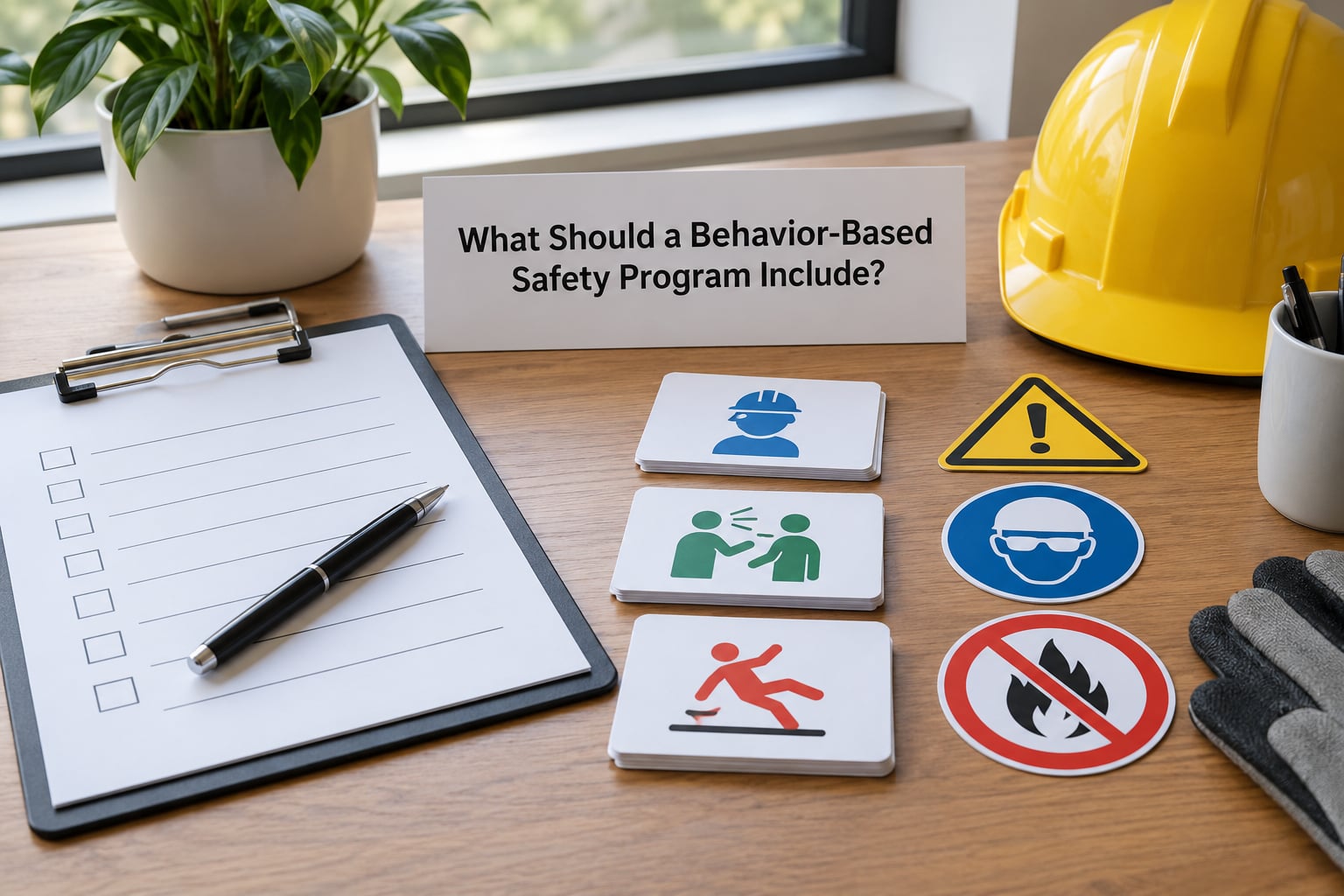
A workable program has about ten moving parts. Some employers start with three and grow the rest as the data tells them where they are blind.
- Hazard and task analysis to identify which tasks carry the real exposure.
- A written list of critical behaviors, each written so two observers would score it the same way.
- Trained observers, including people who do the work, not only supervisors.
- A short observation method, whether that is a five-item card or a mobile checklist.
- Feedback language agreed in advance, so praise and coaching sound consistent.
- Coaching for the behavior, not just the correction.
- Positive reinforcement that runs on the same schedule as the recognition.
- Worker participation in choosing and revising the behaviors.
- Records kept somewhere people can read them, not locked in a supervisor drawer.
- Management review on a fixed schedule with corrective actions assigned and dated.
The seven steps to implement it
The implementation sequence below is the part most employers get wrong, usually by starting at step five.
- Set objectives. Decide what you are trying to change and over what period, in language the crew will understand.
- Build a steering group. One sponsor from leadership, a safety lead, two or three supervisors, and workers from the areas being observed.
- Run a behavioral baseline. Observe for two to four weeks before intervening, so you know where you are starting.
- Choose critical behaviors. Narrow the hazard list down to a short, observable set your people helped pick.
- Train the observers. Calibration practice matters more here than almost anything else in the program.
- Apply interventions. Match the intervention to the cause: coaching, equipment changes, engineering fixes, recognition, or revised procedures.
- Measure and revise. Track the trend, report it openly, and re-baseline once a year or after any significant change.
The steering group is the piece that survives leadership turnover. A program owned by one enthusiastic manager usually dies with that manager. If you want a practical view of the paperwork side, our guide to tracking safety metrics in a small company fits smaller organizations that do not have a full EHS team.
What Behaviors Should You Focus On?
Choose behaviors that are visible, frequent, and connected to a serious outcome. If you cannot watch it from across a work area, or if it happens once a year, it is a poor candidate for observation.
Personal protective equipment
Not “wear PPE” but “eye protection on when grinding, without being asked.” Specific enough to score, and it reflects a hazard that actually bites.
Equipment and pre-task checks
“Complete the documented pre-lift check before the first movement of the shift.” Frequency matters here, because check behavior collapses under queue pressure.
Reporting and stop-work
“Call a stop on the line when a guard is missing,” and separately, “file the near-miss report before the end of shift.” Reporting rates are one of the most honest signals you will ever collect.
Housekeeping and access routes
“Keep the marked walkway clear during staging.” This one is nearly free to observe, easy to fix, and pays off in both safety and trip exposure.
Emergency and energy control
“Verify zero energy before removing the guard,” or “confirm the muster point is clear at the alarm test.” Rare, high consequence, and still worth scoring when it happens.
Resist the urge to define values like “be more careful.” You cannot observe it, and it gives an observer nothing but judgment. Safety professionals on the r/SafetyProfessionals community tend to land on the same point from different directions: vague criteria become checklists, and checklists become theater.
How Do You Introduce Behaviors Without Creating a Blame Culture?
Blame culture does not appear because someone wrote it in a policy. It appears the first time a supervisor uses an observation to build a case, and word spreads faster than any rollout plan.
Say what the program is for before you start counting anything. Workers who believe observations are the first step toward discipline will perform for an audience, which produces data that tells you nothing.
Let workers choose part of the behavior list. A behavior invented in a conference room gets defended in a conference room. A behavior proposed by the person who does the task gets defended on the floor.
Coach the system when the system caused the behavior. If people are skipping the check because the sheet is two aisles away, the corrective conversation belongs with the layout, not with the operator. Mixing those two is how a program teaches people to hide problems instead of reporting them.
Separate observation from performance management, in writing and in practice. If someone’s bonus can move because of a single observation card, the observation stops measuring reality. Give observation data to the safety steering group, and route performance conversations through the line manager with context the observer could never have.
Reward the reporting of problems as loudly as the absence of problems. A team that gets thanked for raising an issue is a team that will raise the next one.
If you want a structured read on whether people feel safe speaking up, 24 copy-ready safety climate survey questions will give you a way to check that assumption rather than guess at it.
How Can You Measure Whether the Program Works?
Measure with two kinds of numbers. Leading indicators tell you whether things are moving; lagging indicators tell you what already cost you.
Leading indicators
- Completion rate for each critical behavior, tracked by area and shift.
- Observation quality: percentage of observations where calibrated observers agreed.
- Number of hazards raised and closed, with median days open.
- Near-miss reporting rate and the proportion of reports that get feedback.
- Number of process changes made because an observation trend demanded one.
Lagging indicators
Recordable injury frequency, days lost, incident investigation findings, and cost. These move slowly and they arrive too late to steer by, which is exactly why the leading numbers matter more.
The mistake that breaks most programs
Never treat raw observation counts as a safety score. Two people watching the same crew twice will produce more data than one person watching once, and a supervisor who wants a good number will simply observe more. Observation totals measure enthusiasm, not safety.
The same trap applies to near-miss counts. A rising trend after a campaign often means reporting trust improved, which is good news. It only looks like deterioration to leaders who were rewarding quiet weeks.
A workable review rhythm
Monthly trend review for the steering group, quarterly reporting to leadership with corrective actions and dates, and a full re-baseline once a year or after a process change. Publish the results where the crew can read them, including the ugly ones.
What Are the Limitations and Risks of Behavior-Based Safety?
Behavior based safety has real weaknesses, and an honest program names them out loud.
It can become surveillance. Observation tracks a person’s every move, the trust cost is severe, and once workers believe they are being watched, the behavior you measure improves while everything you do not measure gets worse.
Observer bias is real. Untrained observers drift toward what they expect, they favor visible and easy-to-score behaviors, and they score the people they like more highly. This is why calibration sessions matter: two observers watch the same task separately, then compare.
Feedback quality varies wildly. Some supervisors deliver a lecture at the worst possible moment, some say nothing at all, and workers quickly learn which supervisors to take seriously.
Easy behaviors get all the attention. Wearing eye protection is quick to score and satisfying to chart. Conflicting permits, machine guarding and contractor coordination are harder to observe and much more likely to hurt someone.
It can hide a reporting problem. If observations come back 95 percent positive while your hazard reports dry up, the program is not measuring your workforce. It is measuring the confident part of it.
It can blame the wrong layer. Behavior based safety originated in a tradition of analyzing individual acts. Applied carelessly, it ends with a worker disciplined for working around a guard that was missing for six weeks. Use the method to find process failures, not to allocate fault.
Safety professionals debate how much of this approach still holds up. Some argue that what once worked as a field technique has been overtaken by leadership development, crew-level coaching, and better hazard reporting. Others point out that no observation scheme can substitute for engineering controls. The defensible position is that behavior based safety is one instrument with a narrow job, used well.
Frequently Asked Questions
What is a behavior based safety program?
A behavior based safety program is a structured system for identifying the specific actions that prevent or cause injuries, observing those actions during real work, giving timely feedback, and correcting the conditions behind risky behavior. It is a management approach rather than a training module, and it works alongside engineering controls, maintenance and legal compliance rather than replacing them.
What are the 7 steps of the behavior-based safety process?
The usual seven steps are: set clear objectives, form a steering group with leadership and worker representation, run a two to four week behavioral baseline, select a short list of critical behaviors, train and calibrate observers, apply interventions matched to the cause of each at-risk behavior, then measure results and revise. Each step feeds the next, so skipping the baseline usually means intervening before you know the problem.
What is an example of a behavior-based safety program?
A construction contractor might define five behaviors: verify scaffold tags before climbing, wear a harness above ten feet, keep the exclusion zone clear during lifts, call a stop when a utility is exposed, and report near misses the same day. Supervisors and trained crew members then observe those actions on a short checklist, give feedback in the moment, and review the weekly trend to see which one keeps slipping.
Does behavior based safety lead to blame culture and employee surveillance?
It can, and that is the most common failure mode. It happens when observation data is used for discipline, when workers had no part in choosing the behaviors, and when leaders treat rising compliance numbers as the goal. Programs that keep observation separate from performance management, let workers help define the behaviors, and reward hazard reporting avoid most of that damage.
How do you measure whether a behavior-based safety program works?
Track leading indicators first: completion rates per critical behavior by area and shift, observer calibration agreement, hazards raised and closed, and near-miss report volume with response times. Add lagging indicators such as recordable injuries and days lost, but expect those to move slowly. Never use raw observation totals as a score, since more observation hours produce more data regardless of behavior.
Can a small company implement behavior based safety?
Yes, and enterprise frameworks are usually too heavy for small teams. A five-person contractor can run the same cycle with a five-item card, one trained observer besides the owner, and a monthly twenty-minute review. The pieces that cannot be dropped are worker participation, calibrated observation and management review. Scale the documentation, not the sequence.
Conclusion
Start smaller than feels impressive. Define three to five critical behaviors with the people who do the work, run a short baseline to see where you actually stand, train two or three observers to score the same way, and then change one thing about the process each month based on what the data shows.
Keep observation away from discipline, publish the results, and let the trends drive corrective action. That is a behavior based safety program explained and running, and it will outperform a fifty-page manual nobody opens.