
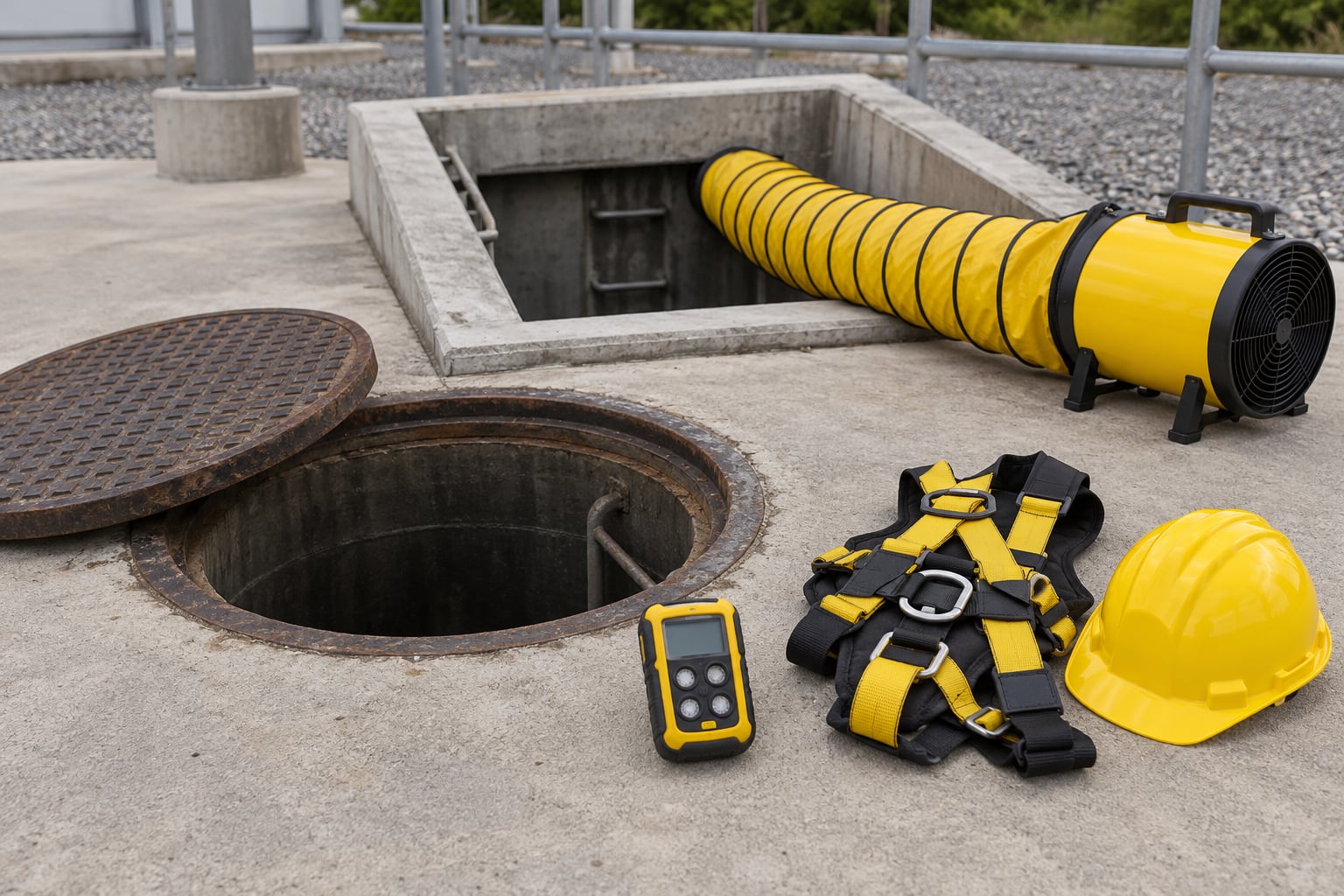
Confined space hazards examples run from the obvious, like a hydrogen sulfide cloud in a sewer, to the quiet ones, like a nitrogen blanket left over in a vessel after inerting. Hazardous atmospheres account for most confined space deaths, so this guide walks through 12 real hazard categories, where each one shows up, and the recognition and control steps that go with it.
This is written for safety officers writing permits, supervisors signing entries, and the workers who climb down first. It is educational material, not a substitute for site-specific training, a qualified person’s assessment, or the written permit for the space in front of you.
Last reviewed October 2026. Thresholds cited below come from OSHA 29 CFR 1910.146, 29 CFR 1910 Subpart Z, and the NIOSH Pocket Guide to Chemical Hazards.
Table of Contents
- Confined Space Hazards Examples at a Glance
- 1. Oxygen Deficiency
- 2. Flammable Atmospheres
- 3. Hydrogen Sulfide Exposure
- 4. Carbon Monoxide Buildup
- 5. Toxic Gases and Vapors
- 6. Engulfment
- 7. Drowning or Inability to Exit
- 8. Entrapment by Machinery
- 9. Electrical Hazards
- 10. Heat Stress
- 11. Poor Lighting and Restricted Movement
- 12. Noise and Communication Failures
- Frequently Asked Questions
- What are the most common confined space hazards?
- How do you test a confined space before entry?
- Can a smell be used to detect a confined space hazard?
- What safety training should workers receive for confined spaces?
- What should an employer do if a confined space entrant becomes distressed?
- Are all tanks, pits, and storage bins confined spaces?
- Conclusion: Start With a Confident Space Hazard Assessment
Confined Space Hazards Examples at a Glance
Every row below is a hazard category you will meet in tanks, silos, manholes, vessels, hoppers, pits, and vaults. Read across the table and you can usually tell which two or three categories control the risk in your own space.
| Hazard | Where it commonly occurs | Potential consequence | Primary safety consideration |
|---|---|---|---|
| Oxygen deficiency | Empty tanks, sewers, pits, purged vessels | Unconsciousness and death within minutes | Test before opening the hatch, ventilate, monitor continuously |
| Flammable atmosphere | Tanks, silos, process vessels, drying ovens | Flash fire or explosion | Test against 10 percent of the lower flammable limit, control ignition sources |
| Hydrogen sulfide | Wastewater systems, sewage pits, manure pits, sumps | Immediate loss of consciousness, rapid death | Never rely on smell; test and ventilate, prepare for immediate evacuation |
| Carbon monoxide | Boiler rooms, engine rooms, fired heaters, tanks | Headache, confusion, unconsciousness, death | Eliminate or isolate the source, ventilate, monitor at the breathing zone |
| Toxic gases and vapors | Chemical vessels, coating work, welding spaces | Chemical exposure burns, organ damage, cancer risk | Know the materials inside, test for the specific substance, purge where needed |
| Engulfment | Grain bins, silos, hoppers, sumps, sludge tanks | Entrapment and drowning in granular or liquid material | Never enter flowing or bridged material; isolate and de-energize all extraction |
| Inability to exit or drowning | Flooded vaults, deep pits, wet wells, steep ladders | Drowning, fall, failure to self-rescue | Provide a retrieval system and confirm the attendant outside has line of sight |
| Machine entrapment | Augers, conveyors, mixers, cyclones, fans | Limb amputation, crushing | Lockout and tagout, block stored material, guard before entry |
| Electrical | Wet vaults, metal vessels, temporary lighting, welders | Shock, electrocution, arc flash, ignition of vapors | De-energize and verify, use protected low-voltage lighting, bond and ground |
| Heat stress | Boilers, hot tanks, summer excavations, dry kilns | Dehydration, heat exhaustion, impaired judgment | Schedule short rotations, schedule water and rest breaks, monitor for symptoms |
| Poor lighting and restricted movement | Ductwork, vaults, tunnels, cluttered vessels | Falls, struck-by events, disorientation, delayed rescue | Provide rated lighting, clean the space, keep access routes lit and clear |
| Noise and failed communication | Pump stations, plants with ventilation fans, tunnels | Missed alarms, no status check, delayed assistance | Set a communication method and test it before entry begins |
1. Oxygen Deficiency
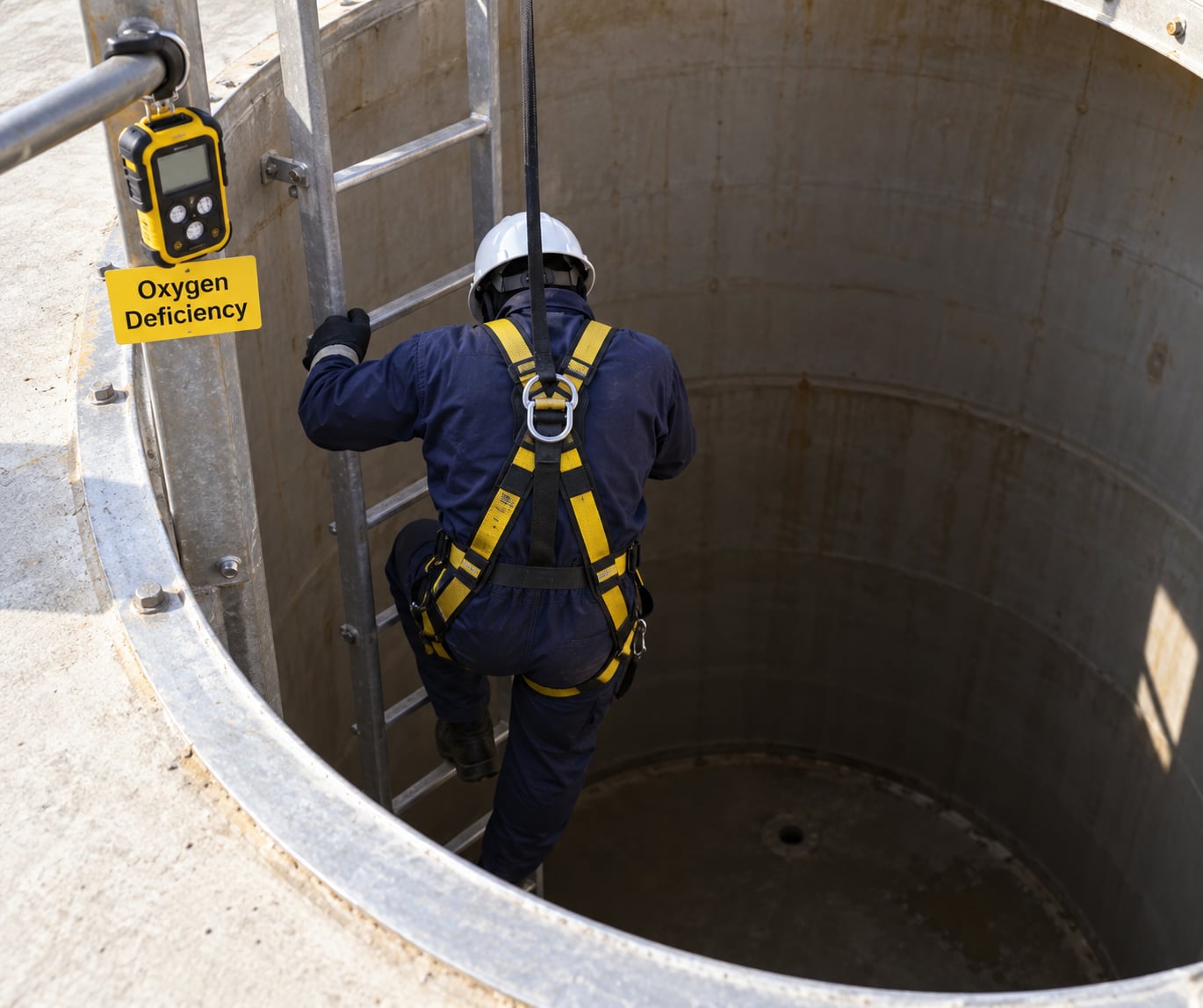
Oxygen deficiency is the simplest hazard to measure and one of the fastest to kill. OSHA treats air below 19.5 percent oxygen as deficient and air above 23.5 percent as enriched, and either condition turns a routine entry into an emergency.
Real examples: an empty storage tank that was previously purged with nitrogen, a sewer main with no forced ventilation, a deep pump pit after a summer rain displaces the air, a reactor vessel still holding inerting gas from the last batch, or a manhole opened after a period of low flow. In each case the space has not been made safe by being empty. It has been made empty of people, not of the gases that displaced the air.
Warning signs are unreliable. Headache, dizziness, sweating, confusion, and a rapid heartbeat can all appear, but a person can lose consciousness in a few breaths with no warning at all, and by the time a second worker sees them fall, they are already beyond self-rescue.
Control means testing the atmosphere before the cover comes off, ventilating mechanically rather than relying on a hand fan, and keeping a monitor on the entrant for the whole shift. Order matters. Test the top of the space before you descend, because gases often layer, and retest after any break in ventilation or after the attendant reports a change in conditions.
Why Confined Space Hazards Examples Matter
Confined space incidents rarely involve one problem acting alone. A worker may be standing in a tank that is oxygen-deficient, holding a solvent rag that is adding vapor to the air, next to an unisolated agitator, under a temporary light that is not rated for the atmosphere, above a sludge layer that nobody drained.
That is why examples are more useful than labels. One visible warning sign, such as a gas reading or a damp floor, tells you almost nothing about the other four hazards waiting in the space. Reading across these twelve categories before entry is what turns a list into an assessment.
The practical test is simple: a space with twenty years of clean entries is not a safe space, it is a space where nobody has recorded a reading recently. Nitrogen used for inerting on the previous batch, a valve left open to a process line, or a plugged vent can change the atmosphere between one shift and the next, and the only record that catches it is a fresh test on the day.
2. Flammable Atmospheres
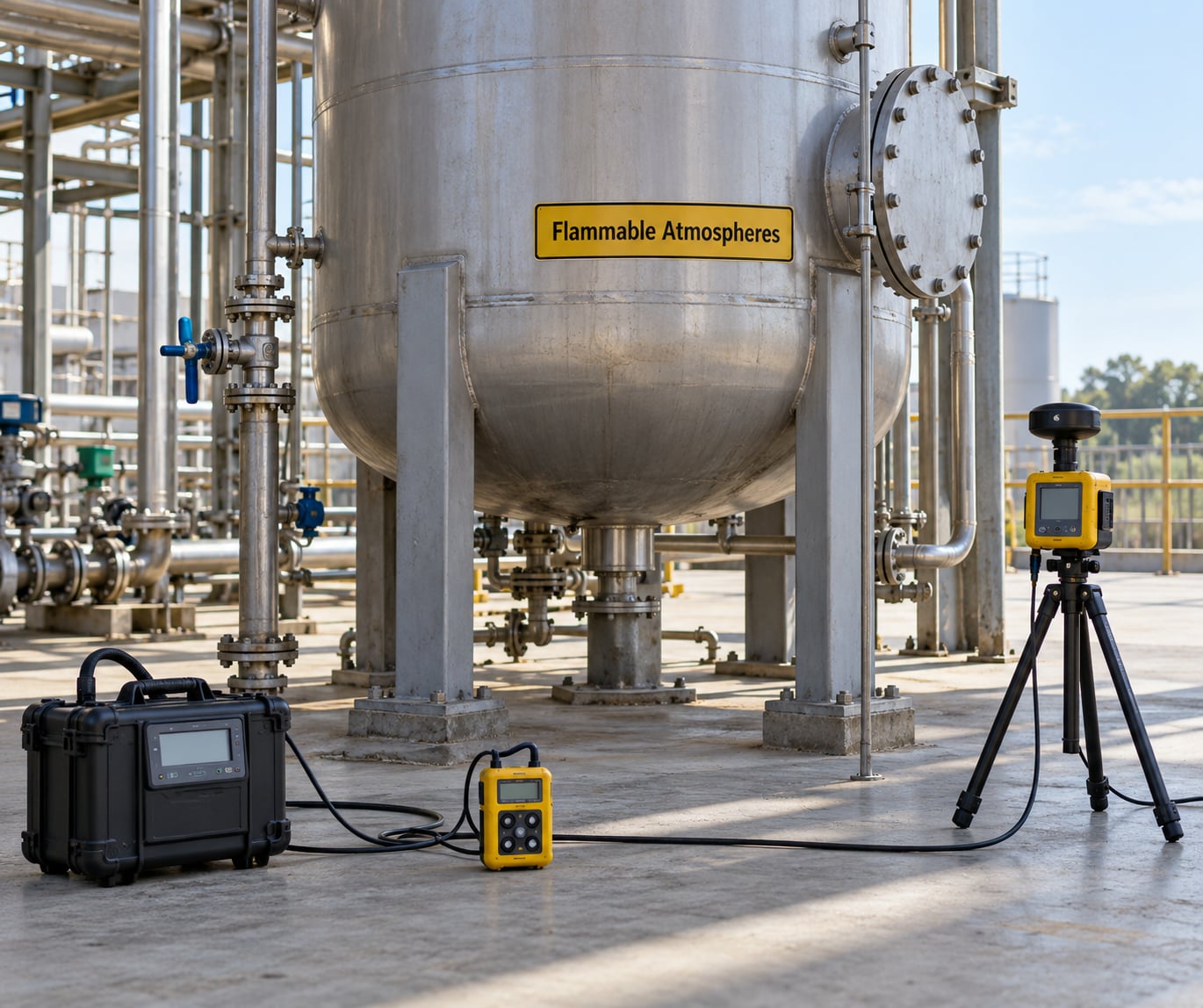
A flammable atmosphere turns a spark into an explosion, and confined spaces make ignition sources and fuel unusually easy to find. OSHA treats any atmosphere at or above 10 percent of the lower flammable limit as one that requires controls before entry.
Typical sources: methane and hydrogen sulfide off a settling tank, propane residue in a cylinder or a vaporizer, vapor from a solvent-based coating or adhesive, residual vapors in a tank that was never gas-freed, and a dust cloud from grain, coal, aluminium powder, or rubber. Combustible dust deserves its own mention because it can explode at concentrations well below the flammable range, and a settled layer disturbed by a dropped tool can become airborne.
Control means testing for the flammable range before anyone opens a hatch or switches on a light, bonding and grounding containers during transfer, using approved equipment rated for the classified area, removing ignition sources including phones and non-rated fans, and using ventilation that does not itself introduce a spark.
Silos and dust collection equipment are the classic cases. A baghouse or cyclone that has been idle overnight can still hold a combustible cloud, and ductwork can propagate a deflagration further than anyone expects if it is not isolated.
3. Hydrogen Sulfide Exposure
Hydrogen sulfide is the gas that makes sewer and wastewater work dangerous, and the one gas where your sense of smell is worth nothing. It kills the ability to smell at concentrations far below the levels that disable you.
Where it accumulates: sewage collection systems and wet wells, grease traps, manure pits and barns, sumps, and any stagnant organic material. It is denser than air, so it collects in the lowest part of a space, right where the work happens.
For reference, the NIOSH recommended exposure limit is 10 ppm as an eight-hour average with a 15 ppm short-term limit, and the immediately dangerous to life or health value is 100 ppm. At that level a person can lose consciousness in minutes, and above roughly 700 ppm death can be immediate. Low concentrations irritate the eyes and throat, which is the warning many workers mistake for a normal sewer smell.
Control means atmospheric testing rather than sniffing, mechanical ventilation with a blower ducted into the space, and a plan for fast removal. Nobody enters a space with a known hydrogen sulfide reading without respiratory protection specified by a qualified person and a rescue plan that can extract them.
4. Carbon Monoxide Buildup
Carbon monoxide is an invisible, odorless gas that a combustion appliance produces whenever it burns incompletely or burns where air cannot reach it, and it accumulates wherever ventilation is poor.
Examples that show up on incident reports: a boiler room where a fired heater was relit inside a sealed room, an engine idling in a pump station bay, a temporary propane heater running in an unventilated vault, a fire watch left burning after a hot work task, or a worker entering a vessel while a drying heater on the outside of the wall is still drawing through it.
Symptoms climb in a familiar sequence: headache, then weakness and nausea, then confusion, then loss of consciousness. Everyone exposed feels the same way, which is why the group can be slow to recognise it as carbon monoxide and fast to collapse together. NIOSH sets a recommended limit of 35 ppm as an eight-hour average and an immediately dangerous to life or health value of 1,200 ppm.
Eliminate the source where you can, which usually means not running combustion equipment inside the space. Where you cannot, isolate it, ventilate, and monitor continuously at the breathing zone rather than at the opening, because the reading at the hatch is often lower than the reading where the work is.
5. Toxic Gases and Vapors
Not every atmosphere hazard is oxygen or flammable gas. A space can be correctly oxygenated and non-flammable and still be lethal because of what the work itself releases.
Examples: chlorine in a water treatment or chemical plant, ammonia in refrigeration or fertilizer areas, solvent vapors from painting and coating, welding fumes in a vessel, and hydrogen or nitrogen from a purge line someone left connected. Solvent vapors are also the classic case where the work creates the fire hazard, since flammable coating residue and vapor can reach the lower flammable limit inside a freshly sprayed tank.
Substances also react badly with each other and with the material of the space. Water into a reactive chemical vessel, or a contaminated rag left to oxidize, produces a hazard that was not in the original inventory. Before anyone opens a hatch, somebody needs to know what the space held, what it is lined with, what is being pumped in, and what reacts with what.
Control is about information and isolation rather than a single instrument. Know the inventory, test for the specific substance at a level that matters for the task, purge or inert where required, bring in supplied air rather than air-purifying respirators when the concentration is unknown, and keep coatings and adhesives out of the space where the fire load cannot be controlled.
6. Engulfment
Engulfment means a worker is swallowed by grain, soil, sand, flour, plastic pellets, sludge, or liquid, and the material closes over the head and holds the body in place.
This is the dominant hazard in grain handling. A bin that was empty yesterday can be bridged over the top and empty at the bottom, so a foot goes into a flow that appears to be nothing but air. Collapse of a grain bridge can then bury a worker in seconds, and the flowing material pulls the person in rather than letting them climb out.
Granular material has weight and resistance far beyond what it looks like. A person buried to the chest in grain cannot generate enough force to free themselves, and grain dust near the surface is combustible, so the rescue itself can trigger a second event.
Control means treating a bin, silo, hopper, or chute as a live flow until it is proven otherwise. Isolate and lock out all augers, conveyors, and sweepers. Never enter material that is flowing or bridged, and leave bridges to people with the equipment and training for that work. For sludge and liquid in sumps and wet wells, the equivalent rule applies: no entry into an unisolated pit with a pumping system that can be started from outside.
7. Drowning or Inability to Exit
A space can kill without containing a single gas. Deep water, a flooded vault, a wet well with a steep ladder, or a slippery floor can leave a worker who cannot climb out or cannot hold their face above the waterline.
Examples: a stormwater vault that filled overnight, a trench that filled during a rainstorm, a cooling tower basin, a paper mill tank drained to a heel that turns out to be a sump, or an access ladder inside a vessel whose rungs sit above the entry point.
The core problem is that a confined space is defined partly by its limited means of escape, so an emergency often removes the exit at the same moment it removes the person. A worker with an injury in a wet well cannot self-rescue. Nobody on the surface can reach down and lift them out without going in.
Control is planned retrieval. Mechanical ventilation keeps water and vapor out of an otherwise dry space, pumps drain the space, and a tripod with a winch, or a full-body harness on a retrieval line, means someone outside can extract an entrant who cannot climb. Waterproof rated lighting matters too, because a worker who cannot be seen cannot be reached.
8. Entrapment by Machinery
Moving equipment inside a confined space catches clothing, hair, hands, and limbs, and it keeps running long after the operator knows someone is in the space.
Examples: an auger or screw conveyor feeding a silo, a mixer or agitator left on a batch timer, a bucket elevator, a fan with a belt drive, a cyclone with an internal rotor, a discharge chute where a slide gate can open by gravity, or stored material held in place by a gate that has been propped open.
Stored material deserves as much attention as the moving parts. A blocked chute, a frozen pile of grain, or a stack of plate steel can shift when something else moves, and the resulting release is a crush hazard that no lockout tag on a drive motor addresses.
Control is the same sequence used everywhere in industry, applied before entry rather than during: shut down, isolate the energy source, lock and tag it, release or block stored energy, then verify by trying to start it and by checking for zero energy. Guarding must be restored after the job, not before the next shift, because a missing guard left off after maintenance is how an unplanned start reaches a space nobody thinks is occupied.
9. Electrical Hazards
Electrical exposure rises sharply inside confined spaces because the enclosure, the moisture, and the confined working volume all work against you, and because entry often happens at night with temporary equipment.
Typical examples: a wet vault or flooded pump station where a submerged extension lead is still connected, a steel tank where a welding lead has a damaged jacket, extension cords daisy-chained past their rating, a light fixture wired without a protective enclosure, a conductive dust or sludge layer, and a generator or inverter positioned where the space’s air can carry exhaust back to the entrant.
The outcomes range from shock and electrocution to arc flash, and also to ignition of a flammable atmosphere that would otherwise have stayed unlit. A vapor-tight fixture rated for the space is not a detail.
Control means de-energizing and verifying where the task allows it, and where it does not, using protected low-voltage lighting and equipment listed or approved for the atmosphere, bonding and grounding metal containers, keeping electrical equipment above standing water, and using residual current or ground-fault protection where temporary power is involved. Many sites have a written procedure for this already, and it is worth reading rather than improvising: how to prevent electrical hazards at work covers the hierarchy of controls and the lockout side of the job in more detail.
10. Heat Stress
Heat builds inside a confined space because the enclosure blocks the body’s main cooling routes. Sweating loses less heat in still, humid air, and radiant heat from a hot vessel wall or a fired heater hits the whole body at once.
Examples: cleaning a hot tank on an afternoon shift, boiler and pressure vessel work during a shutdown in summer, an excavation in July with a sheet pile wall on the sunny side, a kiln or dryer, a paper mill tank with the steam line still connected, and a confined space that is not hot itself but sits inside a plant where the ambient temperature is already high.
Consequences start as thirst and fatigue, move to headache and dizziness, then to confusion where judgment fails at exactly the wrong moment. Workers on a schedule in a hot space take shortcuts, skip breaks, and misjudge a step. Heat also magnifies every other hazard on this list, because a tired, dehydrated person reads a gas meter less carefully and climbs a ladder less steadily.
Control is scheduling and rotation. Put the work in the coolest part of the shift, limit continuous time in the space, provide cool water and rest periods, acclimatize new entrants, and have someone outside watching for confusion, stumbling, or a change in skin color. If the space has no way to move air past the entrant, the time limit matters more than the thermometer.
11. Poor Lighting and Restricted Movement
Confined spaces are dark, cramped, and full of trip hazards, and poor visibility delays both the work and the rescue.
Examples: ductwork and plenums with no fixed lighting, transformer and utility vaults with only a borrowed flashlight, a tank being inspected with a helmet lamp where the beam lights the wall but not the floor, a vessel cluttered with scaffolding, hoses, and dropped tools, and a sloping or converging floor where the only path runs uphill.
Consequences are falls, struck-by injuries, disorientation, and a lost entrant who cannot respond to a name being called. Damaged or improvised wiring for temporary lighting also creates the ignition and electrical risks described above, so lighting is a hazard control and not just a convenience.
Control means providing low-voltage, protected, rated lighting that illuminates the floor and the access route, cleaning out the space before entry where that is safe, and keeping the trip path clear. Where vertical entry is involved, a full-body harness and a descent line give a person control of their own speed on the way down and a way to be raised on the way up.
12. Noise and Communication Failures
A confined space that is loud, or where people cannot hear each other, fails at the one thing an attendant program depends on: knowing whether the entrant is all right.
Examples: a pumping station with large pumps and ventilation fans running, an industrial plant where the entry supervisor is outside the building, a tunnel or culvert with a long run and no radio repeater, a crew that has agreed on hand signals that nobody has practised, and radios that do not work underground or inside a steel vessel where the shell blocks the signal.
What goes wrong is simple and repeated: an attendant cannot hear a cough, an entrant cannot hear the order to get out, a warning gets shouted into a fan, and a delayed status check becomes a delay nobody notices until it matters.
Control means choosing the communication method for the space before entry and testing it end to end. That might be a radio with an antenna routed through the opening, a wired retrieval line with a communication wire attached, or a scheduled check every few minutes with a fixed response. Set the check interval in the permit, write down what the attendant does if a check is missed, and treat a missed check as the emergency it is rather than as a nuisance.
Frequently Asked Questions
What are the most common confined space hazards?
The most common confined space hazards examples are atmospheric. Oxygen deficiency, toxic gases such as hydrogen sulfide and carbon monoxide, and flammable atmospheres cause the majority of confined space deaths. Physical hazards come next, including engulfment in grain or sludge, entrapment by machinery, electrical contact, restricted entry and exit, noise, and heat stress.
How do you test a confined space before entry?
Test from outside before the cover or hatch is opened, then test again after opening, because gases layer and the reading changes with the access. Calibrated equipment should be bump tested before use, and testing follows the manufacturer’s order, commonly oxygen, flammable range, then toxic gases. Acceptable entry requires at least 19.5 percent and no more than 23.5 percent oxygen, under 10 percent of the lower flammable limit, and every toxic gas below its permissible exposure limit.
Can a smell be used to detect a confined space hazard?
No. Smell is not an acceptable detection method for any confined space atmosphere. Hydrogen sulfide deadens the sense of smell at concentrations well below those that cause unconsciousness, so the odor that warns you can disappear exactly when the danger is greatest. Carbon monoxide, methane, and many solvent vapors are odorless to begin with. Use calibrated direct-reading instruments and personal monitors instead, tested before entry and worn for the duration of the entry.
What safety training should workers receive for confined spaces?
Training should cover hazard recognition for the specific spaces on site, atmospheric testing and instrument limits, ventilation and retrieval equipment, lockout and tagout, the attendant and entry supervisor roles, permit conditions, and emergency response without unprotected entry. Under OSHA 29 CFR 1910.146, entrant and attendant training is required, and retraining is required when conditions change, when the procedure is revised, or after an incident involving an unprotected rescuer.
What should an employer do if a confined space entrant becomes distressed?
Do not send untrained people in. Raise the alarm, call emergency services, and initiate retrieval using the equipment already on site, such as a tripod and winch or a retrieval line, while nobody enters unprotected. Attempted rescue without respiratory protection is the mechanism behind many multiple-fatality confined space events, because rescuers arrive with the same unbreathable atmosphere and no way out. Ventilate if it can be done safely, keep the entrant in communication if possible, and preserve readings for the investigation.
Are all tanks, pits, and storage bins confined spaces?
A space qualifies when it is large enough for a person to enter, has limited or restricted means of entry and exit, and is not designed for continuous occupancy. Tanks, pits, and bins often meet all three, but a few do not, such as a fully open aboveground tank with unrestricted access. A space only becomes permit-required when it also contains a serious hazard such as a hazardous atmosphere, engulfment risk, inwardly converging walls, or any other serious exposure, so empty-looking is not the same as safe.
Conclusion: Start With a Confident Space Hazard Assessment
Work down the twelve categories in this guide and ask each one against the space in front of you. What is the atmosphere now and what could change it in the next hour, what is the material inside, what could move, what is the electricity doing, and what stands between the entrant and the outside.
Then let the answers drive the controls rather than the paperwork. Test before the hatch comes off, ventilate properly, isolate energy, keep a monitor on the entrant, keep the retrieval system in place, and set the attendant’s communication method in writing.
A space with a long clean history tells you very little. Pick the assessment that assumes the hazard is still there, because in confined space hazards examples, the dangerous ones are the ones nobody saw coming.