
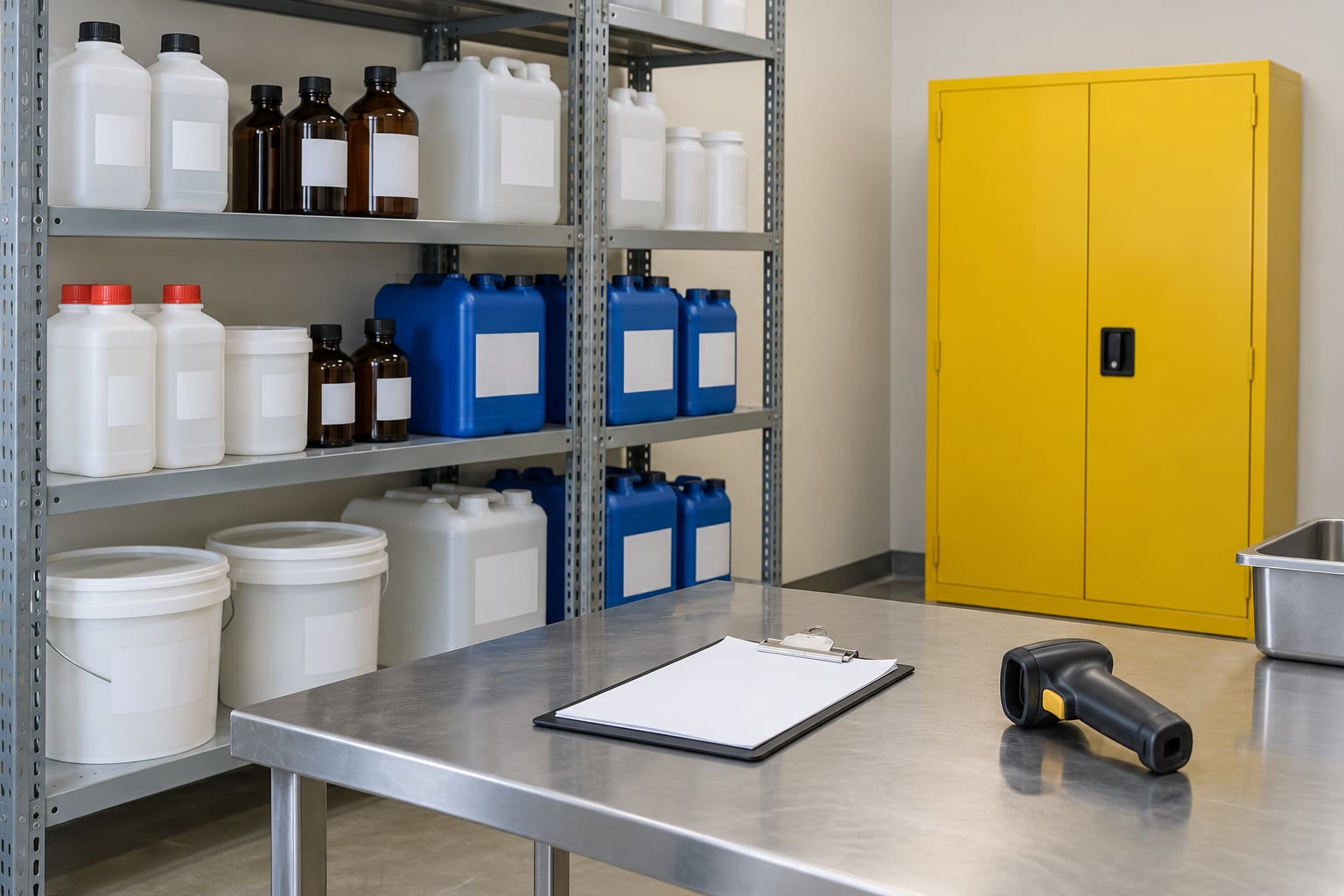
A chemical inventory list is a record of every hazardous chemical known to be present in your workplace, with enough detail on each entry to find the container, know what is in it, and pull its safety data sheet. Learning how to make a chemical inventory list takes one physical walkthrough of your storage spaces plus a few hours at a desk to type it up, and the finished list is what OSHA compliance, fire inspections and emergency planning all depend on.
Most of the difficulty is not the typing. It is deciding what counts as a chemical, what goes on a row, and how you keep the list honest six months later when containers have been moved, opened, emptied or relabelled by someone who did not think about the spreadsheet.
This guide walks through the whole job: what to gather first, the seven steps that produce a finished list, and the habits that keep it accurate. The same method works in a university lab, a restaurant with a cleaning closet, a school science room or a warehouse with a solvent cage.
If your team is new to this, the companion guide on janitorial worker chemical safety covers the products most often left off an inventory in food service and facilities work.
Table of Contents
- What You Need
- Step-by-Step
- How to define the inventory scope and responsible owner
- How to collect product information from every location
- How to record names, identifiers, and quantities
- How to document hazards and required controls
- How to verify the list against purchasing and SDS records
- How to assign locations and control access
- How to maintain, review, and update the inventory
- Common Mistakes
- Frequently Asked Questions
- What should be included in a chemical inventory list?
- What are the OSHA requirements for maintaining a chemical inventory list?
- What chemicals need to be reported on Tier II?
- How often should a chemical inventory be updated?
- Where should the chemical inventory list be kept?
- Do all hazardous products need an SDS?
- Conclusion
What You Need
Gather these before you open a spreadsheet. Having them on hand turns the walkthrough into a transcription job instead of a research project.
- Purchasing and receiving records for the last 12 to 24 months: purchase orders, invoices, packing lists and material issue records. These tell you what should be on the shelves, which is the baseline you reconcile against later.
- Your existing SDS library, including the binder or digital folder, and a note of which products are missing a current sheet. Reading the format makes the transcription faster, and how to read a safety data sheet in seven steps covers which sections carry the details you need.
- Physical containers and their labels. The label is the source of truth for product name, concentration and supplier. Where a label is missing or faded, that container is a finding, not a reason to skip the row.
- A location map with a consistent naming scheme for buildings, rooms, cabinets and shelves. Decide this before you start recording anything, because vague location names are the single biggest reason an inventory goes stale.
- A named owner for the list, usually a chemical hygiene officer, safety officer or facilities manager, plus a backup person.
- A walking kit: clipboard or tablet, a barcode scanner if you have one, a permanent marker for marking containers, and something to flag containers that cannot be identified on the spot.
Step-by-Step
How to define the inventory scope and responsible owner
Scope first. Decide which substances and which locations are in, and write that definition down where the list will live. A useful default is every workplace location you control or are responsible for, including storage rooms, work areas, maintenance shops, janitorial closets, vehicles used for work, and any satellite or remote site.
Record the owner’s name and title at the top of the list, along with the review date and the next review date. When ownership sits with a person rather than a department, the list survives that person’s move to another job. When it belongs to a department, it quietly stops being updated.
Set the cadence now: an annual full physical reconciliation, plus a lighter review after any move, remodel or change of use. The practical guide to healthier break rooms covers another kind of shared-space inspection, and the review habits are similar.
How to collect product information from every location
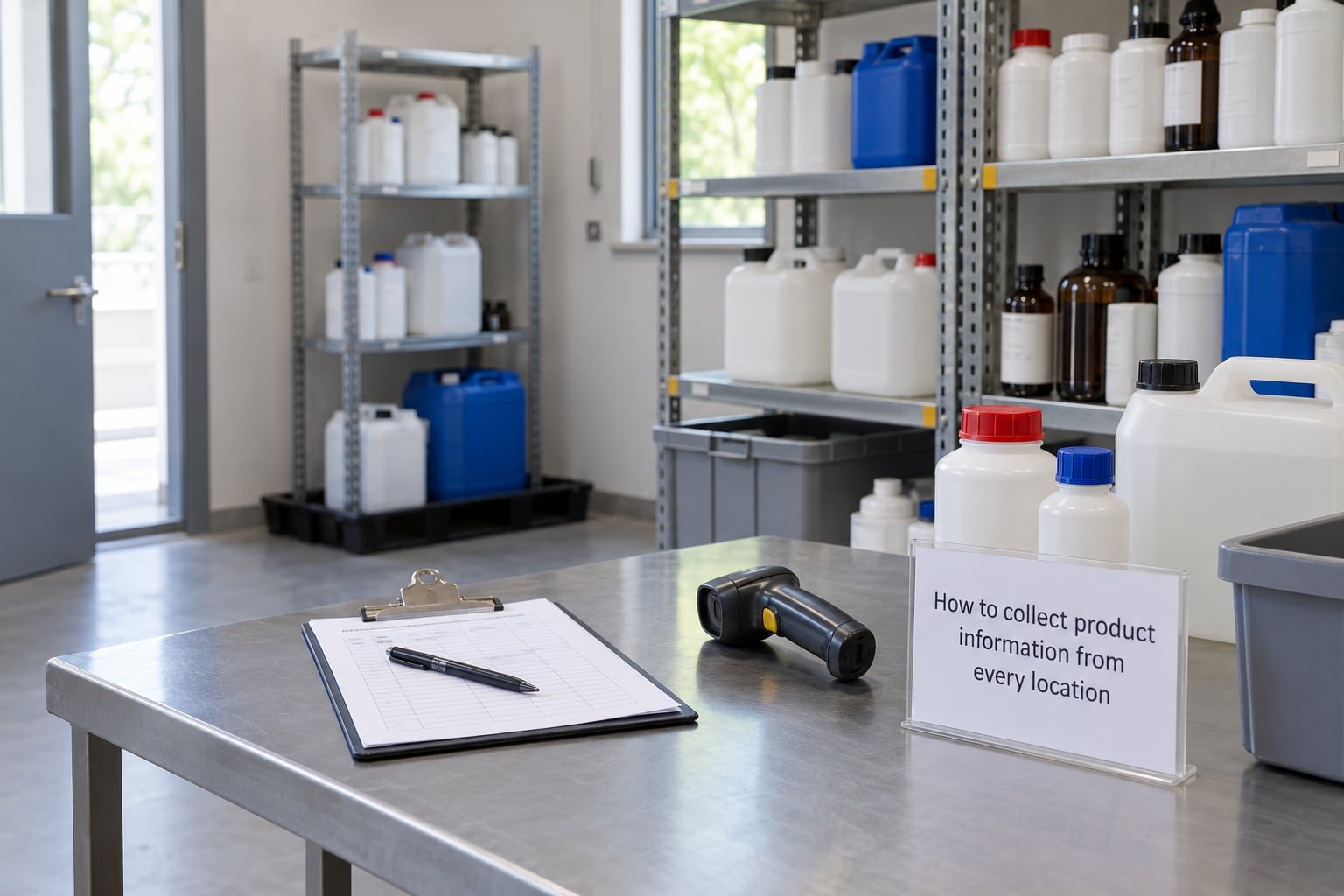
Walk each location shelf by shelf, not alphabetically down the aisle. Start in the room with the worst labelling, not the best, so you learn what a problem looks like before the easy rooms.
At each container, read the label and record what is physically there. Do not type anything from memory or from the purchasing record. Containers move, get refilled from a bulk container, and get relabelled with a marker pen.
Count every container separately, even when five identical containers of the same product sit on the same shelf. A quantity column with a single “5000 mL” figure tells a responder nothing about how many packages are on the shelf, and a leak response is a container problem, not a volume problem.
How to record names, identifiers, and quantities
One row per container is the rule that makes the list work. Substance-level grouping looks tidy and then fails the first time someone needs to know which bottle is half full.
These are the fields every row should carry:
| Field | Why it matters | Example value |
|---|---|---|
| Product name as labelled | Matches the container and the SDS | Sodium hydroxide solution |
| Concentration and solvent | Distinguishes a mixture from the pure substance | 2 M in water |
| CAS Registry Number | Unambiguous identifier; links pure materials to hazard data | 1310-73-2 |
| Physical state | Needed for fire and response planning, and for reporting | Liquid |
| Quantity on hand and container size | Drives threshold reporting and reorder decisions | 2 x 2.5 L |
| Location | Building, room, cabinet, shelf | Bldg 2, Room 114, Flammables cabinet A, shelf 2 |
| Signal word, pictograms, hazard statements | The quick hazard read for responders and for labelling checks | Danger; corrosion pictogram |
| Date received and date opened | Drives shelf life and peroxide-forming chemical testing | 2026-03-14 / 2026-04-02 |
| Storage compatibility group | Shows what must be kept apart | Base, aqueous |
| Responsible person | Tells responders who can describe the material | Lab manager name |
Paste this header row into a spreadsheet and you have the skeleton of your list:
Product name | Concentration and solvent | CAS RN | Physical state | Quantity on hand | Container size | Location | Signal word | GHS pictograms | Hazard statements | Date received | Date opened | Storage compatibility group | Responsible person | SDS location | Purchase order
A few rows filled in, so the shape of a good entry is clear:
| Product | CAS RN | Qty and container | Location | Hazards | Dates |
|---|---|---|---|---|---|
| Acetone | 67-64-1 | 3 x 4 L | Bldg 2, Rm 114, Flammables cabinet A, shelf 1 | Danger; flammable liquid pictogram | Mar 11, opened Apr 2 |
| Hydrochloric acid, 1 M | 7647-01-0 | 1 x 1 L | Bldg 2, Rm 114, Acid cabinet C | Danger; corrosion pictogram | May 30, opened Jun 1 |
| Sodium hydroxide, 50 percent w/w | 1310-73-2 | 2 x 2.5 L | Bldg 2, Rm 114, Base cabinet B, shelf 3 | Danger; corrosion pictogram | Jan 22, unopened |
| Ethanol, absolute | 64-17-5 | 8 x 1 L | Freezer 2, chemical cold room, bay 4 | Flammable liquid; keep below 30 C storage | Jun 18, opened Jun 19 |
Handle mixtures and solutions by their own name, never by borrowing the pure substance’s entry. A 2 M nitric acid solution is a different hazard profile from neat nitric acid, and linking the solution to the pure CAS record corrupts every report generated from the list. Write “nitric acid, 2 M in water” and keep the pure material’s CAS only if it is genuinely the same undiluted substance.
Leave purity and catalog numbers off the product name. They belong in a separate field, because a product named “Acetone 99.9 percent HPLC grade” is a different search string from the one your team actually uses at the bench.
How to document hazards and required controls
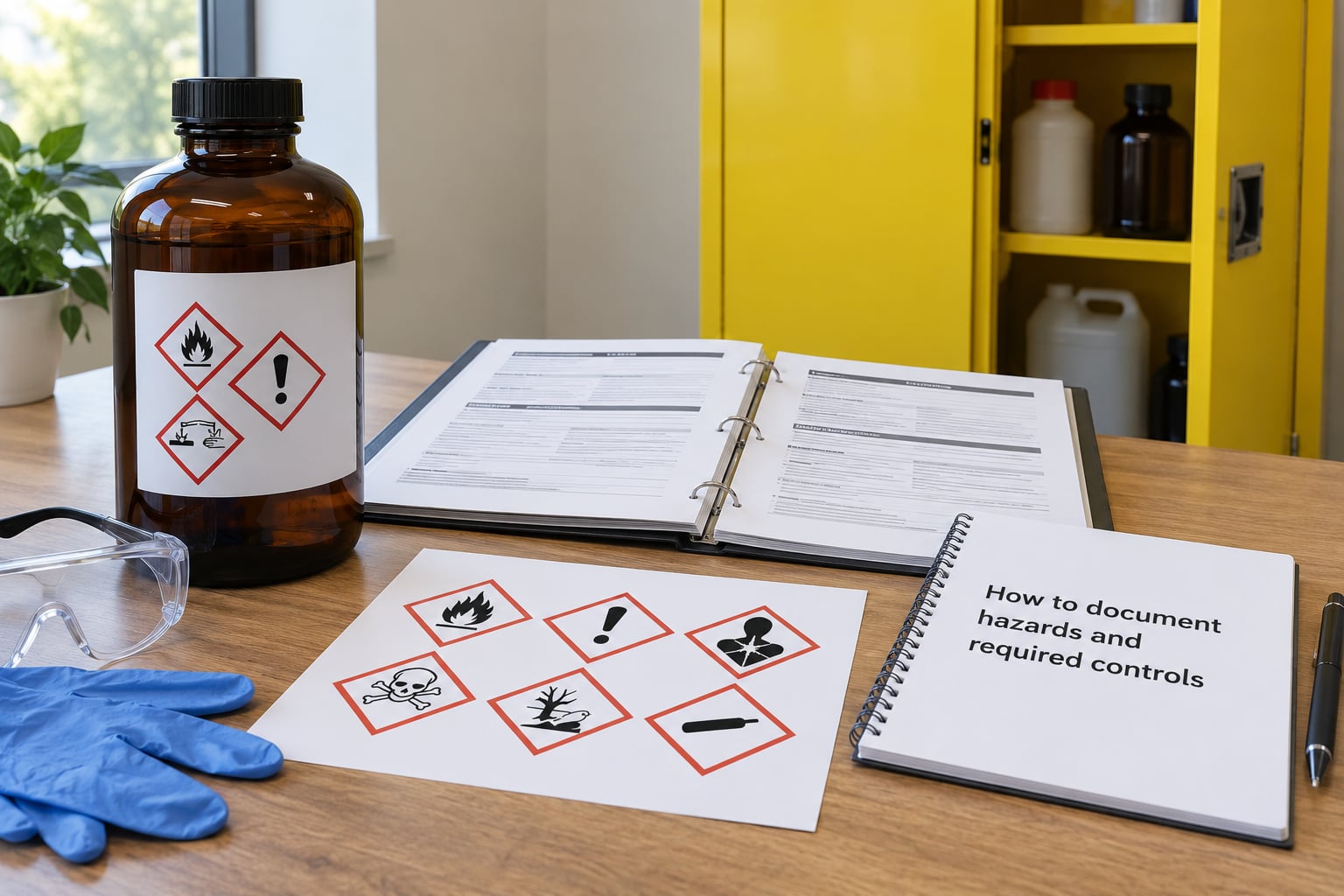
Pull the hazard summary from Section 2 of the SDS: signal word, pictograms and the hazard statements that matter for storage. Note the required controls the SDS calls out: ventilation, whether it belongs in a flammable cabinet or a corrosives cabinet, personal protective equipment, and whether the material is restricted to trained users or requires a permit before use.
Keep the summary short on the row and keep the SDS itself on file. The inventory is not a substitute for the safety data sheet, and copying sixteen sections into a spreadsheet produces a document nobody maintains. A pointer to where the SDS lives is enough.
Flag peroxide-forming chemicals by their date opened. Diethyl ether, tetrahydrofuran and similar solvents form explosive peroxides over time, and the date you recorded at the walkthrough is the only thing that tells you when testing or disposal is due.
Unlabelled legacy containers still get inventoried. A container that has sat in a closed cabinet for a decade may well be hazardous, and guessing “probably fine” is not a record. Note the hazard as unknown, quarantine the container, and work out its identity from the surroundings or dispose of it through the correct waste stream.
How to verify the list against purchasing and SDS records
Reconcile the finished list against the paperwork. Sort by supplier, then by purchase order, and walk each purchase order against the rows you recorded. Every received item should have a row, and every row should trace to a purchase order or a documented transfer.
Where a purchased product has no container, find out why: it was consumed, it was issued to another site, it was disposed of, or it is sitting somewhere you did not walk. That last one is the most common and the most fixable.
Match the CAS number and hazard fields against the SDS on file. A row whose SDS is missing is an open action item, not a row to quietly leave blank.
Totals matter beyond housekeeping. Under EPCRA, facilities must report hazardous chemicals present above a threshold: for Extremely Hazardous Substances, 500 pounds or the Threshold Planning Quantity, whichever is less; for all other hazardous chemicals, 10,000 pounds. Any chemical at or above its threshold has to be on your annual Tier II report with its name, CAS number, quantity, physical state, location and hazard class, so make sure those fields exist on the row. Below the threshold, the substance still belongs on the inventory.
How to assign locations and control access
Use one naming scheme everywhere: building, room, cabinet, shelf. “Storage room 2” is useless when the building has two of them, and “shelf above the sink” fails the first time the sink is moved.
Distinguish where the chemical is permitted to be stored from where it currently sits. Many programs keep a bulk storage area for reserve stock and point-of-use locations for active containers, and the list should show both, with a field for permitted versus current location when they differ.
Assign a storage compatibility group so the list doubles as a segregation map. Acids separate from bases, oxidizers separate from flammables, and water-reactive materials stay away from any wet location. Segregate by hazard class and chemical family, never alphabetically, and never by container size.
Mark the entries that need controlled access. Restricted materials, poisons, compressed gases in cylinders and anything requiring a sign-in get a flag in the list along with the name of the person who can authorize use. If your program has a permit-by-workload or micro-limit threshold for high-hazard materials, the inventory is where that threshold gets checked.
How to maintain, review, and update the inventory
The list decays the day you finish it, so build the update events into the process before you need them. Every new delivery gets a row before the container is put away, and every container that leaves the building for use, transfer, consumption or disposal gets its row closed with a date and initials. That single habit prevents most inventory drift.
Run a full physical reconciliation on a fixed cycle, usually annually, and a walk-through of a subset of locations between full counts. On that walk, check dates opened for peroxide-forming chemicals, flag containers that are open, leaking, corroded, past a shelf life or sitting outside their permitted storage location, and confirm aisles and fire protection are clear.
Retain an audit trail rather than overwriting. Keep the old row and the change date instead of deleting, so the list can show a container that was received in March, moved in June and disposed of in September. A chemist doing decommissioning, a lab move or a handover needs that history.
Once the list is dependable, other work gets easier from it. Emergency planning and spill response documents come straight off the locations and hazard fields, and a fire marshal or local emergency planning committee can be handed a current Tier II-ready export instead of a scramble.
Common Mistakes
These are the failure modes I see most often, each with the fix that closes it.
- Building the list from purchasing records alone. Purchase records show what was ordered, not what is on the shelf. Always walk the space physically, then reconcile the two.
- Grouping a product into one row with a summed quantity. Split it to one row per container so responders know how many packages are involved and where each one sits.
- Dropping mixtures and solutions, or filing them under the pure substance. Name the solution with its concentration and solvent and give it its own entry.
- Using vague locations. “Janitorial closet,” “back room” and “shelf 3” are not locations. Use building, room, cabinet and shelf consistently.
- Storing hazard information with no SDS behind it. Every hazardous entry links to a current safety data sheet, and the sheet is accessible to anyone who handles the material.
- Leaving unlabelled legacy containers off the list. Inventory them as unknown hazards, quarantine them and resolve their identity separately.
- Letting the list and the SDS library drift apart. Same owner, same review cycle, cross-referenced in both directions. If one changes, the other changes the same day.
- Treating the inventory as a one-time project. Schedule the reconciliation date before you finish the first version, and record rows on receipt and on removal.
Frequently Asked Questions
What should be included in a chemical inventory list?
At minimum, each entry needs the product name as labelled, concentration or solvent, CAS Registry Number, physical state, quantity on hand, container size, storage location down to shelf level, signal word and GHS pictograms, date received, date opened, storage compatibility group, and the responsible person. Each row should also point to the safety data sheet on file. One row per container keeps counts, locations and hazard information accurate.
What are the OSHA requirements for maintaining a chemical inventory list?
OSHA’s Hazard Communication Standard, 29 CFR 1910.1200(e), requires employers to maintain a list of hazardous chemicals known to be present in the workplace, and to update it as new chemicals arrive. The list must be readily accessible to employees, and each chemical on it is expected to have a safety data sheet available. It also supports the separate EPA obligation to report certain chemicals above threshold quantities under EPCRA Tier II.
What chemicals need to be reported on Tier II?
EPCRA Tier II reporting applies to hazardous chemicals present at or above a threshold. For Extremely Hazardous Substances, the threshold is 500 pounds or the Threshold Planning Quantity, whichever is lower. For all other hazardous chemicals, it is 10,000 pounds. The report needs the chemical name, CAS number, quantity, physical state, location and hazard class, which is why those fields belong on the inventory row itself rather than in a separate document.
How often should a chemical inventory be updated?
Update it continuously at the points where chemicals change hands: add a row when a delivery is received and close a row when a container is used up, transferred, consumed or disposed of. On top of that, run a full physical reconciliation about once a year, and a partial walk-through of high-use locations between full counts. Set the dates in advance and record who performed each review.
Where should the chemical inventory list be kept?
Keep the master list in a location everyone who handles chemicals can reach, usually a shared drive tied to the written hazard communication program, with a printed copy in the chemical safety file for areas where computers are not practical. A second copy sits with the SDS library. Employees must be able to access it during normal work, and emergency responders, fire officials and auditors should be able to get a current version quickly.
Do all hazardous products need an SDS?
Yes, a safety data sheet must be readily accessible for every hazardous chemical known to be present, in a form employees and emergency responders can use. Most sheets arrive from the supplier, but your responsibility is to have them on file, current, and linked to the inventory row. Products bought in small consumer quantities can be an exception, and lab-prepared mixtures, kits and some wash-bottle solutions are commonly treated as exempt from inventory tracking.
Conclusion
Five actions put a working chemical inventory list in place, in this order:
- Name one person as the owner of the list, plus a backup, and write the review schedule at the top of it.
- Walk every location you are responsible for, shelf by shelf, and record one row per container from the physical label.
- Add the identifiers and hazard fields from each SDS: CAS number, signal word, pictograms, compatibility group and dates received and opened.
- Reconcile the list against purchase orders and the SDS library, resolving every container that appears in one place and not the other.
- Schedule the recurring reconciliation now, and start recording receipts and removals the day the list goes live.
That is the whole job. Most of the work is one afternoon of walking around with a clipboard, and the payoff shows up the first time a fire marshal, an inspector or a responder needs to know what is behind a particular door.