
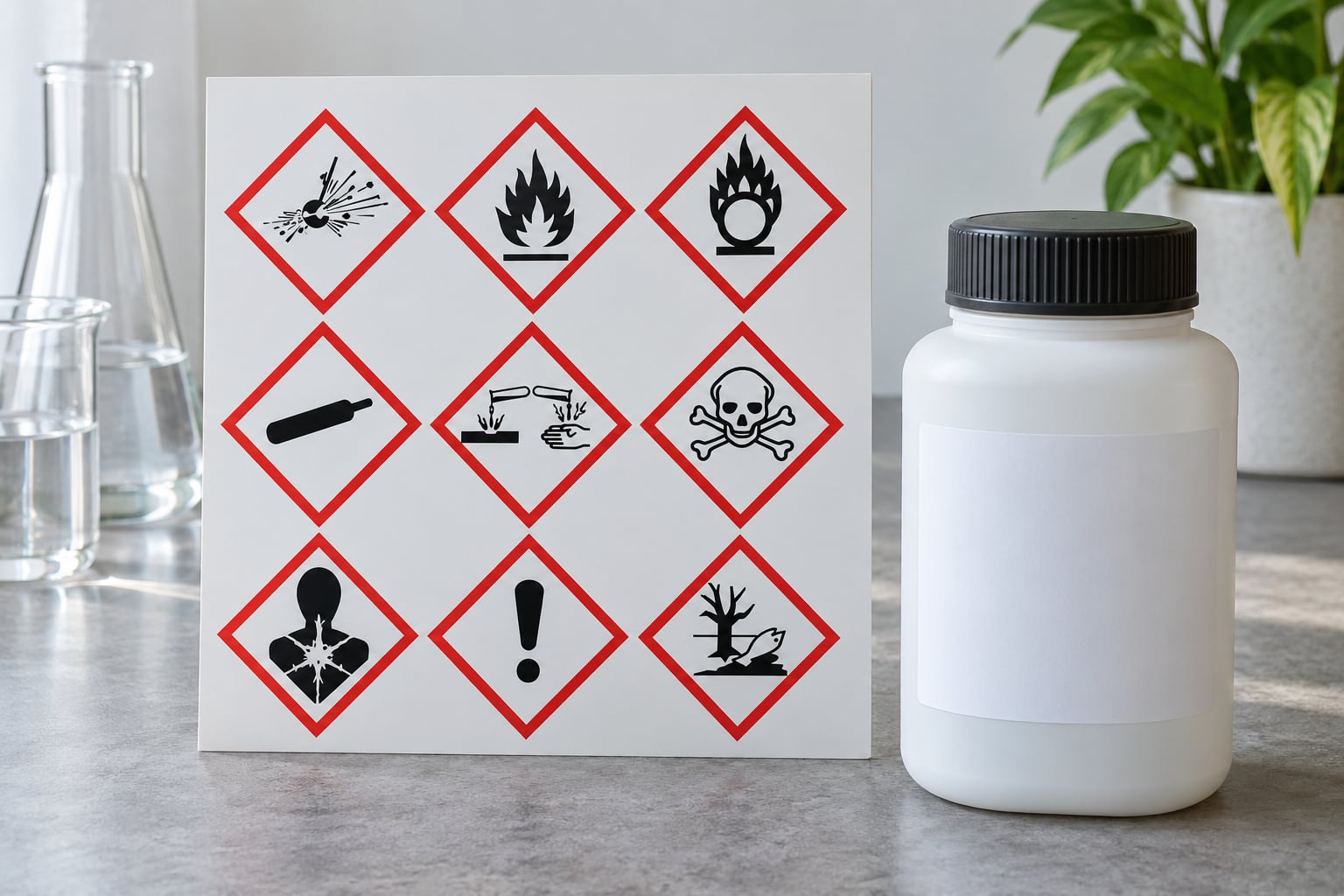
GHS pictograms are the nine red-bordered diamonds printed on chemical labels and Safety Data Sheets, each holding a black symbol that flags a hazard class at a glance. OSHA’s Hazard Communication Standard, 29 CFR 1910.1200, requires US employers to use them so a worker can spot danger before reading a word. This guide covers every one of the nine symbols, how a full label fits together, and where employers go wrong.
If you have handled a drum of solvent or a jug of degreaser, you have already seen these. What most people get wrong is treating the diamond as decoration instead of a decision point. The symbol tells you which controls to reach for. Everything else on the label tells you how to use them.
Table of Contents
- What Are GHS Pictograms?
- How Do You Read a GHS Pictogram?
- What Does Each GHS Pictogram Mean?
- GHS Pictograms Explained: The Flame Symbol and Flammable Hazards
- Exploding Bomb: Explosive or Self-Reactive Hazards
- Flame Over Circle: Oxidizing Hazard
- Gas Cylinder: Compressed or Liquefied Gas Hazard
- Corrosion: Skin or Eye Damage and Corrosive Metals
- Skull and Crossbones: Acute Toxicity
- Exclamation Mark: Irritation, Harmful Exposure, or Warning
- Health Hazard: Serious Long-Term Health Effects
- Environment: Hazards to Aquatic Life
- How Do GHS Pictograms Differ From Other Safety Symbols?
- How Should Employers Use GHS Pictograms at Work?
- What Should You Do If You See an Unfamiliar GHS Pictogram?
- Frequently Asked Questions
- Are all 9 GHS pictograms mandatory in the US?
- What are the 6 elements of a GHS label?
- How is a GHS pictogram different from the NFPA 704 diamond?
- Do secondary containers need GHS pictograms?
- What is the difference between the exclamation mark and the health hazard symbol?
- Do workers need retraining after the 2024 HazCom update?
- The Practical Takeaway
What Are GHS Pictograms?
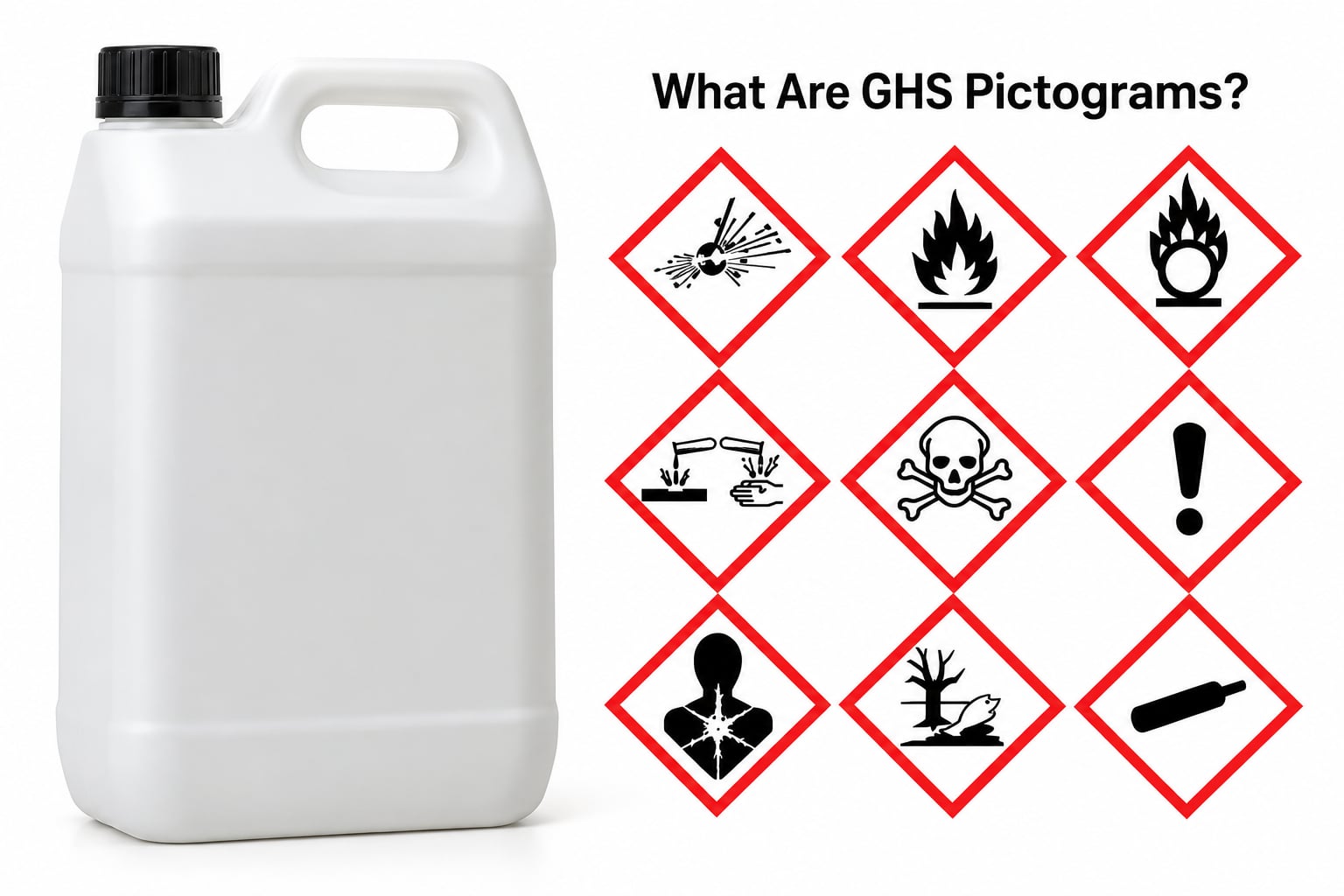
A GHS pictogram is a standardized symbol used under the Globally Harmonized System of Classification and Labelling of Chemicals, the international system the United Nations maintains so that a chemical carries the same hazard warning in every country that adopts it. The design is fixed: a black image on a white background inside a red rhombus frame, rotated 45 degrees into a diamond.
The system covers roughly 28 classes of hazard, grouped into three families. Physical hazards include flammables, explosives, oxidizers and compressed gases. Health and environmental hazards include acute toxicity, skin corrosion, carcinogenicity and aquatic toxicity.
A pictogram is the fastest part of a label to read and the only part that survives a language barrier. That is why employers lean on it for teams that speak multiple languages or read at different levels.
It is also the least informative part. A pictogram tells you the hazard exists, never the concentration, the exposure limit or the exact handling steps. Four things work together on a compliant label, and confusing them is the most common labeling mistake I see:
- Signal word — a single word, Danger or Warning, that sets the overall severity.
- Hazard statement — an H-coded sentence describing the specific hazard, such as H225 for a highly flammable liquid.
- Precautionary statement — a P-coded sentence telling you what to do, such as P210 for keeping away from heat.
- Product identifier and supplier information — the chemical name and who supplied it.
The pictogram alone answers none of the questions those other elements answer. Treat it as the alarm, not the instruction manual.
How Do You Read a GHS Pictogram?
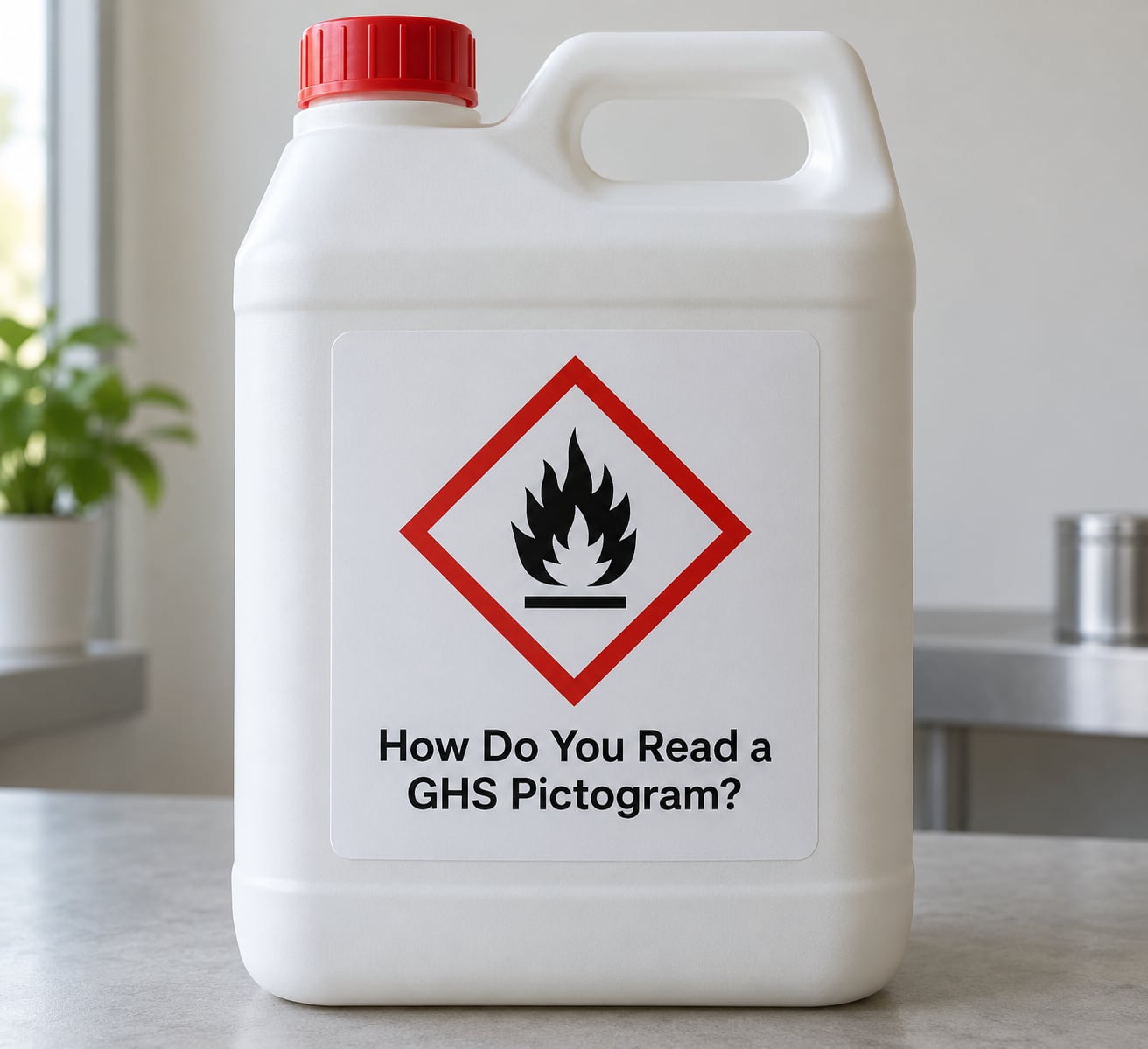
Every pictogram shares one format, so once you know the frame you only have to learn nine interior symbols. The red rhombus is not interchangeable with the white diamond used on older MSDS labels, and it is not the NFPA 704 fire diamond, which looks similar at a glance but works completely differently.
Inside the frame, severity is expressed in words and numbers rather than in the symbol itself. Most health hazard classes are divided into categories 1 through 5, where category 1 is the most severe and category 5 the least. Category 1 or category 2 hazards earn the signal word Danger, while categories 3 through 5 earn Warning.
Here is the reading order I give new hires. It takes about ten seconds on a container that is already in your hand.
- Product identifier. Find the chemical name first. Without it, no other information on the label can be looked up.
- Signal word. Read Danger or Warning before anything else. It sets your urgency.
- Pictograms. Note every diamond. A product can carry several, and they stack.
- Hazard statements. Read the H-codes. These give you the specific hazard, for example flammable liquid or causes severe skin burns.
- Precautionary statements. Read the P-codes for the handling, storage and response actions.
- Supplier identification. Find the company name and a phone number for technical information.
| Label element | What it tells you | Example |
|---|---|---|
| Product identifier | Which chemical this is | Isopropyl alcohol |
| Signal word | Overall severity | Danger |
| Pictogram | The hazard family, instantly | Flame |
| Hazard statement | The specific hazard, coded H2xx to H4xx | H225: Highly flammable liquid and vapour |
| Precautionary statement | The response, coded P1xx to P5xx | P210: Keep away from heat, sparks and open flames |
| Supplier information | Who to call | Manufacturer name and technical contact number |
Hazard statements group into three blocks that follow a simple numeric pattern. H2xx covers physical hazards, H3xx covers health hazards, and H4xx covers environmental hazards. Once you know that, an unfamiliar H-code is at least identifiable as physical, health or environmental without looking it up.
If a container reaches your workplace with no readable label, treat it as a chemical of unknown composition and ask your responsible person before using it. That single habit prevents more exposures than any training slide.
What Does Each GHS Pictogram Mean?
Below is the complete set. Each symbol signals a general hazard class, while the label and the safety data sheet supply the specific details, the category and the concentration threshold involved.
| Code | Name | Hazard it signals | Example H-statements |
|---|---|---|---|
| GHS01 | Exploding bomb | Explosives, self-reactive substances, organic peroxides | H200 Unstable explosive; H201 Explosive; H202 Explosive; severe projection hazard |
| GHS02 | Flame | Flammables, self-heating, substances that emit flammable gas on contact with water | H220 Extremely flammable gas; H224 Extremely flammable liquid and vapour; H228 Flammable solid; H250 Catches fire spontaneously if exposed to air |
| GHS03 | Flame over circle | Oxidizing gases, liquids and solids | H270 May cause or intensify fire; oxidiser; H271 May cause fire or explosion; strong oxidiser |
| GHS04 | Gas cylinder | Compressed, liquefied, dissolved or refrigerated gases, including chemicals under pressure | H220 Extremely flammable gas; H280 Contains gas under pressure; may explode if heated |
| GHS05 | Corrosion | Skin corrosion, serious eye damage, corrosion to metals | H314 Causes severe skin burns and eye damage; H290 May be corrosive to metals |
| GHS06 | Skull and crossbones | Acute toxicity from a single short exposure | H300 Fatal if swallowed; H310 Fatal in contact with skin; H330 Fatal if inhaled; H310+H330 Fatal in contact with skin or if inhaled |
| GHS07 | Exclamation mark | Irritation, harmful exposure, or a general warning statement | H315 Causes skin irritation; H319 Causes serious eye irritation; H302 Harmful if swallowed; H335 May cause respiratory irritation |
| GHS08 | Health hazard | Chronic health effects and serious long-term damage | H350 May cause cancer; H360 May damage fertility or the unborn child; H372 Causes damage to organs through prolonged or repeated exposure; H334 May cause allergy or asthma symptoms or breathing difficulties if inhaled |
| GHS09 | Environment | Acute and chronic toxicity to aquatic life | H400 Very toxic to aquatic life; H410 Very toxic to aquatic life with long lasting effects |
GHS Pictograms Explained: The Flame Symbol and Flammable Hazards
The flame symbol, coded GHS02, marks anything that burns easily or releases flammable gas. It covers flammable gases, liquids and solids, plus aerosols and self-heating substances that can ignite without a spark.
The severity sits in the H-code rather than the picture. H220 means an extremely flammable gas, H224 an extremely flammable liquid and vapour, and H226 a flammable liquid. H250 catches a subtler hazard: a substance that ignites on contact with air, like certain pyrophoric chemicals.
Flammable classes are split by flash point. A liquid with a flash point below 23 degrees Celsius is class 1B and earns the signal word Danger, while one between 23 and 60 degrees is class 2 and earns Warning. Storage cabinets, bonding and grounding, and control of ignition sources all follow from that classification.
Exploding Bomb: Explosive or Self-Reactive Hazards
The exploding bomb, coded GHS01, signals explosives, self-reactive substances and organic peroxides. It covers unstable explosives, blast and fragmentation hazards, and substances that react dangerously with water.
Not every product carrying this symbol is equally dangerous, and the H-code tells you where it sits. H200 marks an unstable explosive. H201 is an explosive, while H204 covers explosives with a severe projection hazard. H240 through H242 in the organic peroxide block covers substances that may explode or ignite on contact with water.
Explosive materials belong in rated storage, separated from ignition sources and kept away from incompatible classes. The quantity on hand often drives which rules apply, so a bulk storage area and a single case on a bench are treated very differently.
Flame Over Circle: Oxidizing Hazard
The flame over a circle, coded GHS03, marks an oxidizer. An oxidizer does not burn, but it supplies oxygen or another oxidising species and makes other materials burn harder or faster.
This distinction catches people out. A solvent marked with the flame will burn on its own. A product marked with the flame over circle may be perfectly stable on its own and still ignite cotton, wood or another solvent the moment they touch. Concentrated nitric acid, concentrated hydrogen peroxide and pool shock are familiar examples of this behaviour in ordinary workplaces.
Because oxidizers intensify fire rather than starting it, they need strict storage controls: separated from flammables and from reducing agents, kept in compatible containers, and handled with contamination control. A wooden shelf or a paper-lined bin is a poor home for these products.
Gas Cylinder: Compressed or Liquefied Gas Hazard
The gas cylinder, coded GHS04, marks compressed, liquefied, dissolved or refrigerated gases. H280 states that the container holds gas under pressure and may explode if heated, and H281 signals a refrigerated gas that can cause frostbite on contact.
Workplaces run into this symbol more often than expected. Propane cylinders for forklifts, nitrogen and argon cylinders for welding or laboratory work, carbon dioxide lines in restaurants, and compressed air in maintenance shops all fall under it. Oxygen cylinders carry it as well, and they get an added layer of attention because an oxygen leak makes any ignition source far more dangerous.
Store cylinders upright, secured, with the valve protected and the cap in place. Never leave one in a vehicle or an unventilated enclosed space. Heat, impact and a valve left open are the three failure modes that matter.
Corrosion: Skin or Eye Damage and Corrosive Metals
The corrosion symbol, coded GHS05, appears on two different hazard types. The first is skin corrosion or serious eye damage, with H314 for severe skin burns and eye damage. The second is corrosivity to metals, with H290 for substances that may corrode metals.
This one bites in two ways. Drain and pipe cleaners carry it for what they do to skin, but the metal statement is why the same product eats through aluminium parts, old shelving brackets and certain stainless fittings. Employees often spot the eye hazard and miss the equipment damage entirely.
Handling rules follow from the classification: face and eye protection, acid-proof gloves chosen to match the specific chemical, and secondary containment during transfer. Always read the precautionary statements for compatibility requirements rather than assuming any glove material works.
Skull and Crossbones: Acute Toxicity
The skull and crossbones, coded GHS06, marks acute toxicity. This is the hazard of death from a single exposure, either one large dose or a short exposure at a high concentration.
Acuteness is the whole point of the distinction. Acute toxicity comes from one exposure event, while chronic toxicity accumulates over time. Wording on the label follows the exposure route, with H300 for fatal if swallowed, H310 for fatal in contact with skin, and H330 for fatal if inhaled. A combined code such as H310+H330 covers a product dangerous by both routes.
Where acute and chronic hazards are both present, both pictograms appear on the label. Never stock or dispense these products without an SDS in hand and a designated location such as an acid or poison cabinet that the rest of the team cannot reach casually.
Exclamation Mark: Irritation, Harmful Exposure, or Warning
The exclamation mark, coded GHS07, is the most frequently encountered pictogram and also the most often misread. It covers skin irritation such as H315, serious eye irritation such as H319, harmful exposure such as H302 harmful if swallowed, and respiratory irritation such as H335.
It is also the general warning pictogram. When a label carries a statement that has no dedicated pictogram, the exclamation mark takes the role. That is why a lightbulb icon and a genuinely irritating chemical can look identical in the hand.
The practical distinction from the skull and crossbones comes down to outcome. The exclamation mark means reversible or irritating effects, while the skull means death. The distinction from the health hazard silhouette is the one people miss most often. The exclamation mark describes harm that stops when the exposure stops. The health hazard describes harm that can follow someone for life.
Health Hazard: Serious Long-Term Health Effects
The health hazard pictogram, a silhouette of a person with a star-shaped burst over the chest, is coded GHS08. It signals serious long-term effects: carcinogenicity, reproductive toxicity, respiratory sensitisation, target organ toxicity, aspiration hazard, and genetic toxicity or mutagenicity.
Every hazard in this group is about consequences that show up later. H350 and H351 cover cancer, H360 covers fertility and unborn-child effects, H334 covers respiratory sensitisation and occupational asthma, and H372 covers damage to organs through prolonged or repeated exposure. H350i on its own identifies a substance known to cause cancer by inhalation.
Many of these substances are also irritants. When a chemical causes both immediate and chronic harm, the label shows GHS07 and GHS08 together. A common training mistake is showing workers only the exclamation mark version and letting them assume the chronic hazard is not there.
Environment: Hazards to Aquatic Life
The environment pictogram, coded GHS09, shows a dead tree and a dead fish. It marks acute or chronic toxicity to aquatic life, with H400 for very toxic to aquatic life and H410 for very toxic to aquatic life with long lasting effects.
Storage and disposal are the practical controls. Secondary containment keeps a spill out of floor drains, and spill kits absorb rather than rinse. Anything that reaches an outflow has to be routed to hazardous waste rather than the storm drain, even when the volume looks trivial.
One regulatory nuance trips up even experienced employers: under OSHA workplace rules this pictogram is not a mandatory label element. Many US suppliers still print it, and other jurisdictions such as Canada and the EU require it. If your site operates in multiple countries, follow the strictest standard that applies to that location.
How Do GHS Pictograms Differ From Other Safety Symbols?
Two red diamonds meet the same worker with different jobs, and confusing them is the single most common misunderstanding in the field. Both describe hazard, but one is regulatory and one is operational, and they are not interchangeable.
| GHS pictogram diamond | NFPA 704 fire diamond | |
|---|---|---|
| Purpose | Communicates hazard classification for handling and storage | Communicates emergency response information for firefighters |
| Layout | One red border with a black symbol inside | Four quadrants with red, blue, yellow and white sections carrying numbers |
| Numbered ratings | Severity appears in H-codes and category numbers on the label text | Each quadrant carries a 0 to 4 rating for health, flammability, instability and special hazards |
| Who assigns it | The chemical supplier, based on UN classification criteria | The organisation, typically as part of its fire prevention plan |
| Legal status in the US | Required by OSHA HazCom for workplace chemicals | Not a substitute for HazCom labelling, and largely outside federal law |
The NFPA 704 diamond rates a material for an incident response. The blue quadrant gives a health rating and the red quadrant a flammability rating, both on a 0 to 4 scale. It answers what a firefighter needs to know in the first minutes, not what a worker needs for a nine-hour shift.
Other symbol families also appear on site. The old white-diamond MSDS label with a black flame predates GHS and is only correct on material genuinely issued before 2015. DOT placards for transport mark shipping containers and bulk packages rather than workplace storage. Wheelchair, biohazard and radiation symbols belong to entirely separate regimes.
A manufacturer’s own logo or a brand mark carries no regulatory meaning at all. A stylized flame in a coloured circle on a household bottle might be a brand graphic, an NFPA-style rating, or nothing formal, which is exactly why trained staff rely on the red rhombus shape and the supplier’s SDS rather than on resemblance.
Internationally the same nine symbols are used, but the surrounding rules differ. Under Europe’s CLP Regulation (EC) No 1272/2008 the environment pictogram is required and the whole set is mandatory. In the US, HazCom adopts the GHS with its own modifications.
How Should Employers Use GHS Pictograms at Work?
A pictogram only does useful work if it arrives intact, arrives in context and reaches the people who need it. These are the points where employers most often fail an inspection or, more importantly, leave a worker guessing.
Check labels when chemicals arrive
Inspect every container at the receiving dock. Look for the product identifier, signal word, pictograms, hazard statements, precautionary statements and supplier identification. Peel the label corner on a sample from each new shipment. If a label is faded, torn or missing, quarantine the container and contact the supplier rather than re-labeling it yourself on a guess.
Label every workplace and secondary container
Anything you transfer into a bottle, a beaker or a spray bottle needs a workplace label with the product identifier and the pictograms, signal word and hazard statements for the hazards the product actually carries. A hand-drawn skull on a coffee mug will not satisfy the requirement, and a crossed-out cigarette sticker will not either.
When a product arrives on site already labelled, keep that manufacturer label intact. OSHA permits removal only in limited situations, and employers who strip labels for cosmetics generally fail the right-to-know requirement later.
Keep safety data sheets reachable
Every hazard determination should point to an SDS, and employees must be able to access it within their shift. Section 2 of the SDS, hazard identification, restates the pictograms and lists the signal word and hazard statements. A searchable electronic system is fine, a locked cabinet in a room nobody has a key to is not.
Train people who are not chemists
Training should be specific enough to change behaviour. Show your actual containers and actual products, not stock photographs. Most teams who struggle are not weak on the symbols, they are weak on the controls, so spend your time on what each pictogram demands: what PPE, what ventilation, what storage cabinet, what spill response.
For crews working across languages or with limited reading, teach the pictograms as pictures first and the words second. For work that involves servicing equipment, pair the chemical side with the machine side. Our guide to the lockout tagout procedure covers the energy-control side that most chemical incidents turn into.
Know which pictograms are mandatory for you
US employers must use every GHS pictogram except one. OSHA adopted the UN system with a carve-out for the environment pictogram, because US water law already covers environmental release through other rules. Eight are mandatory for workplace labels, and GHS09 is advisory under HazCom, though most suppliers print it anyway.
HazCom also lets you add extra pictograms for hazards GHS does not cover, such as a hazard not otherwise classified. Adding more is allowed, and for complex workplaces it often beats trying to force an unfamiliar hazard into a category that does not fit.
Plan for the 2024 HazCom update
The updated Hazard Communication Standard that OSHA finalized in 2024 added a chemical under pressure hazard class, revised the flammable aerosol and flammable gas classes, and tightened small-container labelling rules, with thresholds around 100 millilitres for abbreviated labels and 3 millilitres for limited identifiers. Suppliers and employers are on tiered deadlines for substances and mixtures, running through 2026, 2027 and 2028.
No new pictogram symbols were introduced. That matters for your training: your existing nine-symbol curriculum still holds, but your classification results, labels and SDS may need refreshing against the revised criteria. Workers also need retraining when new hazard information reaches them, so build that trigger into your program rather than treating training as a one-time event.
Broader program elements are worth reviewing alongside this. If you are assessing exposure rather than just reading labels, our health risk assessment guide for employees covers the evaluation side, and the total worker health approach puts chemical risk alongside the physical and organisational factors that affect the same person.
What Should You Do If You See an Unfamiliar GHS Pictogram?
You will eventually meet a container whose symbol you cannot name. That is normal, and the response is the same every time rather than a guess.
- Stop and keep distance. Do not open it, do not smell it and do not transfer it. A few seconds of caution costs nothing.
- Read the product identifier and signal word. Even an unreadable symbol leaves you a name and a severity level to work with.
- Open the SDS, or search the chemical name. Section 2 tells you the pictogram meaning, and Sections 4, 7 and 8 cover first aid, handling and exposure controls.
- Ask the responsible person on site. Competent, qualified and trained applies to the person answering your question, not just to the person doing the task.
- Apply the required controls before use. That means specific PPE, ventilation and storage appropriate to the hazard class, not generic gloves.
Then close the loop. Log the unknown symbol, confirm it in training, and share the answer with anyone else on shift who handles that area. One unfamiliar label handled properly is a five-minute fix. The same label passed along unquestioned for a year is how injuries start.
Frequently Asked Questions
Are all 9 GHS pictograms mandatory in the US?
No. OSHA adopted the UN GHS system with one exception: the environment pictogram, GHS09, is not a required element on US workplace labels. The other eight, GHS01 through GHS08, must appear whenever a chemical falls into that hazard class. Most suppliers still print GHS09 anyway, and employers operating in Canada or the EU need it, so following it in the US is sound practice.
What are the 6 elements of a GHS label?
A compliant workplace label carries six elements: the product identifier, the signal word (Danger or Warning), the hazard pictograms, the hazard statements describing the specific hazard, the precautionary statements describing the response, and the supplier identification with a contact. OSHA also allows supplementary information such as directions for use, but the six above are the required core. A label missing the product identifier is the most common defect found in workplace audits.
How is a GHS pictogram different from the NFPA 704 diamond?
A GHS pictogram is a regulatory hazard classification symbol: a black image in a red rhombus, assigned by the supplier for handling and storage. The NFPA 704 diamond is a four-quadrant emergency rating with numeric scores for health, flammability and instability, used mainly for firefighter response. Both are red and diamond-shaped, which causes constant confusion. NFPA ratings never replace the GHS label or the safety data sheet.
Do secondary containers need GHS pictograms?
Yes, workplace containers must be labelled. Any container you fill from the original, whether a spray bottle, a beaker or a drum, needs the product identifier plus the pictograms, signal word and hazard statements applicable to the substance. Under the 2024 HazCom update, containers at or below 100 millilitres may use an abbreviated format, and those at or below 3 millilitres need limited identifiers. Hand-drawn symbols are never acceptable.
What is the difference between the exclamation mark and the health hazard symbol?
The exclamation mark, GHS07, covers reversible harm: skin and eye irritation, harmful exposure, and respiratory irritation. The health hazard silhouette, GHS08, covers lasting harm: cancer, reproductive effects, respiratory sensitisation, target organ toxicity, aspiration and mutagenicity. When a chemical carries both hazards, both pictograms appear on the same label. Training that shows workers only the exclamation mark version understates the long-term risk.
Do workers need retraining after the 2024 HazCom update?
Yes. Employers must retrain workers whenever new hazard information reaches them, which happens when suppliers reissue labels and safety data sheets against the updated criteria, when new chemicals enter the workplace, or when the written program changes. OSHA also added a clause allowing retraining for workers who show they need it, including those involved in an incident. Document the sessions and keep records with the rest of your HazCom program file.
The Practical Takeaway
Start with one container today. Pick the most-used chemical at your site, read its label in the six-element order, then check the SDS Section 2 to confirm what each pictogram is telling you. Fix anything missing before you do anything else.
The nine symbols themselves have not changed and are not about to. What changes is how your workplace uses them, and that is worth a conversation with your safety lead at least once a year.