
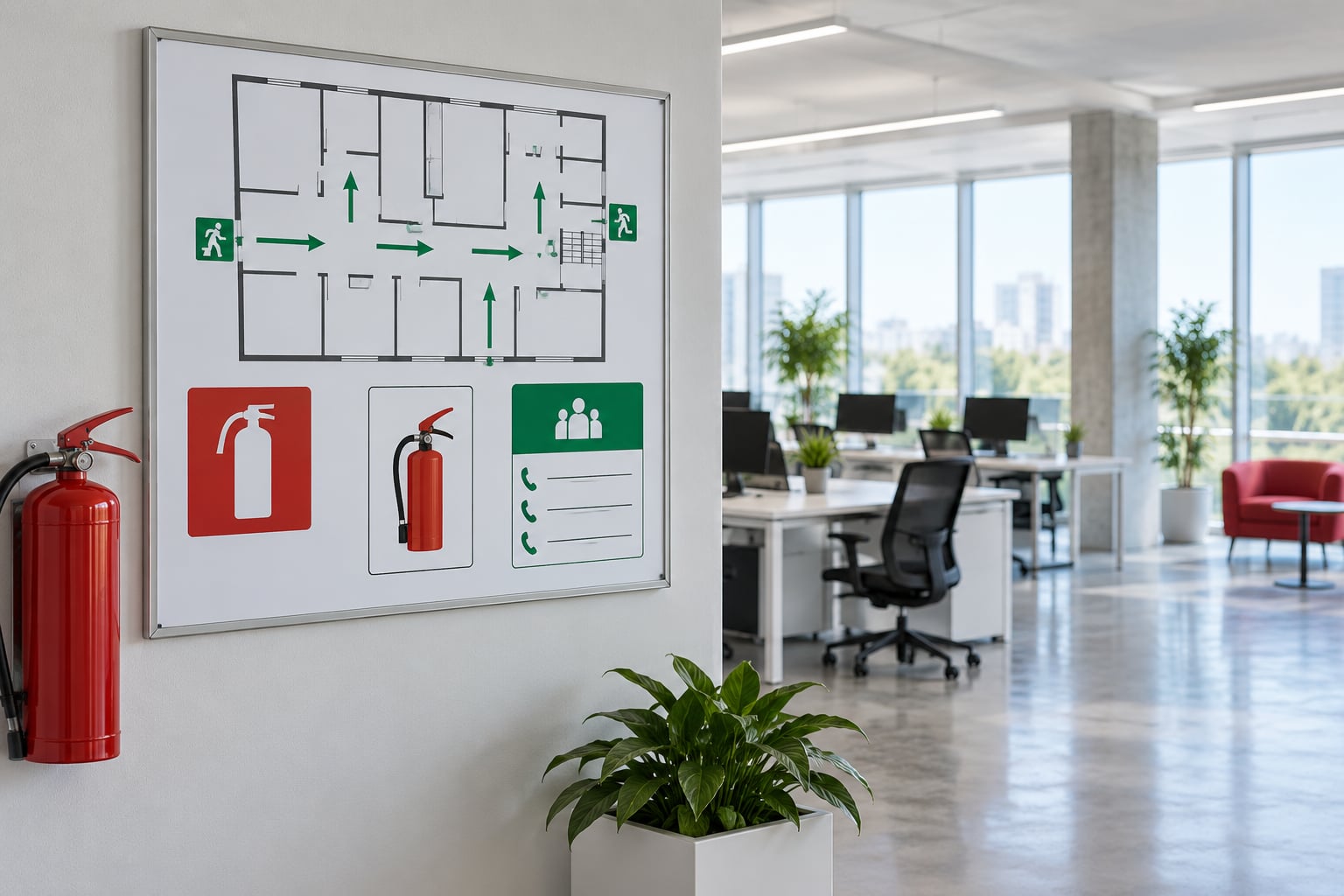
Most office fires start small: a space heater tipped against a partition, a power strip in a closet stacked with cable, a microwave left running. What turns a small problem into a disaster is not the ignition, it is the two minutes afterward, when nobody is sure which door leads out or who is supposed to call. The fire safety tips for the office below are written for people who run the place, staff it, or both.
Every office needs four layers working together: keep fire from starting, detect and warn early if it does, suppress it, and get everyone out through clear routes. Employers carry a legal duty in the US to maintain a written emergency action plan and adequate exit routes under OSHA 29 CFR 1910.38 and 1910.37, but the plan only works if the people inside it know what it says. Requirements get updated, so treat the 2026 version of this checklist as the one you re-check each year rather than a file you file away.
Table of Contents
- 12 Fire Safety Tips for the Office at a Glance
- 1. Keep Fire Hazards Out of the Office
- 2. Keep Walkways and Exits Clear
- 3. Know Your Office Evacuation Plan
- 4. Post Emergency Signs Where Employees Can See Them
- 5. Use Power Strips and Extension Cords Safely
- 6. Control Flammable Materials and Heat Sources
- 7. Check Electrical Equipment and Office Devices
- 8. Train Employees on Fire Alarm and Extinguisher Basics
- 9. Plan How to Report a Fire or Smoke Condition
- 10. Practice Evacuation Routes and Assembly Points
- 11. Keep Fire Protection Equipment Accessible
- 12. Review Your Plan After Changes or Incidents
- Frequently Asked Questions
- What are some tips for fire safety in the workplace?
- What are the 7 basic fire safety control measures in the workplace?
- Should we call the fire department or evacuate first?
- How often should we run a fire drill in an office?
- When is it safe to use a fire extinguisher?
- Who is responsible for fire safety in the workplace?
- A Safer Office Starts With the First Check
12 Fire Safety Tips for the Office at a Glance
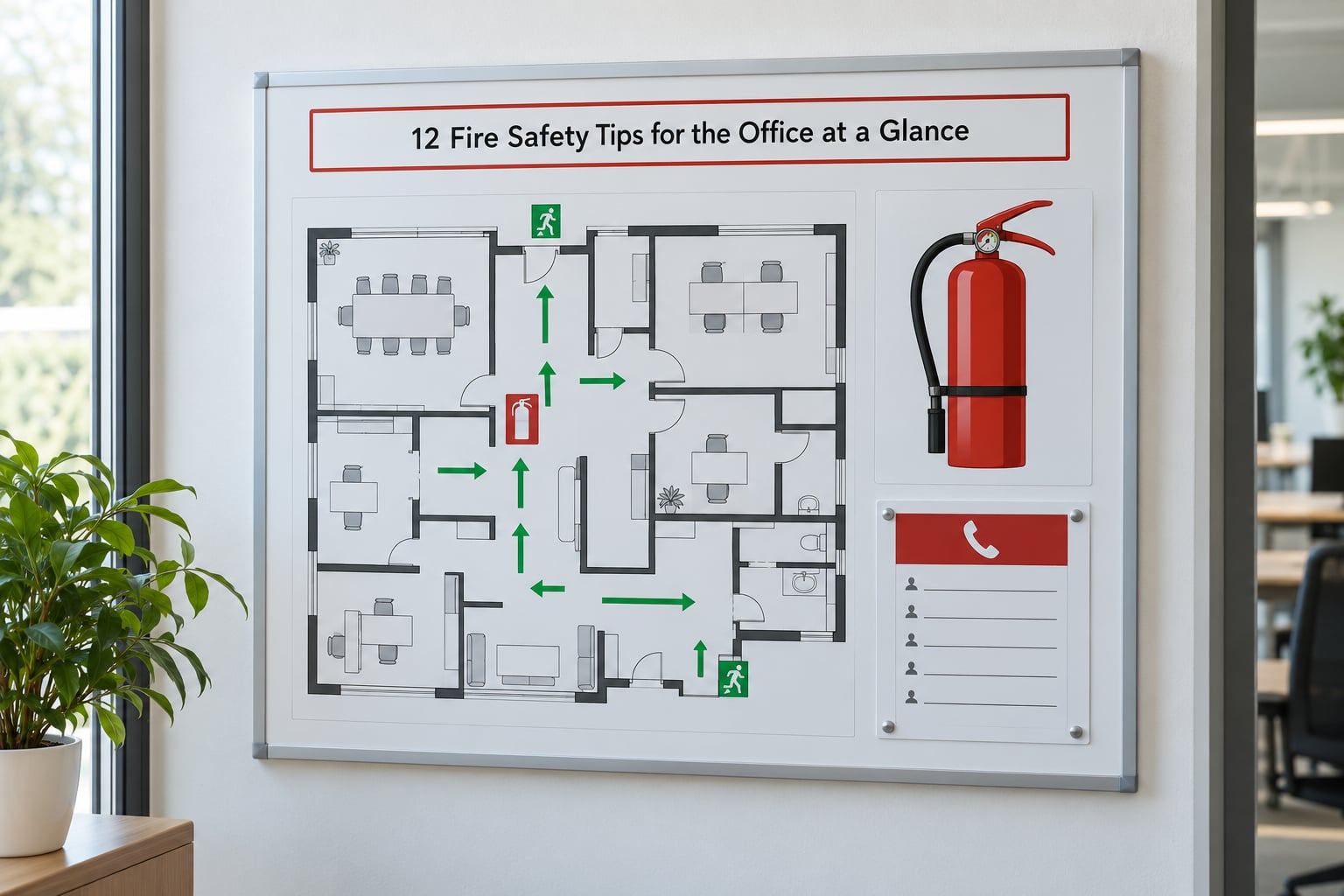
This quick reference puts each tip next to its main benefit, the person who owns it, and the first thing to do. If you only have fifteen minutes, work down the Immediate action column.
| Tip | Main benefit | Owner | Immediate action |
|---|---|---|---|
| 1. Remove fire hazards | Fewer ignition sources | Facilities | Ban personal heaters and daisy-chained strips |
| 2. Clear walkways and exits | Faster egress | Facilities | Walk every route today, remove boxes and cables |
| 3. Have a written evacuation plan | No improvisation | Office manager | Draft one page with two routes per floor |
| 4. Post signs where people see them | Faster decisions under stress | Facilities | Check exit signs from the farthest doorway |
| 5. Use power strips correctly | Fewer electrical fires | Facilities | Replace daisy chains with listed strips |
| 6. Control flammables and heat | Lower fire load | Facilities | Move solvents out of work areas, lock the cabinet |
| 7. Inspect electrical equipment | Catch damage early | Facilities | Add a monthly cord and plug check |
| 8. Train on alarms and extinguishers | Capable response | Office manager | Run a 20 minute hands-on session |
| 9. Plan how to report a fire | No delay calling for help | Everyone | Post the 911 address and floor in reception |
| 10. Drill your routes | Muscle memory under stress | Office manager | Schedule two walkthroughs this year |
| 11. Keep equipment accessible | Usable equipment when it counts | Facilities | Clear 3 feet below each extinguisher |
| 12. Review after changes | Plan stays accurate | Office manager | Re-check the plan after any move or remodel |
1. Keep Fire Hazards Out of the Office
Office fire safety starts with removing things that ignite. The usual offenders are overloaded wall outlets, extension cords run under rugs, portable heaters parked against cardboard, blocked space behind equipment, and paper stacked in an open plan.
A practical rule: anything you would not want touching a heat source overnight should not live near one. Move paper storage into closets with doors, keep heaters at least three feet from anything combustible, and give large equipment the clearance its manual calls for.
If your office has a kitchen, treat it as the highest-risk room. A grease fire in a pan is small and manageable. The same fire under a hood, or in a waste bin, is not.
2. Keep Walkways and Exits Clear
Blocked exits are the single most common finding on an office walkthrough, and they are usually created slowly by deliveries and storage. Workplaces are required to keep exit routes unobstructed under OSHA 1910.37, which means no boxes, no stacked chairs, and no locked doors in the path.
Make the check routine rather than annual. A two-minute walk at opening and again at closing, covering the route from the farthest desk to the door, catches a cart parked in the corridor before it becomes habit.
Watch the margins too. Exit routes need working lights and signage, and doors that open from the inside without a key or a special effort.
3. Know Your Office Evacuation Plan
An emergency action plan is the written version of what your office does when the alarm sounds. It needs primary and secondary routes, an assembly point away from the building, a named person responsible for calling 911, and a method for accounting for everyone who left.
Routes matter more than the writing. If your primary path goes through a space that is frequently locked or crowded at 9 a.m., choose a different primary. Keep floor-specific plans on each floor and by each elevator bank, since your third-floor team should not have to guess.
Two details managers routinely miss. First, visitors and contractors need the same instructions as staff, handed over at reception or the loading dock. Second, anyone who may need assistance during an evacuation should have a personal emergency evacuation plan on file, agreed with them in advance rather than during the alarm.
4. Post Emergency Signs Where Employees Can See Them
Signage does nothing if it is above a door that is always propped open or hidden behind a column. Exit signs, extinguisher location signs, floor plans, and the emergency phone list all need to be visible while people are moving, not while they are standing still.
Test your signage the way a new hire would. Stand at the farthest point on the floor and look for the illuminated exit signs and the map. If either is hard to spot, move it or add one.
Post the building street address, your floor and suite number, and the 911 instructions near every phone. Dispatchers need the suite number, and the time lost looking it up is time the fire spends growing.
5. Use Power Strips and Extension Cords Safely
Electrical overload is a leading cause of office fires, and almost all of it traces back to a temporary fix that became permanent. Plugging one power strip into another, running cords under carpet, or feeding a coffee maker from a strip that already carries three monitors pushes current past what the wiring was built for.
Use listed, rated equipment and stay within the manufacturer’s load limits. One strip per outlet is the simple version of that rule. Never daisy-chain strips or extension cords, and keep extension cords temporary.
Replace any cord that is pinched, taped, cut, or warm to the touch. Tape over a damaged jacket is not a repair, it is a delay.
6. Control Flammable Materials and Heat Sources
Offices store more combustible material than most managers realize. Solvent cleaner in a break room, aerosol cans near a printer, cardboard archives in a corridor, and a stack of paper next to a light fixture all add to what fire professionals call fire load, and every addition shortens the time you have.
Keep flammables in a rated cabinet away from ignition sources, in quantities suited to what the work actually needs. Where you do limited amounts of solvent wiping or similar work, a written hot work procedure with a permit, a fire watch, and a check of the surrounding area for the following hour removes most of the risk.
Control heat sources too. No candles, no space heaters outside a facilities-approved list, no personal cooking appliances beyond what the break room already provides.
7. Check Electrical Equipment and Office Devices
Servers, printers, coffee makers, and space heaters consume a lot of current in a small area, and they fail in predictable ways. A monthly walkthrough takes about ten minutes and covers most of it.
Look for cords running hot at the plug, discoloration around outlets, scorch marks near power bricks, and devices plugged into overloaded adapters. Confirm that equipment has the clearance its manual requires on all sides, which is the single easiest fix for overheating machines.
Server and IT closets deserve their own attention. Keep them closed, free of cardboard and storage boxes, and on the same inspection list as the kitchen.
8. Train Employees on Fire Alarm and Extinguisher Basics
Training should answer three questions: what does the alarm sound like, what does the extinguisher do, and when should I leave instead? Most offices cover the first two and skip the third, which is how trained staff end up delaying evacuation.
Set realistic expectations. Alarm sounders mean get out. Extinguishers are for small, contained fires only, with a clear escape route behind you and the alarm already raised. If a fire has spread to more than a wastebasket, or you are reaching past smoke to find a wall-mounted unit, evacuate.
Do not use an elevator. Do not re-enter the building until the fire department says it is safe.
The PASS method, step by step
PASS is the standard sequence for operating a portable extinguisher, and it is the one piece of fire safety training people remember under pressure.
- Pull the pin. Break the tamper seal and pull the pin to unlock the handle.
- Aim low at the base of the fire. Stand with your exit behind you.
- Squeeze the handle. Test the extinguisher with a short burst before you commit.
- Sweep side to side. Aim at the base of the flames until the unit empties.
Keep the nozzle about 10 feet back and move closer only as the flame shrinks. Any extinguisher use means calling 911 first, and the fire department needs to know regardless of whether you succeed.
9. Plan How to Report a Fire or Smoke Condition
The single most-asked question in workplace safety forums is the order of operations: do you call 911 first or evacuate first? The answer that most safety professionals give is that you cannot realistically do both alone, so agree the sequence before you need it and make sure everyone shares it.
The common pattern is: activate the alarm on your way out, call 911 from outside the building, then begin evacuation. Pulling the alarm gets other floors moving and building systems notified while you are still walking out. Do not stop to gather belongings, and do not delay the call to collect personal items or check on a colleague’s desk.
Whoever calls should say: the building address, the floor and suite, what is burning, whether anyone is injured or missing, and their phone number. Then they should stay available for follow-up questions.
10. Practice Evacuation Routes and Assembly Points
Fire drills work when they build a habit rather than when they scare people. Forum discussions about drill design land in the same place: drills with a debrief, and ideally something light afterwards, get far better cooperation than surprise or punitive approaches.
A practical format is a walkthrough rather than a full alarm. Announce it a week ahead, pick a meeting spot, walk the routes to the assembly point, time it, and note where people hesitated. Then run one unannounced full-alarm drill later in the year so the routine is tested under real conditions.
Give people something to do. Assign floor wardens and a buddy for anyone who may need assistance. Show where the assembly point is and why it sits away from the building. And never allow anyone back inside until the fire department clears it.
Give advance notice to employees who find alarms distressing, and pair visual alerts with audible ones. Advance warning of a test, a clear opt-out path, and a quieter strobe setting are small accommodations that cost nothing and make the whole group calmer.
11. Keep Fire Protection Equipment Accessible
Extinguishers, alarm pull stations, fire doors, emergency phones, and first-aid supplies all stop working when they are buried. Keep the three-foot clearance below and around mounted equipment, keep pull stations unobstructed, and keep fire doors closed rather than propped with a wedge.
Placement follows a distance rule rather than taste. Under NFPA 10, travel distance to a suitable extinguisher is generally 75 feet for Class A hazards and 50 feet for Class B hazards, so walk your floor and see whether the gaps between units fall within that range.
Extinguishers need monthly visual checks by someone on site and professional servicing on the schedule the manufacturer requires. Check the gauge, the pin, the seal, and the inspection tag. A tag that expired last year means someone bought a service visit you do not need yet and skipped one you do.
Know which alarm sounds mean what, too. Not every sounder means evacuate, and a system with only one tone gives your staff no way to tell a test from a real event. Confirm the signals in your building and tell employees what they mean.
12. Review Your Plan After Changes or Incidents
An evacuation plan goes stale fast. Moved desks, a reconfigured reception, a new server closet, an added floor, or a shift change all alter the routes your plan assumes. Set a reminder to re-walk every route after any move, renovation, or equipment change.
Review after incidents too, including false alarms. The first thing to check after a false alarm is whether people left the building at all, because a building where staff continue working through the alarm has a bigger problem than the faulty detector.
Write down what changed, who was told, and the date. That record is short, and it is the thing an inspector or an insurer asks for first. If your site runs a wider occupational safety program, our safety audit checklist for a small business is a good format for the walkthrough, and safety training that employees actually remember covers the classroom half. For the wider picture on office worker health risks, fire is one of the emergencies worth planning around rather than reacting to.
Hybrid and remote staff need their own version of this. Someone working from home on a laptop, a monitor and a router is running the same electrical and fire-load logic in a smaller space. Set the same expectations for home offices: no space heaters on soft surfaces, no overloaded adapters, and a working smoke alarm with a known expiry date.
Frequently Asked Questions
What are some tips for fire safety in the workplace?
The highest value tips are simple: keep exits and walkways clear, keep electrical loads within rated limits, remove flammables from work areas, post signs and maps where people can see them, maintain a written evacuation plan with two routes, and practise that plan so people actually move. Those six cover most of what an office can control day to day.
What are the 7 basic fire safety control measures in the workplace?
The seven controls are prevention, detection, alarm, suppression, means of egress, training, and maintenance. Prevention covers housekeeping and ignition sources. Detection and alarm cover smoke and heat detection plus notification. Suppression covers extinguishers and sprinklers. Egress covers clear routes, signage, and assembly points. Training covers drills and procedures, and maintenance covers inspection and service schedules.
Should we call the fire department or evacuate first?
Agree the sequence in advance and brief it in writing. The usual pattern is to pull the alarm while leaving, call 911 from outside the building, and begin evacuation. Never delay the call to collect belongings, and never re-enter until the fire department clears the building. Whatever sequence you choose, everyone in the office must know it.
How often should we run a fire drill in an office?
At minimum, cover every employee and every floor at least once a year, and more often when headcount, layout, or tenancy changes. Many offices do better with two touchpoints: an announced walkthrough early in the year and one full-alarm drill later. If you run drills more than once, tell employees the schedule so the alarm stops meaning panic.
When is it safe to use a fire extinguisher?
Only for a small, contained fire, with the alarm already raised, 911 already called, and a clear exit route behind you. Never for a fire spread across a surface, up a wall, or involving smoke thick enough to obscure the ceiling. If you have to reach or lean past the flames to find the extinguisher, evacuate instead.
Who is responsible for fire safety in the workplace?
The employer carries the legal duty in the US to maintain a written emergency action plan, adequate exit routes, and required equipment under OSHA 29 CFR 1910.38. Day to day, that duty is usually carried by a named office manager or safety lead with a fire warden on each floor. Employees share the obligation: knowing the routes, the alarm, and their own role.
A Safer Office Starts With the First Check
Stand up right now and find the two nearest exits from your desk. Then find the extinguisher, the pull station, and the assembly point. If any of those took more than a few seconds, you know which of these 12 fire safety tips for the office to act on this week.
Start with the walkways and the power strips, since those are where the physical risk concentrates. Then put the written plan in place, name your fire warden, and book the first drill. That is a short list, and it is the whole job between now and your next review.
Rules and requirements vary by state and city, and fire codes are updated regularly, so check the local fire marshal and building management requirements that apply to your office before you finalise anything.