
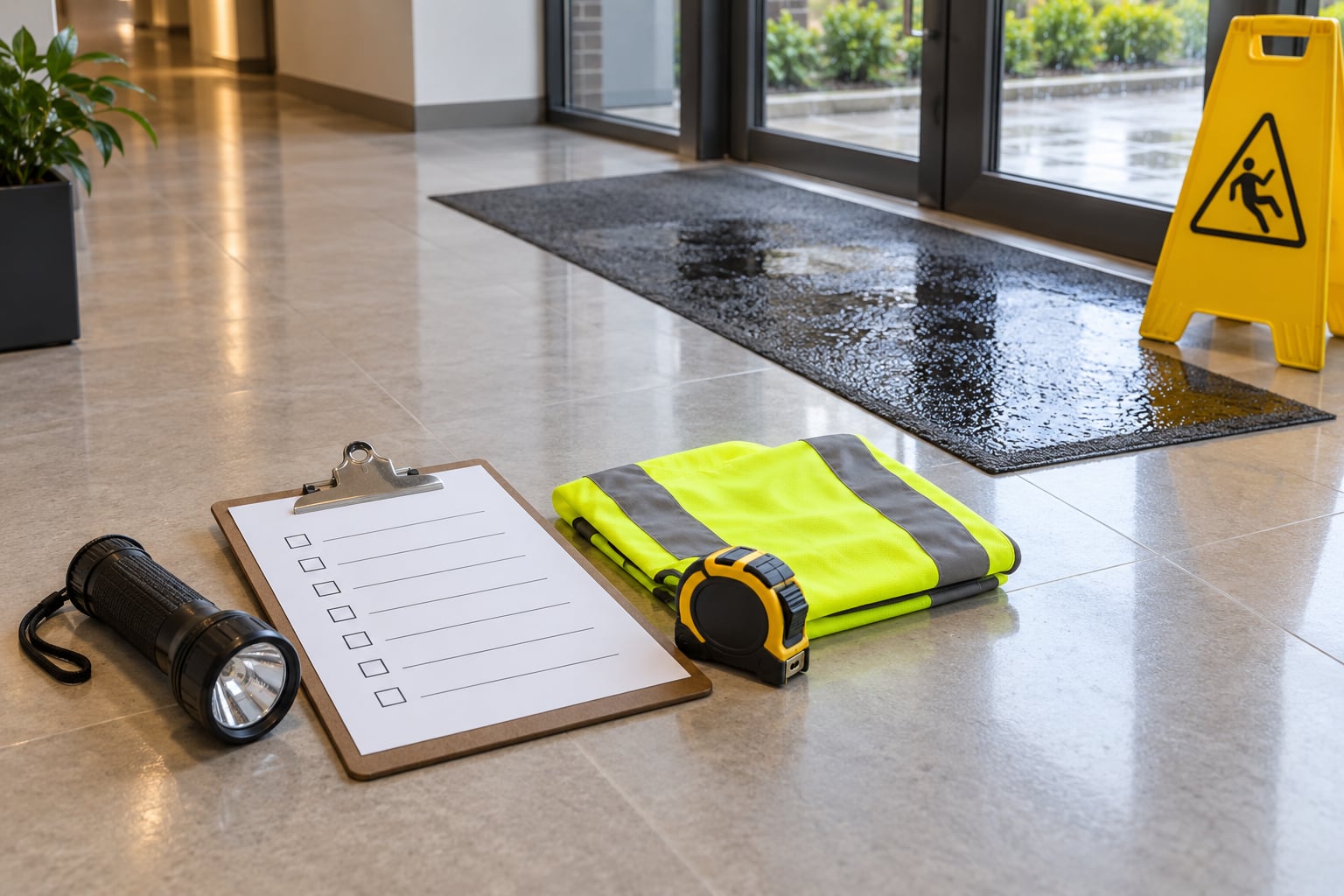
To prevent slips, trips and falls at work, remove the hazard first, then control what you cannot remove, and build routine habits that catch problems early. That means clean dry floors, clear walkways, good lighting, repaired surfaces, suitable footwear, trained staff and a reporting line people actually trust. Most falls are preventable, but only when someone owns the fix.
Slips, trips and falls on the same level account for a large share of workplace injuries in the United States, and they are the second most common cause of fatal workplace injuries after vehicle collisions. They also produce a stubborn pattern: the same wet entry mat, the same damaged stair tread, the same cable across an aisle shows up year after year because nobody owns the repair.
The eight steps below run in the order that actually reduces injuries. Skipping ahead to signage and training while the flooring is still broken is the most common mistake employers make, and it is the one that shows up in every incident investigation I have read.
Most of the work here is unglamorous. You are assigning owners, setting frequencies, tracking closure times and writing down what you fixed. That is the point.
Table of Contents
- What You Need
- Step-by-Step: How to Prevent Slips, Trips and Falls at Work
- 1. Identify Where Slips, Trips and Falls Happen
- 2. Inspect Floors, Stairs, Entrances and Work Areas
- 3. Fix or Control Identified Hazards Quickly
- 4. Use Signs and Barriers Without Relying on Them
- 5. Train Workers and Supervisors on How to Prevent Slips, Trips and Falls at Work
- 6. Improve Housekeeping, Lighting and Access
- 7. Encourage Reporting and Near-Miss Reviews
- 8. Measure the Program and Review It Regularly
- Common Mistakes
- Frequently Asked Questions
- What should an employer do first after a workplace slip, trip or fall?
- Do warning signs prevent slips, trips and falls at work?
- Are non-slip shoes required for workplace fall prevention?
- How should employees respond to a spill or wet floor?
- What training is needed to prevent slips, trips and falls at work?
- How often should employers inspect workplace walkways and floors?
- Conclusion
What You Need
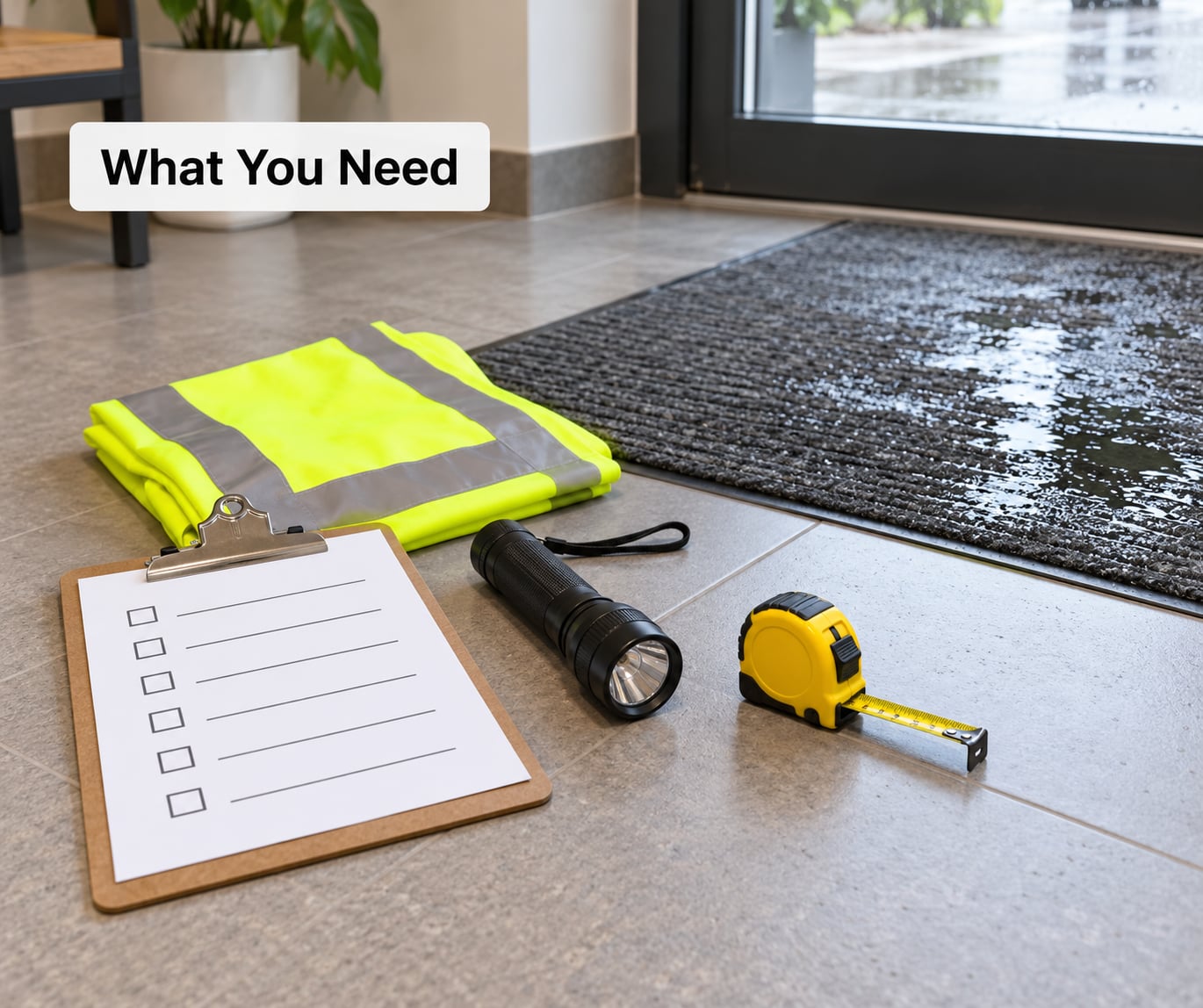
Before anyone walks the site with a clipboard, four things need to be in place, and the fourth one is the one programs usually skip.
People. At minimum that is a program owner with authority to spend money, an inspection team that includes the people who work the area rather than only someone from safety, and the housekeeping and facilities staff who will actually carry out the fixes. Frontline staff know where the floor is always greasy and which stair light fails. Ask them before you design the checklist.
Information. Gather three years of incident records if you have them, every near-miss report filed to date, the current workers’ compensation claim log, and your last inspection or audit report. Also pull the injury data by location, not just by body part. Falls cluster in a handful of places, and those places are almost never where the total count is highest.
Equipment. You need a decent flashlight, a tape measure, a floor-resistance gauge if you are specifying or verifying matting, a phone or camera for photographic evidence before repairs are made, and replacement warning devices that are actually stored somewhere people can reach them.
Authority. The person who owns the program has to be able to close a work order the same day, approve a temporary route change, send an area out of service, and require a repair that a department budget did not plan for. If your owner cannot do any of those, your program is a suggestion.
Add one more: a written spill response procedure that says who cleans, how quickly, and what happens overnight. That single document removes most of the friction from a program built around housekeeping.
Step-by-Step: How to Prevent Slips, Trips and Falls at Work
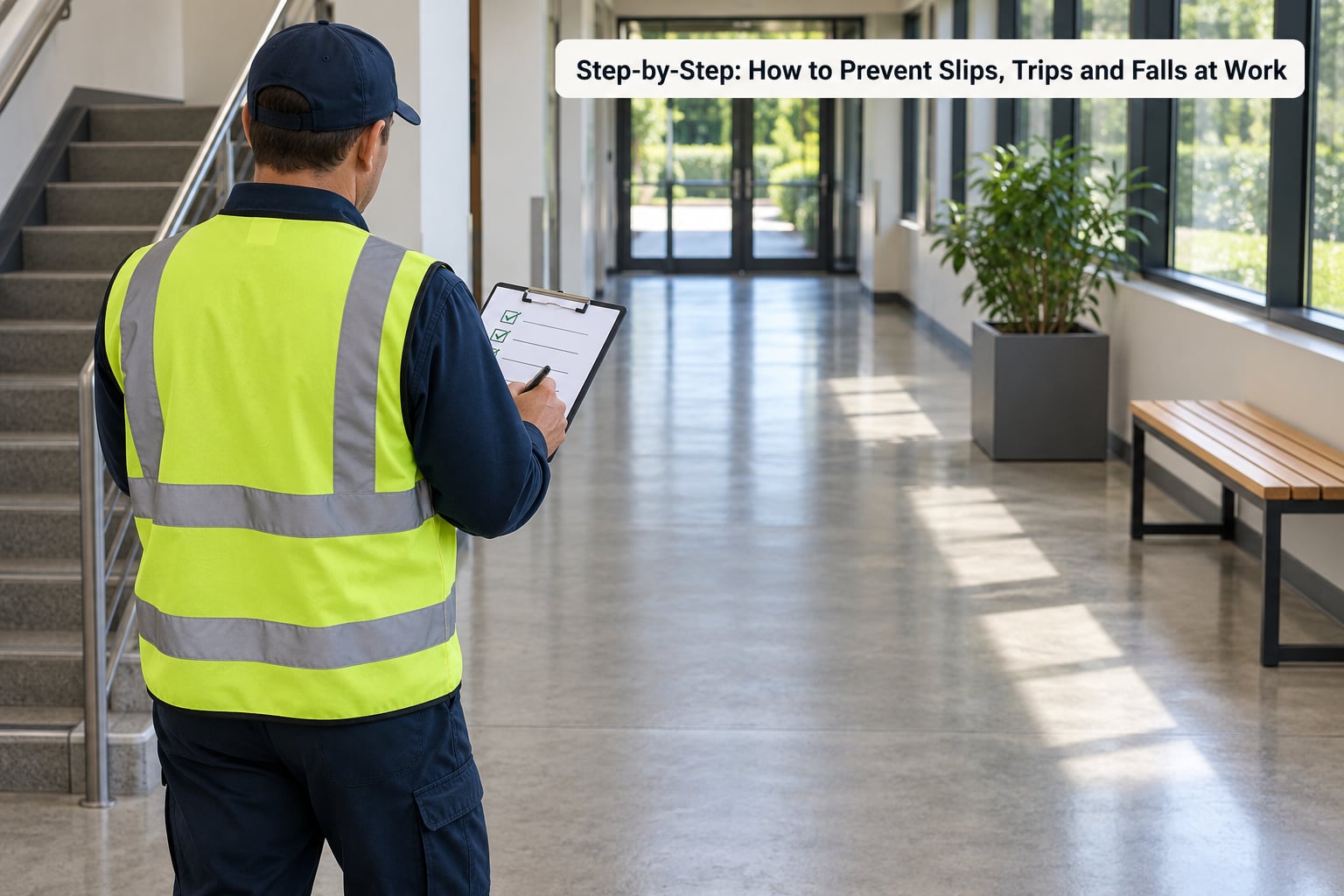
Each step below covers what to do, who owns it, how to verify it worked and what record to keep. Do them in order. Skipping straight to step four and hanging out warning signs is how a temporary measure turns into a permanent one.
1. Identify Where Slips, Trips and Falls Happen
Start with data, not assumptions. Pull your incident records and group them by location, cause and time of day, then layer in near misses and employee reports, because near misses show you the hazards that almost worked.
Look for patterns in three places. Concentration matters: falls cluster at entrances, stairs, restrooms, kitchen and break areas, loading docks, and anywhere two different floor materials meet. Timing matters too. Spills that sit for ten minutes are found quickly; spills discovered at the end of a shift are found by the first person in the morning.
Task patterns are the third lens. Watch for people who routinely carry loads that block their view, work at height on ladders, move between wet and dry areas, or move quickly because their production schedule demands it.
Then walk the routes yourself, following the same paths and the same shortcuts workers use. You will find hazards within ten minutes that no form has ever captured.
Verify: your top hazard list should be specific, ranked and located, not a general statement that floors need attention. Record: the ranked list with incident counts behind each location.
2. Inspect Floors, Stairs, Entrances and Work Areas
Run inspections on a fixed schedule and use the same checklist every time, so the same things get checked in the same way regardless of who is walking the site.
Cover wet and contaminated floors, damaged or uneven flooring, loose mats and thresholds, stair treads and nosings, handrails, lighting levels, cables and extension cords across walkways, storage in aisles and exit routes, floor level changes, and any outdoor or weather-exposed route.
The working inspection checklist below is what most sites actually use. Ownership is the line most programs omit, and it is the one that decides whether anything changes.
- Entrances and exterior doors: mat condition, edge curl, grit tracked inside, drainage. Owner: facilities. Daily informally, formal check weekly.
- Corridors and aisles: spills, obstructions, cable runs, floor level changes. Owner: supervisor. Each shift.
- Stairs and stairwells: tread wear, nosing, handrails, lighting, signage. Owner: facilities. Weekly.
- Restrooms and break areas: water at sinks, wet mop floors, waste bin overflow. Owner: housekeeping. Each shift.
- Kitchen and food service: grease, water, clutter, floor mats. Owner: housekeeping. Each shift.
- Loading dock and warehouse: dock edge, dock plate, traffic routes, housekeeping in travel paths. Owner: operations. Daily.
- Work areas and shop floors: extension cords, tool drops, material in walkways. Owner: supervisor. Daily.
- Parking lot and grounds: ice, snow, drainage, lighting, uneven asphalt. Owner: facilities. Weather-driven.
Photograph any hazard before it is corrected. That single habit turns an argument about whether the floor was actually a problem into a five-second review.
Verify: inspection completion rate against schedule. Record: signed checklists with dates, photographs and hazard reference numbers.
3. Fix or Control Identified Hazards Quickly
Correct hazards using the hierarchy of controls, strongest option first. Elimination and engineering controls come before administrative ones, which is why fixing the drain beats adding a wet floor sign.
Eliminate. Stop the source. Fix a leaking valve, reroute a cable permanently in conduit, move a task away from a wet process, close an unused stairwell.
Engineer. Repair damaged flooring, replace worn matting with slip-resistant material sized for the traffic, add or repair stair nosings, install handrails where required, improve drainage, and raise lighting levels in dim areas.
Administer. Where a permanent fix will take weeks, isolate the hazard, mark it clearly, post a sign, and reroute traffic through a safe path.
Set priority by risk and by time. Anything wet and in a main traffic route is same-day. A damaged floor in a rarely used corner is scheduled, but scheduled with a date attached. Unscheduled repairs are how a broken floor tile becomes a two-year-old complaint.
Send anyone away from an unsafe area rather than past it. There is no shame in closing a corridor, and there is a great deal of shame in explaining an injury that a cone would have prevented.
Verify: mean time to close, and closure rate. Record: work order number, date raised, date closed, cost, and the person who verified the fix.
4. Use Signs and Barriers Without Relying on Them
Warning signs, cones, barriers, temporary mats and alternate routes are legitimate controls. They are also the control people reach for first because they are cheap, fast and visible. Use them, but know what they are worth.
A sign tells a person to change their behaviour. It does nothing for the person who is carrying a box, talking on a headset, has poor vision, or is in a hurry. Signs work best for short, deliberate tasks where the hazard is obvious and the route around it is easy. They work poorly as the long-term answer to a leak, a torn mat or a dark stairwell.
Two specific failures to watch for. Signs left standing on a dry floor teach people that signs mean nothing. Barriers that redirect foot traffic into a narrower or darker path simply move the risk somewhere less visible.
Use signage as a documented interim measure with an end date attached to the work order. When the permanent fix goes in, take the sign down and check that it actually came down.
Verify: audit for signs in place longer than the associated repair deadline. Record: interim control dates.
5. Train Workers and Supervisors on How to Prevent Slips, Trips and Falls at Work
Training works when it is short, site-specific and repeated. Generic annual slides about the importance of safety do not change how anyone behaves on a wet kitchen floor at 6pm on a Friday.
Cover the practical behaviors: how to respond to a spill and who to call, ladder and step stool use, three points of contact on stairs, walking rather than running on stairs, not carrying loads that block your view, stopping on stairs to answer a message, footwear requirements, how to report a hazard and a near miss, and what to do after a fall occurs.
Train supervisors separately, because they make the calls. They decide whether a damaged floor gets repaired this week, whether an area can be used, whether a temporary route is acceptable. Their decisions drive most outcomes.
Set a cadence: onboarding before first shift, a refresher for everyone at a fixed interval, and short toolbox talks on one topic at a time. Five minutes on why the loading dock plate gets inspected every morning beats an hour on general safety.
On footwear, be realistic. Workers consistently describe enforced safety boots as uncomfortable and tiring, and they are right. A foot that aches by the afternoon changes gait, and a changed gait is a new trip risk. Where a slip-resistant sole is required, offer a proper fitting, allow reasonable variety within your standard, and make it clear whether the employer provides or reimburses. People wear the footwear that fits. They do not reliably tolerate the footwear that does not. Related reading on how strain injuries build up in repetitive work is in our guide to how to prevent tendonitis at work.
Verify: training completion by role, plus short observation during walks. Record: attendance, date, topic, and the site-specific hazards covered.
6. Improve Housekeeping, Lighting and Access
Housekeeping is where most slip, trip and fall prevention actually happens, day in and day out. It also fails in a predictable way: it is everyone’s job, so it becomes nobody’s.
Assign it by shift and by area with named owners, built into the routine rather than left to goodwill. A cleaner who knows that the north entrance is theirs before 8am and that the walkway behind the press is checked every two hours will do a different job from a cleaner told to keep an eye out.
Keep aisles, exit routes and stairwells clear of materials, tools, boxes and pallets. Repair flooring rather than working around it. Replace lighting as soon as a lamp fails instead of waiting for a batch change, and check stairwell lighting specifically since it fails unnoticed.
Write a spill response procedure and make it short: isolate, clean, report. Decide whether cleanup starts immediately or after the area is marked, and hold the answer for overnight and weekend cover too. Keep spill kits stocked and stocked at the point of use.
Manage cords properly. Permanent wiring or overhead drops for anything crossing a walkway, cable covers where a temporary run is unavoidable, and no extension cords through a doorway or across an exit path.
Handle weather deliberately. Someone owns parking lot, ramp, dock and entrance conditions on ice days, and they have authority to close an area or delay opening. Drainage gets inspected before a rainy season rather than during it.
Finish with access. Keep routes usable for people with mobility needs, and make sure nothing you install to prevent a trip creates an obstacle for someone else. Our piece on accommodating workers with disabilities at work covers the wider obligations.
Verify: housekeeping audit scores by area and shift. Record: assignment sheets, spill kit checks, lighting repair logs.
7. Encourage Reporting and Near-Miss Reviews
A near miss is an event that could have caused injury but did not. They are the cheapest data you will ever get, and the hardest to collect, because workers assume that reporting one is reporting their own mistake.
Remove that assumption explicitly and repeatedly. Say it in training, say it in the safety talk, and act on it the first three times. When a worker reports something and it gets fixed within days, the reporting culture is built. When a report disappears into a system and nothing changes, you have taught everyone not to report.
Keep the channel simple and low-friction: a form on the intranet, a QR code at the entrance, a card in the break room, or a name and number on the board. Anonymous works for some people, named works better for others, so offer both.
Review near misses on a fixed schedule with the people who reported them in the room. Look for repeats, since a hazard reported three times is a broken process rather than three unlucky events. Track corrective actions to completion and go back to the reporter when the fix is done. Closing the loop is what makes the next report easy.
This is the same muscle you need for preventing workplace violence, where early reporting and a trusted channel matter just as much.
Verify: reports per 100 workers, share of reports closed within the target time. Record: report, review notes, corrective action, closure date, feedback given to the reporter.
8. Measure the Program and Review It Regularly
Injury counts are lagging indicators. They tell you what already happened, which makes them a poor control dial. Track what the program did this month as well as what it costs you when it fails.
Leading indicators: hazards reported, mean time from report to closure, percentage closed within target, inspections completed on schedule, housekeeping audit scores, training completion, near-miss reports per 100 workers, repeat findings from previous audits, and lighting and repair completion rates.
Lagging indicators: recordable injury rate, days away from work, workers’ compensation claim frequency and cost, and incident rate by location.
Watch for the trap where near-miss reports drop sharply. Falling reports usually means falling trust, not a safer site. A healthy site trends upward on reports for a while as people speak up, then downward on repeat findings.
Review the numbers with management on a fixed schedule, monthly for active sites and quarterly for the overall program, and put the results in front of the people who work there. Trend the same metrics each time so changes mean something.
Verify: review held, actions assigned and dated. Record: the dashboard and a one-page summary per management review.
Common Mistakes
These six failures show up again and again, and each one has a straightforward fix.
Treating warning signs as the fix
A wet floor sign on a wet floor is a temporary control with an expiration date, and in practice it never expires. Fix the source, then use the sign while you fix it. If a sign has been standing for more than a week, the repair has lost priority. Give it back.
Leaving damaged flooring in place for months
Cracked tile, curled carpet edge, worn threshold and broken stair nosing are the four most repeated findings in audits I have reviewed. They are also easy to budget. Put flooring repairs on a planned maintenance cycle with a named approver, and stop generating the same work order every month for a problem someone already knows about.
Storing materials in walkways and aisles
Boxes in an aisle look like an efficiency problem and are a fall problem. It also exposes you under OSHA housekeeping requirements, which are specific about keeping walkways and exit routes clear. Set storage locations, mark floor lines, and enforce them on every shift rather than during audit week.
Blaming workers for carelessness
Careless is rarely the root cause. A worker carrying an unstable load on a cluttered aisle with a missing handrail is dealing with three environment failures, and calling it carelessness removes any incentive to fix them. Investigation should ask what made the safe action hard, not who chose the unsafe action.
Failing to document corrective actions
If the record stops at the hazard report, you cannot prove the hazard was addressed, you cannot tell whether it recurred, and you cannot tell whether the same location keeps generating findings. A hazard reference number that follows the report from identification to verification is enough. It does not need to be complicated.
Assigning housekeeping to everyone and no one
Named owners by shift and by area, with the expectation written down, is what separates housekeeping from good intentions. Build it into the daily routine and the handover, and audit by area so you can see exactly which shift is carrying the load.
Frequently Asked Questions
What should an employer do first after a workplace slip, trip or fall?
Secure the injured person and call for medical help before moving them, unless the scene is unsafe to stay in. Make the area safe so nobody else is hurt, then notify the supervisor and follow your incident reporting process the same day. Photograph the scene, preserve damaged footwear or equipment, and record what witnesses saw. Do not let the injured worker return to the area until the hazard is corrected and the cause is understood.
Do warning signs prevent slips, trips and falls at work?
They help, but only for short-term situations where the hazard is obvious and people can see an easy way around it. A sign tells a person to change their behaviour, and it does nothing for someone carrying a load, talking on a headset, rushing, or unable to see well. Signs are best used as a documented interim control while a permanent fix is scheduled. A sign standing on a dry floor for weeks teaches people to ignore signs entirely.
Are non-slip shoes required for workplace fall prevention?
It depends on the work. Slip-resistant footwear is required or strongly recommended in kitchens, cleaning, construction, warehouse and outdoor winter work, where floors are wet, greasy or icy. For office and admin settings it is usually optional. If you require it, specify a slip-resistance standard and a minimum standard of care, and remember that comfort drives compliance. Workers describe enforced boots as tiring, and footwear that causes foot pain changes gait, which creates its own trip risk.
How should employees respond to a spill or wet floor?
Protect the area first. Stand somewhere you can be seen, place a warning sign or barrier if it is safe to do so, and keep people out of the spill while it is there. Clean it as soon as practical, or report it immediately if cleaning is not part of your role. Tell the supervisor so the source can be identified and fixed. Report near misses and repeat spills, because a spill that keeps coming back is a maintenance problem, not a housekeeping problem.
What training is needed to prevent slips, trips and falls at work?
New starters need it before their first shift: hazard awareness, spill response, ladder and stair safety, three points of contact, safe load carrying, footwear, and how to report hazards and near misses. Everyone needs short refreshers on a fixed interval plus focused toolbox talks on one topic at a time. Supervisors need their own session on inspection duties, when an area can be taken out of service, and how to prioritise repairs, since they make most of the calls that matter.
How often should employers inspect workplace walkways and floors?
Daily for main traffic routes, each shift where spills or weather are common, and at least weekly for stairs, entrances, restrooms and outdoor areas, with a full formal inspection on a monthly or quarterly cycle. The right frequency follows the hazard, not a fixed rule. Higher-risk areas such as loading docks, kitchens and wet processes need more frequent checks than a low-traffic corridor. Record every inspection, because an inspection with no record is difficult to defend later.
Conclusion
If you are starting from scratch this week, do five things in order. Walk your highest-traffic areas yourself and find the wet spots, the damaged flooring, the cables and the blocked exits. Correct the active hazards today, even if the fix is temporary. Stop people walking through an unsafe area instead of past it. Write down what you found, who owns it and by when. Then put a reporting line in place and tell people, in plain terms, that reporting a near miss will never be held against them.
That last part is the one that compounds. Every hazard you fix before it hurts somebody is a person who keeps working, and a supervisor with a little more time on their hands tomorrow. If you are ready to go further, our guide to how to prevent workplace violence covers the next biggest safety risk in the same reporting-culture terms.