
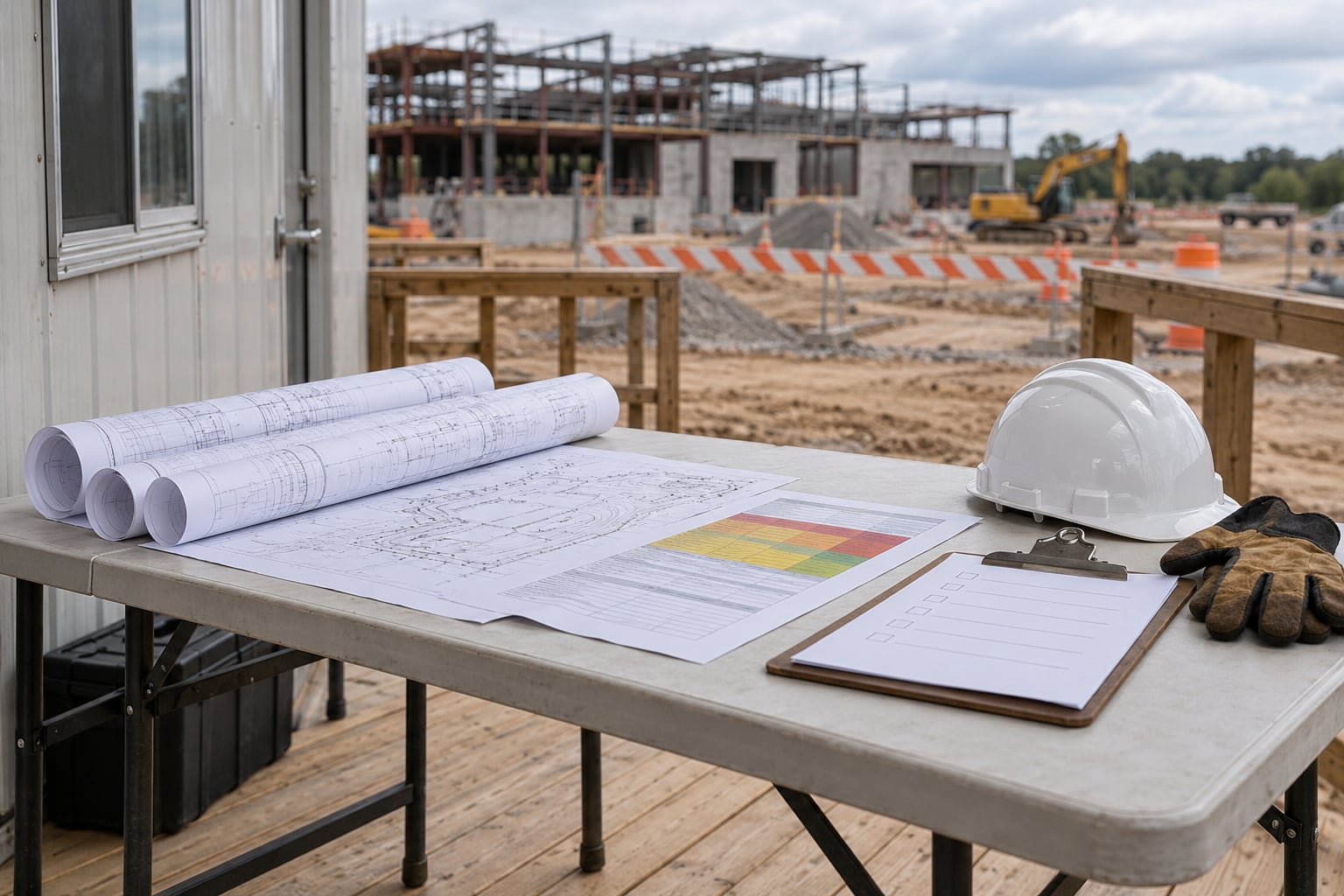
Writing a construction site safety plan comes down to six moves: document the scope, walk the site, rank the hazards, write a control and an owner for each one, add training and emergency procedures, then get the plan in front of the crew and update it as conditions change. The document itself is not complicated. What separates a plan that changes behavior from one that sits in a binder is whether every hazard on the list has a named control, a named person responsible, and a way to check that the control is still in place.
One thing to clear up early: federal OSHA does not require a written safety plan for every construction job. Specific standards do require written plans or programs for falls, excavations, respiratory protection, hazardous chemicals and confined spaces, and most owners and general contractors require one contractually anyway. On smaller jobs the plan can be two or three pages. On a multi-phase project it runs longer, because the hazards change when the work changes.
Table of Contents
- What You Need
- Step-by-Step: How to Write a Safety Plan for a Construction Site
- Common Mistakes
- Frequently Asked Questions
- Does OSHA require a written safety plan for construction?
- Who is responsible for writing the construction site safety plan?
- What should a site-specific safety plan include?
- What is a competent person in construction safety?
- How often should a construction safety plan be updated?
- How do I handle subcontractors who submit a generic safety manual?
- Conclusion
What You Need
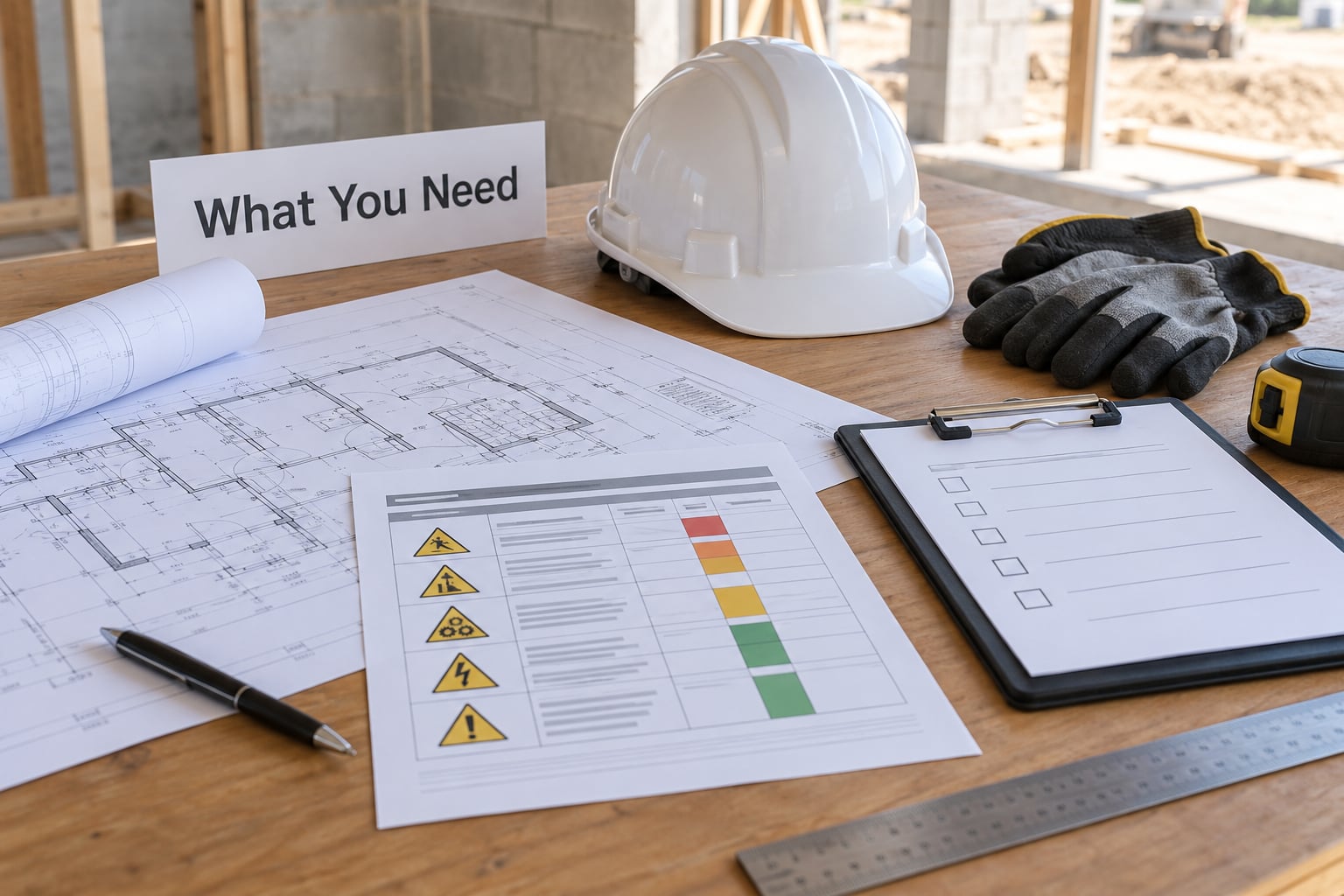
Most plans fail because people start typing before they have the facts. Gather these first and the writing goes quickly.
- Scope documents. Contract drawings, the scope of work broken into phases, the schedule, and any sequence notes that explain what happens where and when.
- Site information. Street address and boundaries, access and delivery routes, building entries and stairwells, overhead lines, adjacent occupied properties, and existing structures that will be tied into.
- The people list. Names, roles, phone numbers and email for the project manager, superintendent, foremen, safety lead, first aid responders, and every subcontractor expected on site.
- Applicable regulations. The OSHA 29 CFR 1926 subparts that match your work, your state plan if you operate in one (California, New York, Washington, Michigan and a handful of others have their own), and any owner or insurance requirement more strict than the code.
- Equipment and chemical documents. Manuals for powered equipment on site and a safety data sheet for every material that will be delivered.
- Prior records. Incident history and near-miss log from comparable jobs, plus any job hazard analysis already done for repetitive tasks.
- Safety resources. Written programs you already maintain, starting with a fall protection plan if anyone works at height and a trench safety program if you will dig. If your company has never written one, the fall protection plan guide is a good place to start.
Step-by-Step: How to Write a Safety Plan for a Construction Site
The process below is the one that holds up when a plan is reviewed months later, after something went wrong or an inspector asked a question.
- Define the project scope, the site boundaries and every party working there.
- Identify hazards task by task and rank them by likelihood and severity.
- Choose controls using the hierarchy of controls, then assign an owner to each one.
- Assign roles and responsibilities, including the competent person and stop work authority.
- Plan training, communication, signage and permit requirements.
- Write emergency, incident and return to work procedures.
- Review, approve, distribute and set a schedule for updating the plan.
1. Define the Project Scope and Site Boundaries
Open with a page that answers the questions a new worker would ask on their first morning: where is the site, what is being built, who is working here, and where do I walk and where do I not.
Break the work into phases, because a hazard that does not exist during framing exists during steel erection. List each work area, the trades that occupy it, the shifts involved, and the equipment that will be there. Note the access routes, delivery routes, staging areas and crane pick zones, plus adjacent properties that stay occupied while you work.
Attach a site map. Show entrances, emergency exits, fire extinguisher and first aid locations, assembly points, and every hazard zone you will describe later in the document. A plan without a diagram forces each reader to rebuild the site in their head.
2. Identify Hazards and Assess Risk
Walk the site in person, during the hours and shifts when work actually happens. A 6 p.m. walk of a site that runs two shifts misses half the exposure, and it misses the traffic conflicts that cause most struck-by injuries.
Work through the hazard categories that account for the majority of construction injuries: falls from elevation, struck-by incidents involving equipment and vehicles, caught-in and caught-between events, excavations and trenches, electrical work, chemical exposure and dust, noise, heat and cold stress, and weather such as lightning and high wind. Add the awkward ones specific to your site: a sloped lot, a live utility crossing, a delivery route that runs past the pedestrian gate.
Rank each hazard twice, on likelihood and on severity, and use the two scores together. A low-likelihood, high-severity hazard still gets a real control, but it does not get the same budget as something that happens every day and sends people to the emergency room.
Then do a job hazard analysis for the tasks that will be repeated. Break each task into steps and ask at every step: what can go wrong, what would cause it, and what stops it. Excavation work in particular has its own protective requirements, so read up on trench safety basics for excavation crews before you write those controls.
3. Choose Controls and Write Action Measures
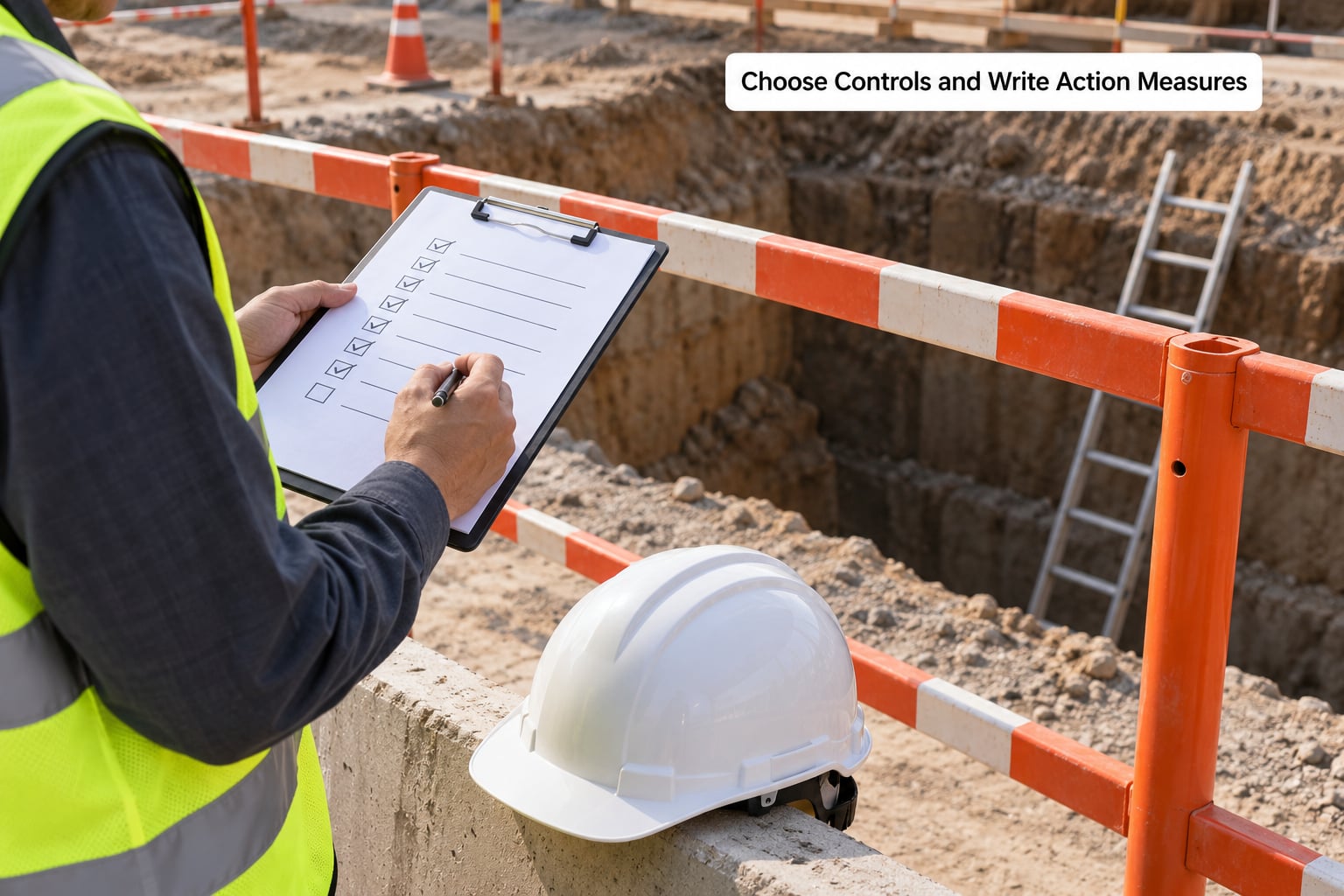
A hazard list on its own is a complaint, not a plan. Every significant hazard needs a control, and controls are ranked: eliminate the hazard first, substitute something less dangerous second, use an engineered fix third, rely on procedures and training fourth, and use personal protective equipment last. PPE is the weakest control because it only works if it is worn, fitted and undamaged.
Write each action in a single line so it can be checked: hazard, control, who owns it, what resource it needs, how often it gets checked, and what “done” looks like. Guardrail systems inspected before each shift by the competent person, rather than fall protection installed, is the difference between a plan line and a wish.
Set the resource column honestly. If a control needs a harness program, a rescue plan and a trained rescue team, say so. A plan that promises controls the project cannot fund teaches the crew that the document is fiction.
4. Assign Roles and Responsibilities
Write the roles as a short section with names attached, not job titles alone. Safety professionals on busy sites consistently flag the same problem: nobody was designated competent person, so nobody had the authority to stop work or approve an excavation or sign off a fall protection setup.
Cover the employer or owner, who carries the overall duty. Cover the project manager and superintendent, who control the schedule and therefore control how much pressure the crew is under. Name the competent person and spell out what that role may authorize, including inspecting protective equipment, approving trench access, and stopping work. Cover supervisors, who run the daily briefings and enforce the rules. Cover subcontractors, who must submit their own plan for their scope and work to yours when on your site. Cover workers, who have the right and the duty to report hazards and refuse work they believe is unsafe.
State the reporting expectations next to the roles: who gets called when something is damaged, who authorizes a restart, and how quickly an incident must be reported.
5. Plan Training, Communication, and Signage
Every person who steps on the site gets site orientation before their first shift, including the visitor rules and the location of the assembly points. From there, run a toolbox talk before work starts on each phase and at least weekly once the site is running, and keep a record with the date, the topic and the attendees.
Cover task specific training separately, because general briefings do not qualify anyone to enter a confined space, run a hot work permit or apply a lock. Our guide to writing a safety standard operating procedure shows how to capture one of those tasks as a repeatable document rather than a paragraph of good intentions.
Make the communication plan practical. What language does the crew speak, and who translates when a briefing matters? Which PPE is required where, and who supplies it? What signage goes up at each hazard zone, and who checks that it is still there? Which tasks need a written permit before work starts?
Finish with a comprehension check. Ask a worker to describe the hazards of the task they are about to do. If they cannot, the training did not land and you have a paperwork problem, not a knowledge problem.
6. Add Emergency and Incident Procedures
Write the emergency section so someone who has never seen the site can act on it. List emergency numbers, who calls 911 first, the site address with the nearest cross street, the hospital with its route, and the location of the first aid kit and the trained responder on each shift.
Describe evacuation or shelter in place, the routes of travel, the assembly points and who takes the roll call. Cover fire response: alarm method, extinguisher locations, who pulls the permit and who calls the fire department. Include the weather triggers, for example the wind speed that stops crane work and the lightning rule that sends everyone inside.
Then write the incident procedure. Near-misses get reported the same day through the same route as injuries, because they are the cheapest information you will ever get. Set out how injuries are reported internally and to the authorities, who investigates, what the investigation must cover, and who authorizes return to work after an incident. Nobody goes back into a task until the cause is either removed or controlled and someone in writing says so.
7. Review, Approve, and Update the Plan
A draft that no one outside the author has read is not finished. Have the competent person review the hazard assessment and the controls, then let a superintendent and one trade lead read it for practicality. Their objections tell you which controls will actually be followed.
Record who approved it and when, then distribute it in a form people can carry: a printed copy in the site trailer, a copy on a tablet, and a sign-off sheet confirming each subcontractor received and read it. That sign-off sheet is also your evidence that you communicated the plan.
Set update triggers rather than an update date. New trade on site, change in sequence, new equipment, new chemical, a design change, an incident or near miss, a regulatory change, and a new shift pattern all require a revision. Put a short scheduled walk-through on the calendar too, weekly on active sites, because conditions drift before anyone writes them down. Close the project with a lessons learned review and keep what worked.
Common Mistakes
These show up again and again, and each one leaves a specific gap on the site.
- Starting from a generic template. A downloaded template fills the page without describing your site. The hazard list ends up generic, so the controls do not match the work, and the plan has no authority with the crew.
- Leaving out the competent person designation. Without a named person and defined authority, inspections do not happen and nobody can approve protective equipment or stop work. Name the person and write down exactly what the role may authorize.
- Accepting a subcontractor company manual as a site plan. This is the most common complaint from safety professionals running site audits. A company manual describes how that trade works everywhere, not the hazards of your floor, your access routes and your sequencing. Require a plan for the scope, review it, and reject manuals that arrive untouched.
- No update cycle. A plan written at mobilization and never touched describes a site that no longer exists. Tie revisions to defined triggers and put a walk-through on the schedule.
- Copy-pasted weather rules. Boilerplate that says suspend work in bad weather without a number attached is unenforceable. Write the trigger, who calls it, and who tells the crew.
- Controls with no owner. If an action item has no name against it, nobody chases it. Every control needs a person and a check frequency.
- Briefings with no record. Toolbox talks that nobody logs cannot prove orientation happened, and the next inspector will ask. Keep a dated sign-in sheet with the topic.
- An emergency section a new hire cannot follow. If it does not name the assembly point, the hospital route and the person who calls 911, it is decoration. Rewrite it for a stranger on day one.
Frequently Asked Questions
Does OSHA require a written safety plan for construction?
Not for every job. Federal OSHA requires written plans or programs for specific hazards, including fall protection, excavations, respiratory protection, hazardous chemicals and confined spaces, plus written procedures for several other tasks. Many owners, general contractors and insurance programs require a site plan for all work, so check your contract and your state plan rules before deciding a document is optional.
Who is responsible for writing the construction site safety plan?
The employer carries the duty, which usually means the general contractor or the owner assigns it to a project manager, superintendent or safety lead. In practice the plan is drafted by the person closest to the work and reviewed by the competent person. Subcontractors submit a plan for their own scope and work under the general contractor plan when they are on site.
What should a site-specific safety plan include?
At minimum: project description and location, a site map showing routes of travel and assembly points, a hazard assessment with controls, named roles including the competent person, emergency and first aid procedures, training and communication arrangements, PPE and signage requirements, subcontractor requirements, weather triggers, and incident and near-miss reporting. Each hazard also needs an owner and a check frequency.
What is a competent person in construction safety?
A competent person is someone with the training, knowledge or experience to identify existing and predictable hazards, and the authority to act on them. OSHA uses the term in standards such as fall protection and excavations. Your plan should name the person by name, define what they may authorize such as equipment inspection or stopping work, and make clear that only they sign off those decisions.
How often should a construction safety plan be updated?
Update it whenever conditions change, not on a fixed calendar alone. Triggers include a new trade or subcontractor, a change in work sequence, new equipment or chemicals, a design change, an incident or near miss, new shift patterns, and regulatory changes. Add a scheduled review on top of those triggers, weekly on active sites, because site conditions usually drift before anyone writes them down.
How do I handle subcontractors who submit a generic safety manual?
Require the plan in the contract before mobilization, specify what it must cover for their scope, and set a review deadline with a written rejection if it does not meet the site requirements. Then compare their controls against yours and record the outcome. Most problems come from accepting a company manual that says nothing about your floor, your access routes or your work sequence.
Conclusion
Do five things this week. Walk the site with the crew and list the hazards you find. Rank them by likelihood and severity, then pick the top five that would hurt someone worst. Write a control and a name against each of those five. Have the competent person review the draft and put it in front of the crew with a sign-off sheet. Then put the first verification walk on the calendar, because a plan with no update cycle quietly stops being true.