
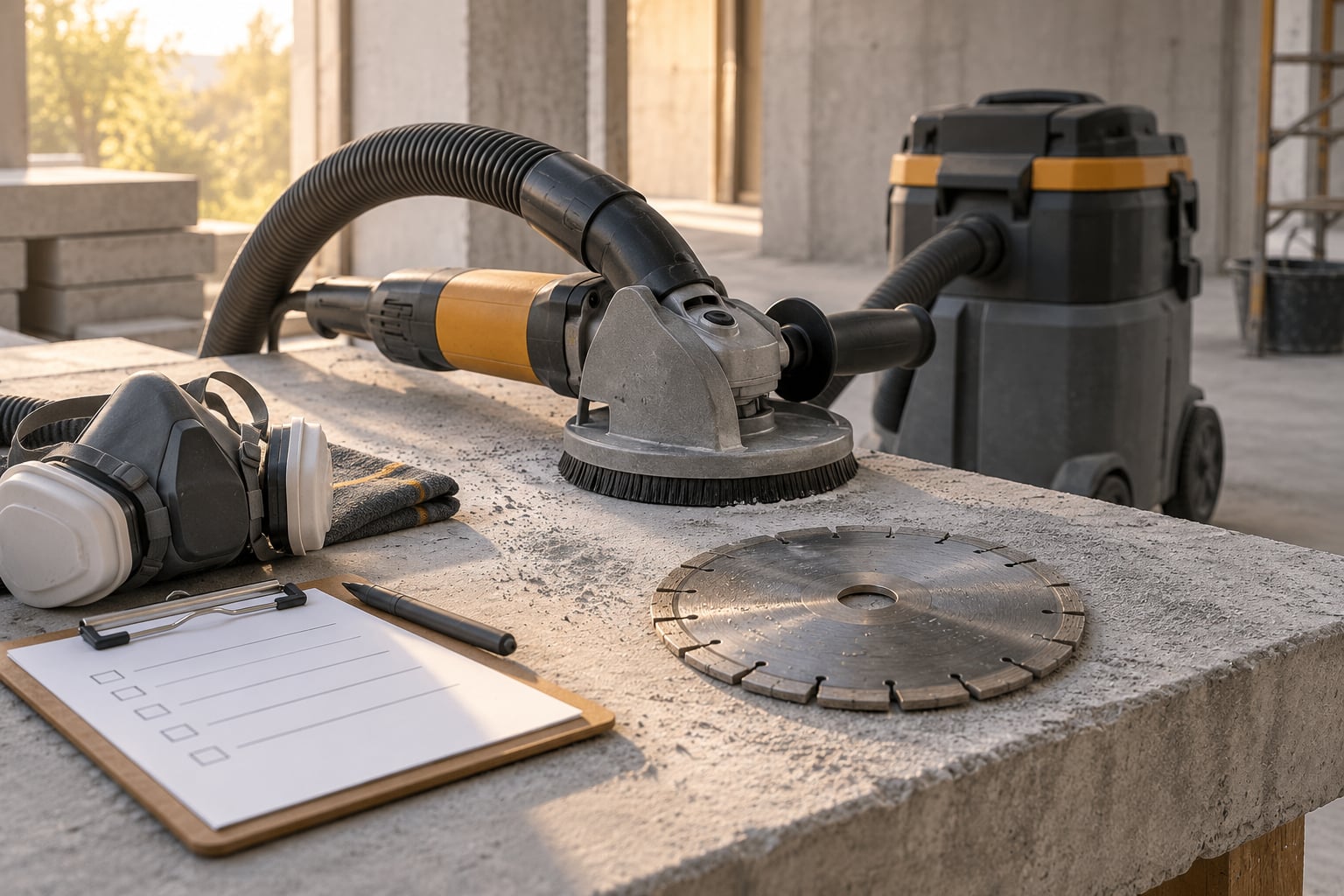
Silica dust exposure prevention works in one direction: stop the dust before it ever becomes airborne, then handle whatever escapes with respirators. You do that by inventorying every dusty task, measuring exposure, using water and HEPA extraction at the tool, banning dry sweeping and compressed air, fit-testing respirators, training people, and verifying it all still works. Most of the effort goes into the first four steps.
About 2.3 million US workers are exposed to respirable crystalline silica on the job, and an estimated 230 lung cancer cases a year are attributed to past occupational exposure. The disease is irreversible and can keep developing decades after you stop working. That combination is why prevention has to be boring and repetitive rather than clever.
This guide covers construction, stone fabrication, manufacturing, mining, foundry work and the odd home project. Rules vary by country, so the legal numbers here are US OSHA figures; check your local regulator if you are outside the US.
Table of Contents
- What You Need Before You Start a Prevention Program
- Step-by-Step: Reduce Silica Dust Exposure
- Identify Tasks and Work Areas That Generate Silica Dust
- Assess Exposure and Respiratory Health Risks
- Use Wet Methods and Safer Work Practices to Stop Silica Dust
- Choose and Fit the Right Respiratory Protection
- Train Workers and Control Access to Dusty Work
- Verify Controls and Maintain the Prevention Program
- Common Mistakes in Silica Dust Exposure Prevention
- Frequently Asked Questions
- Conclusion
What You Need Before You Start a Prevention Program
Most failed silica programs fail at the prep stage, not the tool stage. Get these eight things in place and the rest gets much easier.
- A list of every silica-producing task. Cutting, grinding, drilling, sawing brick, crushing, demolition, sandblasting, foundry mixing and metal casting all count.
- A written exposure control plan. Under OSHA construction standard 29 CFR 1926.1153, general industry and maritime standard 29 CFR 1910.1053, and mining rules administered separately, an employer with exposed workers above the action level needs a written plan describing tasks, controls, training and review.
- Air monitoring results. Personal breathing-zone sampling tells you which workers are actually exposed, not just which tasks look dusty.
- Engineering controls on hand. Water-fed saws and grinders, shrouded tools with vacuum attachments, HEPA-filtered vacuums, local exhaust ventilation hoods.
- A respirator program. Written program, medical clearance, fit testing, cartridge change schedule, and a person who is actually in charge of it.
- Housekeeping supplies. Wet mop, damp rags, HEPA vacs, sealed waste bags, HEPA-filtered laundry bags. No shop vacs for cleanup.
- Training records. Task-specific training with a sign-in sheet, plus whatever language your crew actually reads.
- A named responsible person. A supervisor or competent person who checks controls weekly and has the authority to stop a job.
Step-by-Step: Reduce Silica Dust Exposure
Identify Tasks and Work Areas That Generate Silica Dust
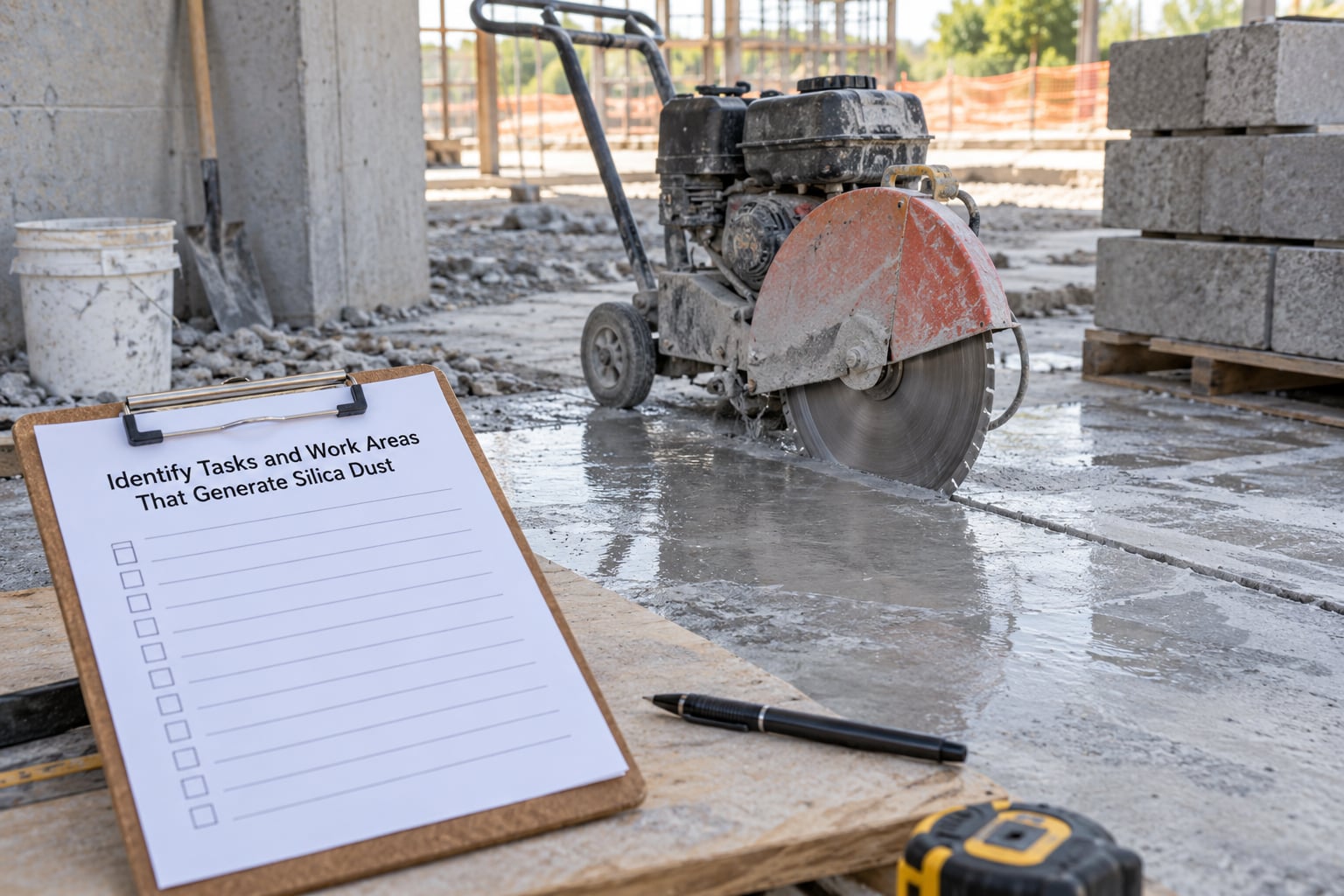
Respirable crystalline silica is not a product you buy. It is generated the moment stone, brick, concrete, mortar, tile or engineered stone is cut, drilled, ground, crushed or blasted. Sand, quartz and diatomaceous earth also carry it.
Walk the job or the plant with a clipboard and write down three things per task: who does it, how long it takes, and how close the worker is to the dust. A half-day of core drilling in a basement is a different exposure profile from a half-day of dry grinding in a busy fabrication shop, and the plan should reflect that.
Engineered and artificial stone deserves its own line on the list. These slabs are resin-bound quartz and often contain a higher silica content than natural stone or concrete, so the same cut produces more respirable dust. Countertop shops are not the same risk as a landscaping crew.
Assess Exposure and Respiratory Health Risks
Assessment tells you which controls to prioritise and whether you have to keep re-monitoring. In the US, the OSHA permissible exposure limit is 50 micrograms per cubic meter averaged over an 8-hour time-weighted average, and the action level that triggers exposure assessment and periodic monitoring is 25 micrograms per cubic meter.
Workers above the action level need medical surveillance, which for silica includes a chest radiograph, a pulmonary function test, a tuberculosis risk assessment and a clinical exam, usually every three years. Bring in an industrial hygienist or occupational health nurse when you have never measured, when tasks change, or when several workers report irritation or coughing.
Nothing about the exposure limit tells you how much dust a single person breathed during one dramatic incident. That number matters after a runaway cut or a dust cloud, so keep area monitoring in the mix alongside personal sampling.
Our advice lines up with the practical guidance on vibration exposure from power tools, where the same tool inspection discipline and the same worker-training records apply.
Use Wet Methods and Safer Work Practices to Stop Silica Dust
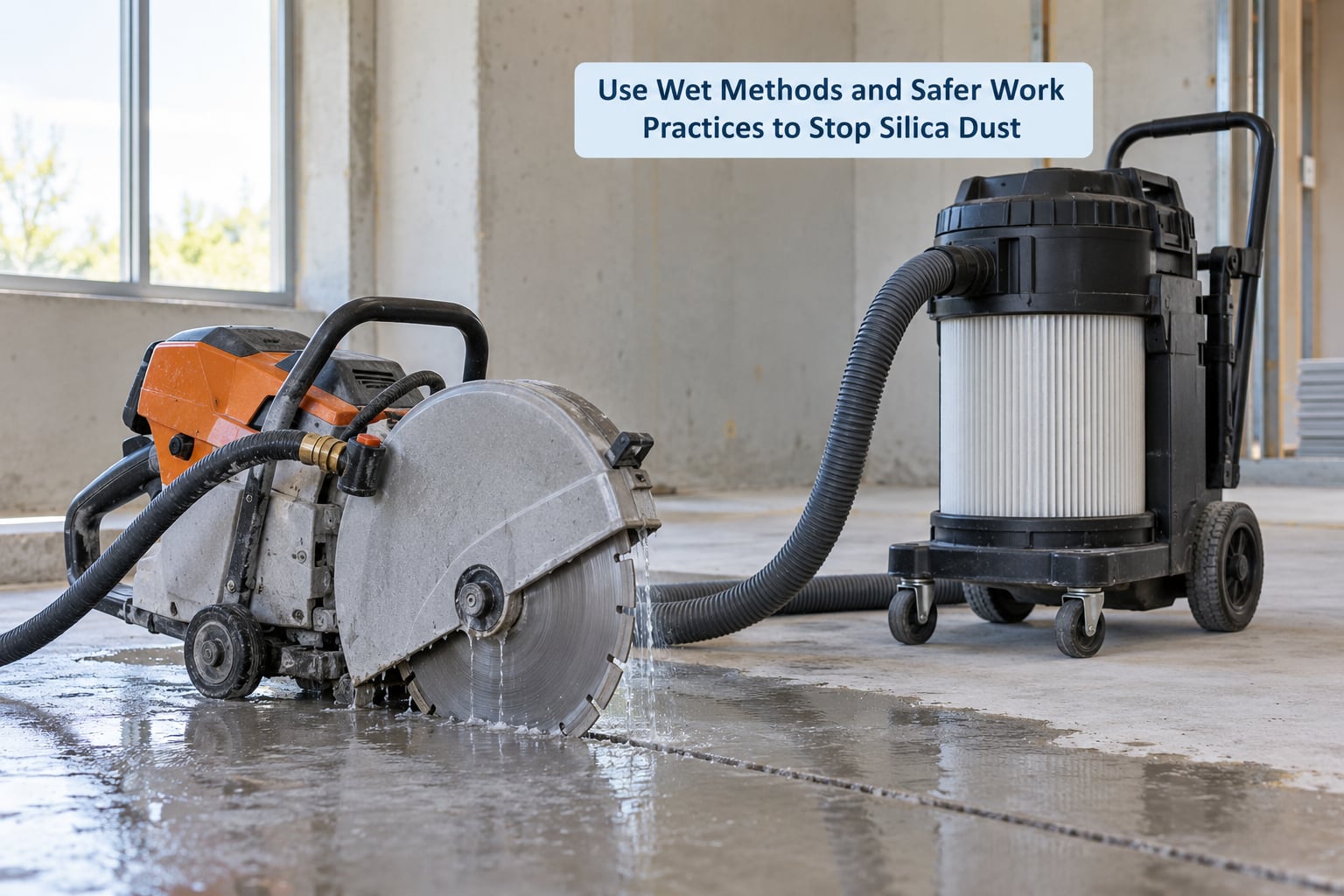
Wet cutting is the single most effective engineering control most crews already own. Feed water to the blade, keep the flow steady, pause to let the slurry drain, and avoid cutting dry because you are in a hurry. Water must reach the cut line, not just the surface.
Next comes capture at the source. Shrouded grinders with a vacuum port, wet diamond blades, local exhaust ventilation hoods and enclosed cabs pull the dust into a HEPA-filtered vacuum while it is still being made. A HEPA vacuum is the tool for cleanup, not a standard shop vacuum with a generic filter.
Isolation beats everything else. Cutting stone in a remote corner of a fabrication shop keeps four other workers out of the plume. Grinding fewer things, using prefabricated pieces, or switching to a less dusty method all outrank buying better PPE.
Then the prohibitions, which are not negotiable in a workplace:
- Never dry sweep. Use a HEPA vacuum or wet methods.
- Never clean up with compressed air. It turns settled dust into a fresh cloud.
- Never use compressed air to blow dust off clothing or skin.
- Wet mop or damp-wipe surfaces instead of dry dusting.
- Bag debris at the point of generation and label it so it does not get reused as fill.
- Wash work clothing or use disposable coveralls; do not take dusty clothes home.
Choose and Fit the Right Respiratory Protection
Respirators are the last line of defence, not the first. Once engineering controls are in place, you use a respirator for whatever exposure remains, or for short tasks where a control cannot be fitted.
NIOSH recommends an air-purifying respirator with a P100 filter for crystalline silica, because silica is a poor oil aerosol and oil-proof filters handle the oil and mist that show up in real silica work. An N95 filters particles but offers no oil resistance, so it performs poorly when the dust carries oil or mist. In Australia and New Zealand, P2 is the common designation for the same class of filter.
Know the assigned protection factor numbers before you decide: 10 for a half-mask filtering facepiece such as N95 or P100, 50 for a full-face or a tight-fitting elastomeric half-mask, and 1000 for a powered air-purifying respirator hood, helmet or loose-fitting facepiece.
Fit and seal decide whether any of those numbers mean anything. A fit test with a seal check on every wear, no facial hair under the facepiece, glasses and PPE configured so they do not break the seal, and a cartridge change schedule matched to the workload. A seal check done by the user each time the respirator is put on catches the failures that quietly void protection.
If you need to read about the hazards of a nearby task, our guide to lead exposure prevention for construction workers covers the same control logic, and welding fume exposure control covers a different airborne hazard on the same job sites.
Train Workers and Control Access to Dusty Work
Training that says “wear your mask” produces mask-shaped behaviour. Useful training is task-specific: here is the task, here is what dust it makes, here is the water feed you switch on first, here is what you must never do during cleanup, and here is who to call when the vacuum stops working.
Control access too. Signage that marks dusty zones, a rule that only trained and fitted workers enter them, and a permit for anyone entering an area where a cut is running. Watch new hires and temps closely; they get handed the least interesting task and the least supervision at the same time.
Give housekeeping a named owner per shift. Dust that is not cleaned within the shift gets tracked into vehicles, break rooms and homes, which is where exposure complaints usually start.
Verify Controls and Maintain the Prevention Program
Verification is the step small programs skip, and it is the one that decides whether any of this works. Inspect water lines, shrouds, vacuum hoses and filters on a schedule, and log it. When a HEPA vacuum loses suction or a shroud cracks, that control is gone, so treat the repair as urgent.
Review monitoring results, respirator medical clearances, fit test dates, cartridge changes, training sign-in sheets and incident reports together rather than as separate files. Anything that failed becomes a corrective action with a name and a date attached.
Update the plan whenever materials, tasks, tools, supervision or the applicable rules change. Swapping quartz countertops for a new engineered product, or moving from a shop to a job site, is a trigger, not a detail. This is the practical silica dust exposure prevention loop: measure, fix, check, repeat.
Common Mistakes in Silica Dust Exposure Prevention
Wearing a dust mask instead of controlling dust. A half-mask respirator on a grinder does not reduce the dust other workers and the rest of the building breathe. Fix: water feed or shroud with extraction first, respirator for the remainder.
Dry sweeping and compressed air cleanup. This is the most common self-inflicted high exposure on almost any site, and it happens during the tidiest-looking part of the shift. Fix: HEPA vacuum or wet mop, every time, no exceptions.
Treating any dust mask as adequate. Fit failure from stubble, a broken glasses seal or an untested mask removes the protection entirely. Fix: a documented fit test, a user seal check at every donning, and a clean-shaven policy at the mask line.
Using a standard shop vacuum for silica cleanup. Most are not HEPA-rated and push fine particles straight out the exhaust. Fix: HEPA-filtered extraction only, verified by filter class rather than by the word “industrial” on the box.
Skipping exposure assessment because the site feels fine. Dust is not visible at the action level of 25 micrograms per cubic meter. Fix: air monitoring rather than intuition.
Assuming home projects are covered by workplace rules. OSHA protections do not reach a homeowner or a casual renovator, which is why forum advice about grinding stone in a spare room keeps turning up. The same hierarchy of controls still applies even when no rule enforces it: wet methods outdoors or with extraction, a P100 or P2 respirator fitted properly, and never dry sweeping indoors.
Frequently Asked Questions
How much silica dust does it take to cause silicosis?
There is no single safe dose. Chronic silicosis usually follows 10 to 30 years of repeated exposure above the OSHA limit of 50 micrograms per cubic meter, while accelerated silicosis can appear in 5 to 10 years and acute silicosis after a few weeks to a few years of very heavy exposure. Lower total exposure means slower disease, so the practical goal is keeping every shift under the limit rather than waiting for symptoms.
What should never be used to clean silica dust?
Never clean silica dust with compressed air, and never dry sweep it. Both methods loft settled respirable crystalline silica back into the breathing zone of everyone nearby, including workers who were not part of the task. Use a HEPA-filtered vacuum, wet mopping, or damp wiping instead, and bag debris at the point of generation so it is never reused.
Do I need a respirator for concrete cutting?
A respirator is the last layer, not the first one. For concrete cutting, use wet cutting or a shrouded saw with vacuum extraction to keep dust from forming, keep bystanders away, and monitor the air if exposed workers stay above the 25 microgram action level. If you are one of those workers, a fit-tested P100 respirator covers whatever remains. If you are a homeowner doing the job once, do it wet and outdoors.
Is an N95 or P2 mask enough for silica dust?
An N95 or P2 filters particles, but silica is commonly carried in oil and mist, and those filters are not oil-proof. NIOSH recommends a P100 filter for crystalline silica, or a higher class such as a PAPR for heavy or unusual exposure. Whatever class you use only works if it fits: do a fit test, keep a clean-shaven seal, and run a user seal check each time you put it on.
Is silica dust covered by COSHH?
Yes. In the United Kingdom, respirable crystalline silica is covered by the Control of Substances Hazardous to Health Regulations, so employers must assess exposure, keep it below the workplace exposure limit, provide training, and supply suitable respiratory protective equipment. Australia and New Zealand cover it under work health and safety law rather than COSHH. All three treat engineering controls as the required first choice.
Conclusion
Start with the list. Every job, every shift, note the silica-producing tasks and who does them. Then measure, keep respirable crystalline silica under the 25 microgram action level and the 50 microgram limit over an 8-hour average, and stop the dust at the source with water, shrouds and HEPA extraction. Never dry sweep and never use compressed air for cleanup.
Then put a fit-tested respirator on whoever still has exposure, train the crew on the task in front of them, and book the next round of verification. Get an industrial hygienist and a doctor involved when the work is unfamiliar or a heavy exposure has already happened. This is general occupational health information, not medical advice.