
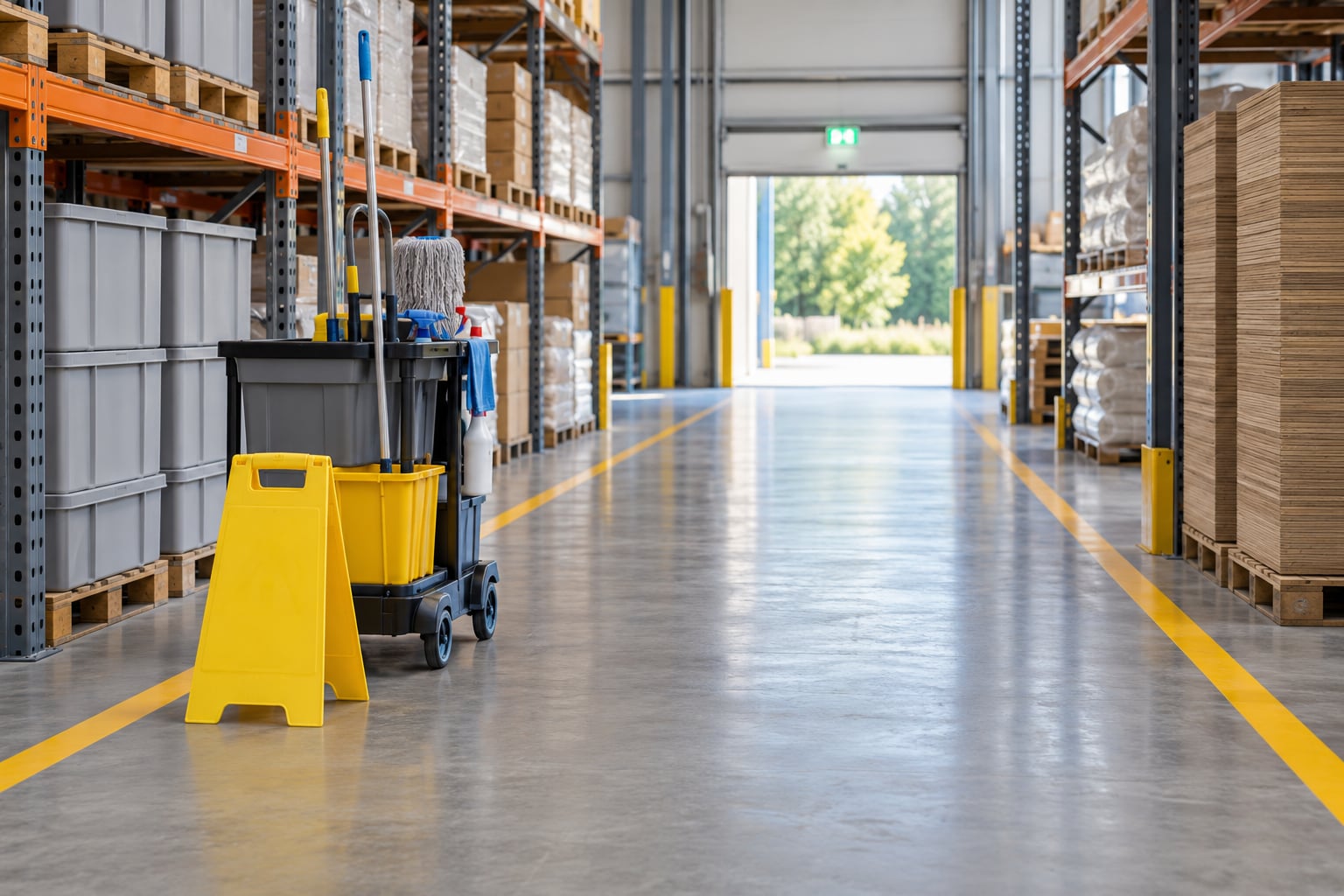
Workplace housekeeping is the routine cleaning, organizing and upkeep that keeps walking-working surfaces clean, dry and free of hazards, so nobody slips, trips, trips over stored material or breathes something harmful on the job.
These workplace housekeeping safety tips turn that definition into 12 concrete actions, each with a frequency, an owner and a way to verify it happened. OSHA treats it as a shared duty rather than a custodial one: 29 CFR 1910.22(a) and (d) require that all work areas be kept clean, orderly and sanitary, and that floors and walkways stay free of hazards such as leaks, spills, sharp or protruding objects, loose boards and corrosion. Nobody gets a pass for saying the mop bucket belongs to someone else.
Two things before you read on. Housekeeping is mostly behaviour, not equipment, so the fix is a habit plus a named owner rather than a new machine. And this is general information, not a substitute for reading the current applicable regulation or talking with a qualified safety professional about your site.
Table of Contents
- Workplace Housekeeping Safety Tips at a Glance
- 1. Keep Floors Clean, Dry, and Free of Obstacles
- 2. Mark Wet Floors and Restrict Unsafe Areas
- 3. Keep Aisles, Walkways, and Emergency Exits Clear
- 4. Store Tools, Materials, and Supplies Safely
- 5. Inspect and Maintain Cords, Lighting, and Electrical Surfaces
- 6. Control Dust, Fumes, and Airborne Contaminants
- 7. Separate Waste and Use Covered Containers
- 8. Use an Appropriate Janitorial Chemical System
- 9. Maintain Clean Restrooms, Kitchens, and Break Areas
- 10. Schedule Regular Walkthroughs and Record Findings
- 11. Make Housekeeping Part of Every Shift
- 12. Review and Improve Housekeeping Performance
- Frequently Asked Questions
- How often should workplace housekeeping be checked?
- Who is responsible for workplace housekeeping?
- What should a daily workplace safety inspection include?
- When is a housekeeping problem serious enough to stop work?
- How should cleaning chemicals be stored safely?
- Do small businesses need a written housekeeping checklist?
- Start With the Highest-Risk Areas
Workplace Housekeeping Safety Tips at a Glance
Here is the whole list on one page, so you can hand it to a supervisor or paste it into your own program.
| # | Tip | Hazard it addresses | Frequency | Owner | How to verify |
|---|---|---|---|---|---|
| 1 | Clean, dry, unobstructed floors | Slips, trips, falls | Continuous, checked daily | Area supervisor | Opening walkthrough log |
| 2 | Mark and restrict wet or unsafe areas | Slip entry while cleaning | Every hazard, removed when dry | Whoever creates it | Photo or sign-off at removal |
| 3 | Clear aisles, walkways, exits | Egress blockage, struck-by, fire load | Daily | Area supervisor | Route walk with a marker line |
| 4 | Designated, stable storage | Falling objects, crush injuries | Weekly audit | Stores lead | Shelf load and stack check |
| 5 | Cords, lighting, electrical surfaces | Shock, fire, trip | Daily visual, monthly formal | Facilities | Logged inspection record |
| 6 | Dust and fume control | Respiratory exposure | Continuous, verified monthly | EHS lead | Filter and gauge check |
| 7 | Covered, correctly sized waste bins | Pests, overflow, contact with chemicals | Emptied before full | Contractor or site team | Container count at shift end |
| 8 | Correct janitorial chemical system | Mixing reactions, exposure | Weekly review | Facilities supervisor | Label and SDS binder audit |
| 9 | Clean restrooms, kitchens, break rooms | Sanitation, slips, cross-contamination | Documented, per use | Facilities | Signed inspection sheet |
| 10 | Scheduled walkthroughs with records | Repeat findings, open hazards | Daily, weekly, monthly | Safety lead | Findings log with closure dates |
| 11 | Housekeeping on every shift | Blurred accountability | Every shift | Whole team | End-of-shift reset |
| 12 | Trend and improve performance | Chronic neglect, tick-box cleaning | Monthly | Safety lead | Trend report with actions |
1. Keep Floors Clean, Dry, and Free of Obstacles
Prompt spill cleanup is the single highest-return housekeeping action, because wet and cluttered floors are where most slips and trips begin. The rule is simple: correct it now or guard it until you can.
Whoever creates the hazard owns the response. A forklift driver who tracks oil, a cook who drops stock and a contractor who knocks over a paint tin should all be able to reach a spill kit without asking permission.
Stock at least two spill kits per work zone, each with absorbent pads, a shovel, a bucket, a neutral cleaner, a floor-drying compound and a sign. In a warehouse, I would keep one kit at the packing stations and one at the goods-in bay, because those are the two places people move fastest with the least attention.
2. Mark Wet Floors and Restrict Unsafe Areas
A wet floor sign is not a fix, it is a notice that the floor is still wet. The floor gets dried; the sign comes down when the hazard is gone.
Two rules keep signage from becoming wallpaper. Place the sign at the approach point where someone actually enters the area, not back against the wall, and remove it the moment the area is dry and reopened. A sign that has sat in a doorway for three shifts tells people signs are optional.
For anything larger than a puddle, put up a physical barrier, a cone or a strap, and offer a marked alternate route. If the only way past is blocked, stop the traffic and tell the supervisor.
3. Keep Aisles, Walkways, and Emergency Exits Clear
Clear routes are not cosmetic. Under 29 CFR 1910.22(a), all work areas must be kept clean, orderly and sanitary, and 1910.22(d) sets the housekeeping standard for walking-working surfaces.
Define your clear width, write it into your site rules, and measure it. Typical practice is to keep a marked walkway line free on both sides, with a defined width agreed with your fire marshal rather than guessed at by the team.
Nothing gets stored in these places: pallets, stock totes, empty drums, paper and cardboard bales, parked carts, chairs, bicycles, or electrical extension leads. Exit doors swing clear, exit routes run unobstructed to the outside, fire extinguishers and pull stations are visible and reachable, and electrical panels keep the required working clearance in front of them.
Watch the vertical space too. Under 1910.22(a)(2) and 1910.34, storage must not interfere with sprinklers; the standard working clearance below sprinkler heads is 18 inches of clear space where items are stored or piled, and 24 inches on the floor beneath the deflector.
4. Store Tools, Materials, and Supplies Safely
Falling objects cause injuries well before anyone touches a floor. Storage is where that starts.
Every tool and material needs a designated location, and using it means returning it there. Nothing lives on the floor beside a machine unless it is a bin or a stand built for that position.
Check three things during any storage audit: shelves are rated for the load actually placed on them and bolted or bracketed to the wall where tall stacks could tip, stacks stay stable and within the height limit set by your sprinkler clearance, and heavy items sit between knee and shoulder height rather than on the top shelf. Our tool safety inspection checklist covers the equipment side of the same walk.
5. Inspect and Maintain Cords, Lighting, and Electrical Surfaces
Housekeeping includes anything that can trip someone or start a fire, and that includes the cable across the aisle.
Take equipment out of service when a cord is cut, nicked, crushed or has exposed conductors; when a plug is cracked, warm or smells burnt; or when an outlet cover is broken or missing. Tag it, pull it from the area and hand it to maintenance. Overloading outlets, daisy-chaining power strips and running extension leads under mats or through doorways are the three failures I see most.
Report flickering lights, buzzing fixtures and lamps with missing lenses, because a flickering fixture is often a loose connection. Temporary wiring and any change to fixed electrical systems belongs to a qualified electrician, not to the person holding the cleaning cart.
6. Control Dust, Fumes, and Airborne Contaminants
Housekeeping is the least expensive way to cut airborne exposure, because most dust problems start with a process that lets the dust become airborne in the first place.
Work in order of what works best. Capture at the source with local exhaust or a wet method rather than sweeping dry. Close lids and cover conveyors before running. Then check the general ventilation on a schedule, since fans fail quietly, and confirm filters are actually installed, seated and changed on interval.
Ask for exposure monitoring whenever someone reports persistent irritation or there is any chance a concentration sits near or above a limit, and whenever a process changes. Cleaning staff handling strong cleaners are airborne-contact workers too, and ventilation matters in restrooms and kitchens as well as on the shop floor.
7. Separate Waste and Use Covered Containers
Waste control is a fire-load control. It also decides whether a spill stays a spill or becomes an incident.
Size the container to the waste, so it is emptied before it overflows rather than after. Keep lids closed or foot-operated, keep the area around the bin clear, and set an emptying frequency tied to actual fill rate, not to a calendar nobody watches.
Stream the waste. Paper and cardboard, general refuse, broken glass, metal and any chemical or contaminated waste go in separate containers, because mixing a solvent-soaked rag with paper or food waste changes the fire risk and puts incompatible materials in contact. 29 CFR 1910.39 is the paragraph to read here, since it covers the fire prevention plan and the accumulation of combustible materials.
8. Use an Appropriate Janitorial Chemical System
Most cleaning chemical injuries come from transfer, not from the product itself. A little discipline closes off nearly all of it.
Keep products in their original labeled containers. Decanting into unmarked spray bottles is the single change with the largest effect, because the label carries the concentration, the hazards and the first-aid instructions. If a decanted container is unavoidable, label it with the product name and the hazard, use a trigger sprayer that will not fit on the original bottle, and keep a copy of the safety data sheet at the point of use.
Store chemicals closed, upright and segregated. Bleach and ammonia must never share a shelf or a bucket, and acids should be kept away from bases. Use secondary containment so a damaged bottle does not become a spill on the floor. Where a safety data sheet is needed, keep it accessible rather than locked in an office. Train people on what not to mix, and have that workplace health and safety policy say the same thing.
9. Maintain Clean Restrooms, Kitchens, and Break Areas
These rooms carry slip, sanitation and pest risk in a way the rest of the building does not, and they show first when staffing is stretched.
Clean on documented frequency tied to use, remove waste before bins fill, and dry floors rather than leaving a mop-bucket puddle near the doorway. Fix leaks at the source, because a mop schedule cannot outrun a dripping tap or a failed seal. Restock consumables before they run out rather than at the moment a complaint arrives.
In kitchens and break rooms, separate raw and ready-to-eat handling, keep food off the floor, and store chemicals away from any food surface or utensil. A signed inspection sheet with time and initials beats an unrecorded assumption that someone was in there.
10. Schedule Regular Walkthroughs and Record Findings
Inspections only work when a finding has an owner and a date. A log full of hazards with no names attached is a diary, not a control.
| Check item | Frequency | Owner | Hazard if missed |
|---|---|---|---|
| Walkways, aisles, exits clear | Daily | Area supervisor | Trips, blocked egress, delayed evacuation |
| Spill response and floor dryness | Continuous, verified daily | Area supervisor | Slips on wet or cluttered surfaces |
| Sprinkler clearance and storage height | Weekly | Facilities | Reduced fire suppression |
| Shelf load, stack stability, anchoring | Weekly | Stores lead | Falling objects, crush injuries |
| Cords, plugs, lighting, panel clearance | Monthly formal | Facilities or electrician | Shock, fire, trip |
| Chemical labels, SDS access, segregation | Monthly | Facilities supervisor | Reaction, exposure, unknown product |
| Waste container fill level and lids | Per shift | Site team or contractor | Overflow, pests, fire load, contact |
| Ventilation running, filters seated | Monthly | EHS lead | Elevated airborne exposure |
| Restroom and kitchen condition | Per shift, documented | Facilities | Sanitation, slips, pests |
Give every finding a named owner, a due date and a status. Then record the closure, not just the discovery. Workers who have reported the same blocked aisle three times need to see the third one closed, and a broader safety audit checklist for a small business picks up the housekeeping-adjacent items a walkthrough misses.
11. Make Housekeeping Part of Every Shift
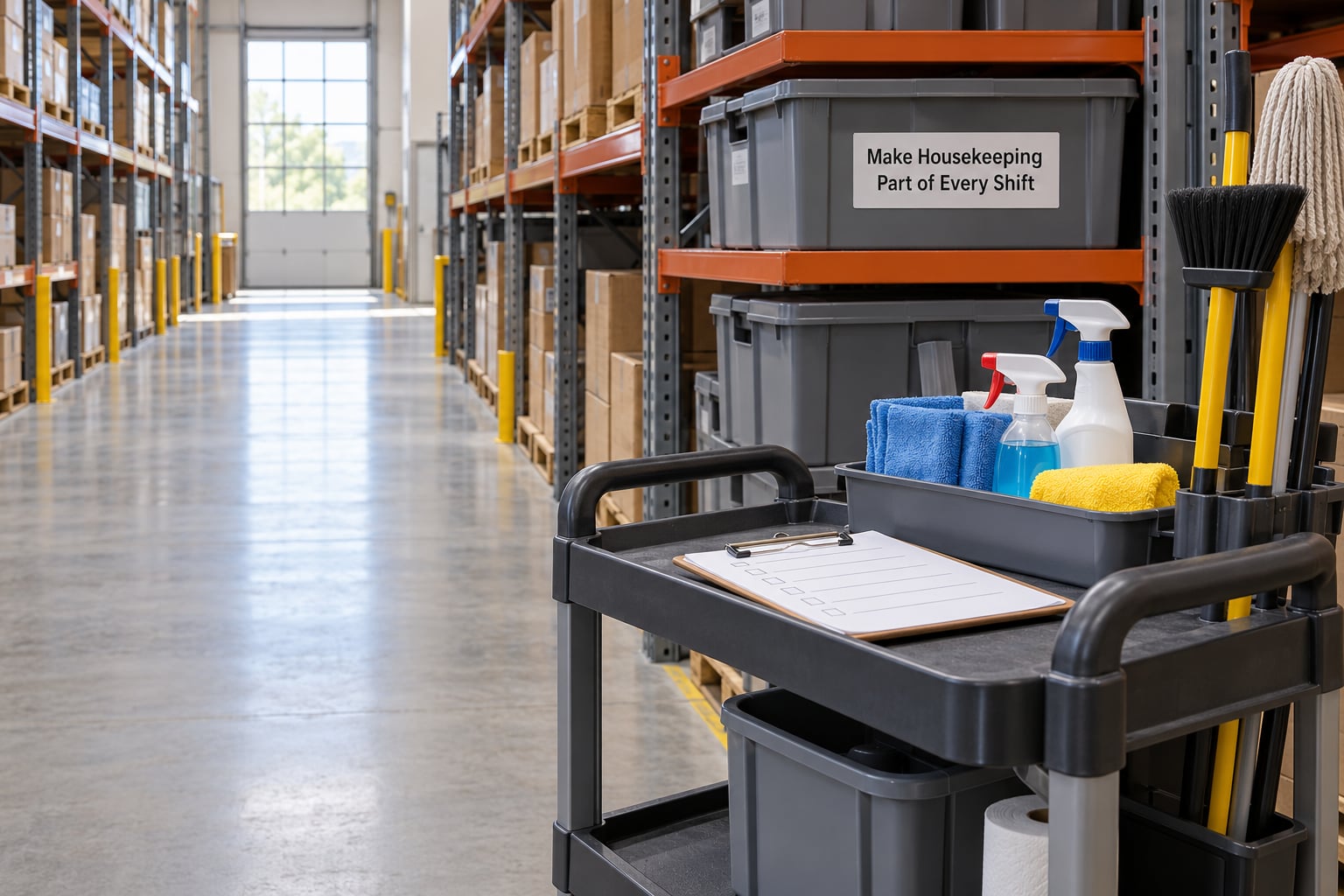
Housekeeping works when it belongs to the shift rather than to a night team. Nobody should be able to say a mess is someone else’s job, and nobody should be doing three people’s cleaning at 10pm.
Split the work in four parts. Inspection belongs to the supervisor opening the shift, reporting belongs to anyone who finds a hazard, cleanup belongs to the person who created the mess or the crew nearest to it, and verification belongs to the supervisor closing the shift. Write those four roles into the shift routine so the argument never happens mid-task.
End every shift with the same short reset: return tools, clear the work surface, empty the bin, wipe the machine and sweep the immediate floor. Five minutes that closes the loop, versus a bigger cleanup at the end of the week that never quite happens.
12. Review and Improve Housekeeping Performance
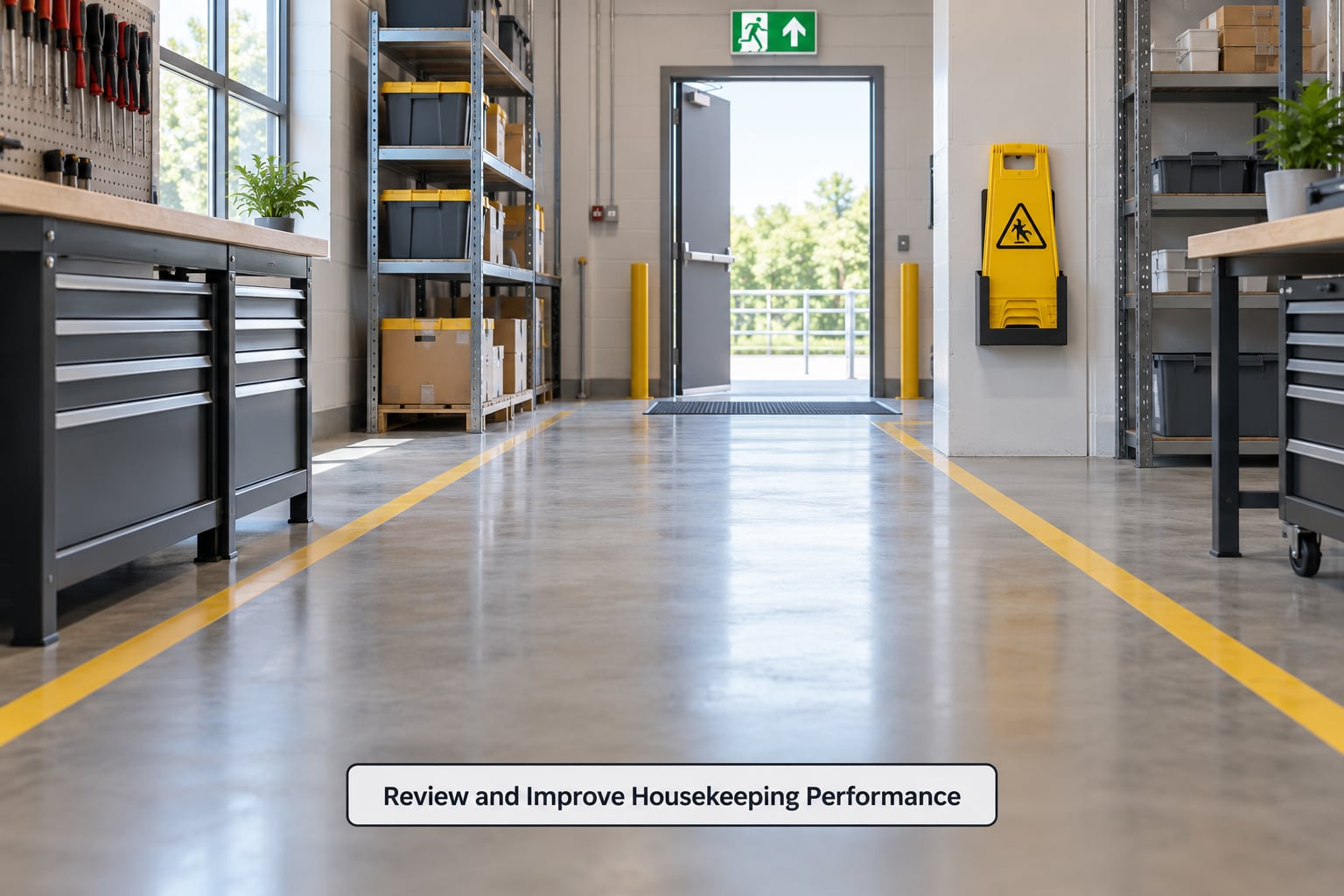
A monthly checklist tells you what a room looked like once. It does not tell you whether the place is getting better.
Watch three signals. First, repeat findings: the same hazard appearing three weeks running means the fix failed, not that someone forgot. Second, near-miss reports mentioning floors, storage or access, which show where people are nearly getting hurt. Third, the completion rate on your findings log, which tells you whether the process has any teeth.
Where a hazard is reported and ignored, the pattern is usually visible in the log: the same item, the same owner, the same open status. Escalate on paper, keep copies, raise it at the safety meeting, and use your internal reporting channel. In the United States, a good-faith safety report is protected from retaliation under Section 11(c) of the Occupational Safety and Health Act, and an unresolved hazard can be reported to your regional OSHA office. Elsewhere, the equivalent is your national enforcement body. Know the route before you need it.
Close the loop publicly. Publishing what was found, what was fixed and what is still open does more for housekeeping behaviour than another poster.
Frequently Asked Questions
How often should workplace housekeeping be checked?
Check the areas you walk through daily at the start and end of every shift, do a fuller walkthrough weekly, and run a documented monthly review of storage, chemicals, electrical items and ventilation. The rule of thumb is that hazards get checked at least as often as they can appear. A spill needs attention in seconds; a shelf load in a storeroom does not.
Who is responsible for workplace housekeeping?
Everyone who works in the building, with different parts assigned by role. Under 29 CFR 1910.22, the employer must keep work areas clean, orderly and sanitary, and employees share the daily practice: you clean what you mess, you report what you find, and supervisors verify that it got done. Custodial staff do the deeper cleaning; they do not carry the whole obligation.
What should a daily workplace safety inspection include?
Walk the main routes and check for spills, obstructions, damaged cords and unguarded hazards. Confirm exits, fire extinguishers, pull stations and electrical panel clearance are clear. Look at storage heights, bin fill levels and chemical labelling. Note anything wet, damaged or obstructed, assign an owner and a due date before you leave the area, and sign the record.
When is a housekeeping problem serious enough to stop work?
Stop when the hazard blocks an exit route, sits near live electrical equipment, involves a chemical spill or unknown container, affects a sprinkler head or its clearance, or creates a risk of falling material overhead. Also stop when a warning barrier cannot keep people out of the area. Isolate it, tell the supervisor, and restart only after the hazard is removed and the area is reopened.
How should cleaning chemicals be stored safely?
Keep products in their original labeled containers, upright, closed and on a surface that contains spills. Segregate incompatibles, so bleach and ammonia never share a shelf or a bucket, and keep chemicals away from food and utensils. Make the safety data sheet reachable for anyone using the product, and train staff on what must never be mixed.
Do small businesses need a written housekeeping checklist?
US general industry rules do not require a written housekeeping program the way they require a fire prevention plan under 29 CFR 1910.39, where certain building classes must follow a written plan. Even so, a one-page checklist costs nothing and gives you proof that hazards were found and fixed. Copy the table in section 10, add your own sites and assign names.
Start With the Highest-Risk Areas
Start where people move fastest and where a mistake hurts most. Crowded walkways, spill-prone zones near sinks and docks, emergency routes and fire equipment, chemical storage and dispensing points, and any elevated or unstable storage should be fixed in that order, not the order that is easiest.
Give each of those a named owner today, a frequency you can actually sustain, and a verification step that produces a record. We keep this guide current for 2026, and it is general information rather than a substitute for the applicable regulation or advice from a qualified safety professional. Once the high-risk areas hold, work outward through the rest of the list.