
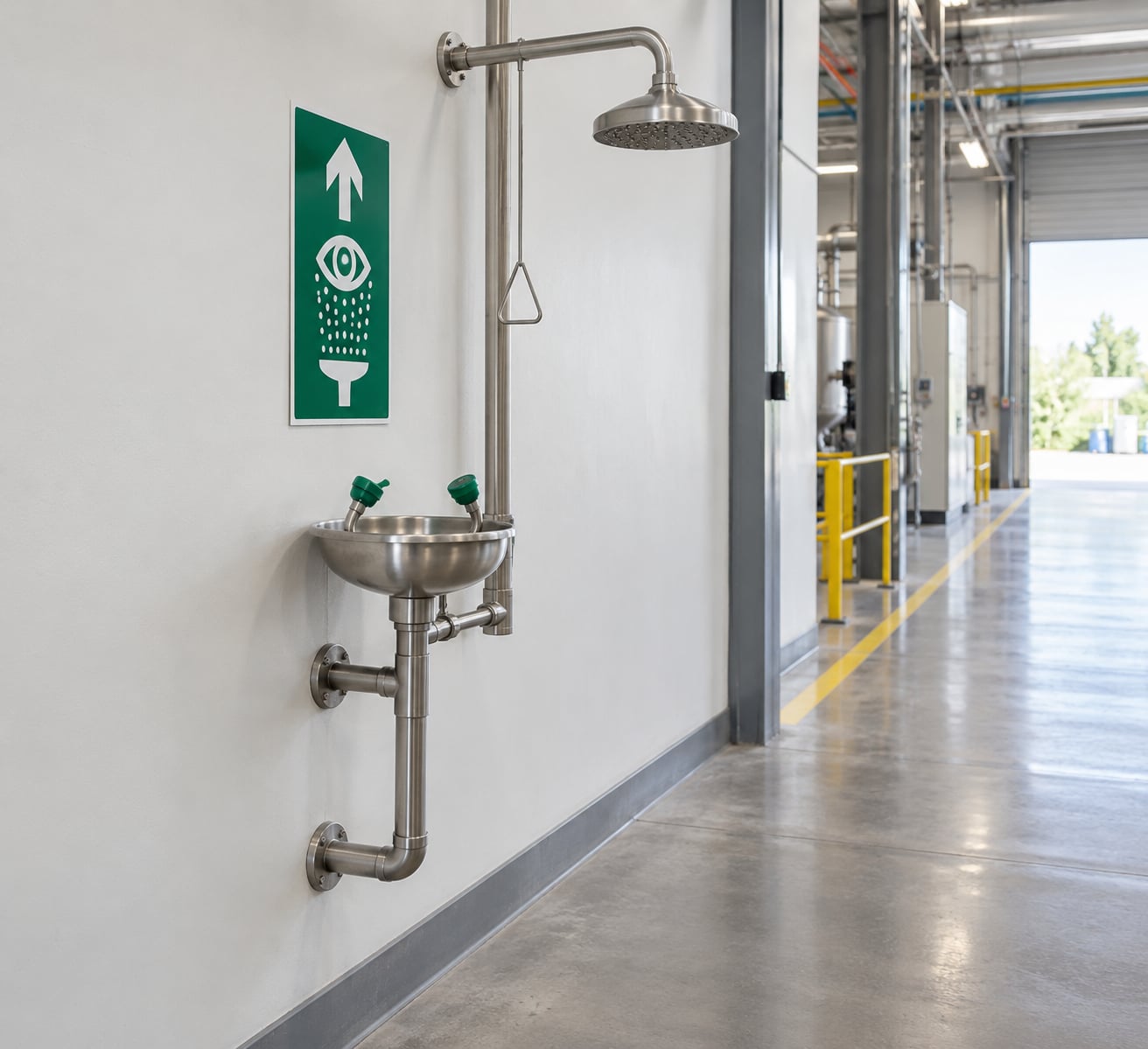
Eyewash station requirements in the United States come down to two documents: OSHA 29 CFR 1910.151(c), which requires suitable facilities for anyone exposed to injurious corrosive materials, and ANSI/ISEA Z358.1, which sets the performance numbers OSHA defers to. Reach it in 10 seconds of travel, about 55 feet. Flush both eyes at 0.4 gallons per minute for at least 15 minutes with tepid water. Nozzles between 33 and 45 inches off the floor. Hands-free activation in one motion.
The regulation is short and general. The standard is where the usable detail lives, which is why most workplace questions drift straight past the CFR text and into spec sheets nobody has read.
This guide covers what triggers the requirement, where the station has to sit, what equipment counts, how to inspect it, how to train people, and what to document. Requirements differ by industry and by state plan, so confirm the specifics against the standard that governs your workplace.
Table of Contents
- What Are Eyewash Station Requirements?
- Which Workplace Hazards Require an Eyewash?
- How Close Should an Eyewash Station Be?
- What Eyewash Equipment Is Acceptable?
- How Much Water Does an Eyewash Need to Provide?
- How Should Eyewash Stations Be Inspected?
- How Do You Train Employees to Use an Eyewash?
- What Should You Do After a Chemical Eye Exposure?
- How Do You Document Eyewash Compliance?
- What Do Employers Need to Check for OSHA Compliance?
- Frequently Asked Questions
- What OSHA standard covers eyewash stations?
- How far away does an eyewash station need to be?
- How often does OSHA require eyewash stations to be inspected?
- What is the minimum height requirement for an eyewash station?
- Do personal eyewash bottles count as an OSHA-compliant eyewash station?
- What water temperature and flow does an eyewash station need?
- What to Do First
What Are Eyewash Station Requirements?
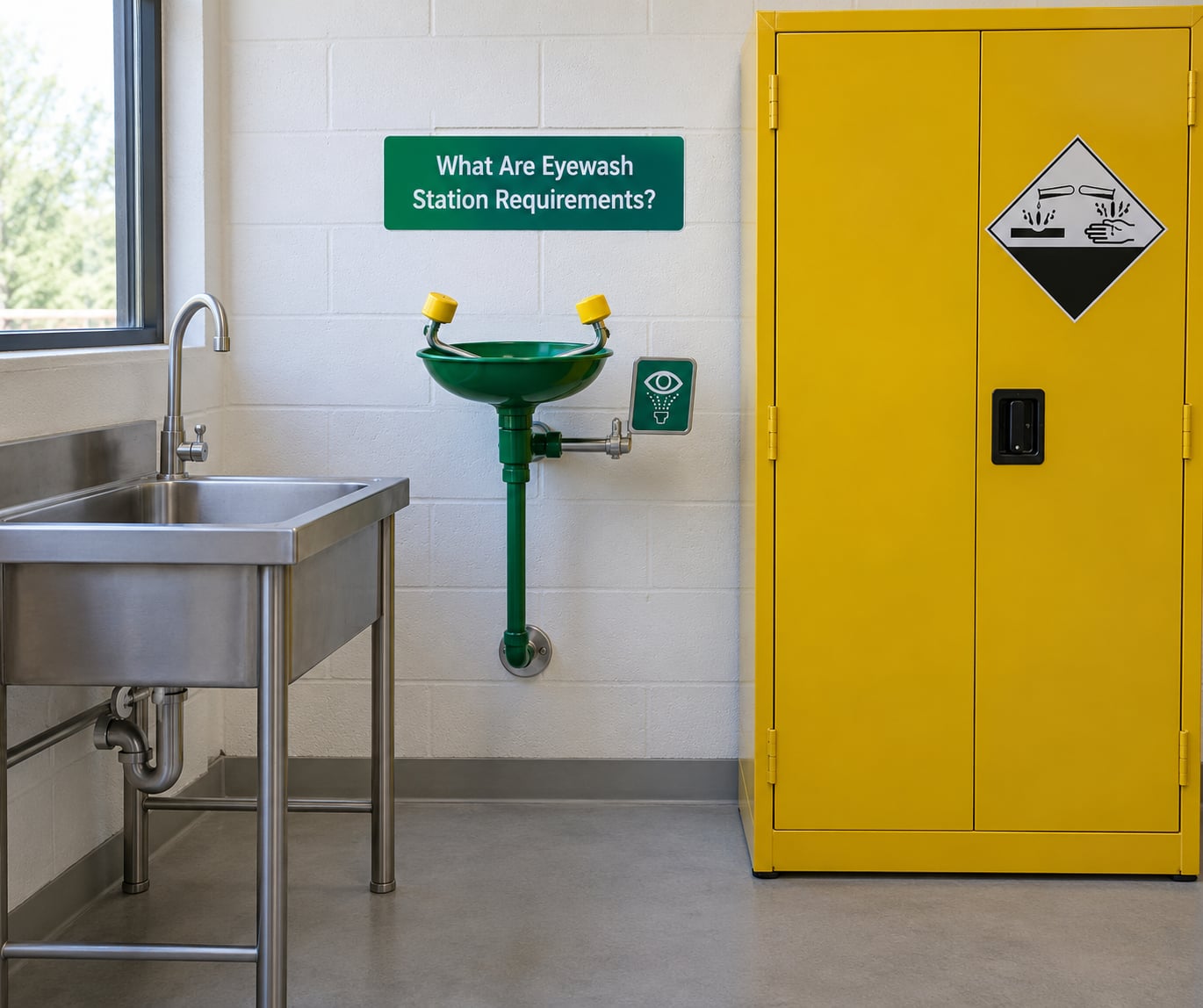
OSHA’s rule is short. 1910.151(c) says employers must furnish facilities for quick drenching or flushing of the eyes and body when employees are exposed to injurious corrosive materials. OSHA’s 2004 interpretation letter on eyewash and shower equipment states plainly that where the regulation does not give specifics, the agency looks to the consensus standard, ANSI Z358.1, for the details.
That distinction matters legally. The CFR is enforceable. Z358.1 is a voluntary consensus standard, and no federal rule adopts it in full as regulation. In practice inspectors measure against Z358.1 anyway, which is why treating it as optional is a bad bet.
The numbers at a glance
| Requirement | Specification | Source |
|---|---|---|
| Travel time to reach the unit | 10 seconds or less | ANSI/ISEA Z358.1 |
| Equivalent travel distance | About 55 feet of walking | ANSI/ISEA Z358.1 |
| Nozzle or outlet height | 33 to 45 inches (83.8 to 114.3 cm) above the floor | ANSI/ISEA Z358.1 |
| Flow rate | 0.4 gallons per minute (1.5 liters per minute) minimum | ANSI/ISEA Z358.1 |
| Duration of flow | 15 minutes minimum without reactivation | ANSI/ISEA Z358.1 |
| Water temperature | Tepid, 60 to 100 F (15 to 38 C) | ANSI/ISEA Z358.1 |
| Activation | One motion, hands-free, 1 second or less | ANSI/ISEA Z358.1 |
| Coverage | Both eyes flushed simultaneously | ANSI/ISEA Z358.1 |
| Trigger condition | Exposure to injurious corrosive materials | OSHA 29 CFR 1910.151(c) |
| Maintenance duty | Emergency equipment kept in working order | OSHA 29 CFR 1910.151(d) |
Two federal rules do most of the work in practice. 1910.151(c) sets the obligation to provide equipment. 1910.151(d) requires emergency equipment to be kept in working order, which turns a one-time purchase into an ongoing maintenance duty.
Everything below is written against the current edition of the standard. If your facility policy names a specific edition, that edition governs internal compliance even when a newer one exists.
Which Workplace Hazards Require an Eyewash?
The trigger is injurious corrosive materials, and that covers far more than a bulk acid drum. Corrosive caustics and acids, alkalis, oxidizers, solvents that defat the cornea, and chemical dusts all sit inside the trigger. Molten metal, hot tar, and heated process streams create a thermal exposure that flushing limits even though it is not strictly chemical.
Mechanical and particulate exposures count too when the consequence is an embedded particle in the cornea or a foreign body that needs immediate washing. High-speed grinding, wire brushing, and chipping operations fall here, as do dust-heavy tasks where the substance itself is not corrosive.
Facilities that routinely trip the requirement include chemical manufacturing and processing, laboratories and university teaching spaces, battery and acid handling, industrial maintenance, printing and coating shops, dental and clinical settings, and commercial kitchens using caustic degreasers.
Construction, field crews, and utility work sit somewhere else. A portable self-contained unit can supplement a worksite where plumbed water is not available, and temporary installations follow a different logic than a fixed facility. Document the hazard assessment either way.
The Hazard Communication Standard at 1910.1200 feeds into this. If your safety data sheets flag serious eye irritation or eye damage, that hazard communication work is the natural place to make the eyewash decision and document it.
How Close Should an Eyewash Station Be?
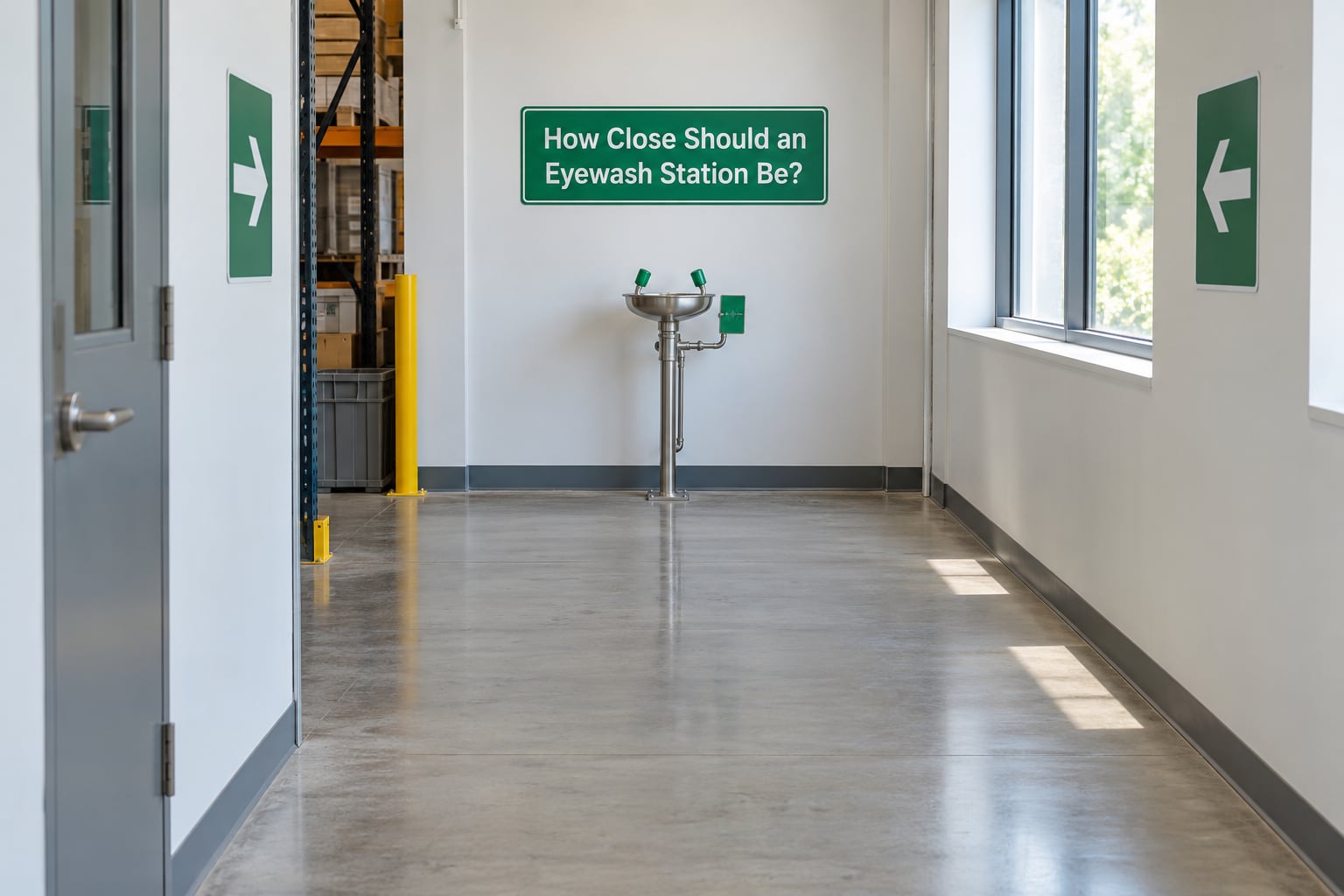
Ten seconds of travel is the answer, not a fixed number of feet. The standard expresses reach as time because people move at different speeds, and the intent is that an injured worker who can still see reaches the unit before the damage escalates. The 55-foot figure is a walking approximation of that ten seconds on an unobstructed path.
Users debate the gap between the two constantly, especially on non-linear routes. A corridor with two turns, a mezzanine, or a set of stairs eats seconds that a straight-line measurement never shows. Measure the actual walked path, including the time to get up from a seated position at a workstation.
Access has to survive contact with daily operations. A path blocked by a housekeeping cart, stacked boxes, or a parked pallet is not compliant in practice, no matter what the drawing shows. A Reddit retail worker posted a PSA about eyewash units blocked by carts, storage, and room furniture, and the thread filled with similar accounts from other sites. That is the single most common real-world failure.
Other accessibility points worth checking:
- Signs must be visible from the hazard area, high-contrast, and legible at the distance where a decision gets made.
- Lighting has to be adequate. A station in an unlit corner is hard to find and hard to use.
- No locks, no doors requiring a key, no elevators you have to wait for, no stairways that require two hands.
- Nothing stored within reach of the bowl or paddle.
- A person wearing chemical protective gear should still be able to operate it.
When the layout genuinely makes ten seconds impossible, document the constraint, describe what you did instead, and put the decision in front of your safety or occupational health lead. An undocumented gap is far worse than a documented alternative.
What Eyewash Equipment Is Acceptable?
Three categories show up in workplaces, and they are not interchangeable. Plumbed units connect to the building’s potable water supply and are the default expectation for fixed facilities. Self-contained and portable units store treated water in a tank and are useful where plumbing does not reach, in temporary setups, or as a supplement.
Personal eyewash squeeze bottles are a first-aid item for immediate treatment after a splash while getting to real equipment. They do not satisfy the OSHA requirement, and treating them as the station is the most expensive myth in this space.
| Type | Water supply | Where it works | Ongoing maintenance |
|---|---|---|---|
| Plumbed, wall or floor mounted | Building potable water line | Permanent facilities with corrosive-material exposure | Weekly activation, flushing, leak checks, temperature confirmation |
| Self-contained or portable | Pretreated water in a pressurized tank | Remote areas, mobile crews, temporary sites, as a supplement to a plumbed unit | Fluid replacement on the manufacturer’s schedule, tank pressure checks, expiration dates |
| Personal eyewash bottle | Buffered saline in a sealed bottle | First aid only, in a carry pouch or at a sink | Expiration checks, replacement on the printed date |
Self-contained units carry a real management burden. The solution has a shelf life and the tank has an inspection date, and both live on the unit or the documentation. If nobody tracks those dates, a nominal unit can expire quietly and still look fine on a wall.
Combination units that pair an eyewash with an emergency shower are common in plants where both hazards exist. One supply line serves both, and a single inspection covers both fixtures.
How Much Water Does an Eyewash Need to Provide?
Four numbers describe the water: how fast it comes, how long it lasts, how warm it is, and what it feels like. ANSI Z358.1 sets a minimum flow of 0.4 gallons per minute at the outlet and a minimum of 15 minutes of uninterrupted flow after activation, with no need to hold the handle down.
That pairing is the part people get wrong. A station that delivers a strong blast for thirty seconds then dies is not a compliant station, no matter how impressive it looks when it first opens.
Temperature gets less attention than it deserves. The 60 to 100 F range exists because plain cold water makes the injured person flinch and stop, and plain hot water can damage an already irritated eye. Below roughly 60 F, flushing becomes painful enough that workers cut the session short. Above the top of the range, the water itself becomes a hazard.
Pressure has to stay inside the tolerance the unit was designed for. Too little and the stream will not clear the contaminant; too much and the spray is painful enough that people cannot keep their eyes open. Faulty regulators and partially closed isolation valves are common causes.
For anything beyond these general considerations, read the product manual and the specification for your unit. Manufacturer requirements are the operative numbers for that specific model, and the hazard-specific standard may call for more.
How Should Eyewash Stations Be Inspected?
A weekly activation keeps water moving through the lines and lets someone confirm the unit actually runs. Z358.1 expects that check at least once a week, and industry guidance commonly describes running the activation for a couple of minutes so the whole line is exercised rather than just wetted at the nozzle. An academic review of emergency equipment notes that OSHA-driven practice calls for flushing at least two minutes weekly, a detail many equipment vendors leave out.
Weekly is the floor, not the whole program. A thorough monthly check covers more:
- The path from the work area is clear, lit, and free of stored items.
- Signs are present, readable, and still point the right way.
- Nozzle caps are present and secure, or their absence is intentional per the manufacturer’s design.
- Activation delivers water to both eyes at once, hands-free, with no need to keep pushing.
- Water arrives within the tepid range and feels gentle rather than hard.
- No leaks at the bowl, supply line, or valve.
- The drain runs freely and the bowl is clean.
- The unit shows no corrosion, scaling, or sediment in the water.
Once a year, have a qualified person do a formal assessment of the installation against the standard, including flow measurement, temperature verification, and a check that the unit still satisfies the type it was specified as. Recurring problems deserve a documented repair rather than another tag.
Record each activation and each inspection. If a unit fails, log the deficiency, tag the unit out of service, repair or replace it, and document the fix. A station with a documented outage and a visible tag is in a different position than one that quietly stopped working.
Flush weekly also handles a problem nobody sees until someone is hurt. Stagnant water in a bowl and supply lines grows organisms including Pseudomonas, Acanthamoeba, and Legionella. Running the unit is the preventive control that stops that growth, which is why the weekly activation is a health requirement and not just a maintenance habit.
How Do You Train Employees to Use an Eyewash?
Training has one goal: someone who has been splashed can reach the unit, start it, and keep it running while calling for help. Most failed responses come from not knowing where the station is, or from someone else having to hold the handle.
A workable session covers these points:
- Where the nearest station is, walking there with them. Pointing at a map does not count.
- How to activate it in one motion without using your hands, which matters when both hands are contaminated.
- Hold eyelids open and flush both eyes. Hands-free operation is designed for exactly this.
- Keep flushing for the full duration the safety data sheet or medical professional advises, and do not stop early because it feels better.
- Remove contact lenses if present and easy to do, and continue flushing.
- Get medical attention afterward, and report the exposure through your incident process.
Hands-on practice beats a slide deck every time. Have people actually push the paddle and hold their hands over the nozzles while someone times them.
Refresh the training when equipment changes, when a new chemical arrives, or when an inspection finds a problem. Workers on night shift, temporary staff, contractors, and anyone who does not read the site’s main language need instruction in a form they can use. Anyone who supervises a shift should know where the station is even if they will never use it.
What Should You Do After a Chemical Eye Exposure?
Move to the station immediately and start flushing. Do not stop to find a source, read a label, or fetch a different unit. Time is the variable that decides the outcome.
Hold the eyelids open with your fingers and let water flow across both eyes. A common mistake is blinking tightly, which keeps the contaminant in place. Hands-free operation exists so you can keep your fingers on the lids.
Continue flushing for at least 15 minutes, and longer if the safety data sheet for the material says so or a medical professional advises it. Remove contaminated clothing if the exposure came with a splash to the face or body.
Take the safety data sheet or a container label with you to urgent care if you can do so safely, and get evaluated even when the pain settles. Corneal damage can be quiet at first. Then file the incident report through your employer’s process.
First aid at the station is not the end of the event. It is the first step, and it does not replace medical evaluation or the written record your employer needs.
How Do You Document Eyewash Compliance?
Documentation is what separates a compliant program from a claim. If an inspector or a lawyer asks whether the station worked, the answer should be in a file, not in somebody’s memory.
Records worth keeping:
- A weekly activation log with date, initials, and any observation.
- Monthly inspection checklists covering the items listed above.
- Annual assessment records with flow, temperature, and installation verification.
- Maintenance and repair work orders, including parts replaced and the vendor involved.
- Training attendance records with dates and the version of the training delivered.
- Self-contained unit fluid replacement dates and expiration tracking.
- Exposure and incident reports with follow-up actions.
- Out-of-service records showing what was tagged, when, and how it was resolved.
Facilities report a specific version of this problem: a unit marked serviced based on a tag, with no verification that the water was actually safe or the unit actually ran. Ask your service vendor for documentation that shows flow and temperature verification, not just a sticker.
Keep logs for the period your state plan or insurer expects, and store them where safety staff can find them. A log nobody can locate does not help you.
What Do Employers Need to Check for OSHA Compliance?
Run the audit in this order. Start with the hazard assessment: which materials are present, and what does your Hazard Communication work say about eye exposure risk. That decision determines whether you need an eyewash at all, and it is the decision that has to be defensible.
Next, confirm the standard that applies to your industry, since some sectors carry their own rules alongside the general OSHA requirements. Then check the equipment against the specification set at the top of this guide: travel time, height, flow, duration, temperature, activation.
Location, signage, and lighting come next, then the inspection and training records, then the emergency procedures and contacts. A chemical spill plan that does not name who shuts down the process and who calls for medical help is not finished.
Regional overlays can add requirements. California building code provisions in Title 24 address eyewash provision in specific occupancies, and Nevada OSHA has said it will cite an eyewash rule for installation deficiencies that leave a unit unsuitable for the exposures it is meant to address. State plan states operate their own programs and can be stricter than federal OSHA. Check where you operate before you sign off.
Finally, put the review in front of someone qualified. A safety director, occupational health nurse, or outside consultant will catch gaps that a generalist walks past, particularly around unusual floor plans and unusual materials.
Frequently Asked Questions
What OSHA standard covers eyewash stations?
OSHA 29 CFR 1910.151(c) requires employers to provide facilities for quick drenching or flushing of the eyes and body when employees are exposed to injurious corrosive materials. Paragraph (d) requires that emergency equipment be kept in working order. The rule itself is short on detail, and OSHA’s 2004 interpretation letter directs employers and inspectors to ANSI/ISEA Z358.1 for specifics such as travel time, flow rate, water temperature, and nozzle height.
How far away does an eyewash station need to be?
ANSI Z358.1 expresses reach as 10 seconds of travel or less rather than a fixed number of feet, and 55 feet is the usual walking approximation of that time on a clear path. Measure the route a person actually walks, including turns, doorways, stairs, and the time to stand up from a seated position. A path blocked by carts or stored material fails the requirement regardless of the measured distance.
How often does OSHA require eyewash stations to be inspected?
ANSI Z358.1 expects eyewash units to be activated at least weekly, which keeps the water moving and limits bacterial growth in stagnant lines. Industry guidance commonly describes running the activation for about two minutes so the whole supply is exercised. A thorough monthly check covering access, signage, nozzles, flow, temperature, leaks, and drainage is standard practice, with a formal assessment of the installation about once a year.
What is the minimum height requirement for an eyewash station?
ANSI Z358.1 sets the height of eyewash nozzles at 33 to 45 inches above the floor, or 83.8 to 114.3 centimeters. That range lets an adult flush while keeping hands on the eyelids and works for most users standing or seated at a fixed station. Wall-mounted and floor-mounted units both have to land inside that band, and freestanding or portable units need to hold the same outlet position.
Do personal eyewash bottles count as an OSHA-compliant eyewash station?
No. Personal eyewash squeeze bottles are first-aid items intended for immediate treatment while a worker reaches a plumbed or self-contained station. They hold a small volume, cannot flush for 15 minutes, and cannot meet the height, flow, or coverage requirements. Relying on a bottle instead of compliant equipment is a common and expensive compliance mistake, particularly in labs and clinics that carry bottles at every sink.
What water temperature and flow does an eyewash station need?
ANSI Z358.1 requires tepid water between 60 and 100 F (15 to 38 C) at a minimum flow of 0.4 gallons per minute (1.5 liters per minute) for at least 15 minutes of uninterrupted flow. The temperature range exists because cold water makes people flinch and stop flushing, while hot water can irritate an already damaged eye. Confirm the specification in the manual for your specific model, since the standard sets the floor.
What to Do First
Walk to the nearest station and time yourself. If it takes more than ten seconds, or if anything blocks the path, that is your first problem to fix, and it is the one most likely to show up in an emergency.
Then confirm the numbers: height, flow, temperature, and fifteen minutes of uninterrupted running water. Put the weekly activation on a real calendar with a name against it, and hand the inspection checklist to someone who will actually use it.