
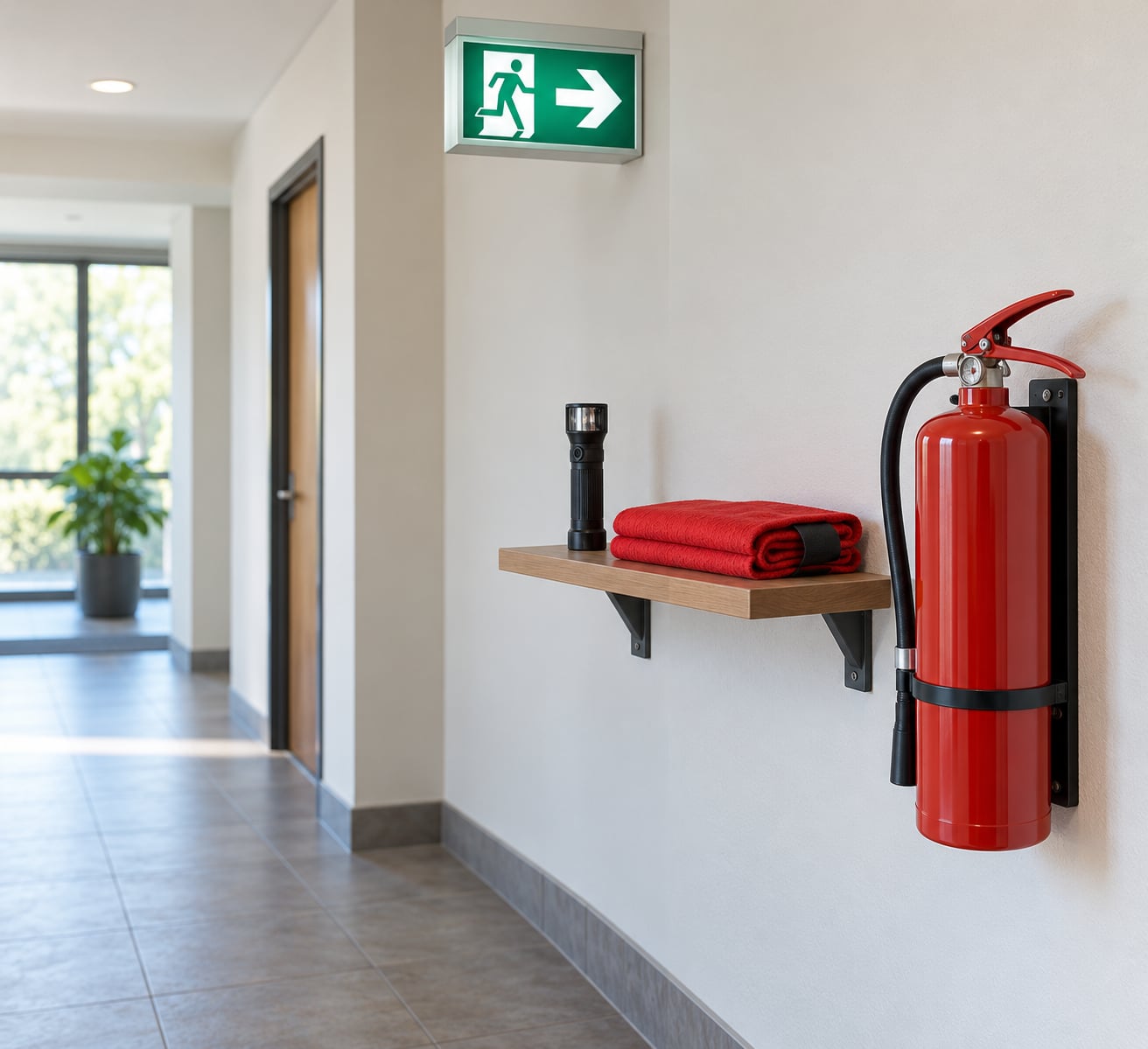
To use a fire extinguisher with the PASS method, you pull the safety pin, aim the nozzle at the base of the fire, squeeze the handle to discharge the agent, and sweep side to side until the flames die out. That whole sequence takes under a minute, and a portable unit holds roughly 10 to 20 seconds of discharge. Learn it before you need it, because the letters only work if they arrive automatically.
One rule comes before any of the four letters: if you cannot get out safely, you do not fight the fire. Raise the alarm, get everyone moving toward an exit, and use an extinguisher only on a small, contained fire with a clear escape route at your back. Life before property, every time.
Most households and a lot of offices own an extinguisher that has never been discharged. People walk past the wall mount dozens of times a week without touching it, which is exactly why the technique has to sit in muscle memory rather than in a drawer of good intentions. This guide covers what to check before you lift the unit, the PASS sequence in order, the mistakes that waste a whole tank of agent, and what to do in the minutes after the fire is out.
Table of Contents
- What You Need
- Step-by-Step: How to Use a Fire Extinguisher With the PASS Method
- Common Mistakes
- Frequently Asked Questions
- What is the first action you should take when using a fire extinguisher?
- What are the OSHA rules for fire extinguishers in the workplace?
- What is the shelf life of a fire extinguisher?
- Where should fire extinguishers be placed?
- How close should I stand, and can I move in as the flames die?
- Do I have to replace an extinguisher after using it?
- Conclusion
What You Need
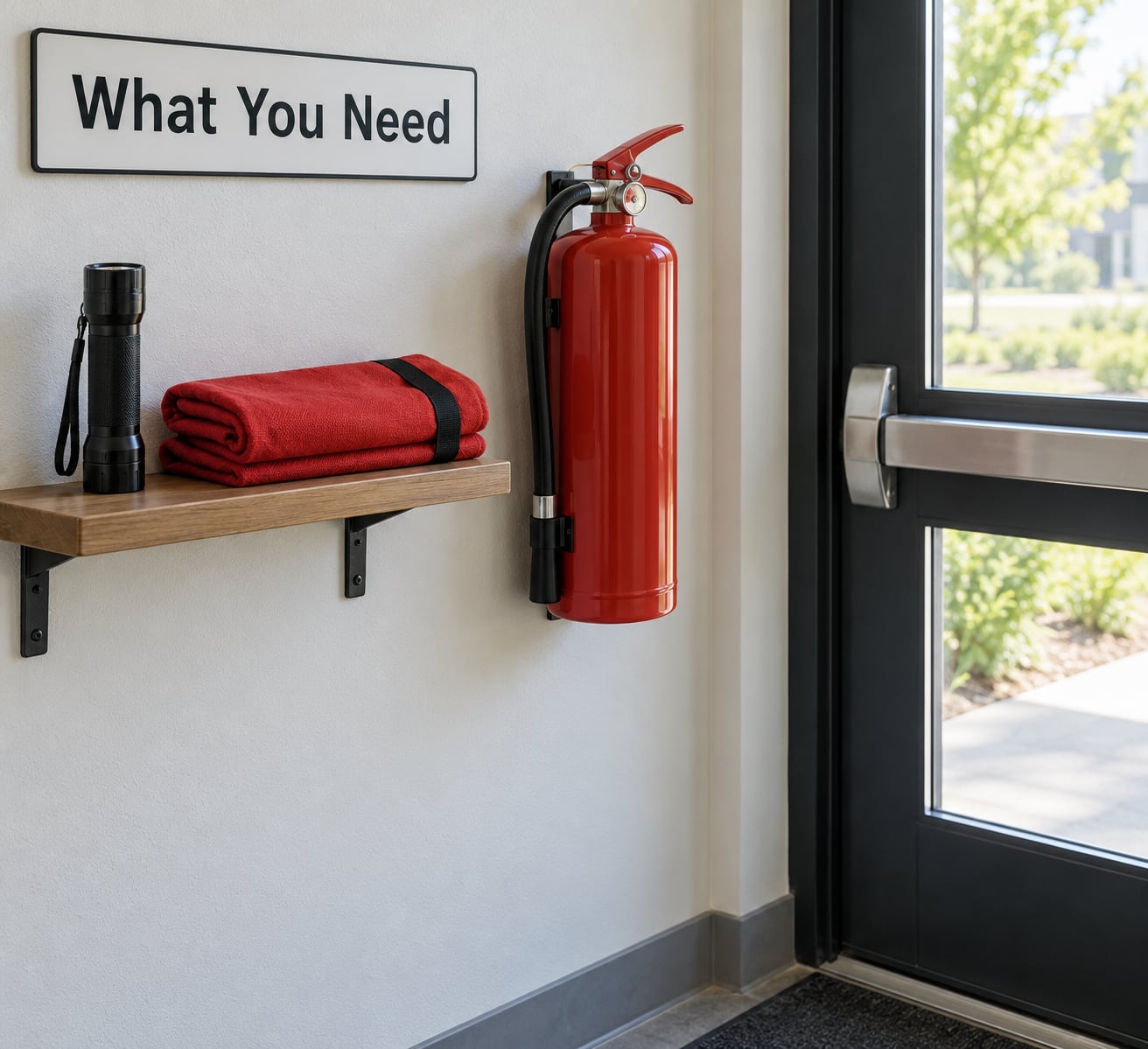
What you need is a charged extinguisher of the right class for the fuel in front of you, a clear route out, and enough distance to work from. Here is how to check each of those things before the fire gives you no time to think.
Match the extinguisher to the fire class
Extinguishers do not all work on all fires. The letter printed on the label tells you what the unit is rated for, and the extinguishing agent inside only works on certain fuels. Using the wrong one is the single most common reason a fire keeps burning while someone empties a full cylinder into it.
| Fire class | What is burning | Correct agent | Never use |
|---|---|---|---|
| Class A | Wood, paper, cloth, rubbish | Water, water mist, ABC dry chemical | Nothing in particular, but water is the fastest choice |
| Class B | Flammable liquids: fuel, paint, solvents, cooking oil | Dry chemical, foam, carbon dioxide, wet chemical for cooking oil | Water straight on burning cooking oil or fuel |
| Class C | Energised electrical equipment | Carbon dioxide, dry chemical, ABC dry chemical | Water, because it conducts electricity |
| Class D | Combustible metals such as magnesium or sodium | Special-purpose powder listed for that metal | Water or ordinary ABC dry chemical |
| Class K | Cooking oils and fats in commercial equipment | Wet chemical (Class K rated) | Water, which can cause a violent boil-over |
An ABC dry chemical unit is the sensible default for a home or a small office because it covers the three classes you are most likely to meet. It is not the right answer for a fryer fire or for a metal fire, which is why the label matters.
Check the unit itself in about fifteen seconds
Look at the pressure gauge first. The needle should sit inside the green zone, not in the red. Check that the safety pin is still in place and that the tamper seal is unbroken, since a missing pin usually means someone started operating it and put it back badly. Look for rust, dents, a cracked hose or a nozzle that has been chewed by a pet. Confirm the inspection tag has not expired, and make sure the unit is somewhere you can reach without passing the fire.
If the gauge reads red, the pin is gone, the seal is broken or the hose is split, treat the extinguisher as unavailable and find another one or call the fire service. It will not work when you need it.
Give yourself room to work
Stand about 6 to 8 feet back from a small fire and keep your back to an exit. You should be able to walk backwards out of the room without turning around. Wear shoes with closed toes, keep loose hair and sleeves away from the flames, and if smoke is already banked down to head height, do not enter that space at all.
Know your workplace rules
In the United States, OSHA 1910.157 sets the baseline for extinguisher placement, maintenance and training, and the general industry standard calls for training on the proper use of the equipment. Where a fire is beyond incipient stage, the standard says plainly that workplace fire protection is the employer’s responsibility, and employees are expected to evacuate rather than fight it. That maps onto wider health and safety planning: an employer who treats emergency preparation as a general wellbeing matter, alongside the support covered in how to support employees with migraine and how to support employees with chronic conditions, tends to get the training culture right too.
Two more placement rules come up in every workplace inspection: travel distance to the nearest unit should stay under 75 feet for most Class A hazards, and the unit has to be visible or clearly marked, mounted so the top sits no more than 5 feet off the floor.
Step-by-Step: How to Use a Fire Extinguisher With the PASS Method
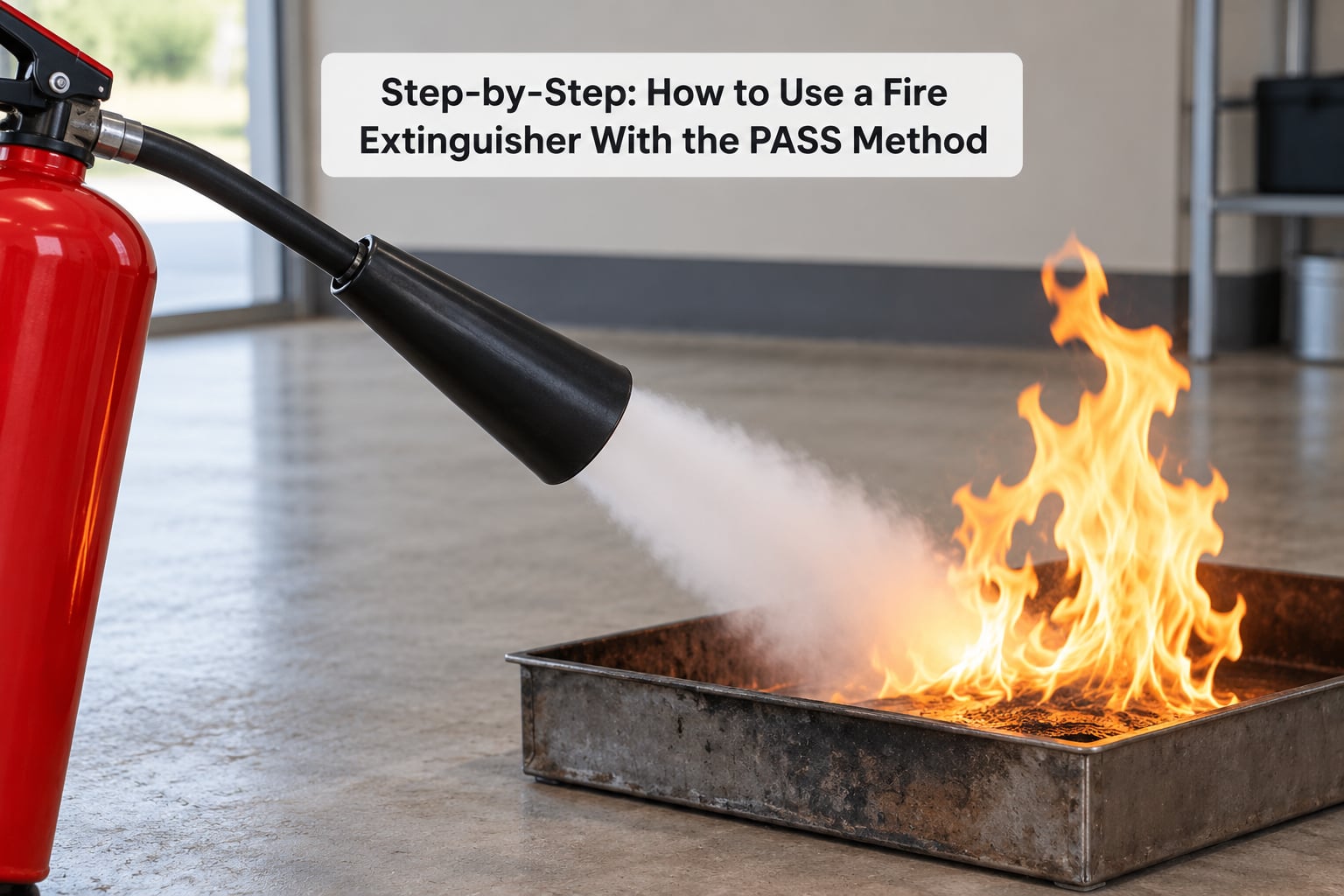
PASS is four actions in a fixed order, and the order matters. Pulling the pin before you are in position wastes seconds you may need for your escape; squeezing before you have aimed puts agent on the ceiling. Here is the sequence in full, with a safety check that comes before the first letter.
| Step | What to do | Common mistake |
|---|---|---|
| P is for Pull | Pull the safety pin straight out, breaking the tamper seal | Yanking or twisting the pin so it snaps and drops on the floor |
| A is for Aim | Aim the nozzle or hose at the base of the fire from 6 to 8 feet back | Aiming at the flames, which scatters agent above the fuel |
| S is for Squeeze | Squeeze the two handles together to start the discharge | Squeezing in short jerks, which wastes agent in one spot |
| S is for Sweep | Sweep side to side across the base until the fire is out | Standing still, or stepping in too early while the tank is still full |
Step 1: Check That It Is Safe to Fight the Fire
The first action is not the pin. It is a decision, made in a few seconds: raise the alarm, call emergency services, and look at the fire. You are only considering a fire that is small, confined to one object, and not producing heavy smoke or racing along a ceiling. If flames are spreading up a wall, crawling across a ceiling or travelling through an opening, the answer is evacuation, and no technique changes that.
Check your exit while it is still calm. If someone else is in the building, get them out first. You are looking for one clear, unobstructed door that you can reach without passing the fire, and a fuel you can identify well enough to pick the right class of extinguisher. Anything less than all three and you are not fighting this fire, you are out of it.
Step 2: Pull the Pin
Hold the nozzle down and away, point it at the fire, and pull the safety pin straight out. It is a metal pin joined to a plastic tamper seal, and it is the only thing stopping the handle from moving. Pull it with two fingers rather than a fist, because the handle is about to be under load and you want a controlled grip on the hose, not a shock that lands you off balance.
You can tell the pin is out because the two handles are no longer held apart by the tamper seal and the unit will move under your hand. If the pin refuses to come, do not force the handle. That is a unit with a broken seal, and it should be reported rather than fought with.
Step 3: Aim at the Base of the Fire
Aim the nozzle or hose at the base of the fire, not the flames. This is the most repeated misconception in every training session I have watched, and it is worth being blunt about why: flames are the visible symptom, the fuel underneath is what is actually burning. Agent landing on a flame breaks apart, drifts upward and does nothing to the heat source underneath.
Get low enough that the stream is directed slightly upward into the fuel, start from about 6 to 8 feet back, and keep moving toward the base. The label on your own extinguisher is the authority here, since a large dry chemical unit behaves differently from a small CO2 unit. If the fire is Class C and energised, cut the power first if you can do so without touching the fire.
Step 4: Squeeze the Handle
Squeeze the two handles together and hold them, because it takes a steady squeeze to keep the agent flowing. A dry chemical unit will belch out a thick cloud that drops a layer of residue over everything in front of you, and a water or foam unit gives you a stream you can control. Either way, the first thing you see tells you it is working: the discharge itself, the drop in flame height within a couple of seconds, or the hiss of a gas unit.
If nothing comes out when you squeeze, stop. Check that the pin is fully out and that your hand is on both handles rather than only the carrying grip. If it still will not discharge, put it down, get out, and close the door behind you.
Step 5: Sweep Side to Side Until the Fire Is Out
Sweep the stream across the base of the fire in short, controlled side-to-side movements, covering the whole burning area. Watch the fuel line, not the flames, and re-aim whenever the fire reappears or spreads to another spot. As the flames die down you can close the distance, but only while the stream is still flowing and your exit is still behind you.
Keep going until the fire is out, not merely small. A portable unit typically empties in roughly 10 to 20 seconds, so a second extinguisher matters if there is any doubt. When the tank runs dry, stop and leave. Do not search the room for another one while the fire service is on the way, and do not leave to fetch your phone.
Common Mistakes
Almost every extinguisher failure comes down to a small number of repeated errors. Each of these has a straightforward fix.
Aiming at the flames. The stream hits the fire’s visible top and scatters. Aim low, at the fuel, from 6 to 8 feet back.
Standing too close. Heat rises, and a person inside the thermal layer gets burned before the fire does. Stay back until the flames are visibly shrinking, then step in.
Jerking the handle. Short squeezes waste the tank in one spot and leave the rest of the fire untouched. Squeeze once and hold it.
Using the wrong class. Water on burning cooking oil, or on anything electrical, makes the fire worse. Read the label before you grab the unit, not after.
Blocking the exit. Standing with the fire between you and the door turns a small problem into a trapped one. Always keep your back to an exit.
Pulling the wrong thing. Some units have two pins. Pull the one that passes through the handle mechanism, not the ring that only holds the tamper seal.
Forgetting the gauge. A needle in the red means the cylinder will not deliver pressure when you squeeze. Check it monthly.
Staying after the discharge. An empty extinguisher is no help at all, and extinguished fires routinely re-ignite as hidden heat works through the fuel. Get out, close the door, and watch from a safe distance until the fire service says it is clear.
Two habits do more for you than anything else on this list. Practise the sequence on an empty unit until your hands know it, and put the unit back exactly as you found it, pin in, seal intact, gauge in the green.
Frequently Asked Questions
What is the first action you should take when using a fire extinguisher?
The first action is to raise the alarm and call emergency services, not to pull the pin. Stand back and look at the fire: if it is small, contained, and not spreading along a ceiling or wall, and you have a clear exit at your back, you can attempt PASS. If any of that is missing, evacuate and let the fire service handle it.
What are the OSHA rules for fire extinguishers in the workplace?
OSHA 1910.157 covers extinguisher classification, placement, maintenance and training in general industry. Units must be mounted, visible, reachable within 75 feet of a Class A hazard, and inspected monthly with an annual maintenance service by a trained party. Employers are required to train employees on proper use. Where a fire exceeds the incipient stage, the standard makes evacuation the employee’s expected action.
What is the shelf life of a fire extinguisher?
A disposable dry chemical unit is typically serviceable for about 12 years from the manufacture date, while rechargeable units can last much longer with annual maintenance. Hydrostatic testing for dry chemical cylinders is generally required at 12 years. Check the manufacture date stamped on the cylinder or label, and follow whatever interval the manufacturer states, since sealed units can lose pressure and dry agent cakes over time.
Where should fire extinguishers be placed?
Place them along normal routes of travel, near a hazard, and by an exit rather than in a dead corner. Never in a spot where the fire itself would block your reach, and keep the top of the unit no more than 5 feet off the floor. In a home, the kitchen and the garage or utility room are the two most useful spots, and you want the kitchen one to be a wet chemical unit if cooking oil is involved.
How close should I stand, and can I move in as the flames die?
Start about 6 to 8 feet back and aim low at the base of the fire. You can walk toward the fire only while the stream is still flowing and the flames are clearly shrinking, and you must never lose sight of your exit. If the unit empties, the flames flare, or you feel heat on your face, stop moving and get out immediately.
Do I have to replace an extinguisher after using it?
Yes, treat a discharged unit as unavailable until it is recharged by a service company or replaced. Even a partial discharge leaves less agent and lower pressure than the gauge suggests. Report it to your workplace facilities team or the property manager, hang an out-of-service tag, and put a replacement on the wall before you leave that area.
Conclusion
The first action is always the alarm, not the pin. Keep an exit at your back, use PASS only on a small contained fire you are trained to handle, and get out the moment it is in doubt. Then follow your workplace or local fire-safety procedure, which knows the building better than any guide on the internet does.