
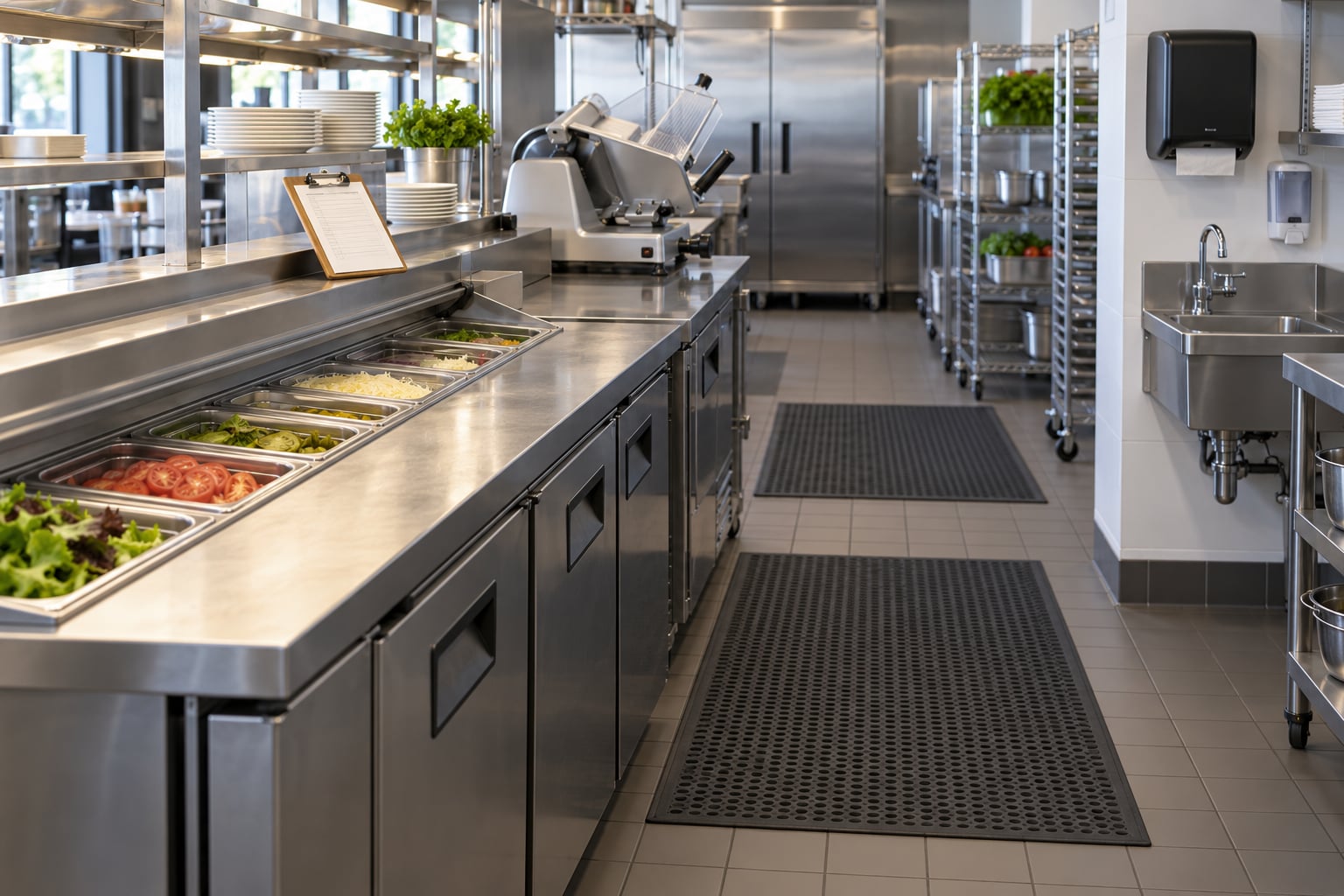
Commercial kitchen safety rules are the required food handling, equipment, and workplace practices that keep a restaurant kitchen from making people sick or hurt. In practice that means handwashing on a schedule, cold food at or below 41°F, hot food at or above 135°F, guarded equipment, dry floors, and a documented plan for fires, cuts, and chemical splashes. The CDC estimates that roughly 48 million Americans fall ill from foodborne illness in a given year, and a commercial kitchen is one of the hardest places to get those basics right because everything happens at once.
I’ve watched small kitchens solve this the same way: they pick a handful of rules, write them down, and check them every shift. That simple system beats an expensive binder nobody opens. The rest of this guide lays out the rules that actually matter, which regulator enforces which one, and how to prove during an inspection that you follow your own written plan.
State and local rules vary and can be stricter than the federal baseline, so treat this as the floor and check your health department’s requirements before you build a policy around it.
Table of Contents
- What Are Commercial Kitchen Safety Rules?
- Commercial Kitchen Safety Rules at a Glance
- Food Handling and Sanitation Requirements
- Preventing Cuts, Burns, and Slips in the Kitchen
- Equipment and Appliance Safety
- Cleaning Chemicals and Sanitizer Safety
- Emergency Preparedness and Worker Training
- How to Build a Kitchen Safety Program
- Frequently Asked Questions
- Conclusion
What Are Commercial Kitchen Safety Rules?
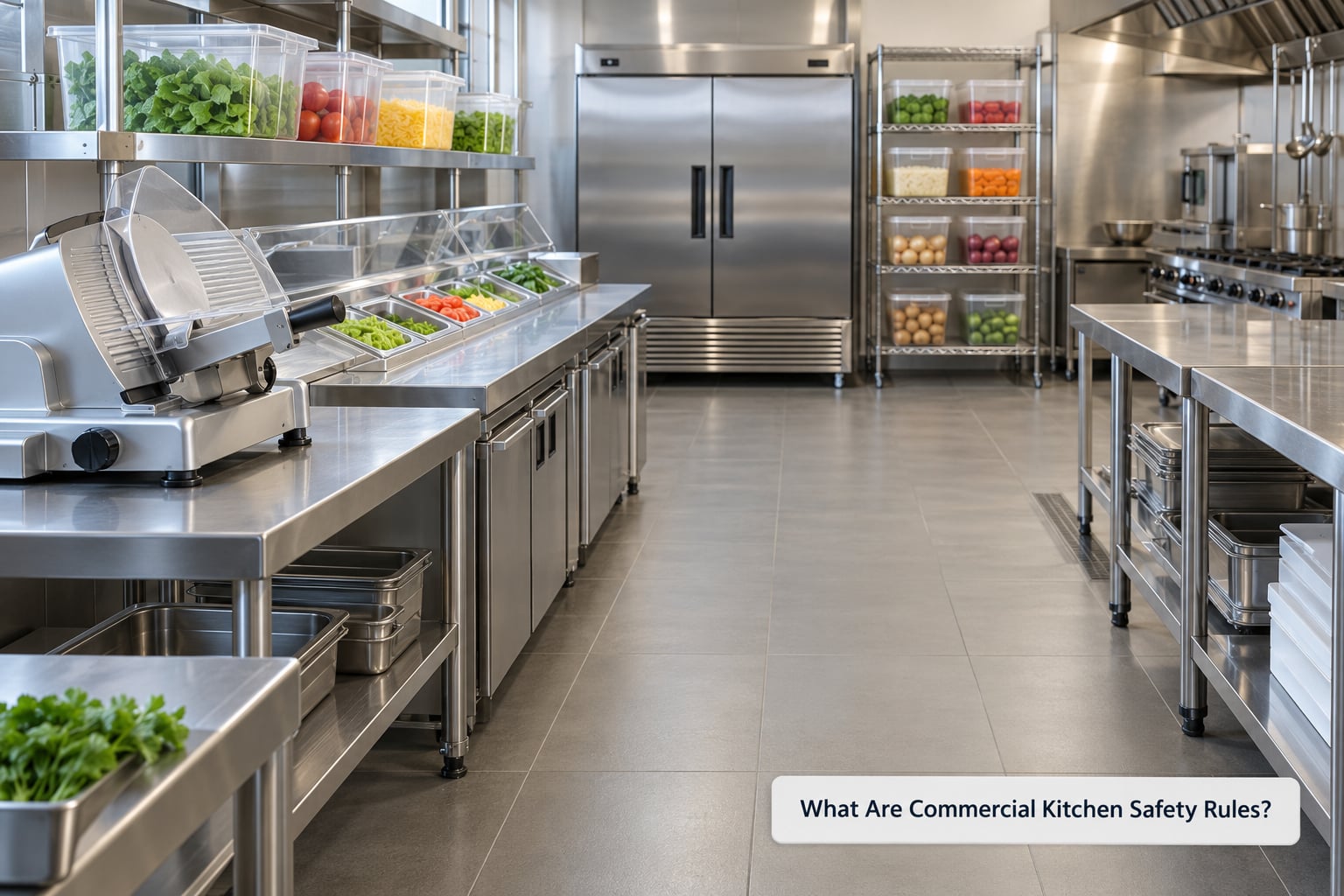
Commercial kitchen safety rules cover five areas: worker protection, food hygiene, equipment safety, chemical handling, and emergency preparedness. They come from three overlapping sources, which is why kitchen managers get confused about who actually enforces what.
The FDA Food Code is the model food code that state and local health departments adopt and enforce. It governs handwashing, temperature control, cross-contamination, cleaning and sanitizing, and pest control. OSHA covers the injury side under its general industry standards: knives and slicers, burns, electrical equipment, chemicals, fire safety, and the right to report a hazard without retaliation. NFPA 96 covers commercial cooking ventilation and fire suppression. Your local fire department usually checks hood cleaning and extinguisher servicing.
So when a health inspector and an OSHA inspector both show up, they are looking at different halves of the same kitchen. The health inspector counts the temperature log; the OSHA inspector checks whether the slicer guard is welded on.
Who regulates what: OSHA versus the FDA Food Code
Think of it as two rulebooks in one building. The Food Code protects the diner. OSHA protects the cook. A kitchen can pass a perfect food inspection and still have an unguarded blade, a frayed cord, and no way out if the hood catches fire.
What health inspectors actually look for
Inspectors separate critical violations from core violations. Critical items involve an imminent risk to health, such as time-temperature control for safety food held outside limits, cross-contamination from raw food to ready-to-eat food, or a sick employee working food. Core items are less severe but still cited: a missing hand sink supply, soiled equipment, food stored on the floor, a dirty restroom.
One critical violation can shut a kitchen down. A pile of core violations will still add up, because inspectors generally escalate when the same defect keeps recurring.
Commercial Kitchen Safety Rules at a Glance
The table below maps each risk area to the control that prevents it, who owns the check, and the record that proves it happened. Everything after it is detail on these same rows.
| Risk area | Required control | Who checks | Record |
|---|---|---|---|
| Handwashing | Dedicated hand sink, 20 seconds, warm water and soap | Shift lead | Opening and closing checklist |
| Time and temperature | Cold at or below 41°F, hot at or above 135°F, calibrated probe | Cook or manager | Temperature log |
| Cooling | 135°F to 70°F in 2 hours, then 70°F to 41°F in 4 more | Cook | Cooling log with times |
| Cross-contamination | Color-coded boards, raw protein stored below ready-to-eat | Prep cook | Opening inspection |
| Cleaning and sanitizing | Wash, rinse, sanitize, air dry, test strips | Dish and utility | Sanitizer concentration check |
| Cuts | Sharp knives, cut-resistant gloves, stable cutting surface | Line cook | Incident report if injured |
| Burns | Dry mitts, lift covers, no unattended cooking | Cook | Closing check |
| Slips | Spill kit and signage within reach, non-slip footwear | Anyone on shift | Spill response record |
| Fire | Accessible extinguishers, serviced hood suppression, clear exit path | Manager | Monthly extinguisher log |
| Equipment | Pre-use inspection, guards intact, unplug before cleaning | Opening cook | Equipment checklist |
| Chemicals | Labeled containers, safety data sheets, never mixed or moved to food containers | Utility staff | Storage walkthrough |
Here is the short version, as a numbered list you can print and post in the kitchen.
- Wash hands with soap and warm running water for at least 20 seconds before food prep and after any break, restroom trip, or raw product handling.
- Exclude sick employees from food handling, and cover cuts with a waterproof bandage and a glove.
- Hold cold food at or below 41°F and hot food at or above 135°F.
- Never leave food in the danger zone of 40°F to 140°F for longer than the Food Code allows.
- Cool cooked food from 135°F to 70°F within 2 hours, then to 41°F within 4 more hours.
- Use a calibrated probe thermometer, not the color of the food or a guess.
- Use separate or color-coded equipment for raw meat, raw poultry, seafood, produce, and ready-to-eat food.
- Store raw poultry on the lowest walk-in shelf, below all ready-to-eat food, and store dry food at least 6 inches off the floor.
- Clean, rinse, sanitize, and air dry surfaces in that order, and verify sanitizer strength with a test strip.
- Keep knives sharp, cut on a stable non-slip surface, and wear cut-resistant gloves when the task warrants it.
- Use dry oven mitts and lift covers, and never leave cooking unattended.
- Clean spills immediately or barricade the area with signage until you can.
- Never remove or bypass an equipment guard, and unplug or lock out equipment before cleaning it.
- Keep cleaning chemicals in labeled containers, separated from food and drink, and never mix two products.
- Keep exits, fire extinguishers, and the suppression system accessible, unobstructed, and inspected on a set schedule.
Some kitchens teach the same set through the four C’s: Clean, Cook, Chill, and avoid Cross-contamination. You will also see the fourth C written as Caution. Either framing works, as long as your written policy names the four parts and what proof each one requires.
Food Handling and Sanitation Requirements
Handwashing and personal hygiene
A handwash needs soap, warm running water, and 20 seconds of scrubbing. Most kitchens teach staff to scrub for the length of singing Happy Birthday twice. Gloves do not replace the wash, because hands get contaminated while putting gloves on, and gloves must be changed between tasks.
Remove jewelry, restrain hair and facial hair, wear clean uniforms daily, and keep fingernails short and unpolished. An employee with a cut must wear a waterproof bandage plus a glove, and discard any food they touched.
Start a wash after using the restroom, handling raw product, touching a face or phone, handling waste or dirty dishes, or returning from a break. During a rush this gets skipped, which is exactly why a written trigger list and a hand sink within reach matter more than reminders.
Temperature control and the danger zone
Bacteria multiply fast between 40°F and 140°F, which is why that range is called the danger zone. Cold food must stay at or below 41°F and hot food at or above 135°F. Use a probe thermometer in the thickest part of the food, away from bone, and sanitize the probe between checks.
| Food state | Required temperature | When to check | Log it |
|---|---|---|---|
| Refrigerated, TCS food | 41°F or below | Opening, every 4 hours, closing | Yes, with initials |
| Hot holding | 135°F or above | Every 4 hours, at service | Yes, with initials |
| Cooking, poultry | 165°F minimum internal | Each batch | Yes |
| Cooking, ground meat | 160°F minimum internal | Each batch | Yes |
| Cooking, whole cuts and fish | 145°F minimum internal with a 3-minute rest | Each batch | Yes |
| Reheating for hot holding | 165°F within 2 hours, then held at 135°F or above | Each batch | Yes |
| Cooling | 135°F to 70°F in 2 hours, then 41°F within 4 more | Each batch | Yes, both stages |
Calibrate thermometers against ice water on a set schedule, and replace any thermometer that reads off. A thermometer kept in a hot steam bath or dropped on the floor gives you numbers, but not true ones.
Cross-contamination, storage and labeling
Assign a color to each food type and post the chart at the prep station: red for raw meat, yellow for raw poultry, blue for raw seafood, green for produce, white for dairy and ready-to-eat food. Color coding fails when staff skip it, so buy boards that are hard to confuse by shape as well as hue.
In the walk-in, raw poultry goes on the lowest shelf and raw meat above it, both below all ready-to-eat food. Label prepared food with the item name and a use-by date, and rotate using first in, first out. Keep chemicals in a separate, clearly marked area that never shares a shelf with food or packaging.
Cleaning versus sanitizing
Cleaning removes food and soil. Sanitizing reduces bacteria on a clean surface. Skipping the cleaning step is the most common reason a sanitized surface still fails, because sanitizer does not work through grease.
Follow the sequence: wash, rinse, sanitize for the time stated on the label, then air dry. Never towel dry, because damp cloths and towels recontaminate. Verify concentration with test strips at the start of the shift and whenever the bucket is refilled. Too weak is useless and too strong leaves residue.
Small kitchens often run short on sinks. If you cannot dedicate a three-compartment sink, document the workaround, get it approved by your health department, and never let raw product share a wash sink with produce. Reach out to a local consultant; if you want a framework for reviewing the whole operation, our safety audit checklist for a small business covers the physical side.
Preventing Cuts, Burns, and Slips in the Kitchen
Cuts and burns are the injuries line cooks actually suffer, and both come from rushing. Managers report the same pattern over and over: the injuries happen during a rush, when attention is split. The fix is a system that works while the cook is busy, not a lecture that does not.
Knife handling
Dull knives slip. Sharpen on a schedule rather than cutting harder, store knives in a rack or block so blades do not hit other blades, and cut on a surface with a damp towel underneath so it does not travel. Keep fingers curled and guide the blade against the knuckle of your other hand.
Cut-resistant gloves are worth wearing for boning, butchery, and heavy prep. They are not for slicing vegetables, where the guard slows you down and causes its own problems. Our guide to knife safety for food service workers goes deeper into selection and fit.
Burn and scald prevention
Oven mitts and potholders must be dry, because wet cloth conducts heat straight through. Use lift covers on pots, carry hot stock in a small container rather than a full stockpot, and turn pot handles inward so nobody walks into them. Open oven doors away from your body so the escaping heat and steam misses your face.
Never leave a burner unattended, and set a timer rather than trusting memory.
Burn first aid: cool the burn under cool running water for 20 minutes as soon as possible. Do not use ice, butter, oil, or ointment, and do not pop blisters. Remove jewelry and loose clothing near the burn unless stuck to it. Seek medical care for burns larger than the size of a coin on the palm, for any burn on the face, hands, feet, or major joints, for electrical or chemical burns, or for burns caused by steam.
Cut first aid: apply firm pressure with a clean cloth for several minutes, do not pull out an embedded object, wash the wound, cover it, and report it the same shift so it can be logged.
Slips, trips and falls
Wet floors, hot spills, and loose mats cause most of the injuries on record. Keep a spill kit, a mop, and wet floor signage at each station, and clean immediately or barricade the area until you can.
Sweep up broken glass with a broom and dustpan or a glass-specific tool, never bare hands, and dispose of it in a rigid container. Use floor drains with slip-resistant covers and seal any raised edges. Require closed-toe shoes with slip-resistant soles and clean up grease at the base of equipment, where it collects without anyone noticing.
Ergonomics and long shifts
Repetitive wrist motion from chopping, long hours on wet hard floors, and heat in a hot line wear people down before an accident happens. Alternate cutting tasks through the shift, use a rolling cart instead of carrying heavy stock, and build in real breaks. Fatigue is a safety control, not a perk.
Equipment and Appliance Safety
Most equipment injuries happen during cleaning and cutting, not during normal operation. Unplug or lock out a machine before taking off a guard, changing a blade, or reaching into a hopper, and put a lockout tag on it so nobody restarts it while your arm is inside.
Never bypass a guard or interlock to keep the line moving. If a slicer guard is missing, take the machine out of service, tag it, and get it fixed. A manager who ignores a disabled guard teaches staff that guards are optional.
Run a pre-use inspection at opening: look for cracked or frayed cords, missing guards, loose knobs, strange noises, leaks, and blocked vents. Anything broken gets tagged out of service and reported the same day, not at the end of the week. Report to the manufacturer and follow the manual for servicing intervals.
Keep ventilation hood filters clean, because grease buildup is a fire hazard as much as an airflow problem. Make sure suppression nozzles stay clear and the system gets serviced on the interval your fire department requires.
A loud, unreliable machine is a warning sign, not background noise. Staff who get trained to say it out loud are the ones who catch failures early.
Cleaning Chemicals and Sanitizer Safety
Sanitizer kills germs on a surface. Degreaser dissolves grease. Most commercial kitchens need both, and the mistake is treating them as the same thing.
Read the label and the safety data sheet before you use anything, and never mix products. Bleach plus ammonia makes toxic gas, and mixing acids and bases can heat and splash caustic liquid. Mix only as the label directs, wear the required gloves and eye protection, and never transfer a cleaner into a food or drink container, even one that is empty and labeled.
Store chemicals in their original labeled containers, in a dedicated area away from food, packaging, and drains where they could splash. Keep the safety data sheets accessible, and post an eyewash station where staff can reach it within seconds.
If someone gets a chemical splash in their eyes, start flushing at the eyewash immediately and continue for at least 15 minutes while someone calls for medical help. For skin contact, remove contaminated clothing and rinse under running water. For ingestion or inhalation, move to fresh air and call emergency services.
Emergency Preparedness and Worker Training
Fire and evacuation
Every employee needs to know the two nearest exits, the route from their station, and the assembly point outside. Mount a K-class or K-1 extinguisher near the cooking line, keep it visible and unobstructed, and check the service tag on a monthly basis. Hold drills with your local fire prevention officer at least annually, and never let a drill block a street or alarm the building.
If grease is burning, do not fight it with water. Turn off the heat if it is safe to do so and evacuate, closing the door behind you.
First aid readiness
Keep a stocked first aid kit, burn cooling supplies, an eyewash, and a clear incident form where staff can reach them within seconds. Assign a named person per shift for first aid and another for calling emergency services, so nobody has to decide roles mid-injury.
Training that actually holds during service
New hires should be trained and documented before their first unsupervised shift, with refreshers after about six months and annually. Most kitchens require a certified food protection manager on site when more than a certain number of food handlers are working, and many states require a food handler card. Rules vary, so confirm your state’s requirement.
Training that explains why works better than rule recitation. Tell cooks that bacteria double in the danger zone, and that a single lapse can put forty people in hospital. Show them the outbreak numbers and the burn statistics instead of reading the code.
Reporting a hazard and worker rights
Any worker can report a hazard, and OSHA’s anti-retaliation provisions protect the person who does. Line cooks often hesitate because they think reporting makes them look slow, so managers need a non-punitive near-miss channel and visible follow-through. If nothing ever changes after a report, people stop reporting.
Keep an incident log for injuries and near misses, and retain the OSHA 300 recordkeeping information when applicable. Records are also what support a workers’ comp claim, so write them the same day.
How to Build a Kitchen Safety Program
A program is written rules, trained people, recurring checks, and proof. Build it in that order, and resist the urge to write a fifty-page manual before anyone has trained on it.
- Write the rules. One page per risk area, in your own kitchen’s language, with the specific numbers you will be held to.
- Assign ownership. Name the person who checks each item on each shift. A rule with nobody’s name on it does not survive a busy week.
- Build the logs. Temperature log, sanitizer test, equipment check, spill response, extinguisher and hood service. Put them where the work happens, on a clipboard or a board, not in an office.
- Train before the shift, not after. Onboarding plus refreshers, covering why as well as what.
- Run the cadence. Daily, weekly, and monthly checks below, held at the same time and signed at the same time.
- Investigate every incident and near miss. Find the root cause, fix it, document the fix, and verify it held.
- Review monthly. Look for recurring violations and revise the rules. Most gaps are system gaps, not discipline gaps.
| Cadence | What gets checked | Who signs |
|---|---|---|
| Every opening | Cold and hot holding temps, fridge temps, equipment condition, hand sinks stocked, sanitizer strength | Opening cook |
| Every 4 hours | Holding temps and sanitizer concentration during service | Shift lead |
| Every closing | Cooled food covered and labeled, floors dry and clear, burners off, chemicals secured | Closing cook |
| Weekly | Full walkthrough, vent hood filters, drain covers, date labels, deep clean tasks | Manager |
| Monthly | Fire extinguisher and suppression service dates, incident log review, first aid kit stock, egress path | Manager |
| Quarterly or annual | Training refreshers, drill with the fire department, thermometer calibration, full audit | Owner or operator |
How do you document that commercial kitchen safety rules were followed?
Use one dated sheet per shift, signed at the moment of each check rather than filled in at closing. Auditors ask for three things: the log, the signature, and the corrective action. If a reading failed, write down what was done about it; a log with no failures ever recorded looks invented.
Writing the procedure down matters as much as the log. If you want a repeatable structure, read how to write a standard operating procedure for safety and copy that format into your kitchen’s manual.
Small kitchens cannot buy a blast chiller or a dedicated hand sink on demand. Document the workaround, ask the health department in writing, and record the date of the conversation. An undocumented gap is the one that turns into a citation.
Frequently Asked Questions
What are the 5 basic rules of kitchen safety?
The five that prevent most incidents are: wash hands with soap and warm running water for at least 20 seconds before handling food and after breaks or raw product contact; keep cold food at or below 41°F and hot food at or above 135°F; prevent cross-contamination by separating raw meat, poultry, seafood, and ready-to-eat foods; clean, rinse, sanitize, and air dry surfaces in that order; and keep knives sharp, floors dry, and equipment guards in place.
What are the four C’s of kitchen safety?
The four C’s are Clean, Cook, Chill, and Cross-contamination, though some kitchens write the fourth as Caution. Clean means handwashing and cleaned surfaces. Cook means food reaches its required internal temperature. Chill means rapid cooling to 41°F or below. Cross-contamination means keeping raw proteins away from ready-to-eat food. Name all four in your written policy and define the proof for each.
What is the 2 2 2 rule for food?
Two different rules share that name. One is a cooling guideline describing two-hour stages, which lines up with the two-stage cooling rule: 135°F to 70°F within 2 hours, then 70°F to 41°F within 4 more hours. The other is a personal hygiene mnemonic: two hands, two feet of shoe coverage, and two hair restraints, sometimes framed as cover hair, hands, and clothing. Check your local health department for the version it uses.
How quickly does cooked food need to cool?
Cooked food needs to go from 135°F to 70°F within 2 hours, then from 70°F to 41°F within 4 additional hours, six hours total. Speed it up with shallow containers about 2 to 3 inches deep, an ice bath, a blast chiller, or stirring with a sanitized utensil. Leave food uncovered until it is fully cooled, then cover, label with a date, and move it to the walk-in.
Does OSHA cover restaurant kitchens, and who else regulates them?
Yes. OSHA covers restaurant kitchens as general industry workplaces, and it enforces duties around knives, slicers, burns, electricity, chemicals, fire safety, and hazard reporting without retaliation. The food side runs through the FDA Food Code, which state and local health departments adopt and enforce, while your fire department handles hood cleaning, suppression service, and extinguishers. Expect separate visits covering separate duties.
Do all restaurant employees need food safety certification?
Usually one person, not everyone. Most states require a certified food protection manager, and many require that person to be on site whenever a certain number of food handlers are working. Some states also require a food handler card per employee. Requirements differ by state and city, so confirm yours, budget for the manager’s course, and run your own documented onboarding training for everyone else.
Conclusion
Start with the three rules that prevent the most harm: 20 seconds of handwashing, cold food at or below 41°F and hot food at or above 135°F, and one written rule about when to clean up a spill. Get those consistent and most of the rest becomes manageable.
Then print the daily, weekly, and monthly checklist, put it where the work happens, and sign it at the time of the check. Train the people on your line, including the new hires who have never seen your expectations, and tell them they can report a hazard without losing anything.
Finally, check your state and local requirements, since they may go beyond what is written here. Every one of these rules exists because something went wrong without it, and a documented, followed-through program is what separates a kitchen that passes an inspection from one that survives the next bad rush.