
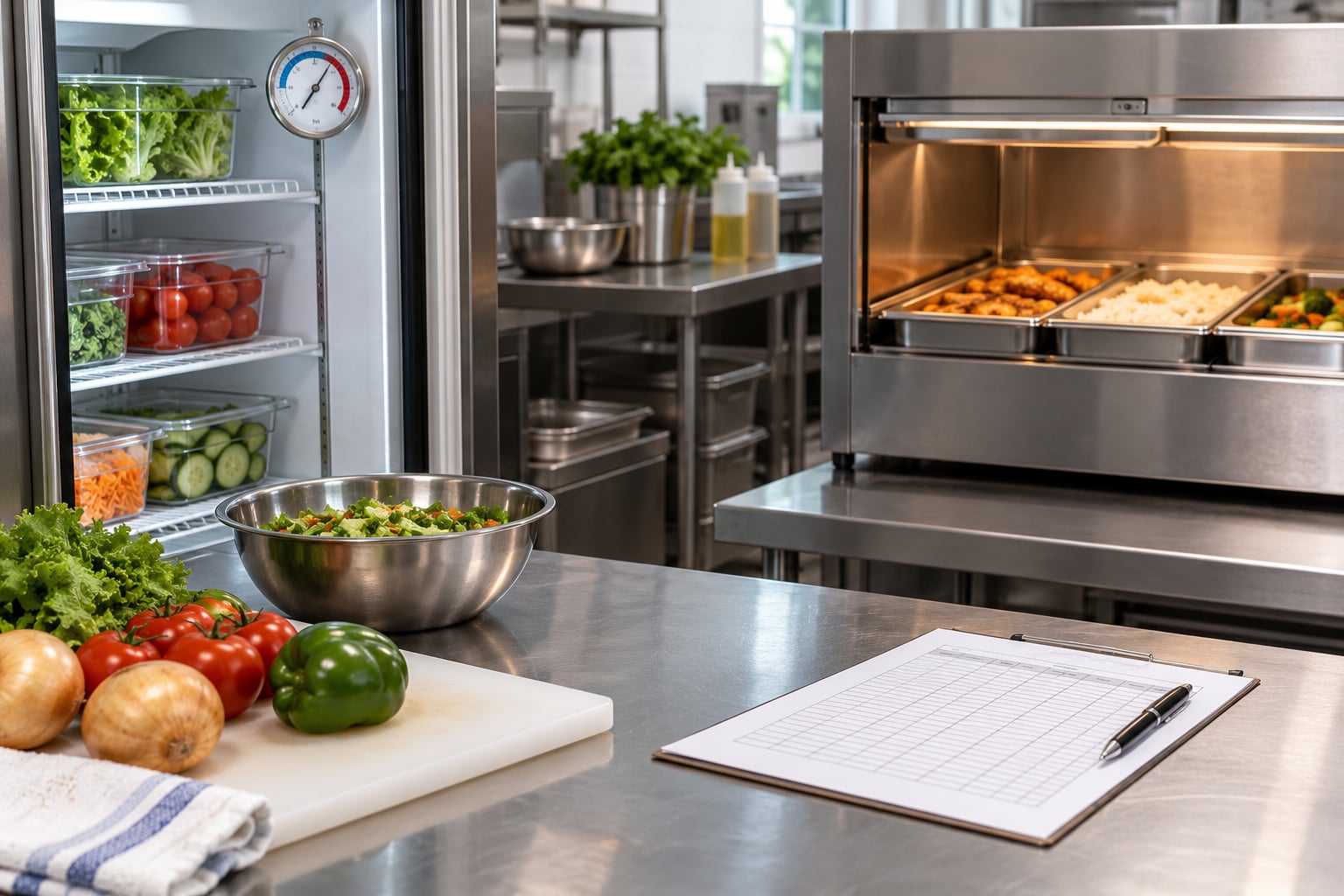
Cold food in a restaurant refrigerator belongs at 41°F (5°C) or below, hot food on the line belongs at 135°F (57°C) or above, and anything in between is the danger zone where bacteria multiply fast. This guide is the working reference I hand new managers: every number a health inspector can measure, plus how to check it, write it down, and fix it when it drifts. Last reviewed for 2026.
Table of Contents
- Food Storage Temperature Guide for Restaurants at a Glance
- What Temperature Should Restaurants Keep Cold Food At?
- What Temperature Should Restaurants Keep Frozen Food At?
- How Hot Should Hot-Held Restaurant Food Be?
- How Quickly Should Cooked Food Cool?
- How Should Restaurants Reheat Food Safely?
- How Do You Check and Record Restaurant Food Temperatures?
- What Should Restaurants Do When Food Is Too Warm or Too Cold?
- Frequently Asked Questions
- Conclusion
Food Storage Temperature Guide for Restaurants at a Glance
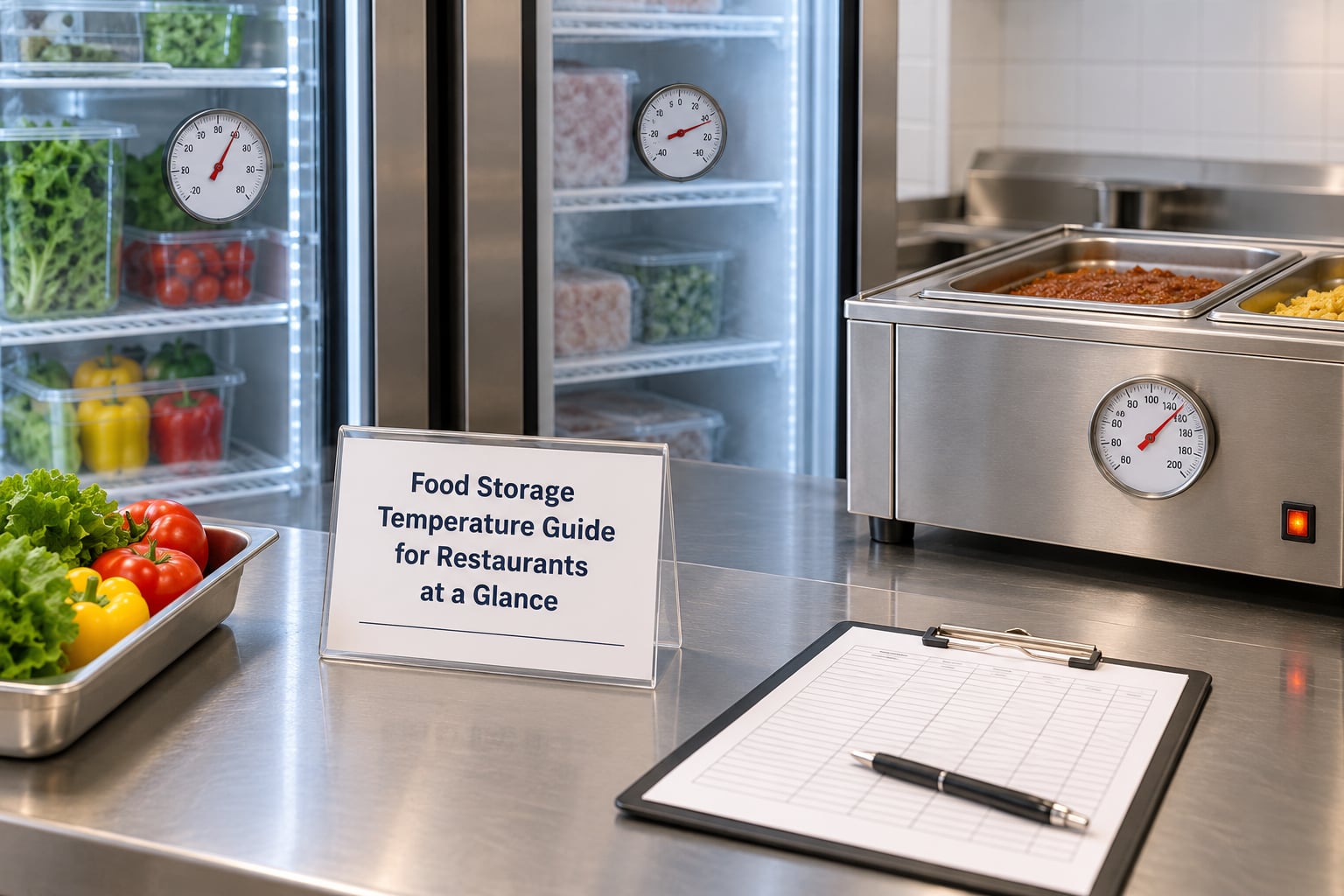
The temperature danger zone is 41°F to 135°F (5°C to 57°C). Bacteria can double roughly every 20 minutes in that band, which is why the code limits how long TCS food sits inside it.
Five numbers cover most of a restaurant kitchen:
- 41°F (5°C) — the ceiling for cold holding and refrigeration
- 0°F (-18°C) — the ceiling for frozen storage
- 135°F (57°C) — the floor for hot holding
- 70°F (21°C) — the midpoint you must hit within two hours of starting to cool
- 165°F (74°C) — the target for reheating, poultry, and re-cooked food
| Food category | Storage temperature | Where it goes in the walk-in | Max time in the danger zone | Notes |
|---|---|---|---|---|
| Raw poultry | 41°F (5°C) or below | Bottom shelf, lowest tub | 2 hours if above 41°F | Keep sealed; always below raw beef and pork |
| Raw ground meat | 41°F (5°C) or below | Bottom shelf, above poultry | 2 hours if above 41°F | Never stack on ready-to-eat food |
| Raw beef, pork, lamb | 41°F (5°C) or below | Second-lowest shelf | 2 hours if above 41°F | Whole cuts on the bottom, chops above |
| Raw seafood, shellfish | 41°F (5°C) or below, over ice | Drain pan on the lowest shelf | 2 hours if above 41°F | Keep drained and covered in melt ice |
| Shell eggs | 45°F (7°C) ambient air | Interior shelf, not the door | 2 hours if above 45°F | Do not store on the door gasket |
| Dairy, cut fruit, cooked vegetables | 41°F (5°C) or below | Top shelf | 2 hours if above 41°F | Ready-to-eat foods belong highest |
| Prepared salads, cut melons, dairy drinks | 41°F (5°C) or below | Top shelf, covered and labeled | 2 hours if above 41°F | Date mark; use FIFO rotation |
| Cooked food kept for later service | 41°F (5°C) or below | Covered, dated, above raw product | Cool to 70°F in 2 hours, then 41°F in 4 more | Reheat to 165°F for hot holding |
| Cooked rice, beans, pasta | 41°F (5°C) or below | Shallow pans, upper-middle shelf | Two-stage cooling required | Cool fast; Bacillus cereus is the concern here |
| Frozen TCS food | 0°F (-18°C) or below | Freezer, sealed and dated | Thaw only under control | No refreezing once above 41°F |
| Dry goods, flour, canned goods | Cool, dry pantry | Pantry, off the floor | Not time/temperature control | Watch for moisture and pests |
What Temperature Should Restaurants Keep Cold Food At?
Keep cold food at 41°F (5°C) or below, and measure the food, not just the dial. An ambient air reading of 38°F says the box is working; it does not prove a tub of sauce sitting at the back of the shelf is actually cold.
Is 40°F cold enough, or is it 41°F?
41°F is the current FDA Food Code number for cold holding TCS food, and 40°F is the older consumer-side phrasing you will still find on older training charts and much USDA home guidance. They are close enough that both end up in the same conversation with an inspector. Manage to 41°F, treat 40°F as your margin of error, and print one number on the walk-in door so nobody is arguing about it at 8pm.
Kitchen professionals who post their own logs in cooking and restaurant safety forums describe standard practice plainly: every entry reads 41 degrees or below, and anything warmer is a problem. That matches what most health departments measure today.
Which equipment counts as storage?
Reach-in units, prep coolers, walk-in coolers, and beverage coolers all have to hold TCS food at 41°F or below. A glass-front display case or a refrigerated buffet sneeze guard is different — the Food Code allows a wider ambient air range for display units because they are not used for storage, so you move the food back into a proper cooler promptly.
Shell eggs are the one temperature exception worth memorizing: 45°F (7°C) ambient air. Everything else on that table sits at 41°F or below.
Where to put the thermometer, and what raises the temperature
Put an air thermometer or data logger near the top of the unit, not in the door or against a wall, and one in product at the warmest point. In practice that means the top shelf and the back wall, where the cooling coil is least effective and where a full walk-in blocks the airflow.
Common reasons a walk-in drifts above 41°F:
- Dense pans stacked to the ceiling and pushed against the evaporator coil
- Walk-in doors held open during a rush, or a door that does not seal
- Hot product carried in and not cooled first
- Overloaded reach-ins competing with an undersized walk-in
- Gaskets that have hardened, and condenser coils packed with grease
If the unit cannot hold 41°F under a normal load, no amount of logging fixes it. That is an equipment problem, and it belongs on a maintenance ticket the same week.
What Temperature Should Restaurants Keep Frozen Food At?
Hold frozen food at 0°F (-18°C) or below. Frozen product is not risk-free indefinitely, but as long as it stays solid or shows ice crystals it is considered safe to refreeze or cook, even if the power has been off for a while.
Thawing methods that pass inspection
There are three accepted ways to thaw TCS food: in the refrigerator, under cold running water that stays at 70°F (21°C) or below, or in a microwave that you move the food straight from into cooking. Thawing at room temperature is prohibited, and so is thawing on a counter or in a walk-in that has been opened up for prep.
What to do when food thaws by accident
If product still holds ice crystals or is at 40°F (4°C) or below, refreeze it or cook it. If it has been above 41°F for more than two hours, throw it out. What you cannot do is refreeze it and pretend the timeline did not happen — refreezing stops growth but does not reverse it.
Keep a freezer thermometer in place rather than guessing from the ice buildup, and use a monthly data logger review to catch a unit that is thawing and re-freezing on a slow cycle.
How Hot Should Hot-Held Restaurant Food Be?
Hot-held food must stay at 135°F (57°C) or above. That is a floor, not a target you sit right on top of — most kitchens run their holding units a few degrees higher so small swings during service do not push the food under the line.
The four-hour clock
Once food is hot-held, it has four hours to be used or discarded. If a service pushes past that, the food comes off the line; it does not get re-heated to reset the clock. Some kitchens track a second pot separately, but a fresh batch is the only clean reset.
Placement and check frequency
Check hot food at the start of service, roughly every two hours, and any time the unit is opened or restocked. Put the thermometer where you will actually serve from — the front of the pan, not the back wall — and take the reading in the food itself, not the cabinet air.
If a reading comes back under 135°F, reheat the food to 165°F (74°C) and return it to the hot box. If you cannot get it back to 135°F within two hours, discard it and record the discard. Leaving a pan sitting on the pass to warm up is not a corrective action, it is a second uncontrolled temperature event.
How Quickly Should Cooked Food Cool?
Cool cooked food in two stages: from 135°F to 70°F (57°C to 21°C) within two hours, then from 70°F to 41°F (21°C to 5°C) within the next four hours. Six hours total is the outside limit, and every stage needs to be written in the log with a time.
| Stage | Target | Time limit | Total elapsed | What it looks like |
|---|---|---|---|---|
| Stage 1 | 135°F to 70°F (57°C to 21°C) | 2 hours | 2 hours | Sauce moves from steaming to barely warm |
| Stage 2 | 70°F to 41°F (21°C to 5°C) | 4 more hours | 6 hours | Steam stops, surface cools, pans go into the cooler |
A worked cooling example
A large stockpot of tomato sauce comes off the burner at 2:00pm at 160°F (71°C). Staff portion it into shallow pans and set them on an ice bath at 2:05pm, which gets the center to 70°F by 3:30pm — stage one passed with about an hour to spare. The pans go into the walk-in at 4:00pm, hit 41°F by 5:15pm, and get a date label and an initials mark. Total time is three hours and fifteen minutes, well inside the six-hour window.
The same sauce left in the stockpot in the walk-in would still be in the low 80s at closing. That gap is the whole reason for shallow pans.
Why shallow containers and airflow matter
Food cools from the outside in, and the rate depends almost entirely on depth. A four-inch-thick pan takes several times as long to chill through as a one-inch pan holding the same sauce, which is why portioning is not optional.
What actually speeds it up: shallow pans, an ice bath or ice wand, dividing large batches across several containers, and a blast chiller where you have one. What slows it down: a walk-in crammed with warm pans, foil lids sealed tight before the food has lost its heat, and a pan stacked under fifty pounds of stock.
Rice, beans, and pasta deserve extra attention because cooked starches are the classic vehicle for Bacillus cereus spores. Get them into shallow pans and onto ice within minutes of cooking, and cool them the same way you would a soup.
How Should Restaurants Reheat Food Safely?
Reheat previously cooked and chilled food to 165°F (74°C) within two hours. Reheating for hot holding and cooking raw food are different jobs with different targets, and mixing them up is a common source of failed inspections.
| Action | Target temperature | Time limit | Notes |
|---|---|---|---|
| Reheating cooked food for hot holding | 165°F (74°C) | Within 2 hours | Verify in the thickest part of the pan |
| Reheating in a microwave | 165°F (74°C) | Covered, stirred halfway | Microwave uneven heating is the risk |
| Reheating cooked food for immediate service | 165°F (74°C) | Check before handing to the guest | No holding window applies |
| Cooking raw poultry | 165°F (74°C) | 15 seconds | Wings, thighs, whole birds, ground poultry |
| Cooking raw ground meat | 155°F (68°C) for 17 seconds; USDA consumer guidance uses 160°F (71°C) | Instantaneous | Burger patties, sausage, meatloaf, meatballs |
| Cooking whole cuts of beef, pork, lamb | 145°F (63°C) | 3-minute rest | Steaks, roasts, chops, ham for cooking |
| Cooking fish and shellfish | 145°F (63°C) | 15 seconds | Until flesh is opaque and separates |
| Cooking eggs for immediate service | 145°F (63°C) | 15 seconds | Custard-style and sauces must reach it |
| Hot holding after cooking | 135°F (57°C) or above | 4 hours max | Verify every two hours |
Two habits keep reheating honest. Reheat only what you will serve in the next two hours, and stir reheated food at least once, especially in a microwave, where the center of a covered bowl can sit cold while the edges boil.
How Do You Check and Record Restaurant Food Temperatures?
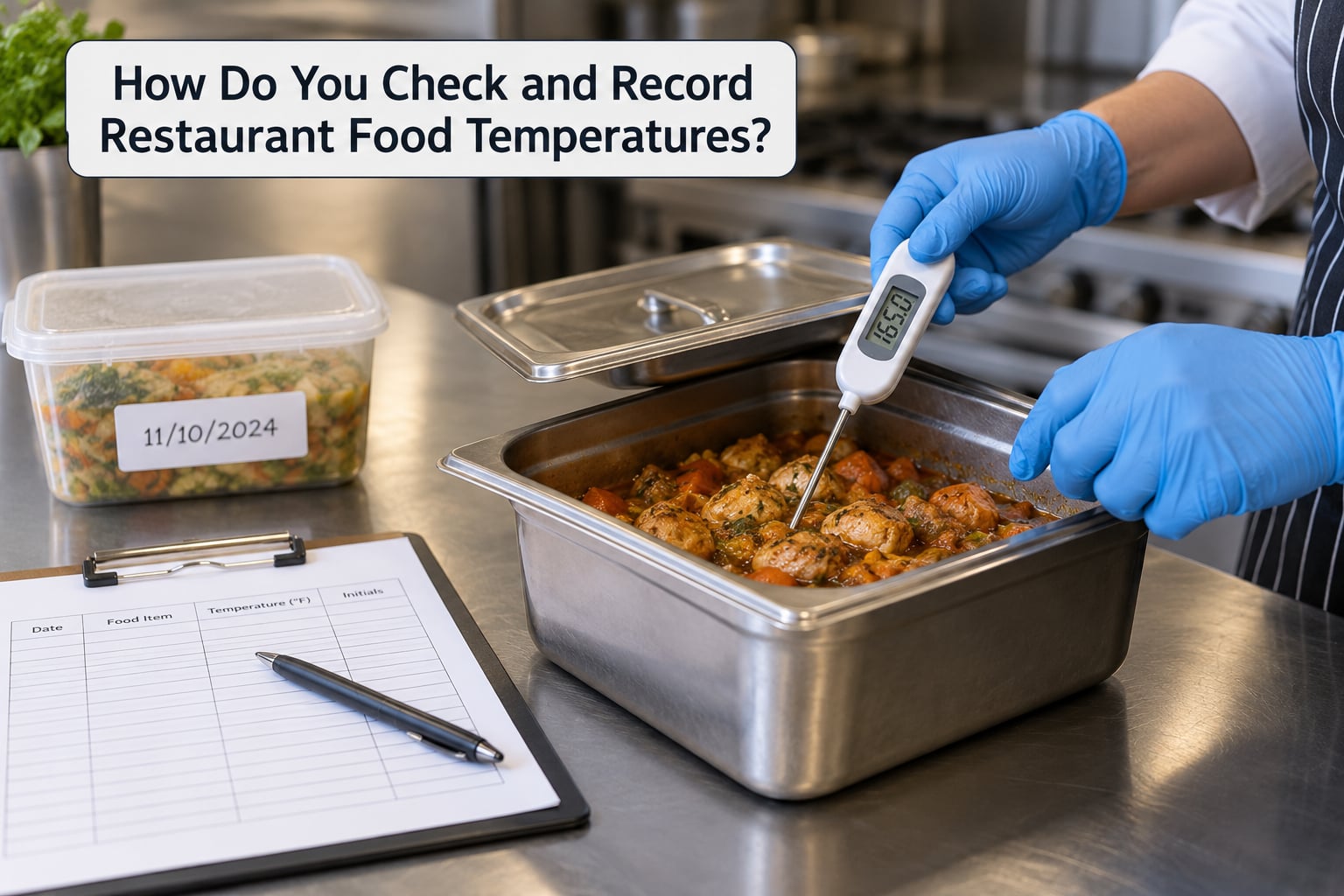
A calibrated thermometer, a consistent probe placement, and a log that someone actually completes. That is the whole verification system, and it takes about a minute per unit if it is built into the shift.
Probe, infrared gun, or data logger?
Use a calibrated digital probe thermometer for food. That is the only reading you can rely on for a food safety decision, because infrared guns measure surface temperature only: a shiny sauce pan reads the pan, a cold center under a browned crust reads the crust, and cold air between ingredients drags the reading down.
Infrared thermometers are useful for checking a hot line cabinet or a shipping container surface, but they cannot substitute for a food temperature at an inspection. Digital data loggers are the upgrade worth making: they record walk-in and hot-holding temperatures unattended, so you have a history rather than a stack of memory. Treat any equipment check list you already run, including a tool safety inspection checklist, as a natural place to add thermometer and cooler checks.
Calibrating at the ice point
- Fill a cup with crushed ice and just enough water to make a slush.
- Stir, then press the probe tip into the center of the slush, avoiding the sides and the bottom of the cup.
- The reading should hit 32°F (0°C). Anything from 30°F to 34°F is workable.
- If it is off, adjust the thermometer or replace the battery, then retest.
- Calibrate at the start of every shift, before first use, and after any probe is dropped or heated.
Probe placement, cleaning and reading frequency
Take the reading in the thickest part of the food, away from bone and fat. Take it before serving the first portion, not from the plate you already slid out the window. Between readings, clean and sanitize the probe with alcohol or the correct sanitizer wipe, then rinse the alcohol off with cold running water before it goes back in the food.
Log both equipment air readings and food readings. That answers the question line cooks keep asking: the walk-in is logged, the reach-in is logged, the hot line is logged, and the food itself is checked when it is cooked, cooled, received, or served.
Record the reading, the time, the food, the equipment, and the initials of whoever took it. If a corrective action was needed, note it on the same line rather than on a separate sheet nobody reads. Keep records for at least three days or for as long as your local code requires, and keep them accessible — an inspector asks for them, and a log stored in a drawer is a log that does not exist.
What Should Restaurants Do When Food Is Too Warm or Too Cold?
Out-of-range readings get a documented corrective action, in writing, every time. The rule is simple: fix the food first, then fix the equipment, then write down what you did.
| Scenario | Immediate action | Disposition | Documentation |
|---|---|---|---|
| Cold holding above 41°F | Recheck with a calibrated probe in the product, not the air dial | Move to a working cooler; use or discard within 4 hours | Log the reading, the action, and the time corrected |
| Hot holding below 135°F | Reheat to 165°F and return to the hot box | Discard if it cannot return to 135°F within 2 hours | Log the reading and the reheat or discard |
| Cooling missed a stage | Continue cooling; verify the food hits 41°F | Discard if above 41°F beyond the 6-hour total | Log each stage with its time |
| Delivery arrives warm | Measure at the dock with an incoming thermometer | Refuse it, or accept only if the product is still below 41°F and can be cooled in time | Record the refusal or the receiving temperature and time |
| Power or equipment failure | Keep doors closed, call maintenance, use ice and dry ice to protect product | Discard TCS food held above 41°F for more than 4 hours | Note the outage time, the door status, and the discard |
Staff should not guess. If a food handler is unsure whether a temperature reading means discard, the correct move is to isolate the product, keep it out of service, and escalate to the person in charge rather than putting it back on the line and hoping.
Power outages and equipment failures
A closed refrigerator keeps food safely cold for roughly four hours. A full freezer holds for about a day, longer if it is packed solid. Keep the doors shut, move product into insulated containers with ice or dry ice, and start discarding perishables that have been above 40°F (4°C) for two hours or more.
When power returns, do not restart a unit and assume the contents are fine. Recheck every recorded temperature before the food goes back into service, and log the outage window with the readings either side of it.
The staff side of hot and cold work
Food safety numbers are only as good as the people standing at the equipment all day. Hot holding near a steam table, and a walk-in that sits at 38°F (3°C), are both physically demanding, and cooks push through fatigue and shortcuts rather than admitting they are cold. Stock the walk-in with a door that seals properly, keep break times scheduled, and treat a worker feeling lightheaded in a hot line as a staffing problem, not a toughness problem. The same discipline shows up in knife safety for food service workers and in food service slip prevention tips: the habits that keep a kitchen safe are the habits you actually write down and rehearse.
Frequently Asked Questions
What is the 2-2-2 rule for food storage?
The 2-2-2 rule is shorthand for the Food Code two-stage cooling process: cool cooked food from 135°F (57°C) to 70°F (21°C) within 2 hours, then from 70°F to 41°F (5°C) within 4 more hours, so the whole job takes no more than 6 hours. It only works if you portion food into shallow pans and cool them on ice or in a blast chiller rather than leaving a deep stockpot to cool on a shelf. Log both stages with times.
Is 40 degrees cold enough to keep food safe?
The FDA Food Code sets cold holding for TCS food at 41°F (5°C) or below, which is the number inspectors use. You will still see 40°F (4°C) on older training charts and in USDA home guidance, so treat 40°F as your working target and 41°F as your legal limit. A reading between the two is not an automatic violation, but a walk-in running at 44°F overnight is a real problem regardless of which number you quote.
What is the temperature danger zone?
The danger zone runs from 41°F to 135°F (5°C to 57°C). Bacteria such as Salmonella, Clostridium perfringens and Staphylococcus aureus multiply quickly inside it, and some produce toxins that reheating does not destroy. TCS food may sit in that band for no more than 2 hours, or up to 4 hours under a documented time-as-control plan that gets the food used or thrown away.
When should a restaurant employee record food temperature?
Record temperatures at receiving, at cooking, at cooling each stage, at the start of service, about every two hours during service, and after any corrective action. Log the walk-in, the reach-ins, and the hot-holding unit as equipment readings, and the food itself whenever it is cooked, cooled, thawing, or served. Write the reading, the time, the food, and your initials on the same line, and keep the log for at least three days.
Can food be returned to the walk-in cooler after it has been out?
Only if it stayed at or below 41°F (5°C) the whole time and was out for less than 4 hours under a written time-as-control policy. If it was above 41°F for more than 2 hours, discard it. Food that has been sitting on the pass during a rush is not a candidate for the cooler, and moving a container around to create space in the walk-in means the food is out of control, so check its temperature before it goes back.
What temperature is too hot to work in a restaurant?
There is no single kitchen air temperature limit, but heat stress becomes a real risk when the kitchen runs above about 80°F (27°C) with no relief, and wet coolers plus steam tables make it worse. Look for heavy sweating, headache, dizziness, cramps, and confusion in staff, and treat those as heat illness until proven otherwise. For cold work, wet or tight clothing in a 38°F (3°C) walk-in can cause cold stress quickly. Schedule breaks and hydration in writing.
Conclusion
Start with four things this week. Check every walk-in, reach-in, and hot-holding unit with a calibrated probe at the warmest point and write the actual reading on the box, not just the dial. Print one chart with the 41/135/0 numbers and tape it inside each door where the line can read it at a glance. Build the log so it captures equipment and food readings, with times and initials, and keep it for at least three days. Then walk the corrective action table with your sous chefs so everyone knows what happens, and who decides, when a number comes back wrong.
Local health departments can set stricter limits than the Food Code, so confirm the numbers that apply to your facility with them and with the current FDA Food Code before you print anything for the wall. If you want the same treatment applied to the rest of your kitchen safety routine, the food service slip prevention tips and tool safety inspection checklist are good next reads.