
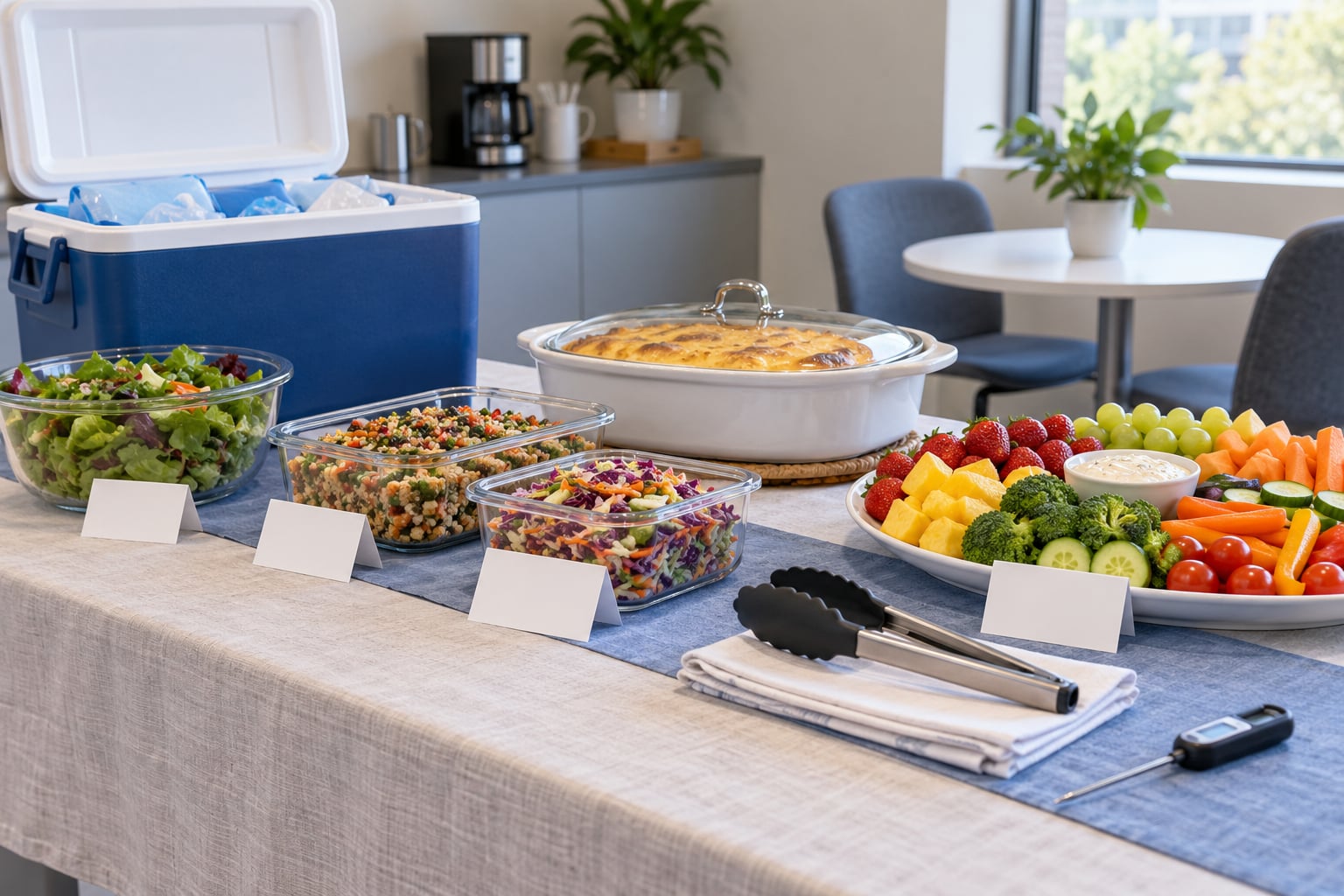
Office potluck food safety comes down to three numbers: keep cold food at or below 40°F, keep hot food at or above 140°F, and toss perishable dishes after two hours at room temperature, or one hour when the room is above 90°F. The clock starts the moment a dish leaves the contributor’s kitchen, not when it hits the breakroom table.
That last point is where most office lunches go wrong. Someone cools a casserole on the counter for twenty minutes, drives it across town in a warm car, sets it out on a folding table, and by the time the queue forms the dish has already spent too long in the range bacteria like. Nothing about the food tastes wrong, which is exactly why people keep eating it.
Most of the rules below apply to any shared meal, but a breakroom changes the math. There is no stove, one microwave serves forty people, the fridge is already crowded with somebody’s lunch, and the table sits in a room that is usually warm. Planning a potluck around the food works, not around the idea of it, is what keeps a workplace meal pleasant instead of a stomach bug story by Friday. If you are choosing the menu, start with our healthy meeting food ideas for modern workplaces and apply these rules as you go.
Table of Contents
- Office Potluck Food Safety Tips at a Glance
- 1. Keep Cold Foods Cold From Home to the Buffet
- 2. Keep Hot Foods Hot During Transport and Serving
- 3. Use a Separate Cutting Board for Raw Meat
- 4. Cook Food to USDA Safe Internal Temperatures
- 5. Wash Hands and Clean Surfaces Before Setup
- 6. Label Every Dish and Its Allergens
- 7. Use Serving Utensils and Keep Foods Separate
- 8. Put Small Portions Out and Refill as Needed
- 9. Store Leftovers Promptly and Refrigerate Them
- 10. Plan a Food-Safe Potluck Instead of Improvising
- Frequently Asked Questions
Office Potluck Food Safety Tips at a Glance
| Main risk | What to do | When the organizer should step in |
|---|---|---|
| Cold food warms up | Transport in a cooler with ice or frozen gel packs, serve over ice, keep at or below 40°F | When the ice melts under the tray or the dish sits at room temperature past two hours |
| Hot food cools down | Preheat before packing, use an insulated carrier or chafing dish, hold at or above 140°F | When a slow cooker drops below 140°F, or a dish has been on the table for over two hours |
| Raw and cooked food touching | Separate boards, knives and utensils, clean surfaces between tasks | When one utensil is doing double duty, or a dish is prepped on a surface that held raw meat |
| Undercooked food served | Cook to USDA minimum internal temperatures and verify with a food thermometer | When a dish arrives raw in the middle, especially poultry and casseroles |
| Allergens and cross-contact | Label every dish with its major allergens, provide a dedicated utensil for allergen-free food | When a guest asks and the label is missing or vague |
| Food sitting out for hours | Put out small batches, refill from cold storage, discard after two hours | When the serving line restocks from a table dish that has been sitting out all morning |
| Leftovers abandoned at the end of the day | Refrigerate within two hours in shallow containers, label with name and date | At cleanup, when dishes are still on the counter at closing time |
1. Keep Cold Foods Cold From Home to the Buffet
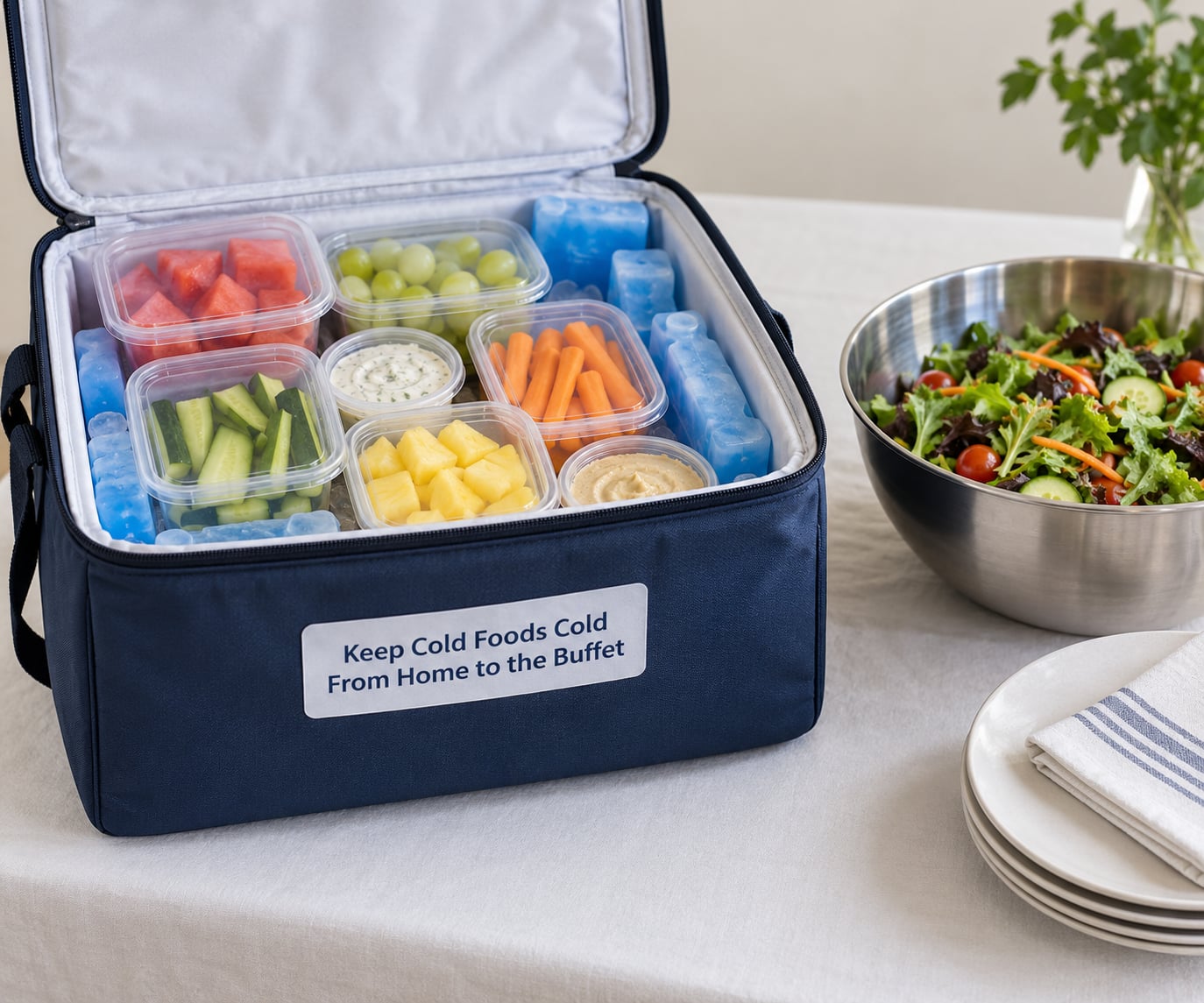
Cold dishes need a cold source the entire way, not just ice in the serving bowl. Pack them in an insulated cooler, grocery bag with ice, or a foam container lined with frozen gel packs, and put the food in at the last possible moment.
Use more ice than you think. A nine-by-twelve cooler with three or four frozen packs will hold a tray of chopped salad cold for the length of a typical lunch meeting; the same tray in a thin grocery bag will not. Keep the cooler out of direct sun and out of a car that has been parked since morning, and put the food into the cooler rather than the other way around.
When you set the table, nest the bowls in ice and refresh it as it melts. An instant-read thermometer is the honest way to check: it should read 40°F or below. If a cold dish arrives above 40°F, put it back on ice and keep an eye on the clock rather than assuming it is fine.
2. Keep Hot Foods Hot During Transport and Serving
Hot food has the same problem in reverse. It should leave the oven at 165°F, travel in an insulated casserole carrier or a lidded slow cooker, and stay at or above 140°F on the table.
A crock-pot set to warm is not the same thing as a crock-pot holding a safe temperature all morning. Low settings often park food in the range where bacteria grow fastest, and nobody checks. The organizers should assume that anything nobody is taking the temperature of is drifting toward unsafe.
If a hot dish cools below 140°F during service, reheat it to 165°F before putting it back out, or take it off the table. Reheating kills the bacteria that multiplied, but only if it gets hot enough all the way through. Scent and appearance tell you nothing here.
3. Use a Separate Cutting Board for Raw Meat
Cross-contamination is how raw bacteria reach food nobody cooked. Give raw poultry, meat and seafood their own board, knife and tongs, and keep them physically apart from anything ready to eat, especially fruit, salads, cheese and bread.
Color coding helps more than people expect: one board for produce, one for bread, one for raw meat. Between tasks, wash the board, the knife and your hands with hot soapy water, and sanitize the counter. Most home cutting boards get wiped with a damp cloth and put straight back in the cupboard, which moves the bacteria to whatever is chopped next.
Store raw meat on the lowest shelf of the fridge so nothing can drip onto the produce below it. Never rinse raw poultry or steak before cooking, because the splashing spreads the bacteria you were trying to contain. If you are prepping a lot of food for a potluck, our knife safety guide for food service workers covers the cutting and handling side of a long prep session.
4. Cook Food to USDA Safe Internal Temperatures
Color is not doneness. The only dependable check for a casserole, a tray of chicken or a slab of salmon is a food thermometer in the thickest part, away from bone, read against the USDA minimums.
| Food | USDA minimum internal temperature | Notes |
|---|---|---|
| Poultry, ground or whole, and stuffed dishes | 165°F (74°C) | The most common potluck casualty |
| Ground beef, pork, lamb and sausage | 160°F (71°C) | Meatballs, lasagna, chili |
| Whole cuts of beef, pork, lamb and veal | 145°F (63°C) | Rest 3 minutes after cooking |
| Fish and shellfish | 145°F (63°C) | Until the flesh is opaque and flakes |
| Eggs and egg dishes | 160°F (71°C) | Quiches, deviled eggs, casseroles |
| Leftovers and casseroles being reheated | 165°F (74°C) | Reheat the whole pan, not just the top |
| Deli meats and hot dogs for high-risk guests | 165°F (74°C) | Steaming hot before serving |
How to use a food thermometer without guesswork
Check the thermometer in ice water before you leave the house, aiming for 32°F. Insert the tip into the thickest part of the food, not against the pan, and accept that a ten-dollar stick thermometer beats a confident guess from a coworker.
At a potluck, designate one person to take temperatures. One probe, one job, written down on the dish card. It also solves the social problem, because the person measuring is doing a job rather than policing the food.
5. Wash Hands and Clean Surfaces Before Setup
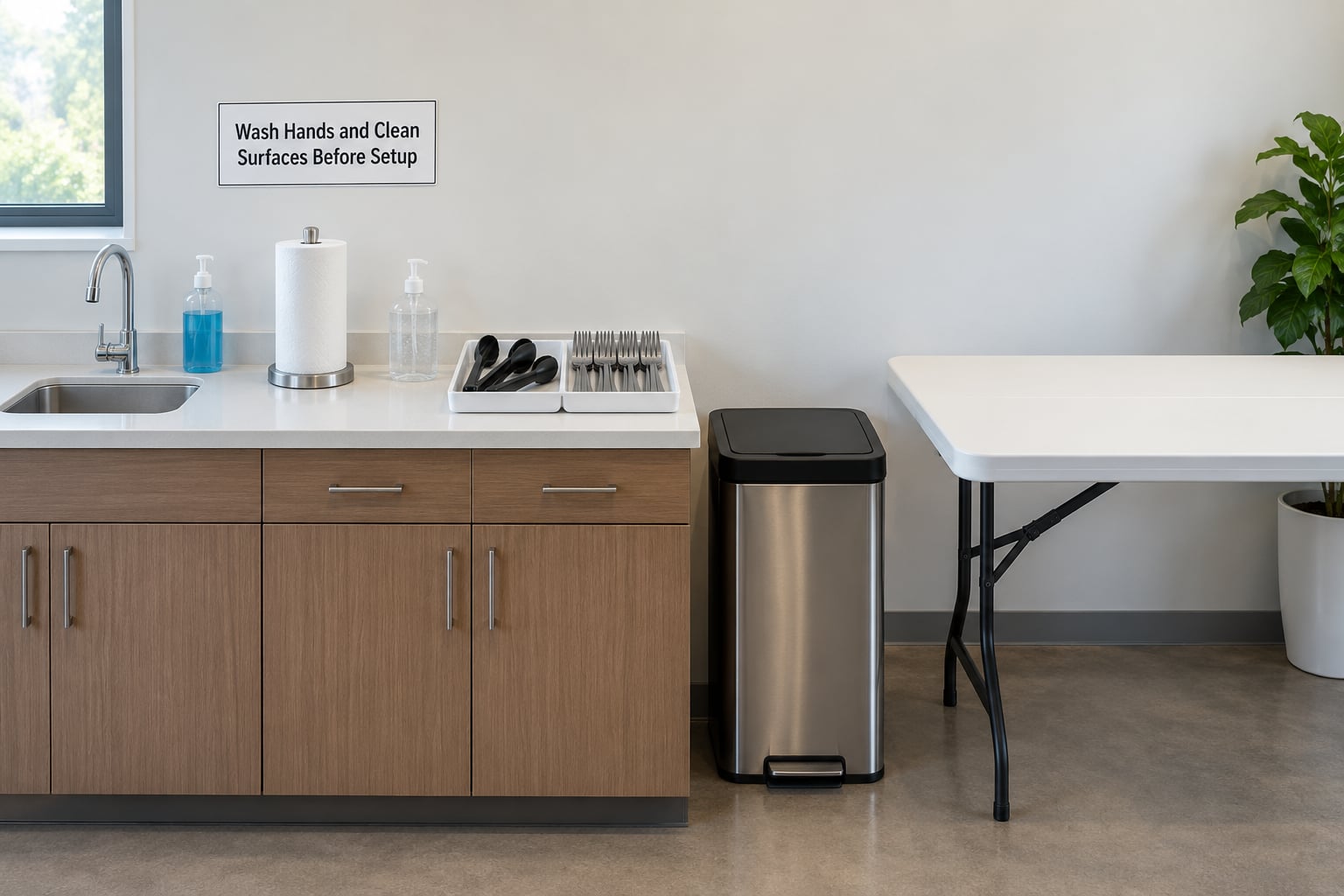
Wash with soap and running water for at least 20 seconds before handling food, after using the bathroom, and after handling money, phones, cleaning supplies or a colleague’s leftovers. Sanitizer is a backup for moments when a sink is inconvenient, not a replacement for washing before you start arranging a table of food.
Breakrooms add their own problems: one sponge that gets used for the sink, the counter and the coffee machine, a fridge nobody wipes down, and a microwave whose door handle sees more hands than its interior. Before dishes go out, wipe the serving table and the counter, clean the sink, and swap out a sponge that has been sitting wet for days.
Water and spills around a buffet are how people slip and how food gets contaminated by contact with a floor. Keeping trays raised off the surface and mopping under the table as it goes helps both, which is the argument in our food service slip prevention tips.
6. Label Every Dish and Its Allergens
Every dish gets a card with its name and the allergens it contains. The big ones people look for are milk, egg, fish, shellfish, tree nuts, peanuts, wheat, soy and sesame, and a dish with gluten in it needs to be flagged clearly for anyone with celiac disease.
Write what you know, not what you hope. A vague card reading homemade cake with a side note that probably has nuts in it is worse than no card, because a guest with an allergy will ask the person who made it and get a different answer each time. If you bought a packaged item, bring the manufacturer’s label or list the main allergens from the box.
Also note vegetarian, vegan and religious restrictions, since some colleagues avoid certain foods without an allergy. And put the all-important qualifier on the cards: label information is whatever the contributor says, so guests with severe allergies should confirm before eating.
7. Use Serving Utensils and Keep Foods Separate
Assign one clean serving utensil to each dish. Tongs for the chicken, a spoon for the salad, a flat server for the casserole, and nothing borrowed between them. It is the cheapest rule on this list and it prevents the single most common cross-contact event at a potluck.
Give utensils a resting place, such as a clean folded napkin or a shallow tray, so they do not lie directly on the tablecloth. And skip the hands-in-the-dish tasting: use a single-use cup if a dish needs a taste check, which the University of California guidance on potlucks recommends specifically for that reason.
Keep allergen-free dishes away from the dish with the known allergen, and use a separate utensil for each. Celiac threads on work social events describe the same problem again and again: the food is fine until it shares a serving spoon with a dish someone dipped into.
8. Put Small Portions Out and Refill as Needed
Smaller batches stay out of the danger zone for less time, and smaller batches get eaten. Bring the full dish in a chilled container behind the table and refill the serving bowl in small amounts rather than putting everything out at 11:30 and letting it sit until 2.
This is also the answer to a slow-moving line. A buffet that looks full does not get eaten, and food nobody eats is food that has spent hours in the danger zone and then goes in the bin. If ice under the cold tray melts, add ice. If a chafing dish goes quiet, check the temperature.
The two-hour rule is the fallback, not the goal. Two hours at room temperature is the ceiling for perishable food in a normal room, and one hour is the ceiling when the ambient temperature is above 90°F, which is worth knowing for patio lunches and summer decks. Dry goods, unopened packaged items and shelf-stable snacks are not on that clock at all.
9. Store Leftovers Promptly and Refrigerate Them
Refrigerate perishable leftovers within two hours of the dish hitting the table, and use shallow containers so the middle cools as fast as the edges. A deep stockpot of warm casserole on a breakroom counter cools the outside and leaves the center sitting in the danger zone for hours.
Cooling happens in stages. Food should move from 135°F down to 70°F within two hours, and from 70°F to 41°F or below within the next four hours. If it will not make that window in one container, divide it into several shallow ones and get them into the fridge or an ice bath immediately.
Label each container with the dish name, the contributor and the date, then give it a shelf. Unlabelled containers in a shared office fridge get cleared out. Refrigerated leftovers are generally good for three to four days, and anything that sat out past its limit goes in the bin rather than the fridge, because reheating does not always fix what grew there. Ask whoever brought the dish to pack the leftover portion before they leave, so the same hands that transported it are not also the ones you need to find at cleanup.
10. Plan a Food-Safe Potluck Instead of Improvising
Good potlucks are organized in advance, usually by a handful of people who set the rules without calling it policing. A short email a week ahead with the temperature rules, the labeling request and the cleanup assignments removes almost all of the friction.
Lowest-risk dishes to volunteer for
- Commercially sealed items, which carry their own controls and labels
- Shelf-stable snacks that need no refrigeration and no reheating
- Store-bought baked goods with an intact ingredient list
- Fresh fruit and whole vegetables, which are low risk until they are cut and handled
Assign roles before the day: someone sets up and ice the cold tray, someone owns the thermometer, someone owns the end-of-event cleanup. Contributors who have a fever, vomiting or diarrhea should skip the event entirely, since most foodborne illness spread at gatherings comes from a well-meaning carrier who felt fine enough to bring a tray.
One more office-specific hazard: the shared microwave. Popcorn, reheated curry and fish in the same small space leave odors and residue that matter to a coworker with an allergy or migraine. Set a rule about covered containers and give reheating its own time slot before the room fills up.
Frequently Asked Questions
What is the 2 2 2 rule for food?
The 2 2 2 rule is a nickname, not an FDA term, and it points to the two-hour limits that follow a dish around: refrigerate perishables within two hours of taking them off the heat, get leftovers into cold storage within two hours of the event ending, and spend no more than two hours in transit or in temperature-controlled holding. Wherever the version you have seen puts a four instead, it refers to the longer total window allowed for cooling: down to 70F within two hours, then to 41F within four more.
What is the 2 2 4 rule for food safety?
The 2 2 4 rule is the cooling version of the same guidance. Bring hot food down from 135F to 70F within two hours, then from 70F to 41F or below within the following four hours, for six hours total. That is why cooling food in shallow containers matters, since a deep pot cannot shed heat fast enough to stay ahead of the clock and is a common way leftovers spend hours in the danger zone.
How long can cooked food sit out at room temperature?
Perishable food can sit at room temperature for no more than two hours, and only one hour when the air temperature is above 90F. The limit drops sharply for foods like cut fruit, potato salad, rice, cooked vegetables, custards and dairy-based dips, because bacteria multiply quickly in that range. Dry crackers, unopened packaged snacks, whole fruit and sealed jars are not perishable and carry no time limit.
Do I need to label allergens at an office potluck?
Labeling is not formally required for a workplace potluck in most places, but it is the one courtesy that prevents a real medical emergency. A small card with the dish name and the allergens it contains, taken from the packaging when the item is store-bought, lets someone with a severe allergy or celiac disease make a decision instead of guessing. Guessing is what the label is there to prevent.
What are the top 5 food safety tips?
The five that prevent most illness: keep cold food at or below 40F and hot food at or above 140F; never leave perishable food out longer than two hours, or one hour above 90F; wash hands with soap and water for 20 seconds and clean surfaces and utensils between tasks; keep raw meat separate from ready-to-eat food; and cook to the USDA minimum internal temperature, verified with a food thermometer rather than by color or texture.
What are the dos and don’ts in the kitchen?
Do wash hands with soap and water for at least 20 seconds, rinse produce under running water, separate raw poultry and meat from ready-to-eat foods, and refrigerate perishables within two hours. Don’t rinse raw meat before cooking, don’t use the same cutting board and knife for raw chicken and salad, don’t leave perishable food on a counter for more than two hours, and don’t rely on a slow cooker set to warm to keep food at a safe serving temperature.
If you do one thing from this list, put a cooler with ice packs and a thermometer in the breakroom before the table is set up. Cold food at or below 40°F, hot food at or above 140°F, a card on every dish, and anything perishable gone after two hours covers most of the risk in an office potluck. The rest is just repeating those numbers to the person who forgot the ice.
These are general food safety guidelines drawn from mainstream USDA and public health guidance, not personal medical advice. If someone at work becomes ill after a shared meal, they should contact a healthcare provider, and a person with a diagnosed condition that puts them at higher risk from foodborne illness should talk to their clinician before joining a potluck at all.