

If you want to know how to avoid the afternoon slump, start with the four things that drive it: food, fluid, movement and light. Most people fight a 3 p.m. energy crash with caffeine alone, then wonder why four o’clock feels worse than three. A short daily routine that covers all four takes about 15 minutes, plus two changes to what you eat for lunch and how you spend your break.
The plan below works for desk-based employees, hybrid workers, shift workers and students. It is written for workplace health teams as much as for individuals, since a protected break and a decent break room change the outcome more than any single habit. The research here draws on mainstream guidance from health systems and public health bodies rather than on wellness blogs, and it sticks to numbers you can actually act on.
One thing up front: this is general information, not medical advice. If fatigue is severe, sudden or getting worse, talk to a doctor rather than trying to engineer your way around it.
Table of Contents
- What You Need to Avoid the Afternoon Slump
- Step-by-Step: A Seven-Part Plan to Avoid the Afternoon Slump
- Common Mistakes
- Frequently Asked Questions
- What is the best way to avoid the afternoon slump at work?
- Does a short walk really help with afternoon fatigue?
- Should I drink coffee to get through the afternoon?
- Can dehydration cause an afternoon slump?
- What should I do if I feel tired every afternoon?
- How can employers support employees with afternoon fatigue?
- Conclusion
What You Need to Avoid the Afternoon Slump
You need very little to run this routine. You need somewhere to stand up and walk, a drink of water within reach, a lunch you have already eaten or plan to eat sensibly, and about 15 minutes of the afternoon that nobody has scheduled a meeting into.
- A water bottle you can see. Sipping on a schedule beats remembering to drink in a rush. Most people carry a bottle they ignore until it is empty, which is the worst possible order.
- Somewhere with daylight. A window, a stairwell, a covered walkway or a bench outdoors. The walk does not have to be a walk around the block to count.
- A lunch with protein in it. Aim for roughly 20 to 30 g of protein plus slow-release carbohydrate, eaten sitting down, away from your keyboard.
- A break that exists on paper. Put a 10-minute block in your calendar with a start and an end time. An unbooked break gets eaten by the nearest urgent message.
- A timer for the nap, if you nap. 20 minutes on the clock, an alarm you cannot sleep through, and somewhere reasonably quiet.
- Permission to adjust your own work. If your calendar puts your hardest task at 2:30 every day, no routine will rescue it. Check whether you can move it.
Step-by-Step: A Seven-Part Plan to Avoid the Afternoon Slump
Run the four main steps below in the same order most days for two to three weeks, then add the last three once the first four feel automatic. Change one variable at a time, because that is the only way you will learn which one is doing the work for you.
Use a Short Movement Break to Avoid the Afternoon Slump
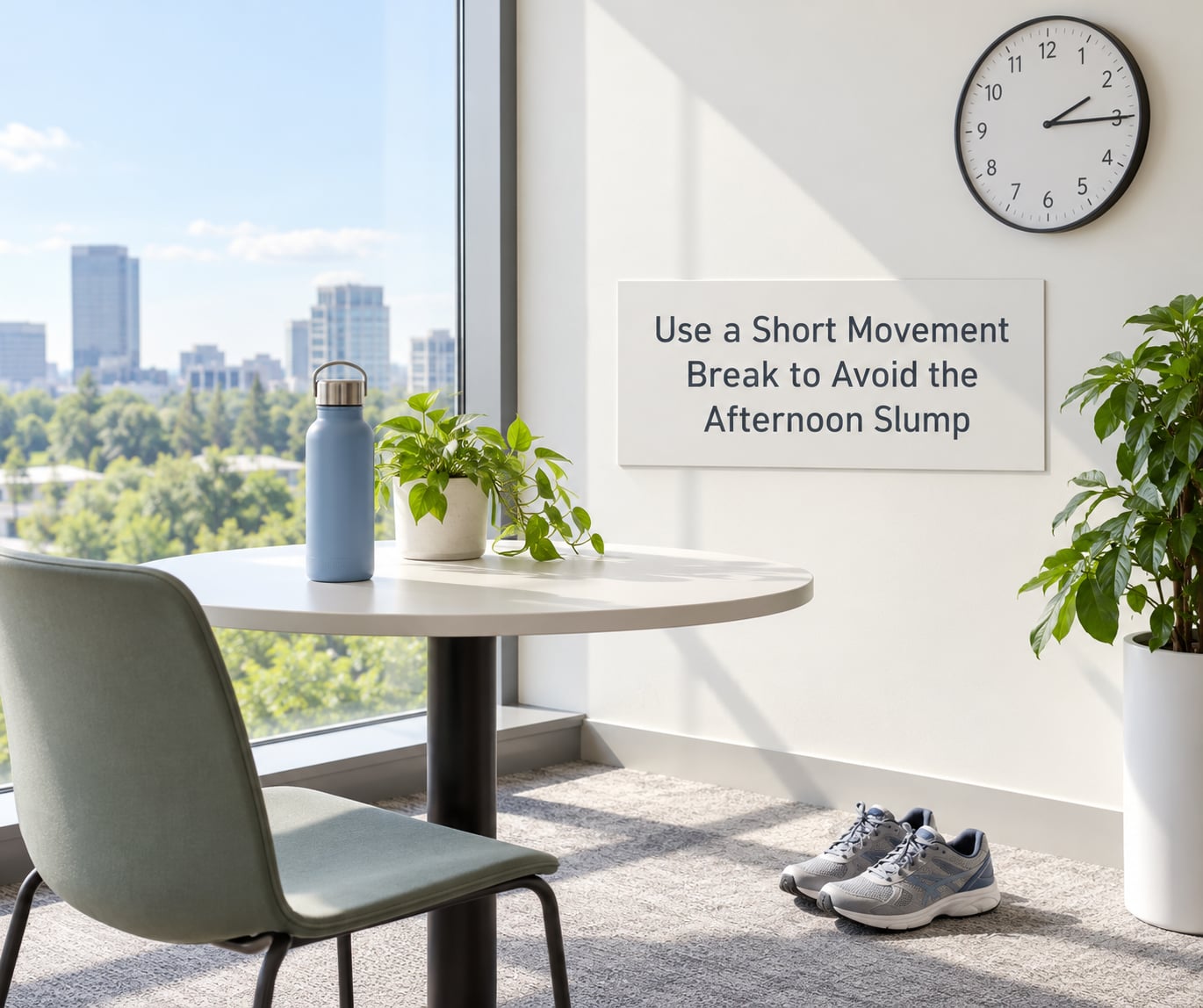
A five to ten minute walk is the single most reliable fix for the mid-afternoon slump, and it needs no equipment and no permission from anyone but your calendar. The point is to break sitting, not to burn calories. After ninety minutes or so of sitting, muscles are restricted, blood is pooled in the legs, and attention has narrowed onto a screen. Standing up resets all three at once.
Make it easy. Walk to the far end of the corridor and back, take one flight of stairs, or stand and stretch your calves, hips and shoulders for two minutes beside your desk. The goal is a small enough action that you will actually do it on a bad day. A 20 to 30 minute nap is reported on r/productivity as the most reliable fix of all, and a 10-minute walk plus a stretch is what people on r/workingmoms describe as refreshing without the grogginess a nap can bring.
Choose something safe for you and safe where you work. Wear footwear with grip, take a flat route, hold the handrail on stairs, and skip the walk if you are unwell, injured, pregnant under medical advice, or recovering from something. Follow your workplace’s access and egress rules, and never use a stairwell or car park as a shortcut for a break.
How to tell it worked: your shoulders drop, you can hold a conversation without trailing off, and the first ten minutes back at your desk produce output rather than re-reading the same paragraph. If you feel worse, you went too hard too fast. Next time walk slowly.
Get Morning Light and Reduce Heavy Afternoon Meals
Morning light is the strongest everyday anchor for the sleep signal that governs your whole day, and the afternoon dip is partly that rhythm doing what it is designed to do. Alertness naturally falls in the early afternoon as the body shifts toward rest. You cannot delete that dip, but you can stop fighting it at 3 p.m. with a heavy lunch on top of it.
Spend 10 to 20 minutes in daylight before work or during your first break. People working nights or rotating shifts get the same signal, just at a different hour, and the same daytime advice stops applying. Keep lunch moderate: 20 to 30 g of protein, slow-release carbohydrate such as beans, oats or whole grains, some fat, and vegetables. That combination holds blood glucose steadier than a large serving of refined carbohydrate.
Individual responses vary a lot, and so do medical conditions. If you have diabetes, a thyroid condition, a history of disordered eating, or take regular medication that affects appetite or blood sugar, ask your doctor or a registered dietitian before you change what and when you eat. Do not skip meals to test a theory about your blood sugar.
Change the Work Task Instead of Pushing Through Fatigue
Put your hardest thinking before lunch and let the afternoon carry the work your brain does not need to be sharp for. Email, tidy-up, scheduling, routine admin, drafting, reading, and walking conversations are all reasonable 2 to 4 p.m. tasks. Analysis, writing that has to be right first time, and negotiation are not.
This is the step that workplace teams control. Many calendars do the opposite because meetings are booked by whoever is available rather than by when people think best. If you manage a team, move recurring decision meetings to the late morning and leave afternoons for work that tolerates a slower start.
Keep your commitments intact while you do it. Tell the people waiting on you when the real answer will arrive, and give yourself a hard end time for the low-energy block. A task list with two items marked easy and one marked needs-focus does more for the afternoon than any supplement.
Use Water, Air, and a Quieter Microbreak
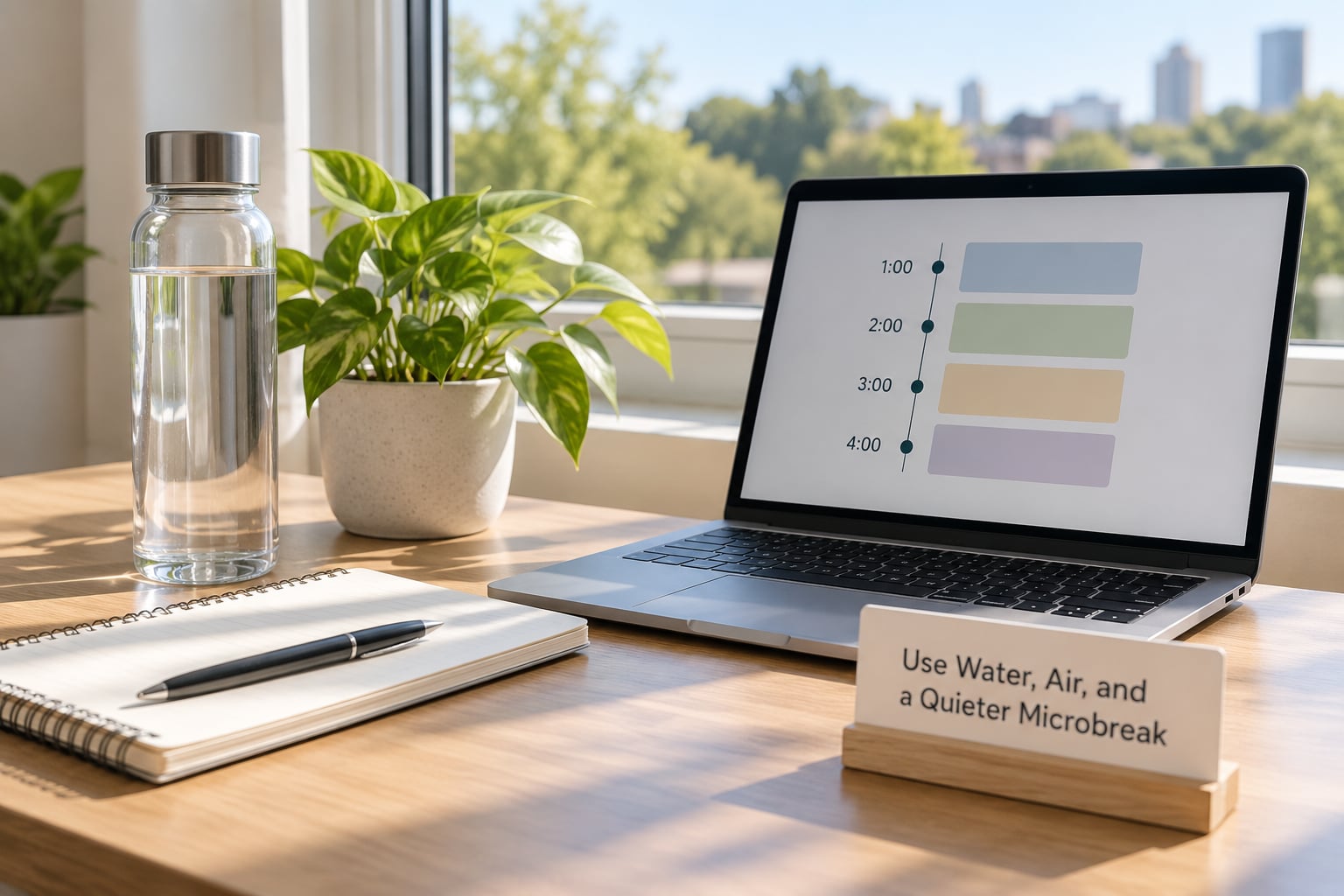
Do the smallest reset first: drink a glass of water, take five slow breaths, and look at something far away for a few seconds. Each part matters. Water addresses the mild dehydration that is easily mistaken for tiredness. Slow breathing lowers the physical arousal of a screen-heavy morning. Looking away from a near screen relaxes the focusing muscles of the eye, which is where a lot of late-morning headache comes from.
The water part surprises people. On r/WeightLossAdvice, members report that the afternoon snack craving is often thirst wearing a disguise, and that a glass of water removes the urge to reach for something sweet. Spreading fluid across the day matters more than the total; most health guidance puts the working range for adults at roughly 2 to 3 litres a day from food and drink, adjusted upward in heat and during activity.
Keep the break off your screen. On r/WFH, the recurring advice is that walking, gardening or reading anything that is not a display breaks the slump, while scrolling tends to extend it. Sixty seconds of looking at a phone is not a break; it is a different kind of screen work.
How to tell it worked: the next 15 minutes feel slightly sharper and you stop rereading the same line. If nothing changes after a few days of genuinely drinking enough water, treat hydration as ruled out and look further up the list. If the tiredness persists despite adequate sleep, regular meals, movement and fluids, that is a conversation for a clinician rather than another afternoon habit.
The last three steps are small and mostly about protecting the morning:
- Fix your wake time, not just your bedtime. A consistent wake time, including at weekends, does more for afternoon energy than an early night you cannot repeat. Most adults need seven to nine hours.
- Cap and time your caffeine. Mainstream guidance puts the limit for most healthy adults at under 400 mg of caffeine a day from all sources. Front-load it in the morning and stop by early afternoon, so you are not borrowing energy against a withdrawal later.
- Stop working through lunch. Eating at the keyboard keeps the digestive and attention systems competing. Ten minutes away from the desk is the cheapest fix on this list, and the one most often skipped by the busiest people who need it most.
Common Mistakes
Almost every failed attempt at beating the afternoon energy crash repeats one of these. Each has a specific fix.
Mistake 1: Loading up on caffeine and then adding more at 3 p.m. Two large coffees produce a lift followed by a sharper drop, and the second caffeine dose at 3 p.m. sets up a withdrawal later the same evening. Fix it by keeping total intake under about 400 mg a day, having most of it before noon, and stopping early in the afternoon. If you want a warm drink instead, unsweetened tea works for plenty of people and carries far less caffeine.
Mistake 2: Treating the crash with sugar. A sweet snack spikes blood glucose quickly and drops it again, which is exactly the shape of the slump you are trying to remove. Energy drinks do the same with a stimulant added. Fix it by having a snack that pairs protein with slow-release carbohydrate, such as nuts with fruit or yoghurt with oats, and by drinking a glass of water before you decide you are hungry.
Mistake 3: Believing your blood leaves your brain for your stomach. It does not, and the myth makes people avoid the real explanation. What actually happens is postprandial somnolence: after a meal, the body shifts toward the parasympathetic system, which is the branch associated with rest and digestion, and attention narrows. A large refined-carbohydrate meal makes it worse by driving the blood glucose curve up and down. Fix it by understanding that the goal is a moderate meal plus a short walk, not a smaller personality.
Mistake 4: Working through lunch at your desk. You get the calories and none of the reset. Fix it by eating away from the screen for ten minutes, then walking. This is the cheapest change on the list and one of the few that works the same day.
Mistake 5: Calling a scrolling break a break. Twenty minutes of news and social feeds keeps the eyes and the attention system under load, which is where the fatigue came from. Fix it by choosing a break that involves a different sense: walking, water, a stretch, a view out of a window, or a quiet conversation.
Mistake 6: Scheduling your hardest work at 2:30. Fix it by moving the demanding block before lunch. If you cannot move it, shorten it and put the easy administrative work between the hard pieces instead of after them.
Mistake 7: Treating sleep as fixed rather than as a variable. A short night, a late bedtime or a broken night is the most common reason every other fix underperforms. Fix it by protecting the wake time first, and by treating persistent sleep problems as a medical matter rather than a discipline problem.
Mistake 8: Waiting for a routine to fix a medical cause. Habits help with a normal circadian dip. They do not treat anaemia, an underactive thyroid, sleep apnoea, a vitamin D or B12 deficiency, or depression. If the fatigue is there on weekends, on holiday, after a full night of sleep, and getting worse over months, book an appointment.
Frequently Asked Questions
What is the best way to avoid the afternoon slump at work?
Move your hardest work before lunch, eat a moderate lunch with 20 to 30 g of protein, drink water steadily through the afternoon, and take a five to ten minute walk away from your screen around 3 p.m. Add 10 to 20 minutes of daylight earlier in the day to anchor your sleep signal. Do the four main steps daily for two to three weeks before changing anything else, so you know which one helps you.
Does a short walk really help with afternoon fatigue?
Yes, and it is one of the few fixes that works the same day. A five to ten minute walk breaks long sitting, gets blood moving out of the legs and gives your eyes a change of focus. Choose a route that is safe where you work, wear footwear with grip, and go slowly. If you feel worse rather than better, you moved too hard, not too little.
Should I drink coffee to get through the afternoon?
Use caffeine early and sparingly rather than as an afternoon rescue. Mainstream guidance puts the limit for most healthy adults at under 400 mg a day from all sources, including tea and energy drinks. A second dose at 3 p.m. often produces a lift followed by a sharper drop and makes the evening harder. Stopping caffeine earlier is usually a bigger win than adding another cup.
Can dehydration cause an afternoon slump?
It can contribute, and it is easy to miss because mild dehydration feels like ordinary tiredness. Aim for steady fluid across the day rather than a large amount at once, and drink a glass of water whenever an afternoon snack craving appears, since thirst is often mistaken for hunger. Most guidance puts working intake for adults at roughly 2 to 3 litres a day from food and drink, more in heat or during activity.
What should I do if I feel tired every afternoon?
Work through the routine above for two to three weeks and keep a short note of sleep, lunch and caffeine. If the tiredness shows up on weekends, after a full night of sleep, and keeps worsening, or if you also notice snoring, breathlessness, weight change or low mood, book an appointment with a doctor. Conditions such as anaemia, thyroid problems, sleep apnoea and vitamin deficiencies need testing, not habit changes.
How can employers support employees with afternoon fatigue?
Protect the lunch break in policy and in practice, and stop scheduling it as a default meeting. Move recurring decision meetings to the late morning, offer somewhere quiet to rest, keep water easy to reach, and allow walking breaks without requiring an explanation. If shift patterns are rotating, give people notice of changes and a quiet space for the first days of a new rotation.
Conclusion
Do one thing this week: note the exact time your energy usually drops, put a ten-minute walk and a glass of water in the calendar just before it, and move your hardest task to the morning. Run that for two weeks before you judge it, since the afternoon slump is partly biological and honest routines manage it rather than remove it.
If the fatigue is severe, persistent, present on days off or getting worse, speak to a doctor. A pharmacist can also help with caffeine intake and with any over-the-counter products you are considering.