

Solvent exposure health effects at work range from burning eyes and a headache after an afternoon with paint stripper to lasting damage to the nervous system, liver and kidneys after years of daily vapour exposure. The solvent itself is rarely the whole story: what really decides the damage is how much vapour you breathe, for how long, and whether anyone ever measured it.
That last part is where most workplaces fall short. Solvents are used in printing, painting, metal degreasing, dry cleaning, ship repair, laboratory histology, chemical manufacturing and ordinary cleaning, and in most of those jobs nobody records the air concentration the worker actually inhales. This guide walks through what exposure looks like, which solvents cause the most concern, the health effects by body system, how limits work, and what employers and workers can do about it.
Nothing here is medical advice. If you think you have been exposed and you feel unwell, get out of the exposure first, then talk to a doctor or an occupational health clinic.
Table of Contents
- What Is Solvent Exposure at Work?
- Which Workplace Solvents Cause the Most Concern?
- What Are the Health Effects of Solvent Exposure?
- How Much Solvent Exposure Is Too Much?
- How Can Employers Reduce Solvent Exposure at Work?
- What Should Workers Do If They Suspect Solvent Exposure?
- How Do You Tell Whether Workplace Controls Are Working?
- Frequently Asked Questions
- What are the most common signs of solvent exposure at work?
- Can workplace solvents cause long-term health problems?
- Does a strong chemical smell mean a workplace is unsafe?
- What personal protective equipment is used for solvent exposure?
- Should a worker see a doctor after a solvent spill or exposure?
- How can employers know whether solvent exposure is below the occupational limit?
- Conclusion
What Is Solvent Exposure at Work?
Solvent exposure at work happens when a worker inhales solvent vapour, gets solvent on the skin, swallows it by accident, or absorbs it through contaminated clothing. A solvent is simply a substance that dissolves another material, and the ones that matter in occupational settings are usually volatile liquids that evaporate fast into the air you breathe.
Three routes do most of the damage. Inhalation is the biggest one: vapour concentration in the air rises quickly in a poorly ventilated room, and the highest readings are usually at the source, not across the room. Skin contact comes second, because many solvents are fat-soluble and strip the natural oils out of skin while passing straight through it. Ingestion is rarer but happens more often than people think, through contaminated food, drinks, cigarettes, or hand-to-mouth transfer after handling solvent.
Routine exposure looks boring, which is exactly why it adds up. Someone opening a drum of thinner, spraying coatings in a booth that was never properly balanced, or cleaning machine parts at the end of a shift is exposed every day at a level that never triggers a single alarm. Acute events are the opposite: a spill, a tank that has to be entered, a burst seal, or a fire that sends solvent vapour across a plant. Emergency response is where confined-space fatalities with solvents come from, and it is where written procedure either works or does not.
The practical difference is that routine exposure is managed by limits and controls, while emergency exposure is managed by permits, rescue plans and getting people out. Both need to exist.
Solvent use sits inside the wider chemical management picture at any workplace, and it is worth pairing this guide with how to build a safety culture at work, because controls that nobody follows are not controls.
Which Workplace Solvents Cause the Most Concern?
The solvents that cause the most concern are the ones that are volatile, absorbed through skin, and toxic to the nervous system or a specific organ. There is no single ranked list that fits every job, so the honest answer is that concern rises with volatility, with skin notation on the limit, and with how much the substance is used.
| Solvent family | Typical workplace use | Main health concern |
|---|---|---|
| Aromatic hydrocarbons (toluene, xylene, benzene, styrene) | Paint, ink, varnish, adhesives, chemical manufacturing | Central nervous system effects, memory and concentration problems, benzene also linked to blood cancers |
| Chlorinated solvents (methylene chloride, trichloroethylene, perchloroethylene) | Metal degreasing, dry cleaning, paint stripping, solvent recycling | Nervous system, liver, kidney and lung; several are classified as possible or known carcinogens |
| Ketones (acetone, methyl ethyl ketone) | Cleaning, degreasing, coatings, adhesives | Irritation, dizziness and central nervous system depression at high vapour levels; very flammable |
| Alcohols (isopropanol, ethanol, benzyl alcohol) | Cleaning, disinfection, laboratory work | Generally lower concern at normal use levels, but vapour causes irritation and drowsiness |
| Glycol ethers (2-butoxyethanol and similar) | Cleaning products, some paints and coatings | Absorbed through skin, targets the red blood cells and the liver |
| Petroleum distillates (mineral spirits, Stoddard solvent, naphtha, turpentine) | Paint thinning, cleaning, wood finishing | Skin defatting and dermatitis, headache and nausea, flammable vapour |
| Formaldehyde and isocyanates | Pathology labs, resins, coatings, spray finishing | Respiratory sensitisation and asthma, plus nasal and eye irritation |
Two solvents deserve a specific mention. Benzene is used as a process chemical and shows up as a contaminant in solvents made from petroleum, and long-term exposure is associated with leukaemia and other blood disorders. Methylene chloride is widely used as a paint stripper and degreaser and is subject to stricter rules because of its carcinogenicity, including requirements for closed systems and respiratory protection in some settings.
OSHA, NIOSH, ACGIH, HSE and CCOHS all publish hazard information on these substances, and the safety data sheet for the exact product in your workplace is always the more specific document.
What Are the Health Effects of Solvent Exposure?
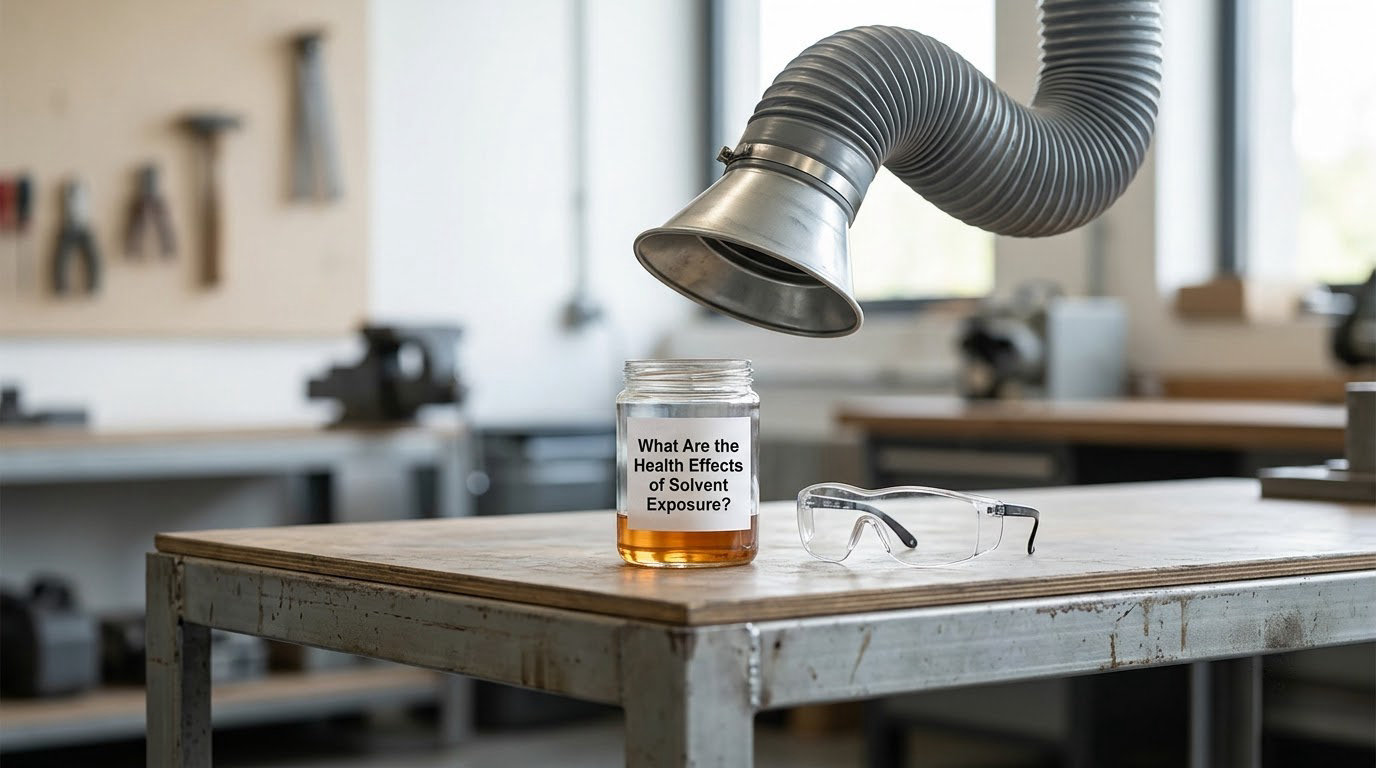
The health effects of solvent exposure split into acute effects that show up within hours and chronic effects that build over months or years. Acute symptoms include eye irritation and redness, nose and throat irritation, coughing, skin dryness and cracking, headache, nausea, dizziness, lightheadedness and impaired coordination. High vapour concentrations can cause unconsciousness and, in an enclosed space, death.
Chronic effects show up in the nervous system first for many workers: memory complaints, difficulty concentrating, fatigue, mood and personality change, and in some cases movement problems resembling Parkinson disease. Liver and kidney injury, chronic respiratory disease, peripheral neuropathy, and hearing loss in combination with noise are also documented. Some solvents are reproductive or developmental toxins, and several chlorinated solvents and benzene are classified as carcinogens.
| Symptom | Body system | Typical time to onset | What to do |
|---|---|---|---|
| Burning or watering eyes, nose and throat irritation | Eyes and upper airway | Minutes to hours | Get to fresh air, note the time, report it |
| Headache, dizziness, lightheadedness, nausea | Nervous system | Within an hour or two | Leave the area, do not drive yourself if impaired |
| Dry, cracked, itchy skin or rash | Skin | Same shift to days | Remove contaminated clothing, wash, seek medical advice if it spreads |
| Poor coordination or confusion | Nervous system | At higher vapour levels | Emergency response, urgent medical evaluation |
| Memory problems, fatigue, mood change | Nervous system | Months to years of exposure | Occupational health referral, exposure review |
| Breathlessness or persistent cough | Lungs | Hours to years | Medical evaluation, remove from exposure |
| Jaundice, dark urine, swelling | Liver and kidney | Months to years | Urgent medical evaluation, report and investigate the exposure |
Research backs the neurological picture. Kaukiainen and colleagues found significant associations between cumulative long-term solvent exposure and memory and cognitive complaints among construction painters, and work by Gerhardsson and colleagues reported increased multiple sclerosis risk in people with occupational organic solvent exposure. Loukzadeh and colleagues looked at the interaction between solvent mixtures and noise, with organic solvent exposure linked to greater risk of noise-induced hearing loss.
One point worth repeating: effects can lag. Someone can feel fine on Friday and wake up on Sunday with a headache and nausea, which makes it hard for both the worker and the supervisor to connect cause and effect. If the same symptoms keep following the same shift, that pattern is itself evidence.
How Much Solvent Exposure Is Too Much?
There is no universal safe number, because limits differ by solvent, by country and by the agency that sets them. In the United States, OSHA sets legally enforceable permissible exposure limits as 8-hour time-weighted averages, NIOSH publishes recommended exposure limits that are often more protective, and ACGIH publishes threshold limit values including short-term exposure limits and ceiling values. In the UK and EU the framework runs through COSHH assessment and workplace exposure limits. A skin notation attached to a limit is a warning that dermal absorption contributes to the total dose, which air monitoring alone will not capture.
Air monitoring tells you what is in the breathing zone, usually with personal or area samples, and biological monitoring measures a metabolite or the compound itself in blood or urine to estimate what a person actually absorbed. Neither is useful without a comparison point: without a measured concentration and a limit for that specific solvent, an employer cannot say whether the exposure was acceptable.
Whichever numbers you work with, the pattern matters as much as the reading. A worker who is under the limit all shift but over it for ten minutes during a spray booth clean may still be the one who ends up in the medical records.
How Can Employers Reduce Solvent Exposure at Work?
Employers reduce exposure using the hierarchy of controls, in order, because personal protective equipment is the least reliable layer in the stack. Substitution comes first, then engineering controls, then work practices, then PPE.
- Substitute. Replace the solvent with a water-based or low-VOC alternative where the job allows it, and choose products with fewer hazardous constituents from an approved list.
- Control at the source. Use closed systems, transfer by pump rather than pouring, keep container sizes small, and cover containers as soon as material is dispensed.
- Ventilate properly. Local exhaust ventilation at the point of use beats general dilution ventilation for almost every solvent task, and it needs checking rather than assuming.
- Fix work practices. Prohibit eating, drinking, smoking, vaping and applying cosmetics in solvent areas, keep food and drink containers out of work zones, and use hand-washing stations at the exit rather than solvent to clean skin.
- Handle waste properly. Put solvent-contaminated rags in closed, labelled metal containers that are emptied daily. Sealed and emptied daily, contaminated rags generate vapour all day and have caused many fires.
- Train and supervise. Cover labels, safety data sheets, cartridge selection, respirator fit testing and spill response, then check that the training happened.
- Provide the right PPE. Chemical-resistant gloves chosen for the specific solvent, splash goggles, a face shield for pouring, and a respirator with an organic vapour cartridge where air monitoring shows it is needed and fit tested.
- Offer medical surveillance. Where exposure is frequent and neurological or hepatic effects are plausible, a baseline and periodic assessment through an occupational medicine provider.
- Prepare for emergencies. Written spill and evacuation procedures, eyewash and emergency showers, and a rescue plan that never depends on entering a contaminated space unprotected.
Launder contaminated clothing rather than taking it home, and treat clothing that has been wetted with solvent as a fire risk rather than laundry.
None of this holds together as a written programme unless it is documented, which is the job that how to write a workplace health and safety policy covers.
What Should Workers Do If They Suspect Solvent Exposure?
If a worker suspects solvent exposure, move to fresh air first, then work through the rest in order. The steps below matter most in the first hour.
- Get out of the exposure area and into fresh air immediately. Do not wait to feel worse to decide.
- Stop the source only if it is safe to do so and you are trained for it. Nobody becomes a hero shutting a valve in a confined space.
- Remove contaminated clothing and footwear, and wash exposed skin thoroughly with soap and water. Wash or discard clothing that soaked up solvent.
- Rinse eyes with clean water for at least 15 minutes if they are irritated, and remove contact lenses if you can do so easily.
- Have someone fetch the safety data sheet for the product. It carries first aid guidance and the correct antidote or treatment note for a doctor.
- Get medical evaluation, especially with breathing difficulty, confusion, fainting, vomiting that will not settle, chest pain, or symptoms that persist beyond 24 hours. Take the SDS with you.
- Write down what happened while it is fresh: product, task, time, how long, what you were wearing, what you smelled, what you felt.
- Report it through your workplace procedure and ask for the incident to be recorded. If it is a confirmed occupational exposure or illness, it may need to appear on the employer injury and illness log.
Do not wait for the paperwork before seeking care. If symptoms are severe, call emergency services.
Workers also have enforceable rights around this. In the US, the Hazard Communication Standard at 29 CFR 1910.1200 gives employees the right to access safety data sheets and to be told what hazards are present, and shipyard work has its own solvent standard at 29 CFR 1915.32. If harm occurs, workers’ compensation is usually the first route rather than a lawsuit, and only a lawyer can advise on the specific case.
How Do You Tell Whether Workplace Controls Are Working?
You tell whether workplace controls are working by looking for measured and repeated evidence, not by asking whether people think the room feels better. A control that cannot be measured will quietly stop working within a year.
| Indicator | What it tells you | What good looks like |
|---|---|---|
| Air monitoring results | Actual concentration in the breathing zone | Below the applicable limit for every solvent measured, with short-term peaks also checked |
| Exposure assessment review | Whether the written assessment matches the current process | Updated when a solvent, process or ventilation unit changes |
| Ventilation inspection | Whether LEV still captures vapour | Airflow measured and recorded on a schedule, filters changed on time |
| Respirator fit testing records | Whether PPE actually seals | Every respirator user fit tested annually and after face changes |
| Reported symptoms and near misses | Whether the early warnings are reaching management | Trends tracked, not dismissed; repeated headaches on one shift trigger a review |
| Contaminated rag and waste practice | Whether work practices hold | Closed labelled containers, emptied daily, no solvent-soaked clothing in lockers |
Two habits catch most problems early. Walk the site and look for open containers, drums in walkways, and vapour you can smell at the boundary of the work area, because smell is a crude but sensitive indicator that something is escaping. Then review the incident and symptom log quarterly and confirm that corrective actions were actually closed out.
Where an assessment overlaps with other hazards, the same approach applies as in how to prevent electrical hazards at work: identify, control, verify.
Frequently Asked Questions
What are the most common signs of solvent exposure at work?
The most common signs are burning or watery eyes, nose and throat irritation, headache, nausea, dizziness and lightheadedness, and dry or cracked skin. Higher vapour levels add cough, poor coordination and confusion. Symptoms usually appear during or shortly after the shift, and repeated symptoms on the same task are a reason to request an exposure assessment.
Can workplace solvents cause long-term health problems?
Yes. Years of solvent exposure has been linked to memory and concentration problems, mood and personality change, peripheral neuropathy, liver and kidney effects, and some movement disorders. Research has also associated occupational organic solvent exposure with increased multiple sclerosis risk. Symptoms may appear long after exposure has stopped, which is why monitoring and recordkeeping matter.
Does a strong chemical smell mean a workplace is unsafe?
Not by itself. Smell detects some vapours at levels far below those that harm you, and it fades quickly, so a person who no longer notices the smell may still be in an exposure zone. Treat a strong solvent smell as a prompt to check ventilation and containment, and to run air monitoring rather than as proof either way about worker safety.
What personal protective equipment is used for solvent exposure?
Common items include chemical-resistant gloves chosen for the specific solvent, splash goggles, a face shield for pouring or splash risk, and a coverall or apron. Respiratory protection uses an organic vapour cartridge or supplied air, and any tight-fitting respirator requires annual fit testing. PPE is the last line of defence, so it never replaces substitution, enclosure or local exhaust ventilation.
Should a worker see a doctor after a solvent spill or exposure?
Get medical advice if you had breathing difficulty, confusion, fainting, chest pain, persistent vomiting, a rash, or any symptoms lasting beyond 24 hours. Take the product’s safety data sheet with you, since it tells the clinician what the substance was and how it is treated. Do not delay care while sorting out paperwork, and record the incident so it appears in workplace records.
How can employers know whether solvent exposure is below the occupational limit?
Only by measurement against the correct limit for that solvent. Personal or area air monitoring gives the concentration in the breathing zone, which is compared with the OSHA permissible exposure limit, the NIOSH recommended limit or the ACGIH threshold limit value. Biological monitoring measures what a worker actually absorbed. Limits differ by substance and country, so the applicable one has to be identified first.
Conclusion
Start by identifying what is actually in use. Get the safety data sheet for each solvent on site, find the exposure limit that applies in your country, and compare it with a real air monitoring result rather than with how the room feels.
Then close the gap between the two, starting with substitution and ventilation, and treat contaminated rags, clothing and habits as exposure sources in their own right. If someone on your team feels unwell after a shift, treat it as a real signal, get them to fresh air and to a clinician, and write it down while the details are still clear.