
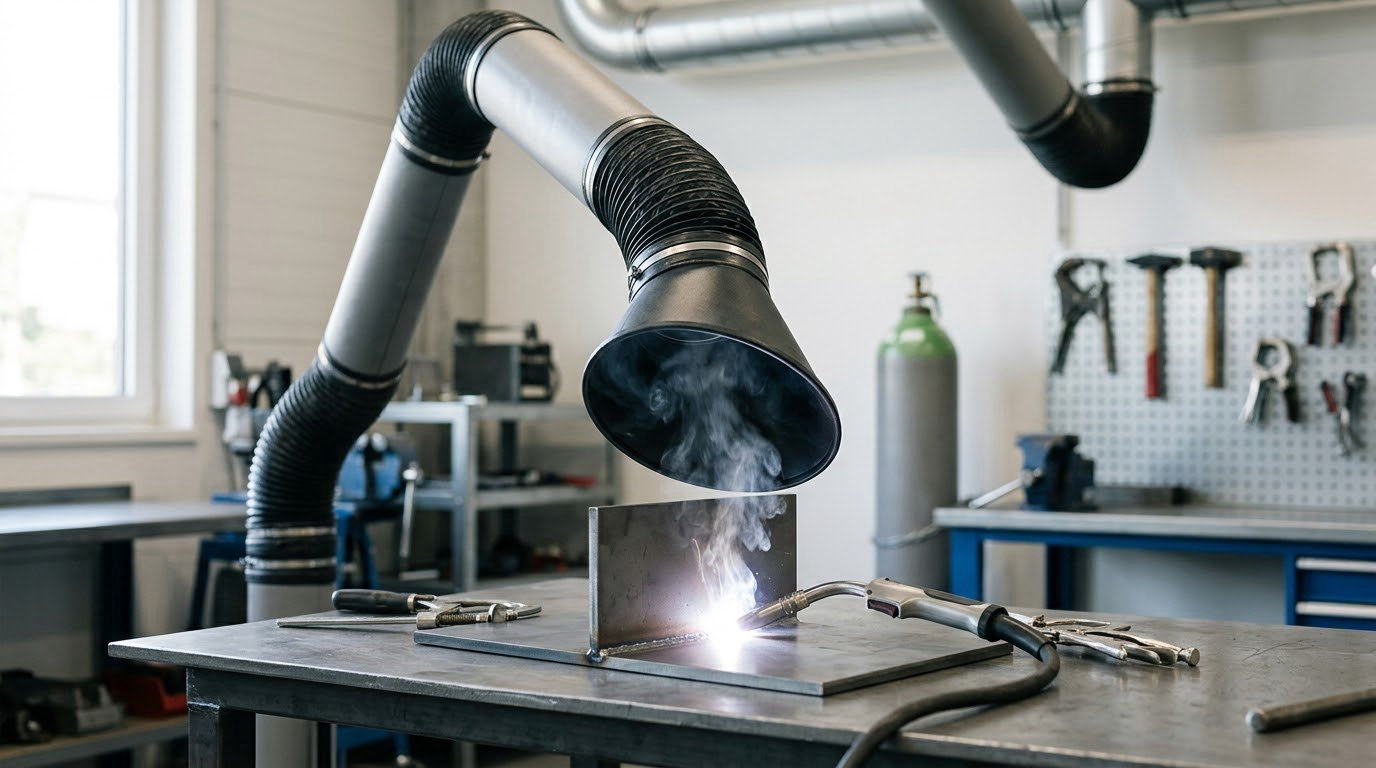
Effective welding fume exposure control comes down to one idea: capture the fume at the arc before it reaches anyone’s breathing zone, then manage whatever remains with work practices and respiratory protection. Welding fume is fine metal oxide particles suspended in air together with gases such as carbon dioxide and ozone, produced when the arc vaporises base metal, filler metal, and flux or electrode coating. A working setup takes a few days of assessment, installation, and training in most shops, provided somebody owns the checks that keep it working.
The order matters more than the equipment. Controls applied at the source remove the hazard before it reaches anyone. Controls applied at the person, such as a respirator, deal with a plume that has already spread through the bay.
Table of Contents
- What You Need for Welding Fume Exposure Control
- Step-by-Step: Reduce and Verify Welding Fume Exposures
- Step 1: Identify the Fume Sources and Materials
- Step 2: Assess Exposure by Task and Location
- Step 3: Control at the Source
- Step 4: Capture Fumes with Local Exhaust Ventilation
- Step 5: Control Work Practices and Worker Movement
- Step 6: Use Respiratory Protection as a Supplement
- Step 7: Verify the Controls and Keep Them Effective
- What Welding Fume Exposure Limits Apply?
- Common Mistakes
- Frequently Asked Questions
- Where to Start This Week
What You Need for Welding Fume Exposure Control
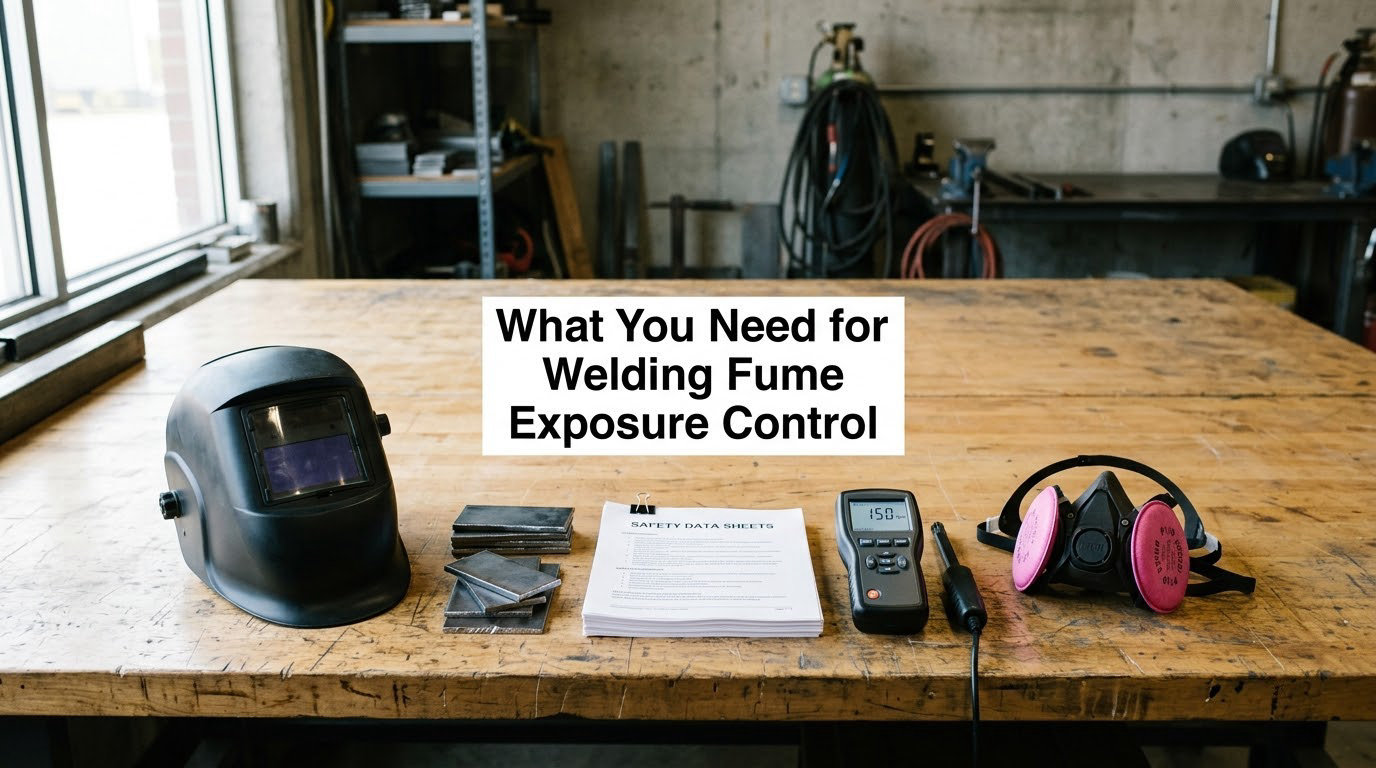
You need three things before touching any equipment: a clear inventory of what gets welded, a written assessment of the tasks people actually perform, and someone qualified to design or sign off the extraction. Everything else is downstream of those three.
- Process and consumable information. Welding procedure specifications, filler metal and electrode data sheets, and safety data sheets for any flux, shielding gas, or coating involved.
- A materials hazard list. Plain carbon steel, stainless or other chromium-bearing alloys, galvanised coating, cadmium-bearing alloys, and lead-bearing materials each carry a different fume constituent.
- A task-based exposure assessment. Exposure follows the task, not the job title, so welding, grinding, cutting, brazing, and fume extraction work all need separate treatment.
- Local exhaust equipment. A hood or extraction arm sized for the arc, a duct and filtration or filtration unit, a discharge location, and confirmation that the system runs before and during welding.
- Respiratory protection where it is genuinely required. The selection, medical evaluation, and fit testing have to be arranged in advance, not on the morning of a stubborn job.
- Monitoring capability. Either in-house industrial hygiene support or a contract hygienist who can take personal samples and interpret them against the limits that apply in your jurisdiction.
- Trained people. Welders, a supervisor who positions hoods properly, and anyone who inspects the system.
Two of these decide most outcomes: an accurate materials list and a hood positioned within capture distance of the arc. Get those right and the rest is maintenance discipline.
Step-by-Step: Reduce and Verify Welding Fume Exposures
Step 1: Identify the Fume Sources and Materials
Start by writing down every process in the area, what is being welded, and what else is happening nearby. Shielded metal arc welding and flux-cored arc welding produce smoke containing particles of various metal oxides, so the consumable matters as much as the base metal. Coatings, degreasers, and nearby cutting or heating operations add their own plume to the picture.
Records to review: work orders, welding procedure specifications, consumable data sheets, and the coating or plating specifications on incoming material. How you know it worked: every weld in the area traces to a listed process and material combination, with no unlabelled coated stock.
Step 2: Assess Exposure by Task and Location
Sample the tasks, not the room. Personal sampling during welding, grinding, cutting, brazing, and fume extraction gives a different answer each time, and the worst task is rarely the one management assumed. Factors that push readings up include long durations, high duty cycle, small work rooms, cross-drafts, and other workers standing in the plume path.
Include anyone standing nearby. A fitter holding a part, a grinder working two metres away, and an inspector walking through the bay can all breathe more than the welder does on a well-ventilated day.
Records to review: the baseline survey and the sampling method used. How you know it worked: you have a named task, location, and person for each measurement rather than a single shop-wide figure.
Step 3: Control at the Source
Elimination and substitution come before ventilation. Where the joint allows it, moving to a process that generates less fume is the strongest control available. Submerged arc welding produces almost no smoke because the granular flux layer hides the arc, which makes it a practical substitution for long, repetitive seams on suitable plate.
Automating a repetitive weld removes both the fume and the person standing in it. Consumables can sometimes be swapped for a lower-fume classification, and welded assemblies can be ordered pre-fabricated so the shop does no welding at all.
Substitution is only worth doing if the replacement is technically suitable for the joint, the service conditions, and the applicable code. Changing to an incompatible consumable trades a health hazard for a structural one, which is not a control. Confirm compatibility with the welding engineer before you change anything.
Step 4: Capture Fumes with Local Exhaust Ventilation
Local exhaust ventilation captures welding fume at the point of generation, before it mixes with room air. That single distinction separates an extraction system from general ventilation, and it is why a booth with a filter unit handles welding far better than an open bay with extra fans.
Capture works only if the hood sits close to the arc, aligned with the plume, and sized so the air is drawn in rather than around the edges. Duct design, filtration, and discharge location all matter, since a duct that is too small or too long loses velocity and the capture range shrinks with it. Discharge should not simply vent back into the same bay or into a neighbouring work area.
Cross-drafts are the most common reason a working system stops working. Open doors, fans pointed across the bay, and air movement outdoors all push the plume away from the hood. Note that gas metal arc welding is already problematic in areas of high air movement because the shielding gas needs a stable shroud, so a draft spoils the process and the control at the same time.
Records to review: the manufacturer’s airflow figures, the commissioning measurements, and any later modifications to ducting or the room layout. How you know it worked: an airflow indicator shows adequate capture while welding, not only at the hood, and nothing in the area is exhausting back into the breathing zone.
Step 5: Control Work Practices and Worker Movement
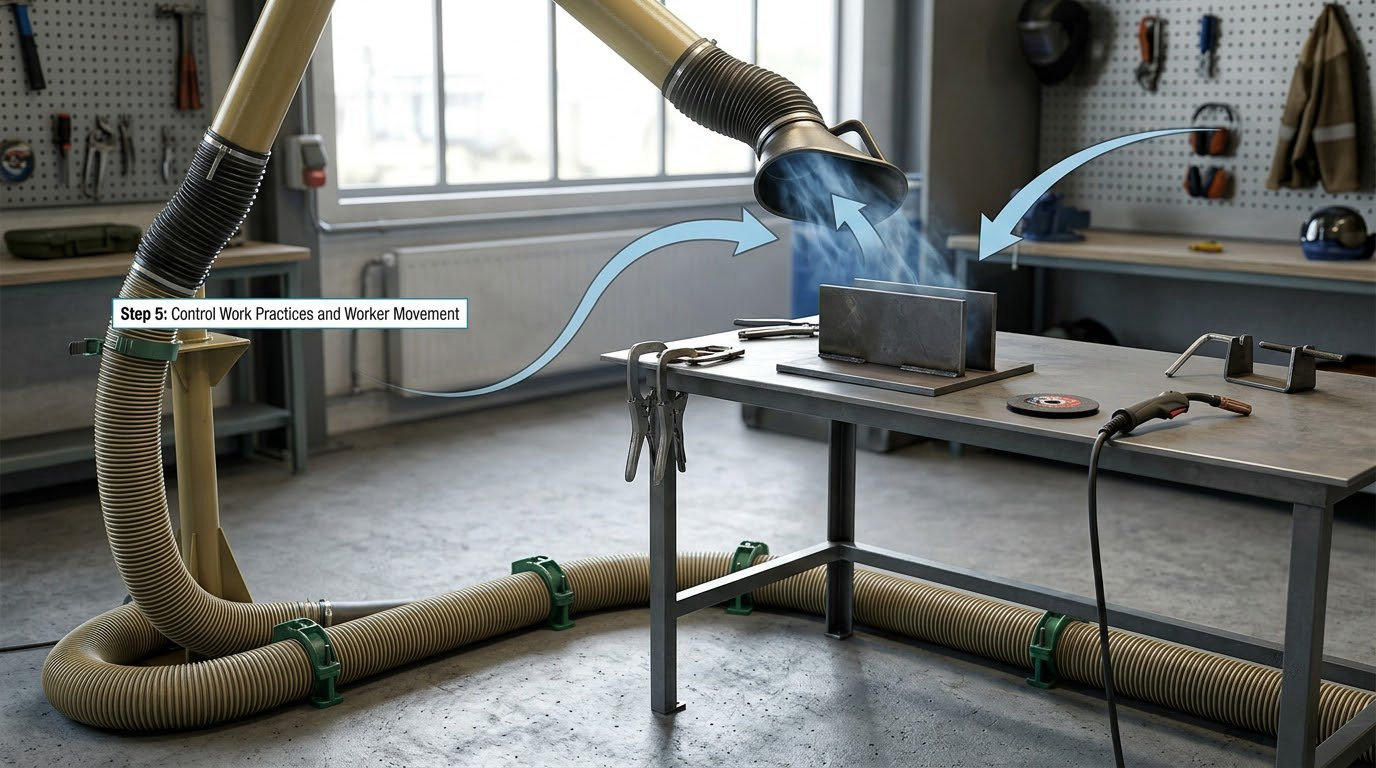
Fume control degrades quietly through daily habits. Limit hot work to the hours and areas that need it, keep unnecessary people out of the area while welding, sequence cutting and grinding away from welding where you can, and keep doors and general ventilation set so they assist rather than fight the extraction. Hoses and cables get walked over or bent until the duct leaks, and hoods get propped up rather than held in position.
Storage matters too. Keep lead and coated materials dry, covered, and separated so that handling them does not contaminate everything a welder touches afterwards. Tasks that generate fume without any welding present, such as grinding, still need their own control and their own place in the assessment.
Good housekeeping programs and exposure-response protocols follow a similar logic to the infection control basics for the workplace, where the same principle applies: the exposure is handled at the source rather than left to the person at the end of the chain.
Records to review: hot work permits, task sequencing rules, and the last competent-person inspection. How you know it worked: hoods are found in position when you walk the floor unannounced, not propped aside.
Step 6: Use Respiratory Protection as a Supplement
Respirators are the last line of defence, not the first. They belong in the plan for short-term high-exposure tasks, enclosed or confined space welding, situations where extraction cannot reach the arc, and any residual exposure the assessment shows is still present after engineering controls are in place.
Running a compliant programme takes more than issuing masks. You need a written procedure, medical evaluation before use, fit testing for tight-fitting respirators, selection by a qualified programme administrator, training, and storage conditions that keep the facepiece serviceable. Change filters and cartridges on a schedule set by the exposure conditions and the manufacturer’s guidance, not when they look dirty, and throw away disposable respirators once damaged or contaminated.
Where a welder has suffered an eye or skin injury, a contaminated burn, or a significant inhalation event, follow the incident reporting route your site already uses. Workplace injury and exposure response is covered in our guide on what to do after an exposure incident.
Step 7: Verify the Controls and Keep Them Effective
An extraction system that was commissioned correctly can still be defeated within a year. Make verification a scheduled task rather than something noticed when the room smells.
- Inspect hoses, hoods, and ducts for damage, kinks, and separation at joints.
- Check airflow indicators before welding starts and again mid-job, with the arm in its working position.
- Compare current readings against the commissioning baseline and investigate any drop rather than assuming it is normal wear.
- Check filter condition and change intervals against actual use, not against a calendar.
- Repeat personal sampling after any significant change in process, material, layout, or extraction equipment.
Keep a short record for each job or area: who inspected it, the airflow reading, what was repaired, and which tasks were sampled and when. If you cannot show what the exposure was, what control applied, and what verified it, you cannot show the control worked. Where exposure limits or medical surveillance decisions are in question, a competent industrial hygienist is the right person to involve rather than an assumption.
What Welding Fume Exposure Limits Apply?
The limits that apply are the ones published for your jurisdiction, and they are not the same document in every country. In the United States, OSHA sets legally enforceable permissible exposure limits, NIOSH publishes recommended exposure limits used when no enforceable limit applies, and state-plan states may enforce something different again. Elsewhere, UK workplace exposure limits, EU indicative limit values, and ACGIH threshold limit values all appear in practice documents, and they are not interchangeable.
So do not work from a number copied out of an article, including this one. Look up the current published value for the specific constituent, such as iron oxide fume, manganese, zinc oxide fume, or hexavalent chromium, in the source that governs your workplace, and note the date you checked. If several constituents matter, the assessment usually needs the industrial hygienist who can apply the mixture rule correctly.
Comparisons between systems are useful for context but dangerous as compliance statements. Where an enforceable limit does not exist for a constituent, a recommended limit may still be the sensible control benchmark.
Common Mistakes
These seven errors account for most ineffective welding fume exposure control I see in audits and shop walk-arounds. Each has a straightforward fix.
- Relying on respirators alone. A respirator protects one person at a time and does nothing for the fitter two metres away. Fix: capture at source first, then add respiratory protection for the residual exposure you can demonstrate.
- Positioning the hood too far from the arc. Capture range falls as distance rises, so a hood set back across the bench captures little. Fix: set capture distance from the manufacturer’s data and check it with the hood in the position the welder actually uses.
- Allowing cross-drafts. Doors propped open, extraction exhausting into the bay, and fans aimed across the work all disperse the plume. Fix: check the airflow pattern, seal or redirect competing flows, and stop exhausting into occupied space.
- Evaluating one workstation. A single satisfactory reading hides the worst task in the area. Fix: sample each distinct task and location, and include bystanders.
- Assuming the filter is suitable. A unit fine for general dust may not address the fume constituents present. Fix: match the filtration or filter unit to the assessment, and verify fit and condition rather than trusting the label.
- Running extraction only while the arc is lit. Fume continues to rise as hot metal cools and slag is handled. Fix: keep extraction running through clean-up and grinding in the same area.
- Neglecting maintenance and training. Worn filters, leaking ducts, and untrained positioning quietly undo a good design. Fix: schedule competent-person inspection, record it, and retrain whenever the setup changes.
Frequently Asked Questions
What is the best ventilation for welding fume control?
Local exhaust ventilation that captures the plume at the arc, before it mixes with room air, is the most effective ventilation for welding. A fixed hood or movable extraction arm placed within the manufacturer’s stated capture distance, supported by a correctly sized duct and suitable filtration, beats general or dilution ventilation in almost every workshop. General ventilation may be adequate as background support or for low-generation processes, but it is not a substitute for capture at source.
Can welding masks replace local exhaust ventilation?
No. A respirator protects the wearer while it is worn and does nothing for anyone nearby who is breathing the same air. Local exhaust ventilation removes the fume for the welder, the fitter, and anyone else in the bay at the same time. Use respiratory protection as the final layer for residual exposure, short-duration high-exposure tasks, and confined space work, on top of engineering controls rather than instead of them.
How often should workplaces monitor welding fume exposure?
Take a baseline survey before controls are finalised, then repeat personal sampling whenever the process, material, layout, or extraction equipment changes significantly, and periodically to confirm the controls still hold. There is no universal interval that fits every shop, because duty cycle, materials, and task mix differ so much. Record each result with its date, the task sampled, and the person sampled so trends are visible to an auditor.
What should an employer do if extraction airflow is low?
Treat it as a control failure, not a nuisance. Stop relying on that system until it is fixed, check the obvious causes first, including kinked or damaged ducting, a blocked or saturated filter, a hood left out of position, or a competing cross-draft. Then have the airflow restored and confirmed at the hood, re-sample if the task has changed, and investigate why it was not caught earlier. Record the fault and the repair.
When should welding workers seek medical advice after a fume exposure?
Seek advice after any unusually heavy fume event, symptoms such as cough, chest tightness, wheezing, or fever that develop hours later, or after an eye or skin injury involving fume or hot metal. Metal fume fever can appear the evening after an exposure and is often mistaken for a cold or flu. Report the event at work as well, because a repeated or severe exposure is a signal that the fume control plan is not working and the task should be reassessed.
Where to Start This Week
If you do one thing, list every process and material in the area. You cannot control a fume you have not identified, and that list drives everything else. Then get a hood within capture distance of the arc for the task with the heaviest duty cycle, watch where the plume actually goes, and sample it rather than guessing.
After that, put the checks on a schedule and give someone the authority to stop work when the extraction is not performing. Welding fume exposure control holds up over years when it is owned by a named person and verified on a schedule, and fails within months when it depends on whoever is nearest the bay remembering.