
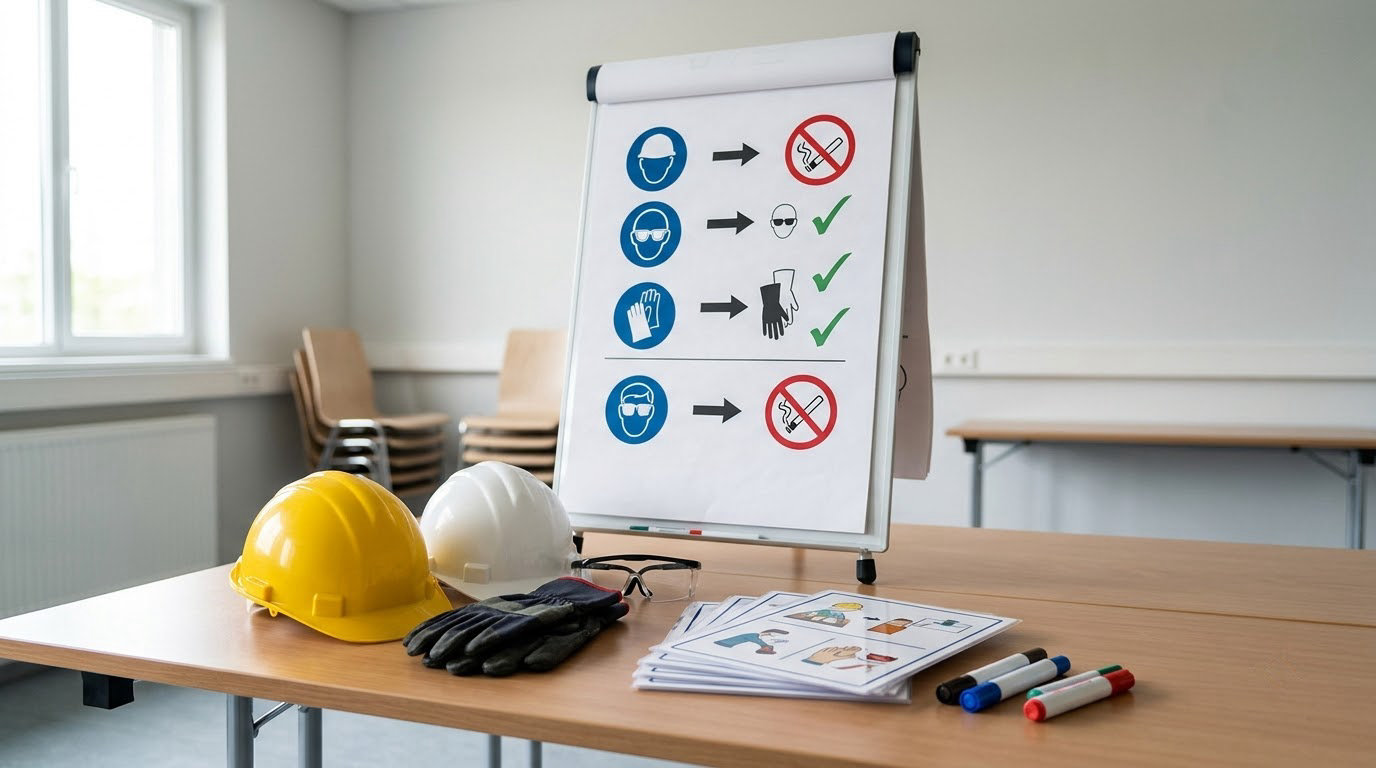
The fastest way to train non-English speaking workers on safety is to stop treating the language problem as a translation problem. OSHA requires that training be given in a manner workers actually understand, so the real deliverable is comprehension, demonstrated, not a signed attendance sheet. Build the program around plain language, hands-on demonstration, and teach-back checks, and record what each worker proved they could do.
The legal floor is short enough to quote. 29 CFR 1926.21(b)(2) says employers shall instruct each employee in the recognition and avoidance of unsafe conditions, and that instructions shall be in a language and vocabulary which an employee receiving the instruction is capable of understanding. 29 CFR 1910.7(b) uses similar language, and 1910.7(c) is where the certification record lives.
Nobody on this topic is trying to be difficult about it. The training is for the job, and the job is the priority. The rest is logistics.
Table of Contents
- What You Need
- Step-by-Step: How to Train Non-English Speaking Workers on Safety
- Identify the hazards and training outcomes
- Use plain language and qualified language support
- Show the task with pictures, objects, and demonstration
- Let workers practice the procedure safely
- Check understanding with teach-back and observation
- Practice emergency actions and incident reporting
- Document completion and schedule refreshers
- Common Mistakes When Training Non-English Speaking Workers
- Frequently Asked Questions
- What are the OSHA requirements for non-English speaking workers?
- Do I have to provide OSHA training in Spanish?
- How do I verify a worker actually understood the safety training?
- What safety training is not mandated by OSHA?
- Can an employer require employees to speak English at work?
- How often should safety training be repeated and records kept?
What You Need
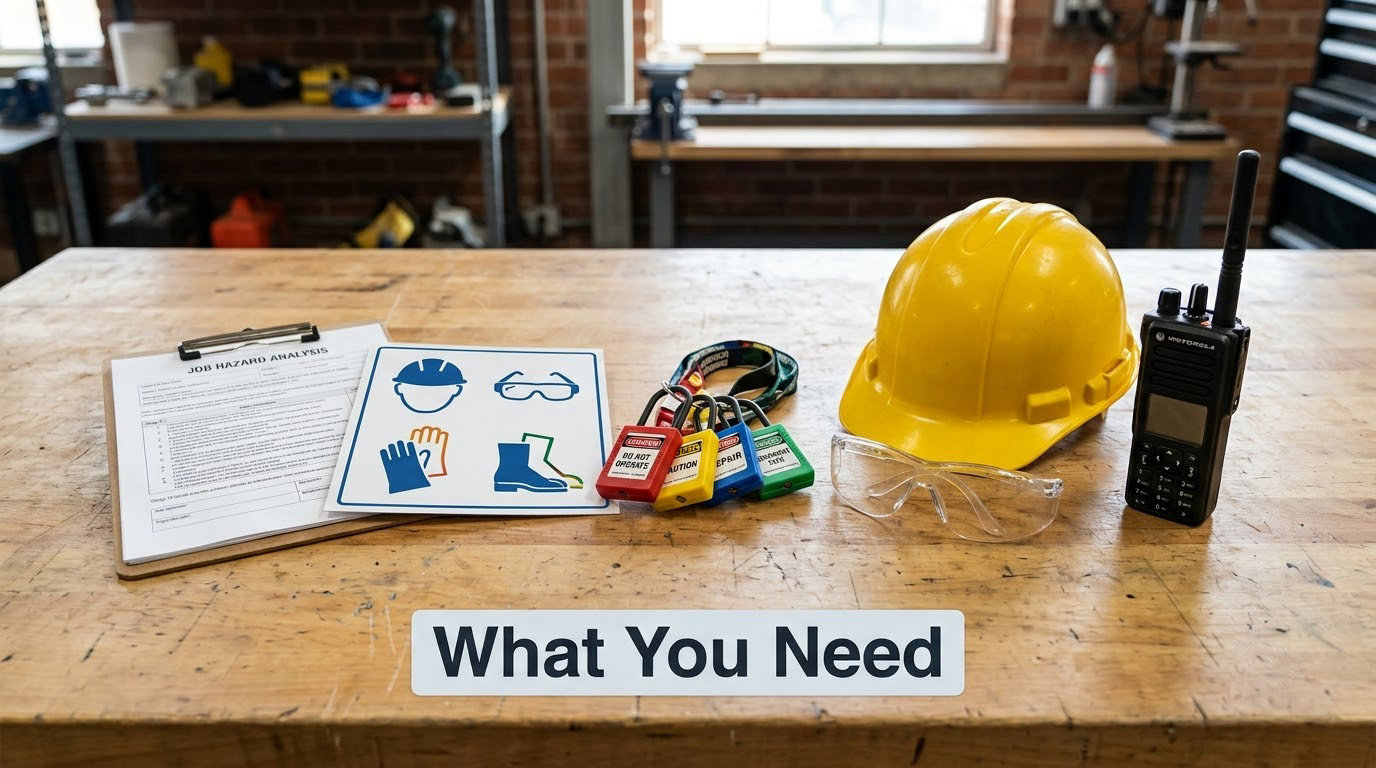
Assemble the language resources first, because they take the longest to arrange. You need a qualified interpreter or bilingual trainer for each language your workforce actually speaks, and a professional translator for the written materials that have to exist permanently, including your standard operating procedures, safety data sheets, and the emergency procedures.
Next, get the substance pinned down. That means a list of the tasks, equipment, chemicals, and emergency procedures each worker must master, and the specific hazards attached to each one. If you already run a job hazard analysis, this is the same document seen from the training side.
The physical materials matter more than most people expect. Bring the actual valve, the actual lockout device, the actual respirator cartridge, the actual connector. Workers who handle the real object on day one recognize it instantly on day fifty.
Then set up the verification side before you need it: an attendance and competency log, the trainer verification script from the fifth step below, and a spot for translated SOPs that live at the machine rather than in a binder in an office.
Match the delivery format to the worker situation
| Worker situation | Delivery format that works | Why |
|---|---|---|
| Reads fluently in Spanish, Haitian Creole, or Vietnamese | Translated written materials plus a narrated explanation in that language | They can take reference material away and revisit it |
| Limited reading in any language | Live demonstration, pictogram cards, narrated video with no subtitles | Decoding text is the barrier, not the language itself |
| New arrival, first 30 days | Task-based training on one procedure, repeated on shift | Confidence comes from finishing a task, not from a session |
| Contractor rotating between sites | Standardized onboarding delivered by your trainer, not the client’s | Every site teaches something slightly different otherwise |
| Low-literacy worker who cannot read the primary language | Verbal teach-back with peer buddy, no written quiz | A written test measures reading, not safety knowledge |
Step-by-Step: How to Train Non-English Speaking Workers on Safety
Identify the hazards and training outcomes
Start by separating critical actions from general safety information. Workers do not need every OSHA standard explained to them, and trying to cover everything is how training turns into background noise. They do need to master the handful of actions that prevent injury on their specific task.
Write those actions as verbs a supervisor can observe: isolate the energy source before opening the panel, verify zero energy with a meter, wear the respirator for a chemical with this letter on the label. Vague outcomes like understand the hazard cannot be observed and cannot be verified later.
Use plain language and qualified language support
Plain language is not dumbing down. It means one idea per sentence, present tense, active voice, and no idioms. Say disconnect the breaker before you remove the panel cover, never make sure the power is properly de-energized prior to accessing the interior.
Use a qualified interpreter for the live session rather than a bilingual coworker asked on the spot. A coworker can be excellent and still not know the technical term. A qualified interpreter is trained to carry the content accurately, and the OSHA Outreach Training Program itself requires that interpreters be competent in both the subject matter and the target language.
Resist two temptations. Machine translation mangles safety vocabulary in ways that read as correct and mean nothing in practice, and live interpretation during the session slows everything down and distracts the group. Translate the permanent documents in advance, bring the interpreter to the delivery.
Show the task with pictures, objects, and demonstration
Demonstration carries more weight than explanation for a large share of adult learners, and it removes the translation layer entirely. Perform the task slowly, narrate each step in plain language through the interpreter, and hand the object around so everyone handles it.
Pictograms and color-coded signage work well alongside the demonstration, especially on lockout devices, chemical containers, and electrical panels. Keep the standard operating procedure at the point of use as a laminated card with checkmarks and X marks for do and do not, which is far more usable than a three-page SOP in a supervisor’s office.
Video is useful when the task is hard to stage. Narrate it in the target language rather than subtitling an English narration, because reading subtitles at machine speed is a literacy test as much as a language test.
Let workers practice the procedure safely
Demonstration is not learning. Supervised practice is where the gap closes. Set up the task so failure costs nothing: a de-energized panel, an empty drum, a locked-out line with a blank tag.
Coach during the attempt rather than after it. Stop the worker at the point where a wrong move would hurt someone, correct in plain language through the interpreter, and let them finish the sequence. Most supervisors fall into the trap of taking over and doing the task themselves, which teaches the worker nothing.
Two or three repetitions under supervision usually clears a straightforward task. Anything involving energy isolation or chemical handling deserves a supervisor sign-off on each specific step, recorded individually.
Check understanding with teach-back and observation
This is where most programs fail, and it is the part nearly every safety article skips. A signature documents attendance. It does not document comprehension, and the gap between those two things is where injuries and citations live.
Nodding is not agreement. In many cultures, nodding and smiling are politeness used precisely when someone does not want to say no or admit confusion in front of a group or a supervisor. Supervisors read agreement into it because it looks like agreement, and nobody corrects them.
Use teach-back. Ask the worker to show you or explain back what they will do, then watch whether what they describe matches safe behavior. Ask open-ended questions, never isn’t that right or do you understand, which invite the polite yes you are trying to avoid.
Useful lines, delivered through the interpreter:
- Show me what you do first when you walk up to this machine.
- What do you check before you start this job?
- If the alarm sounds while you are working, where do you go and what do you do there?
- What would make you stop this job?
- Who do you call if you see a hazard you cannot fix?
A worker who cannot explain the procedure back has not been trained yet. That is not a language failure; it is a training failure, and it is fixable the same day.
Practice emergency actions and incident reporting
Run emergency procedures where they happen, not on a slide. Walk the evacuation route from the worker’s actual station to the actual assembly point, in the shift they actually work, including night shift where routes are unmarked and exits are locked.
Cover alarms and what the sound means, the assembly point, who counts heads, and the emergency contact chain. Then run it more than once, unannounced if you can manage it. One unannounced drill does more for recall than three announced ones.
Incident and near-miss reporting needs its own attention because fear suppresses it. Workers describe worrying that calling a supervisor means getting someone in trouble, so the hazard goes unreported and your own injury data quietly understates the problem. Rehearse the sentence they would say, name the person they should call, and state plainly that reporting a hazard they did not cause is never punished.
Document completion and schedule refreshers
OSHA 1910.7(c) requires a certification record for certain training, including the date, the topic, and the name of the person providing it. Build that record, then extend it with the fields that actually protect you: the language used, the interpreter or trainer name, the materials given, and the specific competencies the worker demonstrated.
Write competency statements as observed actions. Proved they can isolate and verify zero energy, then reset and re-verify, is worth far more than completed lockout tagout training on a sign-off sheet, because the first one describes what the person can do.
Set refreshers by triggers rather than by a fixed annual date: new task, new equipment, new chemical, a near miss, a return after 90 days away, or a language change. Trigger-based refreshers catch the situations a calendar misses.
Common Mistakes When Training Non-English Speaking Workers
| Trainer behavior | Why it fails | Do instead |
|---|---|---|
| Speaking louder to non-English speakers | Volume does not change comprehension and signals that the worker is at fault | Slow down, simplify, and bring in the interpreter |
| Asking closed questions like do you understand? | Produces a polite yes whether or not the worker understands | Ask for a demonstration or an explanation back |
| Handing out a translated manual and calling it training | Reading a document is not performing a task | Demonstrate, then supervise practice |
| Using a coworker as ad hoc interpreter | Technical terms get garbled and the coworker carries blame for the session | Book a qualified interpreter for the session |
| Testing in English after a localized course | Measures English ability rather than safety knowledge | Test the task in the language of delivery |
| Treating the signature as proof of comprehension | Creates a false record that helps nobody in an audit or an investigation | Record observed competencies separately |
| Scheduling sessions at the end of a long shift | Fatigue, not language, is what people remember | Move training into the shift, start with breaks |
One more mistake deserves naming: treating the non-English speaker as the problem to be fixed. Communication is a two-way system, so the burden of adaptation sits with the training program, not the worker who is learning a second language while learning a job.
If professional translation of every document is not affordable this year, prioritize instead of skipping. Translate the emergency procedures, the machine-specific SOPs, and the chemical labels first, use professional interpreters for the live sessions that matter, and revisit the rest at the next budget cycle. Doing the high-consequence items properly beats doing everything approximately.
On the question of an English-only workplace policy, treat it as a documented business-necessity decision rather than a preference, and check current guidance before you rely on it. Employment law and enforcement practice change, so verify what applies in your state and industry before writing a policy that screens out workers by language.
Frequently Asked Questions
What are the OSHA requirements for non-English speaking workers?
OSHA requires that training be provided in a manner and language the employee receiving it is capable of understanding. 29 CFR 1926.21(b)(2) and 29 CFR 1910.7(b) both state this, and 1910.7(c) sets the certification record requirements. In practice, an English-only briefing followed by a signature does not satisfy the standard when the worker did not understand the content. Verify comprehension with teach-back and observation, and record what each worker demonstrated.
Do I have to provide OSHA training in Spanish?
You have to provide training the worker can understand, which in practice may mean Spanish or another language, and often means a combination of a qualified interpreter for live sessions plus professionally translated written materials. You do not have to translate every document in a worker’s home language if you can demonstrate an equivalent method. The test is comprehension, so document what the worker proved they can do rather than which languages you published.
How do I verify a worker actually understood the safety training?
Use teach-back. Ask the worker to explain or demonstrate the procedure back in their own words, using open questions such as what do you check first. Then watch whether the explanation matches safe behavior. Avoid closed questions like do you understand, which invite a polite yes. For hands-on tasks, supervise the full sequence and record each critical step individually rather than signing the whole task off at once.
What safety training is not mandated by OSHA?
OSHA sets no general minimum number of training hours. It requires training tied to specific standards, such as hazard communication, lockout tagout, respiratory protection, fall protection, powered industrial trucks, and bloodborne pathogens, plus the training an employer certifies is necessary under the General Duty Clause. Topics such as general wellness, customer service conduct, or English-language proficiency are not OSHA requirements. Verify current requirements for your industry before building a curriculum.
Can an employer require employees to speak English at work?
Language rules are legally sensitive and fact-specific, so check current guidance before adopting one. An English-only rule is more defensible when tied to a documented business necessity and applied consistently, such as a role that must read safety-critical signage in English with no reliable translated alternative. Policies used to screen out candidates by nationality or national origin carry far greater exposure. Have counsel review the specific policy rather than copying a generic one.
How often should safety training be repeated and records kept?
Some OSHA standards set their own retraining triggers, such as changes in the process, new equipment, or a demonstrated deficiency, and require retraining at those points. Beyond those minimums, refresh on new tasks, new chemicals, near misses, and return from extended absence rather than relying on one annual date. Keep the certification record required by 1910.7(c) together with the language used, the interpreter or trainer, and the specific competencies observed.
Start with the one task on your site that would hurt someone if done wrong, teach it with the real equipment, and verify it with teach-back before the end of the shift. Build the language resources for that single task, record what the worker demonstrated, and then repeat the cycle for the next task. That sequence is the whole program, and it works for the first task on Monday.