
Sleep hygiene tips for workers work best when they fit the schedule you actually have, not an ideal one. The CDC reports that more than one-third of US adults fall short on sleep, and the CDC/NIOSH notes that shift timing and long hours make rest harder for people who work nights, evenings, or rotating rosters. Below are twelve habits that survive a real workweek, from a 5 a.m. warehouse start to a run of twelve-hour nights.
Nothing here needs a gadget or a supplement. Each one is a habit you can start on your next shift, and several cost nothing at all.
Table of Contents
- Sleep Hygiene Tips for Workers at a Glance
- 1. Set a Consistent Sleep and Wake Schedule
- 2. Build a Wind-Down Routine Before Bed
- 3. Use Morning Light to Anchor Your Body Clock
- 4. Keep Work and Sleep Spaces Separate
- 5. Manage Caffeine Without Disrupting Rest
- 6. Keep Alcohol from Undermining Sleep Quality
- 7. Make the Bedroom Dark, Quiet, and Comfortable
- 8. Plan a Short Nap Without Grogginess
- 9. Get Daylight Safely on the Night Shift
- 10. Adjust Meals and Movement Around Your Shift
- 11. Reduce Noise and Disruption During Daytime Sleep
- 12. Use Sleep Hygiene as One Part of Fatigue Safety
- Frequently Asked Questions
- Conclusion
Sleep Hygiene Tips for Workers at a Glance
| Tip | Best time to use it | Main benefit | Especially useful for |
|---|---|---|---|
| Consistent sleep and wake times | Every day, including days off | Anchors the body clock | Fixed-hours and rotating-shift workers |
| A repeatable wind-down routine | 30-60 minutes before sleep | Faster settling, fewer racing thoughts | Overtime weeks and always-on desk work |
| Morning outdoor light | Within an hour of waking | Easier mornings, better night sleep | Early starters and post-night-shift sleepers |
| Separate work and sleep spaces | End of every workday | Work stops intruding on rest | Remote, hybrid, and on-call staff |
| Caffeine timing | Stop about 6 hours before bed | Protects deep sleep | Everyone; tightest for shift workers |
| Alcohol-free evenings | Last 3 hours before bed | Fewer awakenings, more REM | Work events, hospitality, trades |
| Dark, quiet, cool bedroom | All night, every shift | Longer unbroken sleep | Night-shift and daytime sleepers |
| Short timed naps | 15-20 min before shift | Alertness without grogginess | Nights, long commutes, safety-critical roles |
| Light management on nights | Bright at work, dark on the way home | Keeps the night shift alert | Night-shift and early-morning crews |
| Meals and movement timing | Light meals early in the shift | Avoids heavy, restless sleep | Twelve-hour shifts and swing work |
| Noise control for day sleep | Whole sleep period | Fewer wakings from the street | Households with kids, pets, or traffic |
| Treating fatigue as a safety issue | Ongoing, not just at bedtime | Fewer near-misses and errors | Drivers, operators, healthcare, trades |
1. Set a Consistent Sleep and Wake Schedule
The single most useful sleep hygiene tip for workers is keeping the same wake time, day after day. Your circadian rhythm learns from repetition, and a stable wake time anchors it far more reliably than a stable bedtime.
Work gets in the way constantly, so make the range realistic. If your roster has you starting at 6 a.m. four days and 9 a.m. on the fifth, hold your wake time inside about a 60- to 90-minute band rather than pretending the schedule never changes.
On rotating rosters, keep separate sleep windows for day shifts and night shifts, and pick your transition days in advance. A night-shift worker who sleeps until noon on their first day off, then tries to sleep at 11 p.m. that night, is doing a 13-hour clock jump and will feel it for days.
The National Sleep Foundation’s consensus guidance on sleep duration adds a useful wrinkle: a longer weekend lie-in can be helpful after a genuinely short week, but it works better as a small shift than a rescue operation. Most people do best keeping the wake shift to an hour or two.
2. Build a Wind-Down Routine Before Bed
A wind-down routine is a repeatable 30- to 60-minute bridge between work mode and sleep mode. Its job is to stop your brain treating bedtime as the start of another shift.
Keep it small and boring, because small is what you will still do at 1 a.m. after a twelve-hour night. My version is: shower, dim the overhead lights, lay out tomorrow’s clothes, and write tomorrow’s three tasks on paper so they are out of your head.
Screens get the brightness down and the content off. Work chat on your phone at bedtime leaves a trail of half-finished problems that follow you into the pillow. If you must check messages, do it at the start of the wind-down, not the end.
3. Use Morning Light to Anchor Your Body Clock
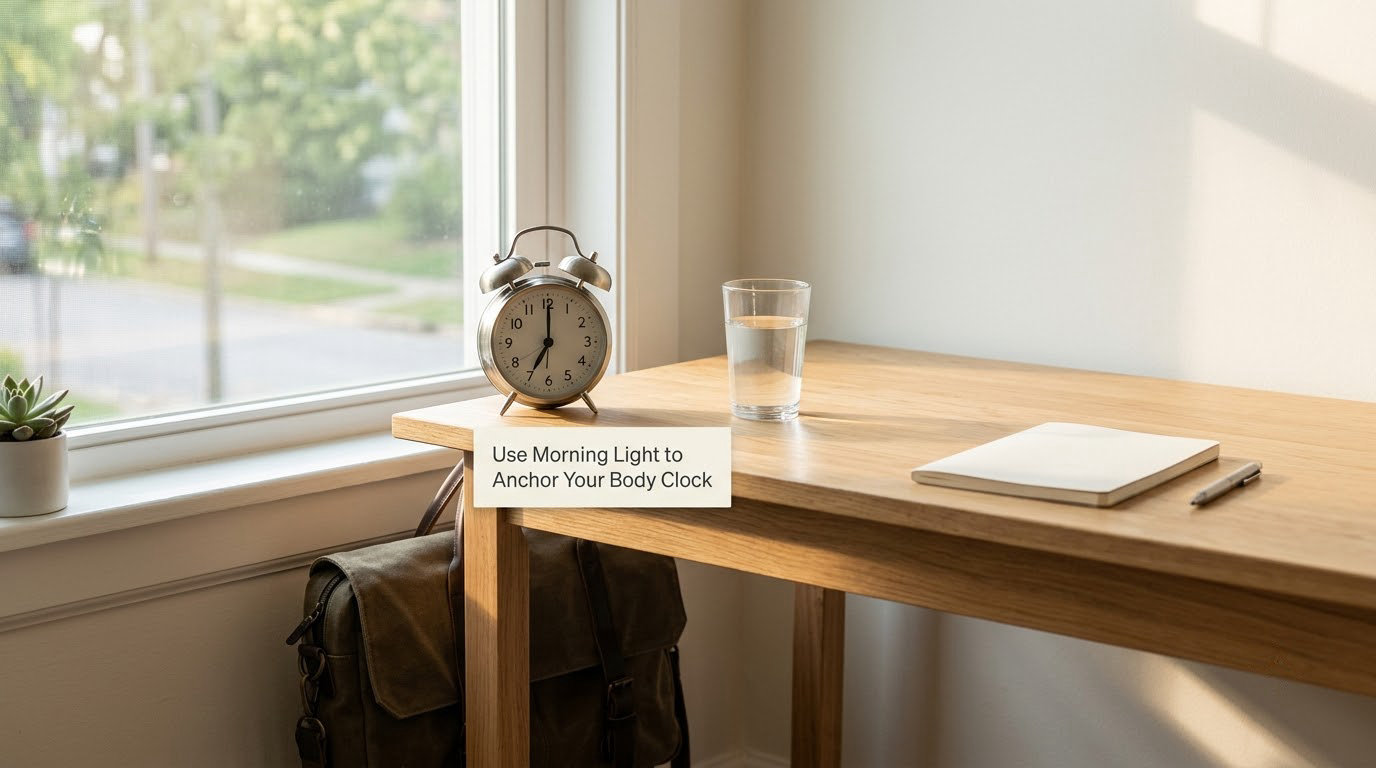
Outdoor light soon after waking is the strongest signal your body gets about what time of day it is. Ten to twenty minutes helps set your clock so that being awake feels easier in the morning and sleep arrives more easily at night.
A practical version that fits a commute: step outside for a short walk either before you leave or right after you get home, rather than sitting in the car in the queue. If you work nights, the rule inverts. Your “morning” is the evening before sleep, so your light exposure belongs early in the shift and your darkness belongs near your pillow.
Two constraints worth naming. In winter, when the sun is low and the sky is grey, outdoor light is still far brighter than any indoor bulb, so it is still the better option. And if you drive before you can get outside, keep the walk for the other end of the trip.
4. Keep Work and Sleep Spaces Separate
Your brain learns from context. A bed that has been used for video calls, emails, and lunch becomes a bed for worry. This matters more in 2026 than it used to, because so much work now happens in rooms that were once only for sleeping.
For remote and hybrid staff, set one rule: work happens at a desk, in an office, or in another room. The laptop closes at the end of the shift and goes back in a drawer. For overnight and on-call rotations, put the phone on charge somewhere you cannot see it, on silent with vibration only, so a wake-up call does not start with you already sitting up in bed.
Finish loose ends before you stop. A five-minute list of what is still open means fewer 2 a.m. moments when your brain hands you an unfinished task.
5. Manage Caffeine Without Disrupting Rest
Caffeine is the most reliable alertness tool workers have, and it is also the most common saboteur of deep sleep. Caffeine has a half-life of roughly five to six hours, so half the caffeine from a 4 p.m. coffee is still in your system at 9 or 10 p.m.
Most workplace caffeine arrives off the radar: the 8 a.m. desk cup refilled at 11, the energy drink at 3 p.m., the pre-shift double shot at 5 p.m. before a 7 p.m. start. A reasonable rule of thumb is to stop about six hours before your intended sleep, and to move earlier than that if you are sensitive or sleep lightly.
For the second half of a shift, switch to decaf, herbal tea, or sparkling water. Cutting caffeine gradually over a couple of weeks avoids the headache week that convinces people to give up.
6. Keep Alcohol from Undermining Sleep Quality
Alcohol is a downer, not a sleep aid. It may shorten the time it takes to fall asleep, but it suppresses REM sleep and pulls you awake in the second half of the night, so you wake unrefreshed after a drink or two.
The pattern is common: a drink after a workplace event, a fast sleep onset, then a 3 a.m. wake-up with nothing to do but worry. If you drink socially on work nights, front-load it earlier in the evening and give yourself an alcohol-free stretch before bed.
Swapping the last drink for a warm drink and a shower gives you the same wind-down cue without the fragmented second half. It keeps the same relaxing ritual and skips the part that wakes you at 3 a.m.
7. Make the Bedroom Dark, Quiet, and Comfortable
Your sleep environment does more work than most people expect. Darkness triggers melatonin release, so any daylight leaking in works directly against sleep onset. Sleep Health Foundation guidance for shift workers points to a room around 60-68°F (16-20°C), with blackout curtains, and Harvard Health suggests keeping it nearer 65-68°F for night sleepers.
On a budget, the high-impact items are a set of blackout curtains or a blackout blind for the window, a comfortable eye mask for gaps the curtains miss, and earplugs or a white-noise machine for early traffic and neighbours. Those three fix most of what wakes people up.
Spending more tends to go on the mattress and pillow, and that is where a real upgrade shows up if you have back or neck pain from an old, unsupported surface. Nothing else matters much if the bed itself hurts.
8. Plan a Short Nap Without Grogginess
A short nap before a night shift or a long commute is the most reliable alertness boost most workers have. The catch is length. Past roughly 20 minutes you drift into deeper sleep, and waking out of it brings sleep inertia, that heavy groggy period that can last 15 to 30 minutes and sometimes much longer.
That matters because the drive home after nights is where tired workers get hurt. Treat the first 15 to 30 minutes after waking as a no-driving window, and longer if you feel heavy.
What nap length works for alertness versus sleep debt?
For alertness, 15 to 20 minutes, and it is the most forgiving option when you have to get back to work quickly. For reducing accumulated sleep debt, a full cycle of around 90 minutes works, but you will pay a bigger sleep inertia bill at the end. UCLA Health notes that a nap of about 90 minutes before reporting for a night shift is a reasonable choice when the debt is the problem.
Put the nap 4 to 6 hours before your main sleep period, not immediately before it, or you will struggle to fall asleep afterward. And stop napping in the late afternoon if you are trying to settle for the night.
9. Get Daylight Safely on the Night Shift
Night workers need the light-dark signals reversed from everyone else’s. Bright light during the shift, especially in the first half, helps you hold alertness; darkness before sleep helps you drop off. Wearing sunglasses on the drive home after a night shift is the practical bridge between the two.
Workplace lighting controls do more for a whole crew than any personal habit. Task lighting, dimmable fixtures, and bright common areas for breaks all push the right signal to the people working there.
Some people are more sensitive to this than others, so expect a few nights of adjustment and adjust gradually rather than all at once.
10. Adjust Meals and Movement Around Your Shift
Eat your larger meal early in the shift rather than close to sleep. Cleveland Clinic guidance suggests finishing a big meal about three hours before bed, since a heavy meal close to lying down can trigger reflux and restless sleep.
For night work, treat the meal after your shift as dinner rather than a midnight snack, and keep it lighter than your usual dinner. Stay hydrated across the shift, then taper fluid in the last hour or two so you are not waking to use the bathroom.
Movement fights the slump better than another coffee. Walk for five minutes every 60 to 90 minutes through a shift, and keep hard exercise at least a few hours before your sleep period so the pre-bed hour stays calm. On day shifts, a workout in the late afternoon works; on nights, do it early in the shift.
11. Reduce Noise and Disruption During Daytime Sleep
Daytime sleep for night workers is a household negotiation. Traffic, deliveries, dog walkers, neighbours’ lawnmowers, children on school holidays, and a partner’s alarm all land in the same window you need protected.
Start with communication, because it costs nothing. Tell your household what your sleep window is. Agree a quiet period. If you share a room with someone on a different schedule, earplugs and a white-noise machine do more work than any conversation about trying to be quiet.
Then mask what you cannot control: a fan, a radio, or an app running a steady sound. If you can afford it, a pair of decent earplugs or noise-cancelling earbuds used for sleep is a genuine step up from foam plugs, which some people find uncomfortable over long sleeps.
A night-shift worker’s daytime sleep example
Consider a worker finishing at 7 a.m. They take sunglasses on the drive home, eat breakfast at 7:30 rather than dinner, shower, and are in bed by 8:15 with the blackout curtains closed, phone charging in the kitchen, and earplugs in. The street is still moving, so the white noise runs all morning. They set an alarm for 3:30 p.m. and treat anything before then as an error, not an opportunity.
12. Use Sleep Hygiene as One Part of Fatigue Safety
Sleep hygiene tips for workers matter, but they are not a cure for a bad roster. Twelve habits will not fix twelve consecutive night shifts, a two-hour commute after overtime, or untreated sleep apnea. If the schedule is the problem, the schedule needs to change, and that is a conversation for a manager or a union rep rather than a self-help article.
Know the warning signs. Microsleeps, nodding off at a red light, drifting attention during a task that once held it, irritability, and headaches are not signs you need to try harder. Treat persistent sleepiness as an occupational hazard.
Use the safety tools that exist: rest breaks, a buddy system on hazardous tasks, and honest handover notes. If you are feeling drowsy, say so rather than pushing through. Reporting fatigue is a safety control, not a performance problem.
Sleep problems that happen three or more times a week and last several weeks deserve a conversation with a clinician, and so does loud snoring, gasping in sleep, or falling asleep while sitting. The American Academy of Sleep Medicine is clear that sleep hygiene alone should not be used as a standalone treatment for chronic insomnia, where cognitive behavioural therapy for insomnia, or CBT-I, is the recommended first-line approach. Anything new here is general information, not medical advice. Talk to a doctor, pharmacist, or your occupational health provider about anything specific to your situation.
Frequently Asked Questions
How long after drinking coffee can I go to sleep?
Most guidance points to roughly six hours between your last caffeinated drink and bedtime. Caffeine has a half-life of about five to six hours, so half the caffeine from an afternoon coffee is still active late in the evening. Plenty of workers need to stop earlier than that if they are sensitive or sleep lightly. Watch out for hidden sources too, including energy drinks, cola, chocolate, and pre-workout mixes.
How can I sleep after a night shift?
Treat the hours after your shift as a full wind-down. Wear sunglasses on the drive home, eat a light meal early, run the shower, close blackout curtains, put the phone in another room, and treat the pre-sleep hour as calm and dim. Daytime sleep fights your circadian rhythm, so environmental control does more work than willpower. Keep your wake time close to the same time each day on days off so the clock does not swing wildly.
Are short naps good for night-shift workers?
Yes. A 15 to 20 minute nap a few hours before your main sleep period is one of the more reliable ways to get through a long night, and it avoids the deep-sleep grogginess that follows longer naps. Longer naps of around 90 minutes help reduce accumulated sleep debt but come with heavier sleep inertia. Whichever you choose, allow 15 to 30 minutes after waking before driving or operating anything.
When should I see a doctor about sleep problems?
Book an appointment if poor sleep happens three or more times a week for several weeks, or if it is affecting your safety, mood, or work. Do not wait if you snore loudly, gasp during sleep, fall asleep while sitting or driving, or feel sleepy within minutes of lying down. Those point to conditions a clinician can check. Sleep hygiene helps with habits, but the American Academy of Sleep Medicine notes it is not a standalone treatment for chronic insomnia.
How can employers support better worker sleep?
Start with the roster. Predictable start times, reasonable notice of shift changes, and limits on repeated back-to-back long shifts do more for worker sleep than any wellness programme. Beyond that, allow protected nap breaks on night shifts, keep break areas dark and quiet, provide bright task lighting for night work, and have a written fatigue policy covering rest breaks, reporting drowsy driving, and what happens after a double shift.
Conclusion
Pick one change that matches your actual schedule this week, and treat these sleep hygiene tips for workers as experiments rather than rules. A fixed wake time inside an hour, a darker and cooler sleep room, a caffeine cut-off six hours before bed, or a 15-minute nap before a long shift are all manageable on a bad week.
Track it for two weeks before adding the next one, since most people need a couple of weeks to see whether a change is working. And if sleepiness is interfering with your work, your mood, or your driving, bring in a healthcare professional and, where the schedule is the cause, your workplace safety contact. Fatigue is a safety matter, not a personal failing.