
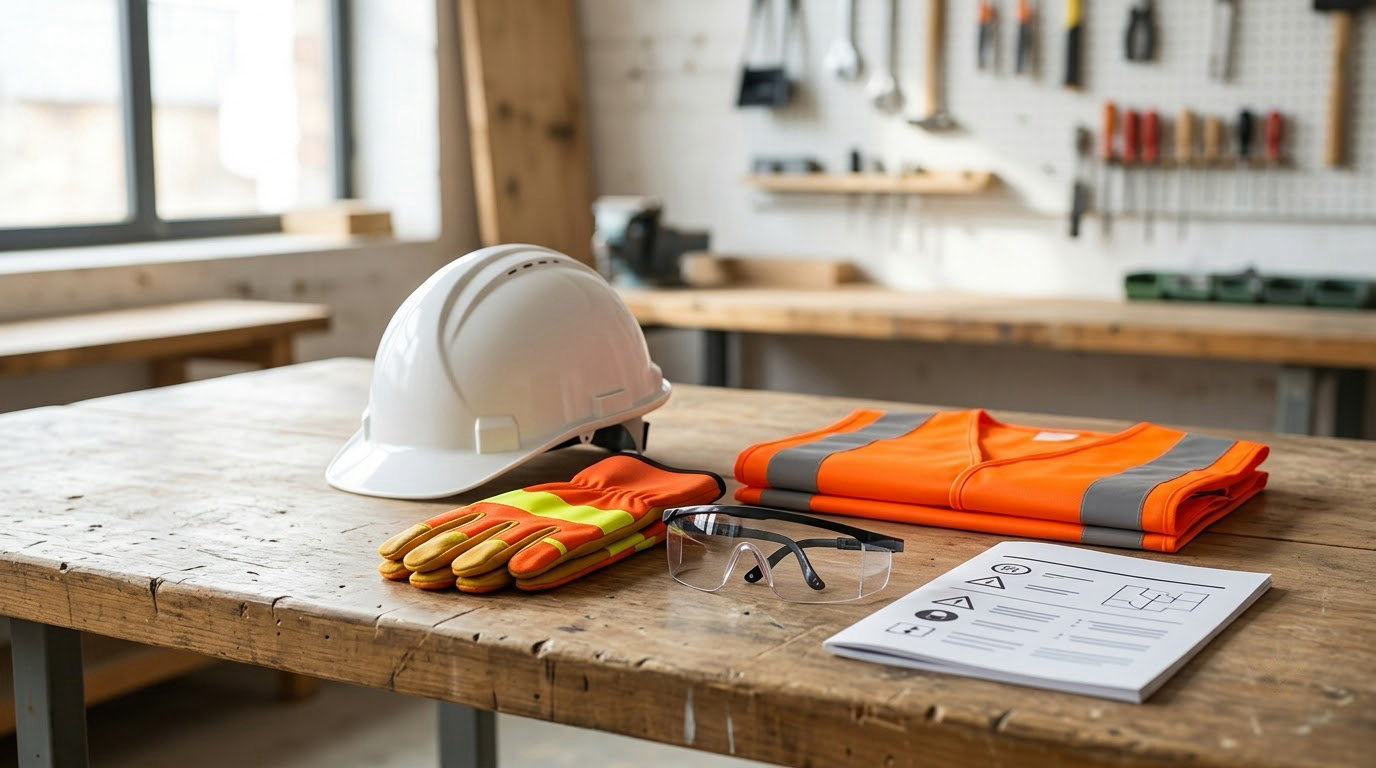
Young worker safety training tips matter because the people most likely to get hurt on a job are the newest, least experienced people doing it. Workers aged 15 to 25 are roughly twice as likely to be injured on the job as older workers, and most of those injuries land in the first year of employment when supervision and induction are at their thinnest.
This guide is written for supervisors, safety leads, restaurant and retail managers, school coordinators and small employers who hire teenagers, apprentices and holiday staff. It assumes a US setting, with a note where rules differ. Legal duties for under-18 workers come from federal law and then from state law on top, and the state layer is often the stricter one.
“Young worker” is a loose term. Most programs and injury data use 15 to 24, sometimes 15 to 25, and legal definitions of minors stop at 18. Before you design anything, decide which ages and which roles you actually cover, because a 16-year-old working a fry station and a 16-year-old working an office have almost nothing in common hazard-wise.
The ten tips below build on each other. Skipping to the PPE section without a hazard assessment is how a young worker ends up wearing eye protection that was never checked against a real task.
Table of Contents
- Young Worker Safety Training Tips at a Glance
- 1. Start With a Job-Specific Hazard Assessment
- 2. Explain Rights, Restrictions, and Stop-Work Expectations
- 3. Teach a Repeatable Hazard-Spotting Routine
- 4. Practice Tasks With Clear Safety Demonstrations
- 5. Run an Emergency Response Drill
- 6. Match PPE to Real Job Tasks
- 7. Make Near Misses and Incident Reporting Easy
- 8. Create More Than One Way to Ask for Help
- 9. Coach New Habits During the First Weeks
- 10. Test Understanding and Improve the Training
- Frequently Asked Questions
- How often should young workers receive safety training?
- What safety training do teenage employees legally need?
- How do I check whether young workers understood the training?
- Should young workers receive the same training as adult employees?
- Can safety training be completed online?
- How should employers document training for young workers?
- Start With the Highest-Risk Tasks
Young Worker Safety Training Tips at a Glance
Here is the whole plan on one page. Each row is a training action, who leads it, when it matters most, and the one piece of evidence that tells you it landed.
| Training action | Who should lead it | When it matters most | How to confirm it worked |
|---|---|---|---|
| Job-specific hazard assessment | Supervisor with safety support | Before the first shift | Written assessment listing hazards for each duty |
| Rights, restrictions and stop-work briefing | Employer or site manager | Day one, before any work starts | Worker explains back the hour and duty limits |
| Hazard-spotting routine | Supervisor or experienced peer | First week, then weekly | Trainee names three hazards during a walkaround |
| Task demonstration and supervised practice | Competent coworker or supervisor | Before first unsupervised task | Observed correct performance, not a signature |
| Emergency response drill | Site manager | Within the first month, then twice a year | Worker finds the exit and names the assembly point |
| PPE fit and inspection training | Supervisor | Day one and at every change of task | Correct donning, doffing and pre-use check |
| Near-miss and incident reporting | Supervisor | First week, reinforced monthly | At least one report filed, no retaliation |
| Multiple routes to ask for help | Employer, with a named contact | From day one onward | Worker knows a route beyond their own supervisor |
| First-weeks coaching and refresher prompts | Direct supervisor | Daily, then fortnightly | Supervisor check-ins logged with notes |
| Understanding check and program revision | Safety lead or trainer | End of induction, then after every near miss | Scenario questions passed and training updated |
1. Start With a Job-Specific Hazard Assessment
Assess the hazards of the job before you train anyone, because a slide deck about hazards in general teaches nothing. The assessment is a short document that names, for each task a young worker will actually perform, what can hurt them and what control is in place.
Work through five categories. Chemical hazards are cleaning products, degreasers, bleach, solvents, smoke and fumes. Physical hazards are noise, heat, cold, vibration, poor lighting, slippery floors and electricity. Ergonomic hazards are lifting, reaching, repetitive motion and awkward postures. Equipment hazards are unguarded machinery, sharp tools, vehicles, ladders and hot surfaces. Psychosocial hazards are bullying, harassment, aggression, isolation, fatigue and work-related stress.
What the assessment should cover
For a fry cook, the assessment might list hot oil burns, burns from the salamander, burns and cuts from the slicer, grease burns, a busy kitchen floor and verbal abuse from a stressed customer. That is a completely different list from a barista’s, and a completely different list again from a stockroom assistant driving a pallet truck.
Attach the control to each hazard. Elimination first, then substitution, engineering controls, administrative controls, and personal protective equipment last. Young workers benefit from hearing this order out loud, because a lot of workplaces hand out PPE and call the problem solved.
Record the assessment where supervisors can use it
Keep the document in the training file and post a plain-language version in the work area. Practitioners in r/SafetyProfessionals describe the same failure repeatedly: generic training that never touches the actual task, so it does not transfer to the work at all.
2. Explain Rights, Restrictions, and Stop-Work Expectations
Tell every young worker, in plain words and in writing, what they are allowed to do, what they are not, and what to do if something feels wrong. This is the part employers skip, and it is the part that protects the employee the day something goes wrong.
In the US, two federal rules matter most. The Fair Labor Standards Act child labor provisions set hour limits by age: workers aged 14 and 15 may work outside school hours with limits, and those aged 16 and 17 generally work a maximum of 8 hours a day and 40 hours a week with no overtime. The Hazardous Occupations Orders under the Occupational Safety and Health Act ban under-18 workers from a long list of jobs, including operating most power-driven hoisting equipment, using explosives, working with certain toxic substances, and entering confined spaces.
State law adds on top of that, and it is frequently stricter. Many states restrict hours further, require breaks at shorter intervals, require a work permit or employment certificate issued through the school, and set their own rules for minors in hazardous work. Check your own state labor department before you schedule anyone. Requirements differ substantially outside the US, and in Australia, Canada and the UK each has its own framework.
Finish with the stop-work rule, in writing: any worker may stop work they believe is unsafe, report it, and be protected from retaliation for doing so. Say clearly that the young worker does not have to prove the task is dangerous before stopping it.
3. Teach a Repeatable Hazard-Spotting Routine
Give trainees one short scanning routine and drill it until it is automatic. Experience builds hazard recognition, and no checklist replaces it, so the routine exists to give untrained eyes something to notice while the experience is still building.
Teach it as a fixed order, in a fixed time, at the start of every shift. The value is the repetition, not the sophistication.
A scan order trainees can actually remember
Walk the area in the same direction every time: floor, then walls and fixed equipment, then machines and tools, then chemicals, then people and exits. On the floor: spills, trip edges, stock in walkways, worn mats. On machines: missing guards, frayed cables, damaged plugs, unusual noises, leaks, hot surfaces. On chemicals: open containers, missing labels, second decanting, no safety data sheet nearby. On people: the exit routes, the fire extinguisher, the eyewash station, the first-aid kit, the emergency contact board.
Then the personal check: am I warm enough or tired enough that my attention has slipped, and is anything on me loose, unfastened or in the way.
Make the rule simple: anything unfamiliar gets reported, even if it seems fine. Nobody is expected to diagnose a fault, only to notice it and tell someone. A short walkaround with a trainee pointing at three things is a fast check that the routine stuck.
4. Practice Tasks With Clear Safety Demonstrations
Show the task, then have the trainee do it under observation and explain the hazard back to you. Demonstration plus teach-back is what actually transfers, and it is the point where most young worker safety training tips get skipped in favour of a signature on a form.
Break the job into steps small enough to see. A safe way to change a blade on a counter slicer might be: unplug, wait for the stop indicator, release the carriage, change blade with cut-resistant gloves, replace guard, plug back in, test on a scrap. That is what to demonstrate, and what to ask about.
Why generic training slides fail
A trainee who has watched a video of a warehouse cannot tell you where the emergency stop is in that warehouse. Demonstrations tie the training to a person, a place and a tool, which is the only version that survives contact with a busy shift.
Demonstrate the unsafe version too, deliberately and briefly. A supervisor who blocks a path with a pallet, or opens a guard to show what the guard stops, teaches recognition faster than any slide. It is worth doing in a controlled setting with a trainee, not as a stunt.
Then have the trainee talk. Ask what could go wrong at each step and what they would do if the machine misbehaved. Foremen posting in r/Construction push the same idea: OSHA-style certification helps, but it does not replace task-specific coaching on the actual job.
5. Run an Emergency Response Drill
Every young worker should know the alarm, the exits, the assembly point and who calls for help before they need it. Drill it early, keep it non-destructive, and repeat it at least twice a year.
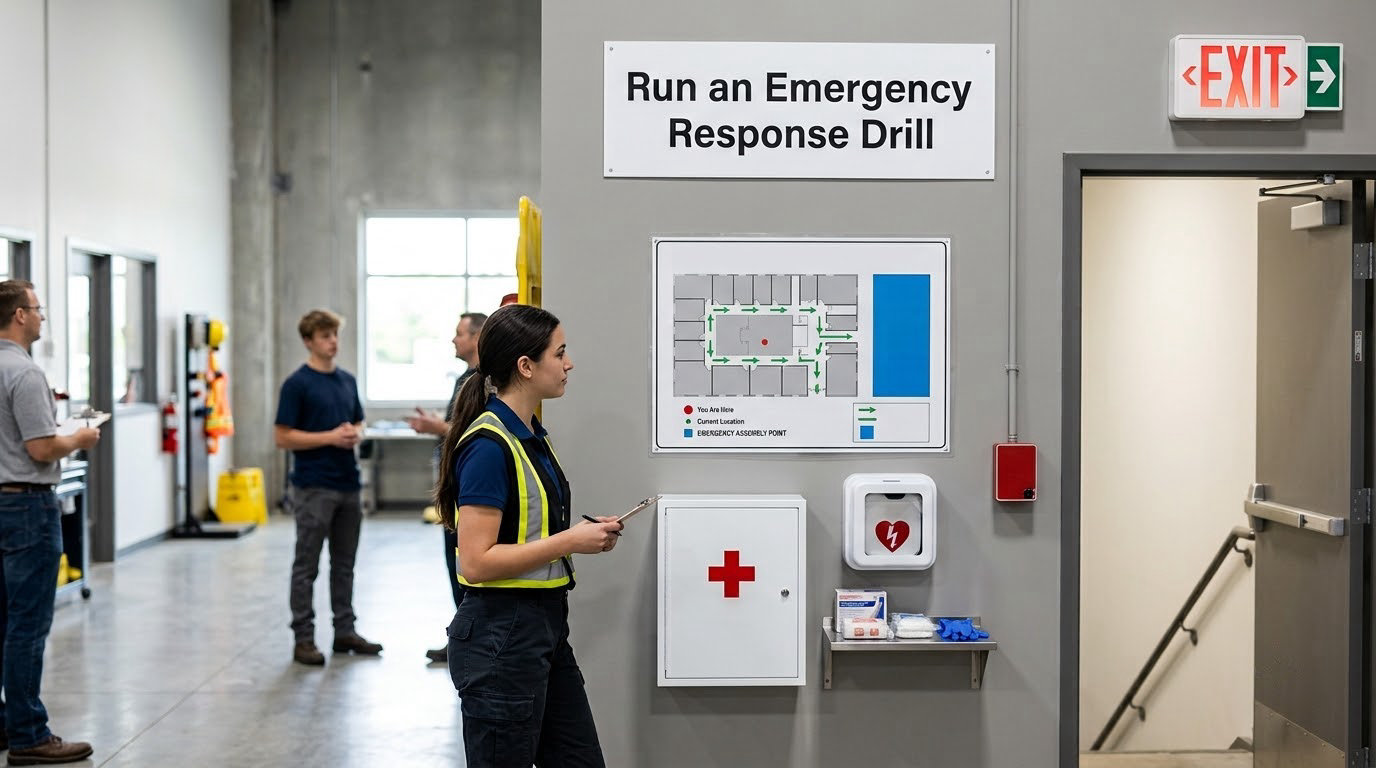
Run an evacuation drill with young workers, then walk back through the same route with them so the building is familiar both ways. Cover five things: what the alarm sounds like, the two nearest exits from wherever they usually work, where the assembly point is and who counts people, who calls emergency services and what address to give, and where the first-aid kit and eyewash are.
Role restrictions apply during a drill exactly as they apply during a real event. A young worker assigned a task that is a hazardous occupation does not perform that task during an evacuation, and nobody runs back inside for belongings. Keep drills calm and short. A drill that frightens people teaches the wrong lesson and gets taken seriously the next time.
Include psychosocial behaviour in the drill briefing. Lockdown, harassment and violence procedures count as emergency response, and a 17-year-old closing a shop alone on a Friday needs to have thought about that in advance, not in the moment.
6. Match PPE to Real Job Tasks
Personal protective equipment is the last line of the hierarchy of controls, and it only works if it fits, is used for the actual task and is worn consistently. Show young workers that ordering, and then explain what each item is actually for.
Cover four things for every item required on the job. Why it is needed, tied to a specific hazard. How to check it before use, including cracks, cuts, nicks, expiry dates and missing parts. How to put it on and take it off without contaminating yourself or touching the wrong surface. When it must be replaced, by whom and how quickly.
Fit deserves its own line. Safety glasses that slide down, gloves too large for a control, or a hearing defender that sits over hair and glasses instead of sealing properly will be quietly abandoned by week three. Employers are the ones who have to fix fit, and a supervisor in r/electricians makes the point that gear an electrician will not fight to wear is the only gear that survives the month.
Also separate required protection from comfort gear, so nobody mistakes a fleece or a bike helmet for protection. And be straight about the limit: PPE reduces exposure, it does not make a hazardous task safe on its own.
7. Make Near Misses and Incident Reporting Easy
Young workers stay quiet about hazards because they are afraid of losing shifts or looking inexperienced. Your reporting process has to be easier to use than silence, or silence wins.
Say plainly that nobody is disciplined for reporting a near miss, and mean it. Remove blame language from the form. A near miss is an unplanned event that did not cause injury but could have, and reporting the ten near misses that do not hurt is how you find the one that would have.
Teach the sequence after an incident: stop the work, give first aid, tell the supervisor, complete the report, preserve the equipment and scene, then follow up on the workers compensation process. Preserve matters because a discarded damaged guard or a swept-up spill destroys the only evidence of what happened.
What an incident report should contain
Keep it short and factual. What happened, where, when, who was involved, what was injured or damaged, what the immediate cause appeared to be, and what was done. Facts only, no opinions about who is to blame. Long forms produce incomplete reports; short forms get filled in.
Also make near-miss reporting a two-way loop. Give feedback on what was reported and what changed because of it. Reporting that leads to silence teaches everyone that reporting is pointless.
8. Create More Than One Way to Ask for Help
Give young workers at least two routes to raise a concern, so they are never entirely dependent on the one person they are afraid to disappoint. Psychological safety is a training topic, not a personality trait, and it can be built into the system.
Layer the routes. A direct conversation with the supervisor for small things. A named safety contact outside the direct reporting line. A written or digital form, ideally anonymous. A scheduled check-in in the first weeks where the worker is asked how the job is going, rather than whether they like it. And a clear escalation path to management, a safety committee or a health and safety representative where one exists.
Watch for the supervision gap. A 22-year-old shift lead supervising 17-year-old staff has less experience than the people directing them, and forums on small-business employers describe the supervision load as far bigger than most managers plan for. Pair young supervisors with a named experienced mentor of their own, and give that mentor authority to step in.
Train supervisors on the response they will get. When a young worker says the fryer smells wrong or a customer grabbed their wrist, the supervisor’s first job is to thank them, not to explain why it was fine. Small employers in r/smallbusiness report the same pattern: the young worker who speaks up once, and then never again.
9. Coach New Habits During the First Weeks
Safety behaviour is built by repetition under observation, not by an induction day. The first weeks need a schedule of short check-ins rather than a second long training session.
A workable rhythm: a demonstration before the first attempt, observed practice on every task in week one, a brief check-in at the end of each shift for the first week, then a weekly fifteen-minute catch-up covering one new task and one question. By week four, a two-way conversation where the worker raises concerns rather than receiving instructions.
A first-week supervision checklist
Work through this list with the trainee and their supervisor, and tick it in the training file. Each task the worker will perform has been demonstrated. Each task has been performed once under direct observation. PPE for each task has been issued and fit-checked. The worker has walked both evacuation routes. The worker knows who the safety contact is. The worker has reported at least one observation or near miss. The worker has been asked what is unclear, and the answers are logged.
Schedule the next training whenever the task, the tool, the shift pattern or the site changes. In r/SafetyProfessionals the recurring complaint is that training lands after the exposure, not before it. Putting new equipment in front of someone who was trained last quarter on different equipment is the most common avoidable failure we see.
10. Test Understanding and Improve the Training
If you do not check whether the training worked, you have delivered a document, not training. Use three checks and a revision loop, and you will find gaps in the first session.
Scenario questions work best. Put a trainee in a real situation and ask what they do: the fryer starts smoking, a delivery blocks the fire exit, a coworker asks them to reach over a running machine, a customer refuses to leave a bar at closing time. Wrong answers are the most useful data you will collect, because they show you what was not explained clearly enough.
Teach-back confirms the rest. Ask the worker to describe the machine lockout procedure to you. Observation fills the gaps: a short observed task check on a real shift, using a checklist, done by someone other than the trainer.
Then revise. Every near miss, every incident investigation, every inspection finding and every new piece of equipment or changed process should trigger a look at the training. Keep a version history of the induction pack, because after an incident the question is always when the worker was shown the current procedure.
Hand feedback to managers too. New young workers in r/smallbusiness are described as needing a lot of hand-holding, and that is a coaching plan, not a character flaw. Name it, schedule it, and write down what was covered.
Frequently Asked Questions
How often should young workers receive safety training?
Before the first shift, before any new task, and again whenever the job, equipment, site or supervisor changes. Most injuries happen early in employment, so the first few days carry the most risk. After that, keep short refresher sessions rather than occasional long ones: a brief catch-up for each new task in the first month, and a full emergency drill plus policy review at least twice a year.
What safety training do teenage employees legally need?
In the US, federal rules come from the Fair Labor Standards Act child labor provisions and the Hazardous Occupations Orders under the Occupational Safety and Health Act. Hazardous Orders restrict a fixed list of jobs for under-18 workers, and states add their own hour limits, break rules and work permit or employment certificate requirements. Many states are stricter than the federal floor. Verify the current rules for your own state before scheduling a minor.
How do I check whether young workers understood the training?
Ask, do not tell. Use scenario questions with real situations from that workplace, ask the trainee to teach the procedure back to you, and run one short observed task check on a real shift. Record the answers and the observation. If someone cannot explain what they would do in a specific situation, the training has not worked yet, whatever the sign-off sheet says.
Should young workers receive the same training as adult employees?
The same core content applies to everyone, but the delivery should not be identical. Young workers need longer supervised practice, a job-specific hazard assessment, a buddy or mentor, and repeated checks in the first weeks. A worker with less experience gets more coaching on the same material, not less material and a shorter session. Watch for young supervisors who need mentoring of their own.
Can safety training be completed online?
Online modules work well for rules, rights, hours and restrictions, hazard categories and reporting procedures, and they are easy to document. They work poorly for anything physical: donning PPE, operating equipment, spotting a real leak, evacuating a real building. Combine online theory with on-the-job demonstration and observation, and check that the young worker can act on the content before they work unsupervised.
How should employers document training for young workers?
Keep a per-worker record: the date, the trainer, the modules covered, the tasks demonstrated and observed, the competency check result, the questions the worker raised, and any refresher training with its trigger. A short sign-off with those fields is usually enough. After an incident, the record is what shows the training matched the task, so vague entries like induction completed are the weakest thing you can write.
Start With the Highest-Risk Tasks
If you only do three things this week, do these. List the duties that can hurt someone most seriously in your workplace, and check them against the Hazardous Occupations Orders and your own state rules before a young worker is assigned any of them.
Then watch one task being performed, without interrupting, and write down what a new worker would not know from your current induction pack. That short list is your training plan for the month.
Book the demonstration, the observed practice and the first emergency drill inside the first week of employment, and put the record in the file while the details are fresh. Young worker safety training tips only pay off when they arrive before the exposure, not after it.
Finally, tell the young worker one thing on day one: if something looks wrong, stop and ask. Give them a name to ask, not a policy number. Most workplace injuries are prevented by a person who felt unsure and said so, and that person has to be given permission first.