
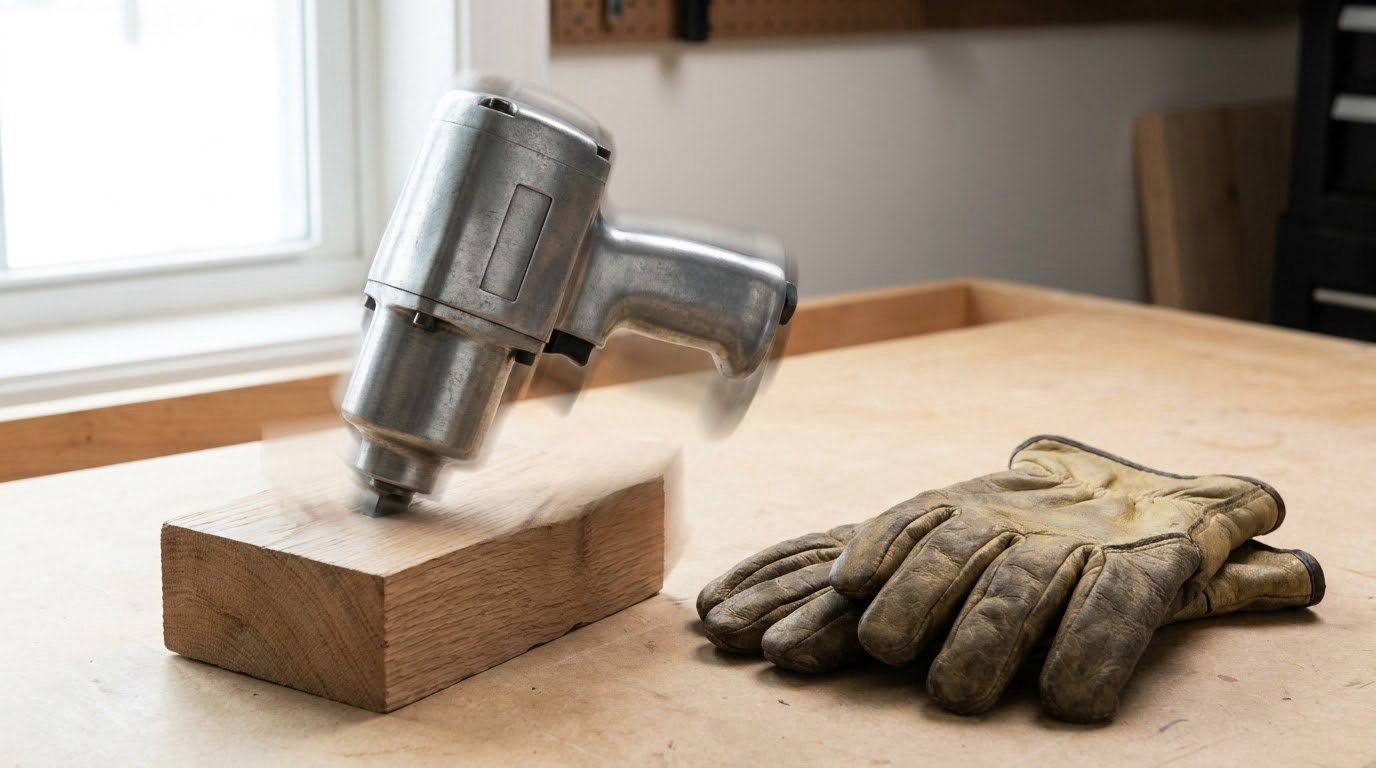
Vibration exposure from power tools happens when a chainsaw, angle grinder, jackhammer or pneumatic drill pushes mechanical energy into the hands and arms of whoever holds it. That energy accumulates across a shift into a daily dose, and enough of it, often enough, damages the nerves and small blood vessels in the fingers.
Hand-arm vibration syndrome, usually shortened to HAVS, is preventable. Once the nerve damage is established, most of it stays with the worker for life, which is why the useful conversation is not about whether vibration is dangerous but about where your exposure actually sits and what you can change this month.
Vibration exposure at a glance
- Vibration is a physical hazard, classed alongside noise and dust, and it is regulated as a chemical-agent-style exposure.
- Roughly 2.5 million US workers are estimated to be exposed to hand-arm vibration from power tools, with other estimates nearer 2 million depending on the survey year and definition used.
- The daily exposure action value is 2.5 m/s² A(8). The exposure limit value is 5 m/s² A(8).
- A tool rated at 20 m/s² reaches the action value in about eight minutes of continuous running.
- Two separate problems hide under one name: vascular damage (white finger) and neurological damage (numbness, tingling, lost dexterity).
- Tools vibrate more as bearings wear and handles loosen, so a five-year-old fleet can be worse than the datasheet suggests.
Table of Contents
- What Is Vibration Exposure From Power Tools?
- What Health Effects Can Vibration Cause?
- How Is Vibration Exposure Measured?
- Which Power Tools Create the Most Risk?
- How Can Employers Reduce Vibration Exposure?
- How Do Workers Reduce Their Own Exposure?
- How Do You Set Up a Workplace Vibration Program?
- What Should You Do If Symptoms Appear?
- Frequently Asked Questions
- What tool is most likely to cause HAVS?
- What are three early signs of HAVS?
- What are the exposure limits for vibrating tools?
- What is the most common injury caused by vibration tools?
- Is vibration considered a physical hazard?
- What type of control involves changing the way people work to reduce vibration exposure?
- Conclusion
What Is Vibration Exposure From Power Tools?
Vibration exposure from power tools is the transfer of mechanical energy from a rotating or impacting machine into a worker’s hands, arms and shoulders, repeated for long enough to matter. The energy arrives as a shaking motion, and the body absorbs it through the palm, up the wrist and into the shoulder.
Three things decide how much harm that shaking does: how strong the vibration is, how long it lasts, and how many separate times it interrupts the working day. The same jackhammer used for twenty minutes at the start of a shift is a different exposure from the same jackhammer used in four bursts across six hours.
Hand-Arm Vibration vs Whole-Body Vibration
Hand-arm vibration reaches the body through the hands and is the exposure this article is about. Whole-body vibration reaches the body through the seat or the feet, typically in lorries, tractors, excavators and workshop platforms.
The symptoms differ, which is why mixing them up causes delays. Hand-arm exposure shows up in the fingers. Whole-body exposure tends to show up as lower back discomfort, and that symptom has many other workplace causes, so it is harder to attribute. Some roles carry both, and a driver-salesperson who also uses a breaker on callouts accumulates two separate doses.
Who Is Exposed, and How Much?
Common occupations include construction and trades, forestry and chainsaw work, road crews breaking concrete, metal fabrication and grinding, mining and quarrying, foundry and manufacturing roles, plus municipal and utility maintenance. Anyone using a handheld power tool for more than a few hours a week sits in that group.
On epidemiology, a commonly cited estimate puts the number of US workers exposed to hand-arm vibration at about 2.5 million, while a National Safety Council figure nearer 2 million also circulates. The gap is mostly definitional: whether you count anyone with any exposure or only those above a threshold, and which survey year you use. Treat both as “millions of workers,” and stop there.
Historical studies of forestry cohorts are the clearest evidence we have of the long-term picture. A chainsaw cohort studied from the mid-1970s onwards reported a substantial share of long-serving workers showing vascular changes on examination, with effects concentrated in those who worked longest. It is old evidence, but it remains the reference point for how exposure tracks to damage.
What Health Effects Can Vibration Cause?
Repeated vibration causes two distinct sets of problems in the hands and arms, and hand-arm vibration syndrome is the name for both together. The vascular component affects blood flow in the fingers. The neurological component affects the peripheral nerves that carry feeling.
The vascular form shows up as vibration-induced white finger, an occupational form of Raynaud’s phenomenon. Fingers go pale, then bluish, then red as blood returns, most often in cold weather but sometimes during emotional stress or even in warm conditions. Poor sensation makes it harder to notice small injuries, which is part of why hand problems linger.
Early, Late and Permanent Symptoms
| Stage | Neurological symptoms | Vascular symptoms |
|---|---|---|
| Early | Tingling or pins and needles in the fingertips, numbness that comes and goes | Occasional white finger episodes in cold weather, fingers recovering within minutes |
| Intermediate | Reduced tactile sensitivity, dropping small fasteners, hands feeling spongy or clumsy | White finger episodes more frequent and lasting longer, noticeable colour change in mild cold |
| Late | Persistent numbness, loss of fine motor skill, numbness spreading beyond the fingertips | Continuous white finger or blue finger that does not return to normal quickly |
| Advanced | Damage largely irreversible, loss of normal grip, work often has to change permanently | Chronic colour change in the fingers, persistent cold sensitivity year-round |
One practical note on detection: white finger is easiest to spot on lighter skin, where the colour shift is obvious. On darker skin the pallor and blue stages are much harder to see, so assessment should rely on other signs too, including colour change in the nail beds, prolonged finger blanching after a warm shower, and how quickly the fingers rewarm.
Practitioners report numbness and tingling within minutes on high-vibration tools such as jackhammers, and also report symptoms that come and go rather than staying constant, which is exactly why workers dismiss them. That pattern is normal and does not mean the exposure is safe.
This section is general information, not a diagnosis or a treatment plan. Finger colour changes, persistent numbness or joint pain need assessment from a qualified healthcare professional, and if the cause is work, ask about occupational health referral rather than treating it as a general complaint.
How Is Vibration Exposure Measured?
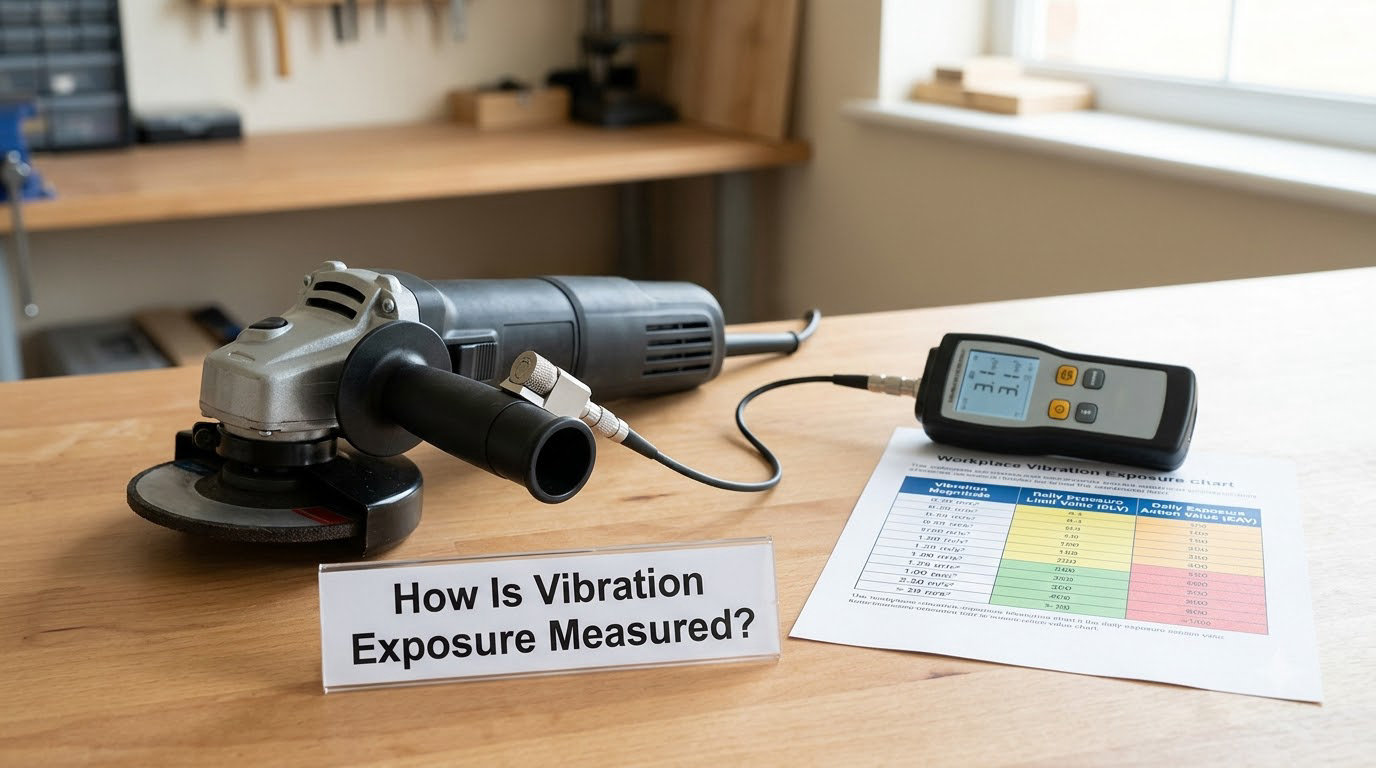
Vibration exposure is measured as frequency-weighted acceleration in metres per second squared, written m/s², and expressed as a daily figure called A(8) or the eight-hour energy-equivalent exposure value. A(8) turns however long the shift was into the equivalent of eight hours of work, which is why a short, intense morning of drilling and a long shift of light grinding can produce the same number.
Weighting matters because the frequency band that injures the finger blood vessels and nerve endings sits roughly between 5 Hz and 1500 Hz. A meter applies the weighting for you, so the number in a tool manual is already adjusted.
The Terms You Will See on a Tool Spec Sheet
| Term | What it means | Why it matters to you |
|---|---|---|
| Vibration emission value | The acceleration the tool produces when measured under standardised test conditions | This is the figure printed in the manual; it is an emission figure, not your exposure |
| A(8) daily exposure | Your eight-hour energy-equivalent dose for the day | The number to compare against 2.5 m/s² and 5 m/s² |
| Trigger time | How long you must run a tool before it reaches its declared exposure time | Short trigger times mean a tool burns through your daily allowance fast |
| Frequency weighting | The filter that emphasises the damaging frequency band | Compare like with like; unweighted figures are not comparable |
| Working hours | Hours actually running the tool, not hours on site | Most sites overstate this by counting time on standby |
What the Exposure Limits Mean
The widely used reference values are an exposure action value of 2.5 m/s² A(8) and an exposure limit value of 5 m/s² A(8). The action value is the point at which you must start doing something about it. The limit value is the level you must not exceed. Both are widely used across European and UK frameworks, where the EU directive and the standard behind it define these figures.
| Reference value | Level | What you must do |
|---|---|---|
| Exposure action value | 2.5 m/s² A(8) | Start assessing, reduce exposure and provide training and information |
| Exposure limit value | 5 m/s² A(8) | Do not allow exposure above this level under any circumstances |
| Very high example | 20 m/s² | Reaches the action value in roughly eight minutes of continuous running |
Because dose scales with the square of acceleration, time, the arithmetic is blunt. Halving the exposure time cuts the daily dose by half. But halving the vibration level cuts it by a quarter, so buying a better tool and cutting hours both help, and buying a better tool is usually the bigger win.
Reading the Vibration Exposure Figure in Your Tool Manual
Find the vibration section in the manual, often in the technical data table or the declaration of conformity. Look for a number in m/s² next to a symbol such as a= or ah, and check whether it is an emission value or an exposure value. Then find the operating time, sometimes listed alongside the vibration figure as hours per day.
If the manual lists several attachments, use the figure for the one you actually run, since discs, chisels and saw blades change the result considerably. Older machines may have no figure at all, and in that case you are estimating rather than measuring.
If you need real numbers and own no meter, a competent occupational vibration consultant can do the measurement and the assessment together. That single visit usually replaces weeks of guesswork on a site with mixed tooling.
Which Power Tools Create the Most Risk?
Tools that hit, cut, break or rotate at speed carry the highest exposure, and among those, chainsaws, jackhammers, concrete saws and road drills sit at the top. Pneumatic drills, air chisels, angle grinders, impact wrenches and bench grinders follow behind them. But the tool category alone tells you very little.
| Tool | Typical work | Where it is common | Why exposure is high |
|---|---|---|---|
| Chainsaw | Felling, pruning, cutting logs | Forestry, arboriculture, utilities | Engine runs constantly, two-stroke grip, blade and chain resistance |
| Jackhammer / road drill | Breaking concrete and tarmac | Road construction, utilities, demolition | Repeated high-magnitude impact straight into the hands |
| Concrete saw / core drill | Cutting or coring slabs | Construction, concrete specialists | Long cutting strokes at high load with a two-handed grip |
| Angle grinder | Cutting, grinding, surface prep | Metal fabrication, construction, repair | Disc wear raises vibration sharply as the tool ages |
| Pneumatic drill | Drilling and fixings on compressed air | Mechanical and electrical trades, manufacturing | Air tools lose damping as hoses and fittings wear |
| Air chisel / scaler | Chiseling and scraping | Foundries, fabrication, maintenance | Short high-intensity bursts, often used bare-handed |
| Impact wrench | Fastening large nuts and bolts | Vehicle maintenance, manufacturing | Impacts repeated over long sessions, vibration through the trigger |
| Bench or die grinder | Sharpening and finishing | Foundries, workshops | Long sessions, poor workpiece support, frequent wheel dressing |
| Angle sander / orbital sander | Surface finishing | Joinery, manufacturing | Moderate level, but long continuous runs add up |
| Nail gun / spike gun | Fixing timber and sheet | Joinery, roofing | Lower level than breakers, but very high volume of daily shots |
Three variables sit above the tool list, and they often matter more. The model matters, because a well-damped machine at the same task can be several times better than an old one. The technique matters, because pressing a drill harder increases load and vibration sharply. And the duration matters most, because a low-vibration tool used all day and a high-vibration tool used briefly can end up in the same place.
There is a further wrinkle worth knowing: lower-frequency vibration is more damaging than higher-frequency vibration at the same acceleration level. That is why impact tools that thump through the wrist and elbow tend to cause more trouble than lighter, higher-frequency tools, even when the printed numbers look modest.
How Can Employers Reduce Vibration Exposure?
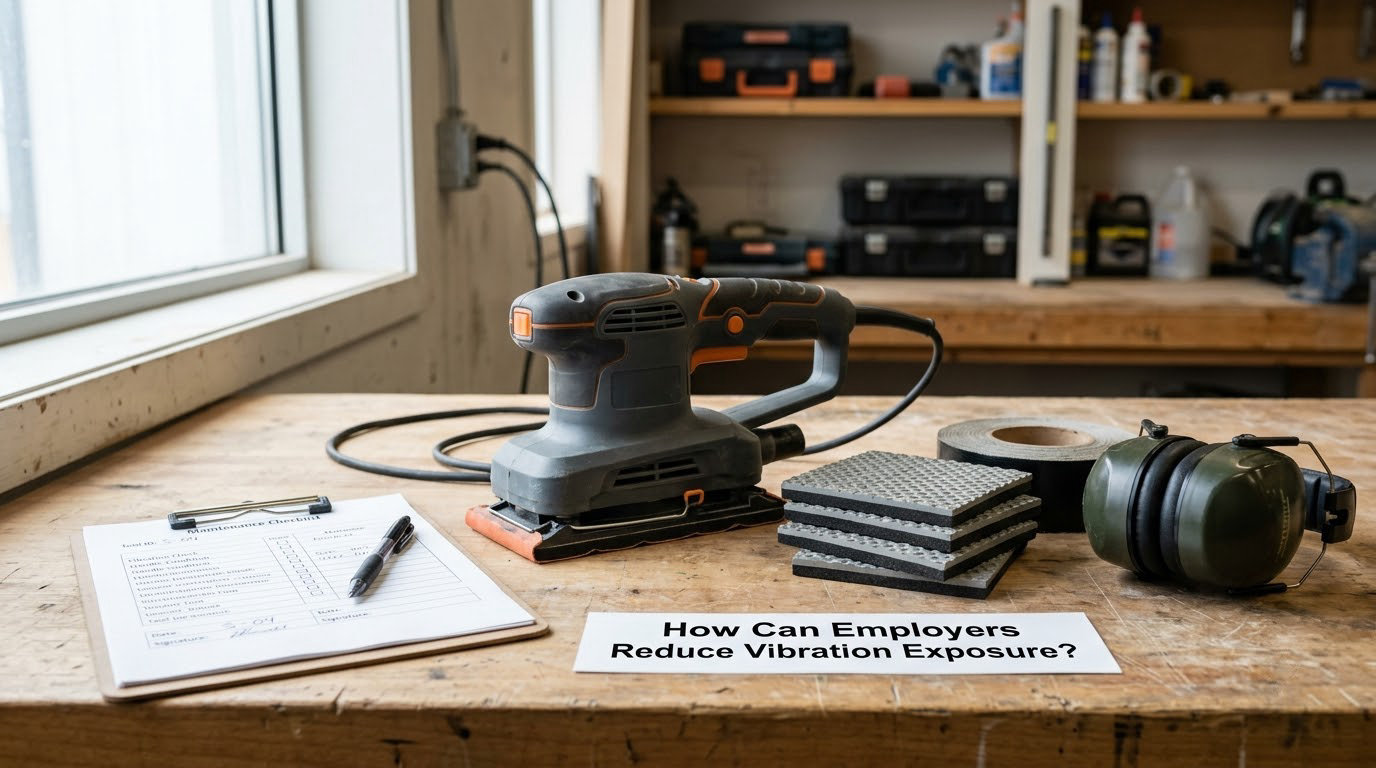
The most effective reduction is removing the vibration entirely: stop the task, automate it, or use a method that does not need a vibrating tool in the operator’s hands. Anything else is a weaker option, and the order matters more than most people expect.
The Hierarchy of Controls, Most to Least Effective
- Eliminate the task. Can the work be redesigned, prefab off-site, or done with a fixative, adhesive or clamp instead of sustained tool use?
- Substitute the method. Move to a tool that does the job with less vibration, such as a lower-vibration demolition method in place of a hand-held breaker.
- Substitute the tool. Choose equipment with lower-vibration specification from the start, and make it the default on the equipment list.
- Engineer controls. Fit anti-vibration handles or isolators, mount the work properly, use weight or support so the operator carries less load, and remote-control or automate the machine.
- Administrative controls. Rotate tasks so no one carries the whole dose, shorten continuous runs, build in breaks, and cap hours on the highest-vibration tools.
- Personal protective equipment. Anti-vibration gloves, warm handwear and correct technique. Useful, never a substitute for the levels above.
Job rotation is the control that most often fails in practice. On a small crew where everyone uses the same breaker, there is nobody to rotate with. Where that is true, the honest options are to buy lower-vibration equipment, reduce the volume of that task, or bring in a second operator on shifts.
On gloves, be straight about the trade-off. Vibration-damping gloves and anti-vibration handles reduce some of the transmitted energy, but gloves can cut grip strength by up to 20%, and a worker gripping harder or losing control of a spinning tool has a new problem. Use them where they fit the task and the worker is trained, not as a blanket answer.
Maintenance is the control most sites skip. Bearings, chucks, hoses, air fittings and worn discs all drift away from specification, and a badly serviced tool can be far worse than the datasheet suggests. Put vibration-relevant checks into the routine inspection schedule, and record tool age so replacements can be prioritised.
Noise often arrives in the same breath as vibration, since the same grinder is loud as well as shaking. Handling both together usually works out cheaper than treating them as separate projects. See how to prevent hearing loss from workplace noise for that side, and our guide to shoulder pain from overhead work if the same job is loading the shoulder as well.
How Do Workers Reduce Their Own Exposure?
Most of the control sits with the employer, but technique and duration are yours to influence every single day. A loose grip lets the machine vibrate against your hand; a tight, absorbing grip takes less of the shock.
- Hold the tool lightly. Let the body and the handle absorb some of the energy rather than clamping against the impact.
- Let the tool do the work. Pressing harder increases load and vibration. Sharper accessories, correct blade type and correct pressure reduce it.
- Keep hands warm. Cold hands are more sensitive to vibration and more vulnerable to vascular episodes.
- Break up long runs. Six steady hours is not the same dose as six hours with breaks built in.
- Vary tasks. Where you can, move between higher and lower vibration jobs across a shift.
- Look after the tool. Report buzzing, rattling or unusual warmth early, since worn components signal drifting specification.
- Use the anti-vibration features supplied. Built-in isolators work as designed; anything improvised on site usually does not.
- Do not shrug off symptoms. Mention tingling, numbness or colour change straight away, while it is still reversible.
Two habits deserve extra attention. First, keep records of how long you actually run the tool, because most people badly overestimate it in their own favour. Second, raise anything you are unsure about with your supervisor or safety lead rather than working through it, especially if the task has changed since you last did it.
How Do You Set Up a Workplace Vibration Program?
A workable vibration program is mostly paperwork, data gathering and a few decisions about which tools to replace first. It does not need a full-time safety role to run, but it does need an owner.
- Inventory the vibrating equipment. List every handheld power tool in use, with make, model, age, task and the number of people using it.
- Collect the emission data. Take each tool’s vibration figure from its manual. Flag any machine with no figure and any machine older than about five years.
- Estimate daily exposure. Combine emission value with actual running hours per person per shift. Remember that a breaker used intermittently all day can still reach the action value.
- Rank the tasks. Rank by estimated dose multiplied by the number of people exposed, since a common high dose beats one rare extreme.
- Get a competent assessment. Where estimates sit near the action value or you lack meter access, bring in a qualified vibration assessor for measurement.
- Apply controls in order. Start at the top of the hierarchy and buy out of the biggest dose first. Budget replacement on the ranked list, not on which machine annoys a supervisor.
- Train and involve the crew. Cover technique, task rotation, reporting and early symptoms. Workers often know which tasks hurt most before any report does.
- Set up health surveillance. Give a reporting route for symptoms, and put repeat assessments on a schedule for anyone above the action value.
- Keep the records. Store tool data, exposure estimates, control decisions and training. Recalculate when a tool, accessory or task changes.
If your exposure is spread across many short tasks rather than a few long ones, sum the doses instead of judging each task separately. Exposure across a shift accumulates, and that pattern is the one that gets missed on sites where every individual task looks harmless.
What Should You Do If Symptoms Appear?
Treat new hand symptoms as a work-related question, not a personal one. Vibration-related symptoms are much easier to manage when they are reported early, and the record of when they started matters for anyone who later needs support.
- Stop and report. Tell your supervisor and safety lead the same day, describing which task, which tool and how long the symptoms lasted.
- Get a medical opinion. Ask for assessment by a qualified healthcare professional, and mention the work you do and the tools you use so vibration is considered.
- Ask about occupational health referral where symptoms persist or recur, since many employers have arrangements for this.
- Adjust the task while you wait. Where symptoms are clear, move the worker off the highest-vibration tool rather than waiting for an appointment.
- Check other causes. Numbness and colour change can have non-occupational causes, and a clinician should rule those out rather than assuming.
- Keep the paperwork. Symptom onset dates, task history and any exposure estimates help both the worker and the employer later.
Where symptoms persist despite control measures, a change of role may end up being the right answer for that person. That is a difficult conversation, and it is easier to have it honestly than after a claim. Workers also need to know their rights, and unions or worker representatives can usually help frame that conversation.
Frequently Asked Questions
What tool is most likely to cause HAVS?
Chainsaws, jackhammers, road drills and concrete saws carry the highest vibration exposure, because they either run constantly or deliver repeated high-magnitude impacts straight into the hands. Pneumatic drills, air chisels, angle grinders and impact wrenches come next. Tool category alone does not decide it though: the specific model, the technique and the hours of use per day often matter more than the label.
What are three early signs of HAVS?
The three common early signs are tingling or pins and needles in the fingertips, numbness that comes and goes, and occasional white finger episodes where fingers blanch in cold conditions and then return to normal. Reduced dexterity, such as dropping small fasteners or feeling clumsy, is also an early sign. None of these mean the exposure is safe, and reporting them early is worthwhile.
What are the exposure limits for vibrating tools?
The widely used exposure action value is 2.5 m/s² A(8) and the exposure limit value is 5 m/s² A(8). A(8) is the eight-hour energy-equivalent daily dose. At or above the action value you must assess the risk, reduce exposure and train workers; the limit value must not be exceeded at all. A tool rated at 20 m/s² reaches the action value in roughly eight minutes.
What is the most common injury caused by vibration tools?
The most common problem is neurological damage to the peripheral nerves in the hands, producing numbness, tingling and loss of fine motor skill. The second is vascular damage, known as vibration-induced white finger or occupational Raynaud’s phenomenon, where fingers blanch and change colour in the cold. Together these make up hand-arm vibration syndrome, and the nerve damage is usually the part that does not recover.
Is vibration considered a physical hazard?
Yes. Vibration is a physical hazard in occupational health, classed alongside noise, heat and radiation rather than with chemical hazards. Because of that it is regulated in a similar way: exposure is estimated over a working day, action and limit values are set, and employers are expected to assess, control and record exposure. Regulated limits are commonly expressed in m/s² A(8).
What type of control involves changing the way people work to reduce vibration exposure?
That is an administrative control. Administrative controls change how, when or by whom the work is done, such as task rotation, shorter continuous runs, scheduled breaks and training. They sit near the bottom of the hierarchy of controls because they depend on people behaving consistently. Eliminating the task, substituting the method, or engineering controls such as anti-vibration handles are more reliable.
Conclusion
Start by finding out where the vibration actually is. List the tools in use, pull the vibration figures from the manuals, and combine them with real running hours so you can see who is sitting near the 2.5 m/s² action value.
Then cut the biggest dose first, starting at the top of the hierarchy rather than at the gloves. Replace the worst offender on the ranked list, break up long continuous runs, and put vibration checks into the routine maintenance schedule so tools do not drift past their specification.
Finally, give workers a route to report tingling, numbness or finger colour change without friction. Vibration exposure from power tools is one of the more preventable workplace hazards we deal with, and the controls that work are well known and not expensive. If you are unsure how to measure or where your exposure sits, a competent vibration assessment is the fastest way to a defensible answer, and any symptoms should go to a qualified healthcare professional. If the same work is loading the rest of the body, our guides to preventing back injuries from lifting and managing shoulder pain cover the other half of the problem.