

Most wellness vendor decisions go wrong for the same reason: buyers shop features instead of problems. The way to choose wellness vendors is to define the employee need first, score every candidate against the same written criteria, and put the hard questions about data, access and money into a standard request for proposal before any demo. That process takes roughly six to ten weeks for a mid-size employer, and most of the work happens in the first two.
The rest of this guide walks through that process step by step, including the questions to ask about evidence, employee privacy, accessibility, pricing models and contract terms. If you are still at the very beginning, how to start an employee wellness program covers the groundwork on the employer side.
Table of Contents
- What You Need
- Step-by-Step
- Define the employee need and desired outcomes
- Ask how to choose wellness vendors using fair criteria
- Shortlist vendors and request equivalent proposals
- Ask detailed questions about evidence, privacy and employee data
- Evaluate the demonstration using a realistic employee scenario
- Run a limited pilot and define success measures
- Check references and negotiate the final agreement
- Common Mistakes
- Frequently Asked Questions
What You Need
Vendors are good at answering questions you thought to ask. They are much better at the questions you forgot, which is why preparation matters more than interrogation.
Before any vendor contact, put six things on paper.
A one-page needs summary. The specific workplace challenge you are buying against, written so a vendor who has never met your team can picture it. Stress and burnout, musculoskeletal strain from desk work, blood pressure trends, sleep, or access to mental health care are all different problems with different answers.
A population profile. Headcount, locations, shift patterns, languages, job types, and how many employees work remotely. Vendors price and staff differently for a workforce spread across four time zones than for one sitting in a single building.
A budget range and the rules around it. Whether spend is per employee per month, per eligible employee, a flat annual fee, or tied to participation. Know the approval threshold and whether procurement, legal or the security team must sign off before a contract can be signed.
Real sample feedback. A short anonymous survey of your workforce, or a dozen quotes from a recent pulse survey. Without it you are guessing what employees want, and every vendor will happily claim their niche is the one your people need.
A weighted scoring rubric. Ten criteria, each scored one to five, with weights decided before you read a proposal. Evidence, service fit, employee experience, privacy and security, accessibility, implementation support, price, measurement, references and contract terms usually cover it. Decide the weights while you are still neutral.
A single standard request for proposal. Every finalist receives the same document, on the same deadline, with the same required format. Anything less and you end up comparing a well-written proposal against a thin one instead of comparing vendors.
Send the legal list to counsel at the same time. HIPAA applicability, GINA limits on requesting genetic information, ADA accommodation duties, state rules on biometric and wellness data, and GDPR obligations for employees outside the US all change what a vendor is allowed to collect. Benchmarking your current program first gives you the baseline numbers a vendor will ask for.
Step-by-Step
Define the employee need and desired outcomes
Write down what success looks like in numbers before you look at a single proposal. Participation is the easiest metric and the least meaningful one, so pair it with something closer to the problem, such as completed sessions, repeat use in month three, or employees reporting the tool made a specific routine easier.
Also write down who is eligible and who is not. Some programs invite spouses, some are employee-only, and part-time or seasonal staff are often left out unless you ask. If your workforce has shift workers or deskless staff, note that now, because a phone-first platform that assumed desk workers is the wrong tool for a distribution center.
Set a realistic participation expectation before any vendor conversation. In most workplaces a meaningful, sustainable participation rate lands somewhere between a quarter and a half of eligible employees over the first year, and pilots routinely come in lower. Treat a vendor’s claim of eighty or ninety percent engagement as a request for the denominator.
How do you know this step worked? You have a one-page brief you could hand to a stranger, a budget range, a target population, and three to five outcomes with baselines attached.
Ask how to choose wellness vendors using fair criteria
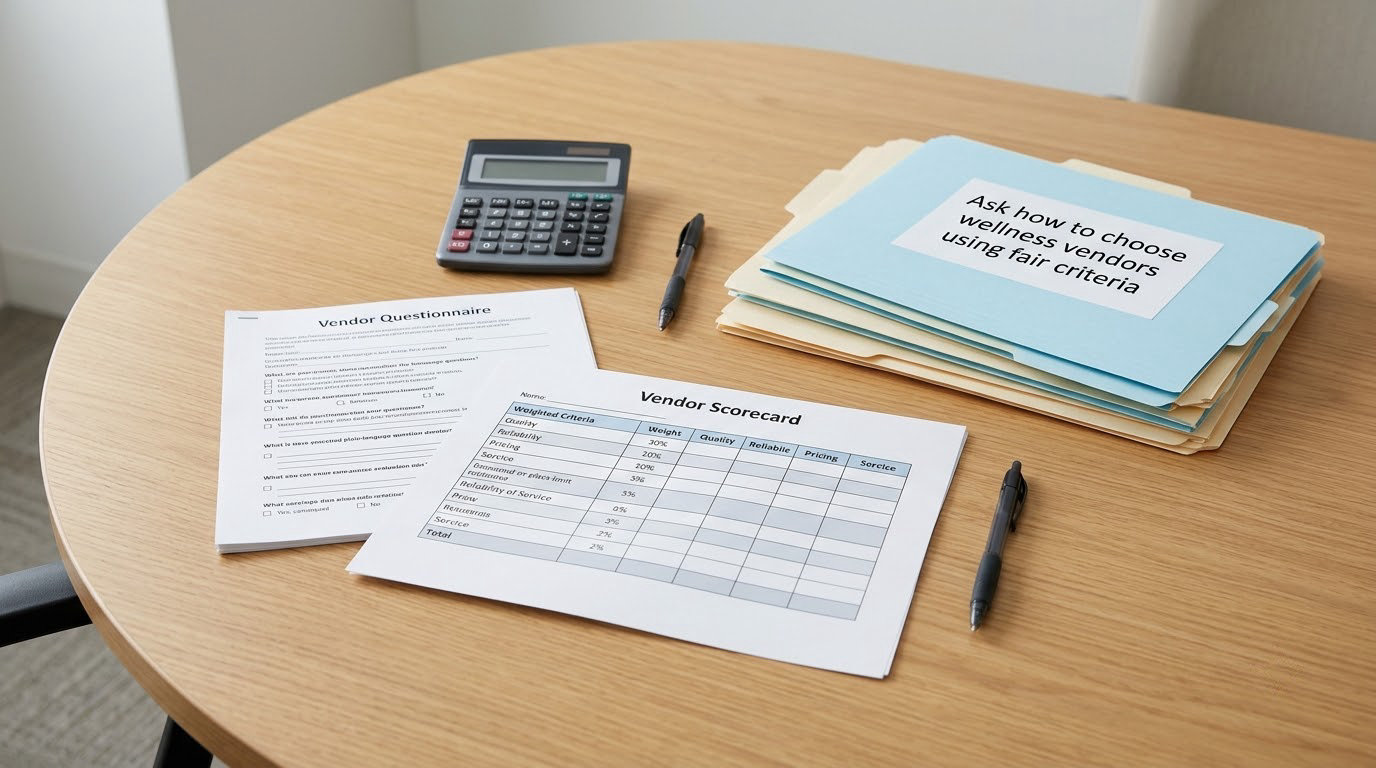
This is where buyers get vague, so build the rubric before shortlisting and refuse to change it mid-process. Assign each of your ten criteria a weight that reflects your actual priorities, then score each candidate one to five with a one-line written justification.
Weights differ by organization. A small employer with one benefit and no wellness staff should put most of the weight on implementation support and ease of use, because nobody on your team will run a complicated program. A large employer with a benefits team and a privacy office should weight data governance, HRIS integration and measurement much higher.
Write the rubric with a decision rule attached in advance: what score a vendor must reach to stay in the running, and what happens if two finalists tie. Without a rule set in advance, the loudest sales conversation wins, and the loudest conversation is not evidence.
How do you know this step worked? Every finalist has a score, a written reason for that score, and the same weight behind each number. A second reviewer who did not attend the demos should be able to look at your sheet and reach roughly the same ranking.
Shortlist vendors and request equivalent proposals
Cut the field to four to six candidates. Any more and the responses stop being comparable because vendors start tailoring their answers to what each of you told them separately.
Before you send the request for proposal, check the basics. How long has the company operated, who actually delivers the service, do they hold the clinical credentials their coaches need, what does a typical client cohort look like, and can they show current clients in your industry and size band. Ask for a business assurance letter or equivalent and check whether they carry professional liability coverage at a level that makes sense for your employee count.
Then require every response to cover the same ground: what is included, what is optional, what is excluded, how pricing is calculated and what could change that calculation later, which assumptions they are making about your workforce, what they need from your team, and what they will deliver by when.
Insist on sample reports and sample program materials. A dashboard screenshot in a proposal tells you nothing; a real report from a client of similar size tells you what you will actually be looking at in month four.
How do you know this step worked? The proposals are different lengths and formats, but each one answers the same required sections in the same order, so you can line up the answers side by side.
Ask detailed questions about evidence, privacy and employee data
This is the section buyers rush, and it is the one that creates real legal exposure. Put these questions in the request for proposal so every vendor answers in writing, and read the answers rather than listening for the pitch.
Evidence. What research supports the specific programs you are proposing, and for whom were it studied. Do the results hold for populations like mine, which may include shift workers, hourly staff or a workforce with a high proportion of employees with disabilities. How do you measure what the program actually changed, and what do you refuse to claim.
Collection and consent. What employee data do you collect, why is each field necessary, and how is consent obtained and recorded. Is participation truly optional, and does declining affect anything at all, including manager visibility of an individual employee.
Individual versus aggregate reporting. What is the smallest group size before a statistic can be reported. This is the single most important number in the whole conversation, because a vendor that reports on groups of three can expose people at a small worksite.
Retention and deletion. How long is data kept, what triggers deletion, and can our data be exported in a usable format. Who are the subprocessors, where is data stored, and does anything cross a border.
Security and legal. Is the vendor a covered entity or business associate under HIPAA, and will they sign a business associate agreement. What encryption is in place at rest and in transit, what is the breach notification timeline in hours, and has there been a breach in the last three years. How do you handle GINA limits on genetic information, ADA accommodation requests, and state biometric privacy laws.
Termination. What happens to our data and our employees’ accounts on the last day of the contract. Get the answer in the contract, not in a sales conversation.
How do you know this step worked? You have written answers on file, the minimum group size for reporting is stated in a number you are comfortable with, and counsel has confirmed the data position before anything else moves forward.
Evaluate the demonstration using a realistic employee scenario
Demos are theatre. The vendor’s most polished scenario, run on a device they control, tells you almost nothing about what your employees will experience. Insist on walking through a typical employee journey instead, from first login to second month of use.
Ask to see the path an employee takes when they do not have a smartphone, or when they have one but limited data. See whether there is a non-app route into the core service, because deskless, warehouse and clinical staff rarely carry company phones.
Then test the awkward parts. What languages is the content actually available in, and is the translation human or machine. How does the platform handle screen readers, captions, high contrast and keyboard-only navigation. What happens on a slow connection. How does someone book a session when they work nights, and what does an appointment look like for someone who cannot easily leave a work area.
Push on the service behind the software. Who are the coaches and what credentials do they hold, how are they matched to an employee, what is the escalation path when something goes wrong, and how fast does a real person respond during working hours.
Finish with the commercial question vendors hope you will skip: is every feature you just saw included in the proposed price, or is any of it an add-on.
How do you know this step worked? Your accessibility colleague or a volunteer tester can get through the flow unaided, and the vendor’s answers about staffing and language support were specific rather than generic.
Run a limited pilot and define success measures
A pilot turns opinions into data, but only if you decide what success means before it starts. Pick a group that resembles your whole workforce rather than the most enthusiastic volunteers, since early adopters skew heavily toward people who already exercise and already own wearables.
Eight to twelve weeks is the usual window. Long enough to see whether usage holds past the novelty spike, short enough that you are not paying a full year to discover the fit is wrong.
Communicate neutrally. Tell employees what is being tested, what data is collected, what is optional, and what happens to the data afterward. Offer a non-platform alternative so nobody is effectively forced into the tool to access the benefit, and give an accessible alternative for anyone the app flow does not work for.
Track a small set of measures: participation and enrollment, completion, repeat use at eight and twelve weeks, satisfaction, whether the program added meaningful work for your team, whether participation was even across shifts and job types, and any agreed well-being indicator such as stress scores or blood pressure readings. Where you want to measure wellness program ROI properly, agree the method before launch, not after the results look disappointing.
Write the go/no-go criteria into the pilot agreement itself, with a threshold. If the vendor will not agree to a pilot with stated success measures, that tells you something important about how they handle an underperforming contract.
How do you know this step worked? You have numbers for each measure, a written comparison against the criteria you set before launch, and a decision that was already defined rather than improvised afterwards.
Check references and negotiate the final agreement
References are easy to fake and hard to fake well, so make the call slightly awkward. Ask to speak with a client of similar size and industry who launched more than a year ago, then ask questions the vendor would not have coached them on.
What is your actual participation rate now, and what was it in the first six months. How many reporting questions does your team field in a typical week. What did you wish you had negotiated. Would you buy it again, and what did it cost to switch in the middle. A reference who answers all of these plainly without flinching is worth more than three glowing testimonials.
Then negotiate the contract while you still have leverage, which is right after a pilot. The clauses worth pushing on include service levels with meaningful reporting obligations, implementation fees broken out, renewal caps on increases, data ownership and export rights, termination for convenience and for failure to meet service levels, accessibility commitments stated as obligations rather than aspirations, warranties on credentialed staff, and language on outcome reporting that does not promise results the vendor cannot control.
Ask what happens to the program if the vendor is acquired. This is common in this market, and your data and your ability to move away are worth more once they are written down.
How do you know this step worked? The signed agreement reflects what was negotiated, not the vendor’s original template, and you can name the person at your organization who owns the vendor relationship and the first annual review date.
Common Mistakes
Choosing on price alone. The cheapest proposal is cheap for a reason, and the cost usually shows up as unused licenses, a program nobody adopts, or admin time your team does not have. Compare total cost of ownership over two years, including implementation, integration, incentives and your staff hours, then weigh that against the evidence and the support included.
Reading engagement statistics without context. A participation percentage means very little until you know the denominator, the time period, how it was measured and whether people did anything more than log in. Ask for the raw counts and the definition of active, and compare how the vendor counts a person who opens an app once against a person who completes a session.
Skipping privacy and accessibility review. These are the two areas where a rushed decision creates lasting damage: a data practice that violates a legal obligation, or a service that quietly excludes part of your workforce and then produces participation numbers that look fine. Give both their own block of time with people who are not the vendor’s salesperson.
Comparing proposals that are not equivalent. This is the mistake that quietly decides most vendor selections. One response describes a full program, another describes a platform alone, and one includes coaching that the others price separately. Fix it by listing the required components in the request for proposal and asking each vendor to state explicitly what is excluded.
Letting incentives do the work. A launch spike driven by a prize drawing tells you nothing about whether the program will still be used in month six. Ask what usage looked like after the incentive ended at comparable clients, and be cautious about any design that rewards sharing health information, since that creates exactly the privacy problem you were trying to avoid.
Failing to define what happens at renewal. If success measures only exist for the pilot, the contract renews on habit. Set review measures up front, schedule the first review before the initial term ends, and decide in advance what result justifies continuing, renegotiating or leaving.
A few habits that consistently help. Keep one point of contact on each side so the same questions are not asked five times. Write everything down during the process, because memory flatters vendors. Give each finalist the identical core question set, then let their written answers do the sorting. And keep the losing vendor’s proposal file, because the winner has every incentive to forget the promises they made in writing.
Frequently Asked Questions
How do I compare wellness vendors when their services are different?
Compare them on the problem, not the product. Write the outcomes you need before you look at any menu, then score every vendor against the same criteria: evidence for the specific service, access for your shift patterns and languages, privacy and reporting thresholds, integration, price over two years, and support. A coaching-only provider and a platform vendor will never match feature for feature, and they should not. They can be held to the same questions about evidence, data handling, accessibility and cost.
How long should a wellness vendor pilot run?
Eight to twelve weeks is the usual window. Four weeks mostly measures the launch announcement, and six months often costs more than the decision is worth. Use the first four weeks to confirm enrollment and access work, then watch whether usage holds at week eight and twelve. Agree the success measures and the go/no-go threshold in writing before the pilot starts, and make sure the agreement is part of the vendor contract rather than a side conversation.
What employee wellness information can a vendor collect?
It depends on the service and on the consent you give, and the vendor should be able to explain every field it collects and why. Health risk assessments and biometric screenings may collect identifiable health information, which can trigger HIPAA obligations if the vendor handles it on your behalf and requires a business associate agreement. Most employers should limit collection to what the program needs, obtain meaningful consent, receive only aggregate reporting with a minimum group size, and state retention and deletion rules in the contract.
How do I choose a wellness vendor for a small business?
Favor simplicity over configurability. With no dedicated wellness staff, you want a vendor who does most of the program design, communication and measurement for you, and who can support a population of a few dozen people without charging for setup you cannot absorb. Ask directly who will do the work if your program manager is on vacation, request references from businesses of your size, and confirm the program works without company smartphones on the floor.
Should I choose the wellness vendor with the lowest price?
Not on its own. Low price usually reflects a narrower service, fewer included components, or implementation and integration costs that appear later. Price the two-year total instead, covering implementation, admin time, incentives, add-on features and renewal increases, then check whether that budget buys evidence, coverage and support that meet your criteria. If two proposals land close on total cost, price should not be the deciding factor.
Start where it matters most: write the needs summary and the weighted rubric this week, before anyone calls a vendor. Then send the same core questions about evidence, data, accessibility, pilots and contract terms to every finalist, and let the written answers and the pilot data make the decision. Reviewed for 2026, and worth revisiting whenever your workforce or your benefits strategy changes.