

An employee focus group is a facilitated conversation, usually 10 to 15 colleagues from one defined segment, built around a single question about work. To run focus groups with employees well, you set one objective, recruit a representative group, work through a short guide of open-ended prompts in 45 to 60 minutes, then report what you heard back to participants within two weeks.
It takes about three hours of prep for an hour of discussion, which sounds like a lot until you compare it with the cost of building a policy nobody uses. The groups that fail are rarely failures of enthusiasm; they fail on vague questions, a senior person in the room, and findings that vanish into a deck.
One more constraint before you start: a standard 60-minute session does not work for shift-based or frontline staff, and that is the barrier HR practitioners raise most often. There is a working short format for that case, covered in the tips section below.
Table of Contents
- What You Need
- Step-by-Step: How to Run Focus Groups With Employees
- Step 1: Define the Topic and the Decision You Need to Make
- Step 2: Recruit a Representative Group of Employees
- Step 3: Write an Easy-to-Follow Discussion Guide
- Step 4: Facilitate the Discussion, Including How to Run Focus Groups With Employees Who Barely Talk
- Step 5: Record, Organize, and Analyze the Notes
- Step 6: Report Findings and Turn Insight Into Action
- Common Mistakes to Avoid
- Tips for Better Employee Focus Groups
- Frequently Asked Questions
- Conclusion
What You Need
Most of the work happens before anyone speaks. Gather these seven things and the session runs itself.
- One decision question. A single sentence naming the choice the group should inform, such as whether to keep the current hybrid rota, change it, or run a six-week pilot.
- Participant criteria. Which segment the group represents: role, level, tenure, shift pattern, location, or a combination. Write it down, because it decides the invite list later.
- An invite and a consent note. Plain wording on what the session covers, how long it runs, whether it is recorded, and who sees the notes.
- A discussion guide. Two warm-up questions, six to eight core questions, two wrap-up questions, on one page.
- Ground rules you can read aloud in 30 seconds. Short enough to memorise, so you do not read from a slide while people settle.
- A way to capture what is said. A consented recording plus one note taker, or two note takers if recording is not permitted. Handwritten notes alone lose the nuance.
- An analysis grid and a reporting owner. A simple spreadsheet with columns for theme, evidence, who said it, and confidence, plus the name of the person who will write the summary and the date it goes out.
Book a room people can talk in, or send a link to a virtual session with cameras optional. A focus group fails faster in a glass-walled meeting room than in almost any other setting.
Step-by-Step: How to Run Focus Groups With Employees
Step 1: Define the Topic and the Decision You Need to Make
Turn the broad concern into one question a 60-minute group could actually answer. “How do we improve culture” is unusable. “What gets in the way of you getting work done when you are at home three days a week” is answerable.
Write the decision your findings will inform, not just the topic. Something like: if the group says X, we will pilot Y by a certain date; if it says Z, we stop. Groups give sharper answers when they know what happens next.
Check the method matches the question before you invite anyone. Using a focus group to count how many people want a benefit is a slow, expensive survey.
| Your question | Best method |
|---|---|
| How many people feel stressed, and by how much | Pulse survey with a validated scale |
| Why does handover fail on night shifts | Focus group, frontline segment |
| What is it like to manage a new policy rollout | One-to-one interviews |
| Which of three policy drafts reads clearly | Quick task-based group or paired review |
| What do people mean when they say “the culture is fine” | Focus group, no attribution |
How you know it worked: two people read your decision question and describe the same good answer. If they describe different answers, it is still too vague.
Step 2: Recruit a Representative Group of Employees
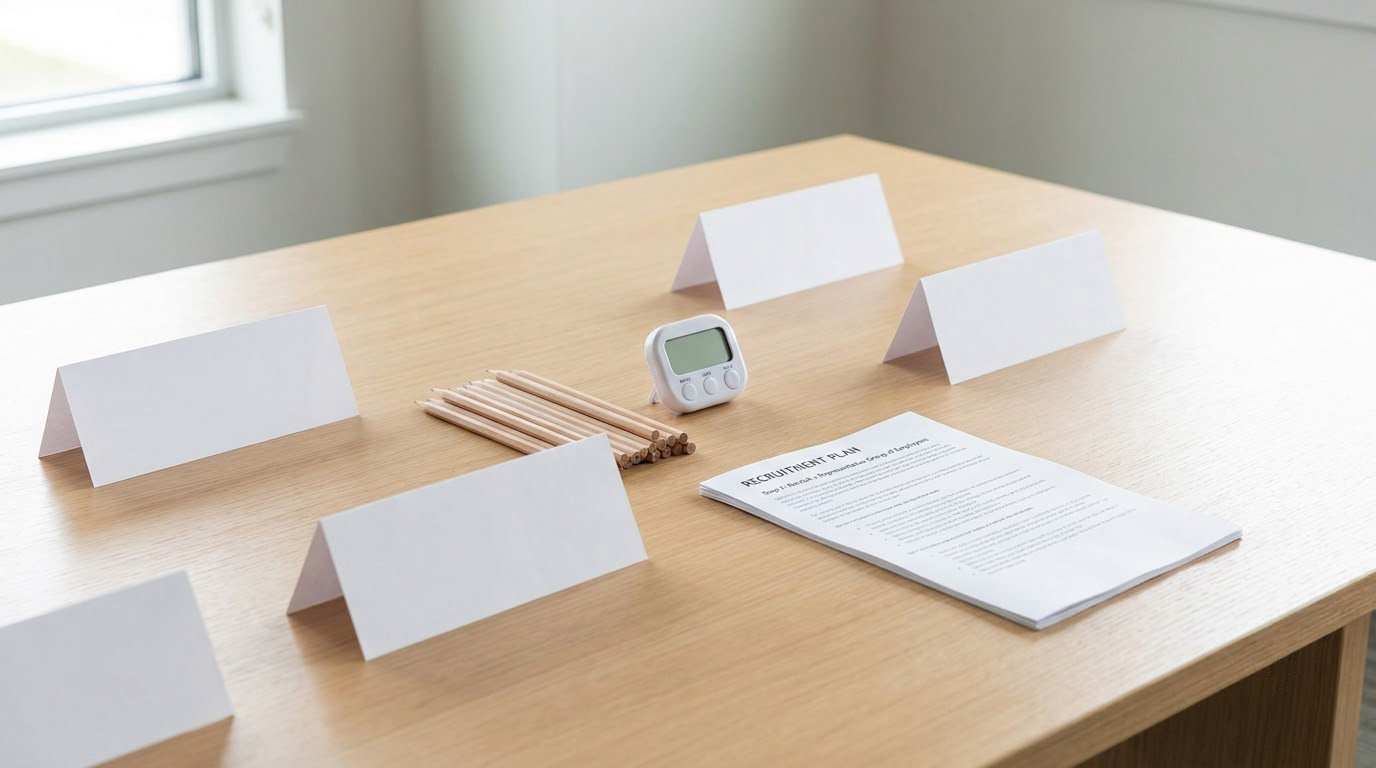
Aim for 10 to 15 participants, with 12 a good target. Below six, the range of views narrows and one person takes up a third of the airtime. Above 15, everyone waits too long to speak and the session turns into a seminar.
Run one group per segment rather than mixing everyone. A group of night-shift warehouse staff will talk about the handover; a group of day-shift supervisors will talk about the reporting line. Different segments, different themes, and mixing them produces polite, general answers.
Recruit across levels, functions and tenure. Practitioners report the same problem every time: the people who volunteer are already the most engaged, so the group tells you what is working rather than what is broken. Send the invitation to a named list, not a “anyone interested” post, and check the resulting list against the segment before the day.
Invite without pressure. Say what the session is for, how long it is, who will see the notes, and that skipping it affects nothing. Offer the slot twice so shift workers have a chance, and pay the same incentive to everyone who takes part.
Be honest about confidentiality. Say plainly that you will not share who said what, that notes are combined and de-identified, and that if someone discloses a safety or legal issue you may need to pass it on. Over-promising anonymity is the fastest way to lose the session.
Keep managers out of the room where possible, and run a separate manager group on the same questions. We will come back to why.
How you know it worked: your sign-up list looks like your workforce, not like your most enthusiastic volunteers. Keep recruiting until the themes from a new group stop adding anything new, which usually takes three to four groups per segment.
Step 3: Write an Easy-to-Follow Discussion Guide
Six to eight core questions is the working number for a 60-minute session. More and you reach the end with ten minutes for wrap-up, which is the part people remember.
Build the guide in three stages. Warm-up questions are easy and low-stakes: how long have you been here, what does your shift start look like, what is one thing that always goes wrong on a Tuesday. Core questions do the work and follow the decision question. Wrap-up questions close it: what should we not change, what would you want your manager to hear, what have we not asked about.
Write open questions, not quizzes. “What would make your first 30 minutes easier” gets you a story; “would a longer handover help” gets you a yes or no that tells you nothing you can act on.
Watch for three traps. Leading questions push people toward the answer you expect. Double questions such as “is the pay fair and are the benefits competitive” produce a half-answer to both. Hypotheticals such as “if you could change one thing” invite polite generalities instead of a specific day last month.
Under every core question, write two follow-up prompts. “Tell me more about that” and “what would need to happen for that to work” do most of the work that a script cannot. Experienced facilitators report the same technique repeatedly: let people talk, then probe rather than advance.
Write your ground rules too. One conversation at a time. Step back when you have spoken. Disagree with the idea, not the person. No names or departments in the room. Anything off-topic goes on a visible parking lot that you actually read later.
Replace the icebreaker with a written warm-up. Everyone writes one line answering a simple prompt, then reads it aloud. It gets wallflowers talking without asking anyone to describe their favourite pizza.
How you know it worked: read the guide without your notes and it still flows. If you cannot see where one question leads into the next, it is a questionnaire, not a guide.
Step 4: Facilitate the Discussion, Including How to Run Focus Groups With Employees Who Barely Talk
Open by setting expectations fast, in under a minute: what the session covers, that you want disagreement, that you will keep time, and that you will pass the floor if someone is talking too much. Skip the joke, the team trivia, and the round of “how are we all feeling”.
Use this shape for a 60-minute session. It is the timing most readers are actually looking for.
- 0-5 minutes: open, ground rules, consent to record
- 5-12 minutes: warm-up and written exercise
- 12-42 minutes: core questions, roughly five minutes each
- 42-52 minutes: wrap-up and the parking lot
- 52-60 minutes: what happens next, owners, dates
The facilitation work happens in the middle 30 minutes. With dominant speakers, thank them once, name the value of what they said, then commit out loud to come back to them: that is important, I want to hear how others see it. Move on without making it a confrontation. With quiet participants, use a round robin at least once, offer a genuine pass, and invite people by name with a full ten seconds of silence before speaking again. Silence that feels long to you is short to the participant deciding whether to risk it.
Handle disagreement as data. Write the dissenting view on the parking lot in front of the group and keep going. When someone raises a real problem, such as unsafe practice or a grievance, do not debate it in the room: note it, say you will come back to them privately within two working days, and then actually do that.
Keep yourself quiet for a full minute after every answer. The instinct to fill the gap is the thing that makes focus groups useless. If the group goes off track, park the detour visibly rather than steering.
How you know it worked: several people say something you did not expect, and at least one participant changed their view out loud. If every answer was one you predicted, you led the discussion.
Step 5: Record, Organize, and Analyze the Notes
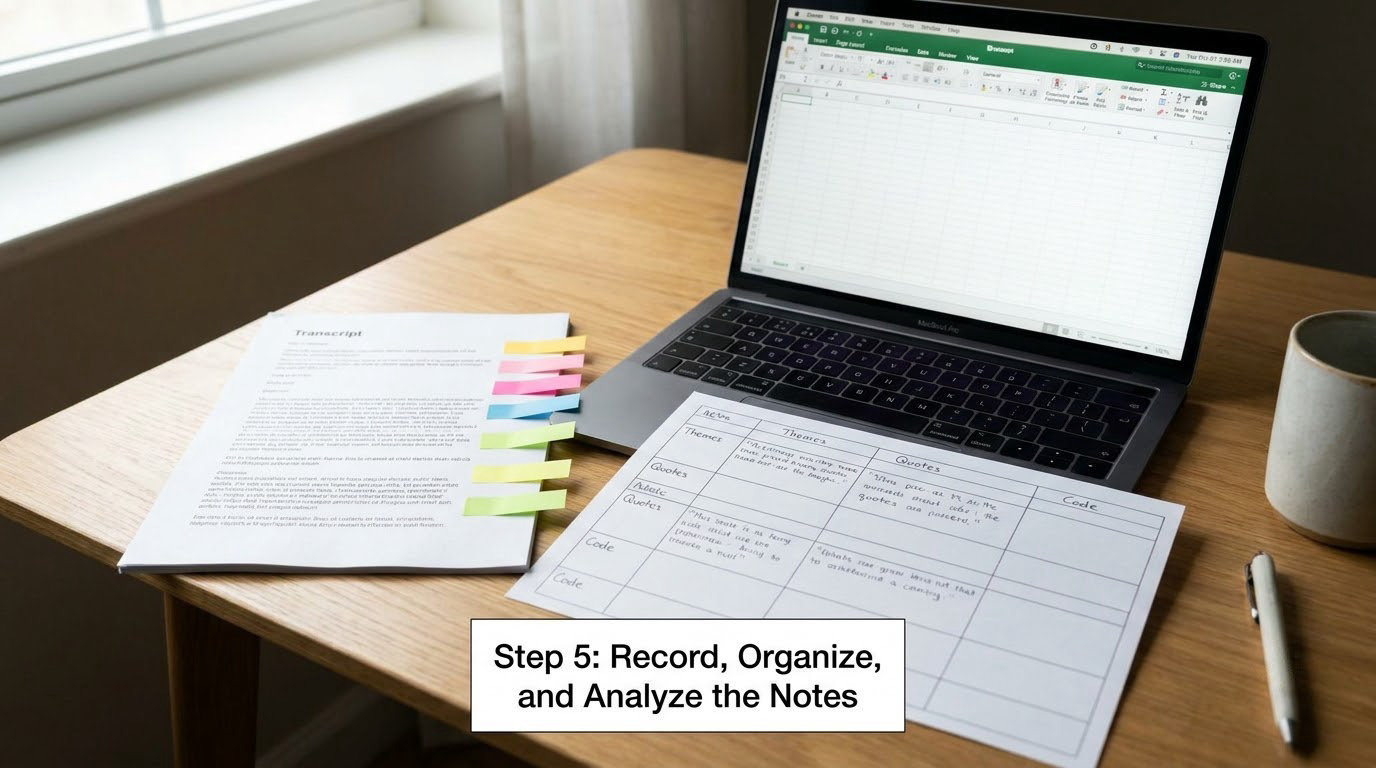
Ask for consent to record at the start, and note the answer in the room so nobody has to be the one to object. If you record, capture behaviour and themes, not names or job titles that identify a person in a team of six.
Debrief with your note taker for ten minutes immediately after. Memory fills gaps with plausible detail, and that detail ends up in the report as fact. Write down what surprised you, what you failed to follow up on, and which answers came from more than one person.
Transcribe if you recorded, then work through the notes in a grid: one row per theme, columns for evidence, who raised it, and how confident you are. Colour-code as you go. Themes that appear in three or four groups are findings; a single vivid comment is an anecdote worth keeping, not a conclusion.
Separate what people said from what you think it means. Write the verbatim first, the interpretation in a separate column. That habit is what stops a focus group from becoming a well-meaning assumptions machine.
Watch for saturation. When two consecutive groups raise no new themes, stop recruiting. Most segments need three to four groups, not ten.
How you know it worked: someone who was not in the room can read the themes and predict what participants told you, without being told which quotes to look for.
Step 6: Report Findings and Turn Insight Into Action
This is the step most organisations leave out, and the one that decides whether you get to run another group. Findings that never come back are the reason employees stop volunteering their honest opinion.
Send a one-page summary within ten working days. Five sections, no more: what we asked, who took part, what we heard, what changes and who owns it with a date, and what we are not changing right now. That last section matters as much as the commitments, because unmet expectations are worse than no expectations.
Send it to the whole segment, not only to participants, and add the owners’ names to the action list. If leadership will not commit to a change, say that in the summary rather than letting the silence imply agreement.
Book the follow-up date in the room before anyone leaves. Then run it, even when the news is that nothing changed.
How you know it worked: participation in your next round holds or improves, and you can name actions that were completed because of what the group said.
Common Mistakes to Avoid
Each of these is easy to fix and hard to undo, because a bad session uses up trust you cannot buy back.
- Asking managers to attend their own team’s session. Fix: separate manager groups, and say in the staff session who was in the other room.
- Vague questions. Fix: every core question must point at a specific situation, and you must know what a useful answer sounds like.
- Reading the guide like a script. Fix: put the follow-up prompts in front of you and let the conversation move.
- Letting one voice set the tone. Fix: a planned round robin, a thank-you-and-park move, and a visible timer.
- Over-promising confidentiality. Fix: state the limits out loud before the first question, not after someone asks.
- Promising action you cannot deliver. Fix: agree the realistic commitment with leadership before the session, then keep to it.
- Stopping after one group. Fix: run the segment until themes repeat; one group gives you opinions, several give you findings.
- Never reporting back. Fix: put the summary date in the calendar on the day of the session.
- Ignoring shift patterns. Fix: run more, shorter sessions rather than one long one that only office staff attend.
- Recording without consent. Fix: ask at the start, write the answers down, and only then press record.
Tips for Better Employee Focus Groups
Run a 15-minute version when the calendar is the constraint. Frontline teams tend to need exactly this format, and it works well if you change the design rather than compressing the format. Give the last five minutes of the shift, cap the group at four or five people, open in 30 seconds, ask two questions only, take the answers offline if anyone wants to say more. If you want to encourage participation in wellbeing or safety topics, our well being survey questions for employees gives you wording that works in written format too.
Close the loop and expect it to buy you the next session. People who see one change because they spoke will speak again. If you get several requests for access to your wellness programs or similar, send the summary and the answer. Our guide to getting employees to participate in wellness programs covers that side in more detail.
Use a written opener. One line on paper, read aloud, beats ten minutes of icebreakers and gets the quietest people talking first.
Have a brain dump between groups. Thirty minutes, water and something to eat, and a blank page. Themes from the previous session will otherwise colour the next one’s answers.
Bring an occupational health voice when the topic is psychosocial. Stress, burnout and workload are health questions, not just engagement ones, and a session run without that framing often produces polite answers. If you are planning adjacent training work, our hazard communication training guide for employees shows the same design in a safety context.
Rotate the facilitator. The person who runs the session learns the most, and the person who does not should occasionally learn that answers are not aimed at them.
Frequently Asked Questions
How many people should be in an employee focus group?
Ten to fifteen participants is the working range, with twelve a good target. Below six, the spread of views narrows and one person tends to fill the airtime. Above fifteen, everyone waits too long to speak and the session starts to feel like a seminar. Run one group per segment rather than mixing night-shift staff with day-shift supervisors, because their experiences of the same process can be completely different.
How many questions should a focus group have?
Six to eight core questions for a standard 60-minute session, plus two easy warm-up questions and two wrap-up questions. That leaves roughly 30 minutes for core discussion at about five minutes each, with time left for opening, ground rules and next steps. Write two follow-up prompts under every core question. More questions than this and you reach the end still answering the list, with no time for the wrap-up people actually remember.
Should managers be in the room with their own team?
Usually not. People answer differently when their own manager is listening, and the honest version of the conversation is usually the one you lose. Run a separate session for managers on the same questions, and tell staff who was in the other room. Where a manager must attend, for example for a change they are personally delivering, set that out in the ground rules and give participants a written route to share something privately afterwards.
How do you get quiet people to talk in a group?
Use a written opener instead of an icebreaker: everyone writes a one line answer to a simple prompt, then reads it aloud. That gets everyone speaking once before anyone has to think on the spot. After that, do a genuine round robin with a real pass option, and invite people by name, then wait a full ten seconds of silence before rescuing them. Long silences feel much shorter to you than they do to the participant deciding whether to risk speaking.
How long should an employee focus group run?
45 to 60 minutes is the standard, with six to eight core questions inside it. For shift and frontline staff who cannot attend an hour, run a 15-minute pulse format instead of shortening the standard one: cap the group at four or five, open in 30 seconds, ask two questions, and take anything longer offline. What you are trading away is breadth, so run more short sessions than one long one rather than compressing the content.
How often should you run employee focus groups?
Most segments need three to four groups before the themes stop adding anything new, which usually takes one to two months. After that, refresh rather than repeat: a quarterly pulse on one rotating topic beats an annual full sweep that everyone has already seen. Keep going when you are making decisions, rolling out change, or after an incident. Pause when nothing has changed since the last round, because repeated asking with no visible response teaches staff that the channel is decorative.
Conclusion
Start with one question and one decision it will inform, then recruit twelve people who represent a segment rather than the volunteers who always show up. Write six to eight open questions, put the follow-up prompts under each one, and hold back your own opinions for a full minute after every answer.
Then do the part most people skip: send the summary within ten working days, with owners and dates on it, and say plainly what you are not changing. One honest report back is worth more than five sessions nobody hears the results of. Book the next round before you leave the room, and you will have employees telling you things a pulse survey never would.