

To support caregivers in your workforce, start by treating care as work that happens alongside work: build flexible scheduling and clear leave rules, train managers with an actual conversation framework, offer practical backup and navigation help, then measure whether people are using it. Most employers start in the wrong place, buying a benefit nobody takes because the culture punishes it.
A caregiver in the workforce is any employee who provides unpaid physical, medical, or emotional support to a child, parent, partner, or other loved one while holding a job. Most of them never use the word caregiver about themselves, which is why head counts are always lower than reality.
That invisibility is the core problem. Managers assume caregiving is rare, HR plans for a handful of cases, and the cost surfaces later as absenteeism, quiet errors, and regrettable resignations. This playbook is written for HR, people, and benefits leaders, and for the line managers who get the first call, whether you employ twelve people or twelve thousand.
Table of Contents
- What You Need
- Step-by-Step: How to Support Caregivers in Your Workforce
- Common Mistakes
- Frequently Asked Questions
- How can an employer support caregivers without making them disclose private medical or family information?
- What types of workplace benefits are most useful for employees caring for children, older adults, or someone with a serious illness?
- How should managers handle a caregiver who needs a schedule adjustment or time away?
- Do all caregiving situations need a formal accommodation or workplace plan?
- How can a small business create caregiver support with limited resources and staff?
- How should employers measure whether caregiver support is helping employees without creating privacy risks?
- Where to Start This Quarter
What You Need
You need six things in place before the work starts, and none of them require new software or a large budget.
A named executive sponsor. Someone senior enough to approve schedule changes that affect coverage. Without that, every request dies in a middle-management layer that cannot say yes.
One accountable owner. Usually an HR or benefits partner who holds the policy, the vendor relationships, and the data. Caregiver support falls between HR, benefits, and wellbeing programs, so somebody has to own the seams.
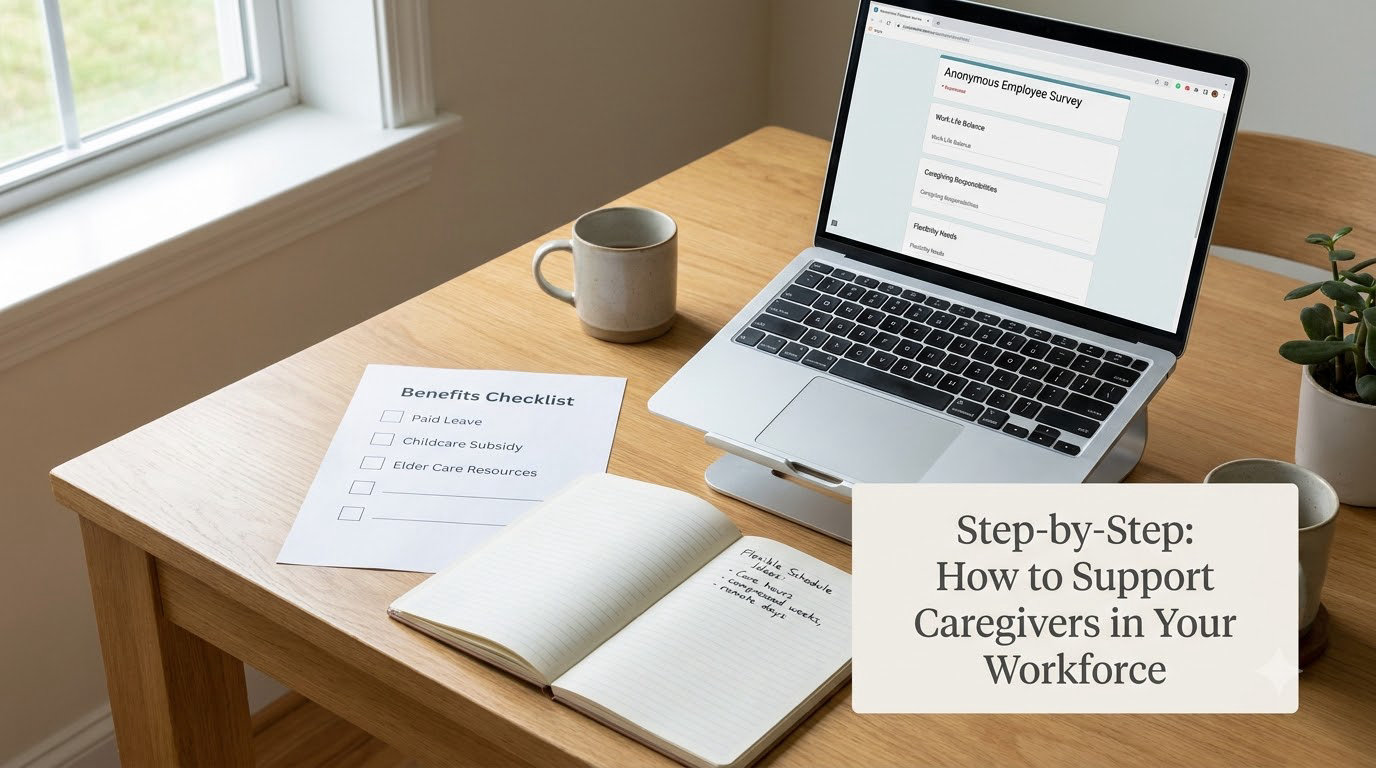
Anonymous baseline data. You do not need names to start. A short anonymous pulse survey tells you roughly how many people are caring for someone, what pressures hit hardest, and which supports would actually be used.
A manager conversation guide. One page of framing, do’s, don’ts, and escalation routes. Managers have asked for scripts, not empathy tips.
Employee input. Six to ten conversations, or a caregiver affinity group, before you write policy. Policies designed in a conference room get low uptake.
Budget authority and a realistic horizon. Decide in advance which changes cost nothing (schedule flexibility, protected time, self-care days) and which need money (backup care credits, care navigation, paid leave extensions). Mixing the two is how programs stall in month three.
Step-by-Step: How to Support Caregivers in Your Workforce
1. Understand Your Employees’ Caregiving Needs
Learn what your workforce is actually dealing with by asking anonymously, never by asking people to explain their family medical situation to you or their boss.
Keep the survey short and practical. Ask whether the person currently provides unpaid care for someone, what kind of care it involves, which work pressures cause the most difficulty, and which support options they would actually use. Multiple-choice answers only, and no free-text boxes that invite disclosure.
You will usually find four distinct groups, and treating them as one group is the most common policy error:
| Profile | Typical pressure | What helps most | What not to do |
|---|---|---|---|
| Newborn and infant care | Sleep loss, unpredictable hours, daycare handoffs | Predictable scheduling, parental leave ramp-back, backup care | Assume a return-to-work date is fixed |
| Aging parent care | Appointments during work hours, transport, sibling coordination | Flexible hours, care navigation, occasional remote days | Treat it as a phase that ends |
| Chronically ill spouse or partner | Unpredictable crises, medical decisions, financial strain | Leave protection, EAP access, job-protected flexibility | Ask for medical detail as an accommodation shortcut |
| Child with special needs or chronic illness | Recurring medical appointments, therapy schedules, exhaustion | Long-term flexible arrangements, respite care, peer support | Apply a one-time arrangement and move on |
Ask managers what they are already seeing too, in aggregate. The pattern of emergency leave requests and schedule changes usually reveals caregiving load before any survey does.
2. Review Existing Workplace Policies
Audit what you already have, because the gap is usually in how existing policies are applied rather than in what the handbook says.
Look at leave and attendance rules first. Watch for terms that push people toward unpaid leave, patterns where sick days get used for caregiving by default, and any rule that makes a short absence formally recorded in a way people fear.
Next, check scheduling and flexibility. If flexible work is advertised but the reality is that it goes unrequested because it damages promotion prospects, that is a policy failure regardless of the wording.
Then review performance management. Many organizations quietly write a caregiver’s slower quarter as an attitude problem. Look for language that ties engagement scores to availability, and for managers who treat an accommodation request as a performance issue.
Finish with accommodations, insurance, and wellbeing channels. Note whether the process for a formal accommodation is understandable, whether an employee assistance program is explained in plain language, and whether dependent care benefits are mentioned at enrollment or buried in a PDF.
Legal guardrails belong here. Federal and state family leave, disability accommodation rules, and anti-discrimination obligations vary by state and change often, so confirm current requirements with counsel rather than copying a checklist from a blog.
3. Build a Core Caregiver Support Plan

Build the plan in three tiers so you can act immediately and still leave room to grow.
| Tier | Examples | Typical cost profile | Who uses it most |
|---|---|---|---|
| Low cost | Flexible start and end times, core-hours scheduling, remote option for scheduled appointments, self-care days, calendar blocks for care appointments | Policy change only | Nearly everyone, including managers |
| Mid cost | Backup care credits, care navigation or coaching, EAP promotion, dependent care FSA contribution, respite care subsidy | Annual per-employee spend, varies by plan design | Employees with aging parents or chronic illness |
| Higher cost | Paid caregiver leave beyond statutory minimum, top-up programs for longer absences, dependent care fund, subsidised caregiver training leave | Material budget commitment | Caregivers in crisis |
Write one page that names the option, who is eligible, how someone requests it, how long approval takes, and who to contact. Anything that takes more than one form or one conversation to access will be used mainly by people who have no alternative.
Add a clear escalation route. A named HR contact for caregiving questions, with a response expectation stated in the guide, prevents managers from improvising or quietly saying no.
4. Train Managers to Respond Productively
Train managers with a repeatable framework: listen without prying, confirm what support is needed, agree a workable arrangement in writing, document it consistently, and escalate to HR when legal or medical questions come up.
Give them a short list of what to say and what to avoid. Managers improvise when they are nervous, and improvisation usually produces either overreach or an unwanted promise.
| Say | Avoid |
|---|---|
| What would make the next four weeks workable for you? | Do you need help with anything? (too vague to act on) |
| Here is what we can flex, and here is what we cannot. | Let us know if you ever need anything. (no action, no follow-up) |
| You do not have to share medical details with me. | Is this something serious? (pressure to disclose) |
| Let us put this in writing so you are covered. | I will keep this between us. (creates risk, not privacy) |
| Does this need to go through HR as a formal request? | Just take the time you need. (an open-ended promise you cannot keep) |
Run the training on a real scenario, not a policy summary. Ask each manager to practise the opening lines with a partner and to practise one escalation, because the first conversation is where most plans succeed or fail.
Include a section on managers who are themselves caregivers. They often absorb their team’s caregiving load quietly, and they are the least likely to use support because they think asking would look like an admission of weakness.
5. Communicate Support Without Favoritism
Offer the support to everyone, in the same place, at the same time, so no one has to request special treatment to receive it.
Publish one caregiver support page in the HR portal, with the option list, eligibility, and a single contact. Announce it company-wide through the same channels you use for other benefits rather than sending it to a list of people you think are caregivers.
Reduce stigma in the language. Caregiving is a responsibility many employees cannot decline, not a choice about how to spend leisure time, and describing it that way in policy documents matters more than any benefit you add.
Have senior leaders model it. A leader who blocks a recurring care appointment on the shared calendar, or takes leave for a parent’s surgery, tells a team more about what is acceptable than any policy statement.
Watch the calendar. National Family Caregiver Month in November works as a natural launch moment because it gives managers something to point at when they are not sure how to raise the topic.
6. Measure Whether the Plan Helps
Measure a small set of fair indicators every quarter, at population level, and never at individual level.
Track utilisation by option rather than by person: how many employees used backup care credits, how many flexible schedule requests were approved, how long approvals took, and how many people joined the caregiver affinity group. Utilisation is the clearest early signal that a benefit is real or decorative.
Pair that with retention and absence data for the whole workforce, plus a short anonymous pulse question about whether caregivers feel supported. Compare against the baseline you set in step one, and expect the employee-experience measure to move before the financial measures do.
Protect confidentiality absolutely. Never connect an individual’s leave or medical record to a performance or retention decision, and report anything sensitive in groups small enough that nobody can be identified.
7. Improve the Program on a Regular Basis
Review the plan on a fixed quarterly rhythm, with a written update to leadership every six months.
| Action | Owner | Timeline | Success signal |
|---|---|---|---|
| Anonymous baseline survey | HR or benefits | Days 1-30 | Response rate above 60 percent |
| Policy audit and gap list | HR with counsel | Days 20-45 | Every gap has an owner |
| Manager conversation training | HR with leadership team | Days 40-60 | All managers trained and practised a scenario |
| Support page published | Benefits owner | Days 50-70 | One page, one contact, all options listed |
| First benefit tier live | Benefits owner | Days 60-80 | Options usable without a manager’s discretion |
| Affinity group launched | ERG sponsor | Days 70-90 | First meeting held with peer volunteers |
| First measurement report | Program owner | Day 90 | Baseline and utilisation numbers in writing |
Each cycle, check whether the options are still the ones people want, whether policy language matches what employees actually experience, and whether any group is being served noticeably worse than others. Caregiving needs change as families change, so a plan that has not been touched in two years is doing nothing.
Common Mistakes
These are the errors that show up repeatedly, and each has a straightforward fix.
Assuming every caregiver needs the same thing. A parent caring for a newborn needs predictable hours; an employee caring for a chronically ill spouse needs job protection. Fix: keep the profile table from step one next to the policy and match options to profiles.
Singling people out. Sending a private note that says we know you are caring for your mother tells the employee their caregiving is visible. Fix: publish options to everyone and let people self-identify.
Promising what you cannot deliver. Telling someone to take whatever time they need creates an expectation that surfaces as conflict with a real coverage plan. Fix: state clearly what flexes and what does not, before the employee asks.
Leaving managers to improvise. An untrained manager either says yes to something impossible or says no to something reasonable. Fix: the one-page framework and the escalation route, delivered with practice, not just documentation.
Ignoring coverage fairness. Flexibility that always lands on the same handful of people breeds resentment. Fix: agree in advance how shift swaps, coverage gaps, and remote days are distributed.
Measuring enrolment and calling it success. A benefits portal with high sign-ups tells you nothing about whether anyone felt better. Fix: measure utilisation, anonymous experience scores, and workforce-level retention signals together.
Also worth an explicit avoid list: do not build the program entirely around a vendor pitch, do not collect medical detail just to be helpful, do not tie support to performance discussions, and do not launch in a month when nobody is listening.
Frequently Asked Questions
How can an employer support caregivers without making them disclose private medical or family information?
Design everything so that support is offered to the whole workforce, never to identified individuals. Publish one caregiver support page listing options, eligibility, and a single contact, and announce it company-wide. Survey anonymously with multiple-choice questions only, and report results in groups large enough that nobody is identifiable. Managers should be told explicitly that employees do not need to share medical details with them, and that formal accommodation requests go through HR instead.
What types of workplace benefits are most useful for employees caring for children, older adults, or someone with a serious illness?
Start with the low-cost tier, because it serves almost everyone: flexible start and end times, core-hours scheduling, remote options for scheduled appointments, and self-care days. Then add backup care credits, care navigation or coaching, respite support, and a clear route to an employee assistance program. For longer or more serious situations, paid caregiver leave beyond the statutory minimum matters most. Match the option to the caregiving profile rather than offering one generic benefit.
How should managers handle a caregiver who needs a schedule adjustment or time away?
Ask what would make the coming weeks workable, confirm what the company can flex, and be explicit about what cannot move. Document the agreement in writing so the employee is protected, then agree a short review point. Managers should not ask whether the situation is serious or offer open-ended time. If the request may involve legal leave or accommodation, the manager routes it to HR the same day rather than deciding it alone.
Do all caregiving situations need a formal accommodation or workplace plan?
No. Most employees need a practical arrangement rather than a legal process, and over-using formal accommodation routes creates paperwork and discourages people from asking early. Use informal flexibility for ordinary scheduling needs, and reserve the formal process for situations where medical or legal protections are actually relevant. Let employees choose which route they want, and tell them plainly what each one involves before they commit.
How can a small business create caregiver support with limited resources and staff?
Start with policy changes that cost nothing: flexible hours, core scheduling, remote options for appointments, self-care days, and blocked calendar time for care. Add one affordable benefit rather than five, often backup care credits or care navigation, and make it accessible without a manager’s discretion. Publish everything on one page with a single contact. A caregiver affinity group costs little and often surfaces needs you would never find in a survey.
How should employers measure whether caregiver support is helping employees without creating privacy risks?
Measure at population level only. Track utilisation of each option, approval turnaround times, and an anonymous pulse question about whether caregivers feel supported. Compare against your baseline survey and watch for movement in retention and absence figures at the whole-workforce level. Never connect an individual’s leave or medical record to a performance or retention decision, and suppress any data group small enough that a person could be identified.
Where to Start This Quarter
Pick one thing and do it this month: send the short anonymous survey, because you cannot fix what you have not measured. Everything else, the policy audit, the manager training, the first benefit tier, follows from what the answers tell you, and it moves faster than most HR plans because it starts with evidence rather than a catalogue.