

The supervisor support and employee health connection is one of the better-documented relationships in occupational health research. The way a manager behaves on an ordinary Tuesday shows up later in stress levels, sick days, burnout and turnover. Ask people what their employer does for wellbeing and they will talk about a benefits portal. Ask what their manager did last month and they will give you a much truer picture.
This guide is written for HR leaders, people managers, occupational health practitioners and anyone running a wellness program who has wondered whether the soft stuff actually moves the health numbers. I have kept it non-clinical on purpose: no diagnoses, no treatment advice, and clear signposting to the people who are qualified to help.
Table of Contents
- What Is the Supervisor Support and Employee Health Connection?
- How Does Supervisor Support Influence Employee Health?
- What Makes Supervisor Support Feel Genuine?
- Which Workplace Conditions Strengthen or Weaken the Connection?
- How Can Employers Strengthen Supervisor Support?
- How Can Employees Recognize and Use Supportive Supervision?
- What Should Employers Measure to Know Whether Support Is Working?
- Frequently Asked Questions
- Conclusion
What Is the Supervisor Support and Employee Health Connection?
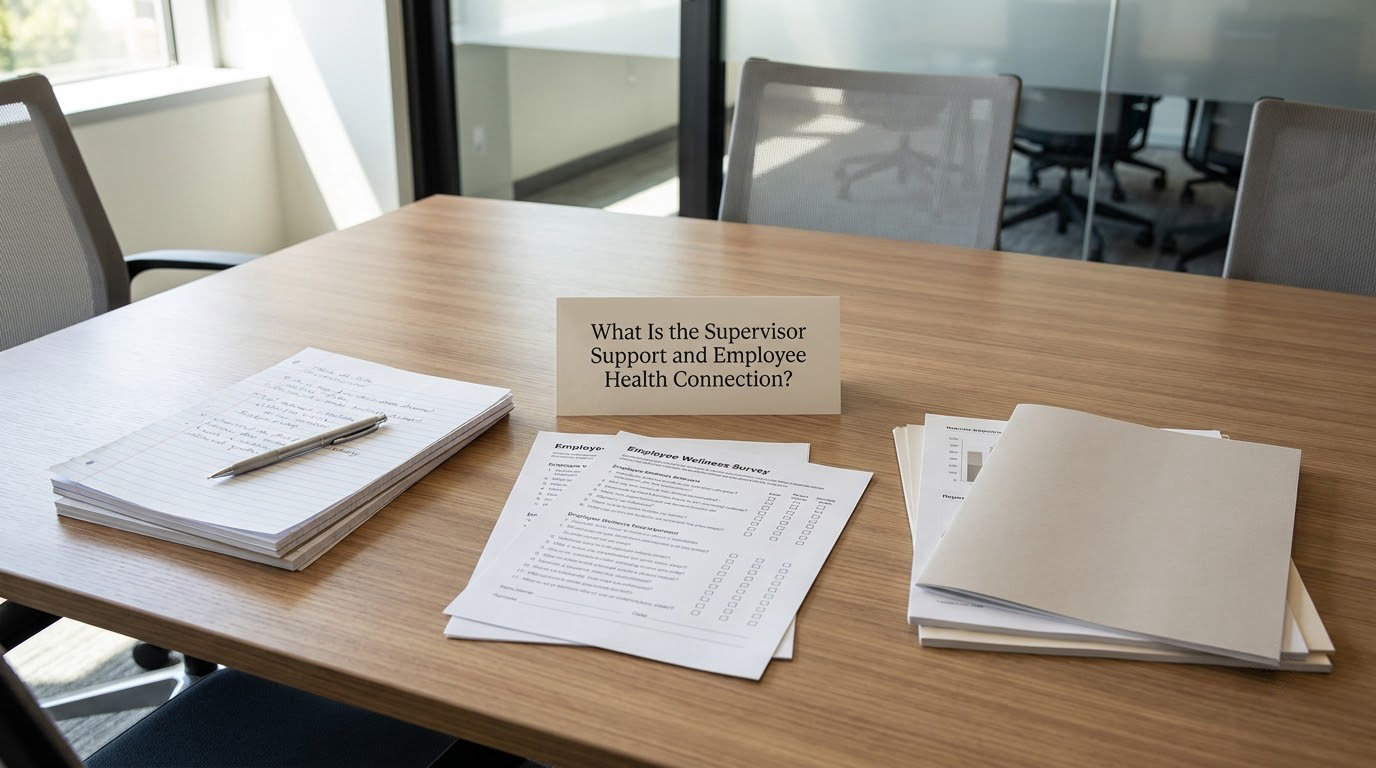
The supervisor support and employee health connection is the documented relationship between a manager’s day-to-day behaviour and measurable physical and mental health outcomes among their team. Supportive behaviour means practical help, empathy, autonomy, clear communication and follow-through. When it is present, employees tend to report lower stress, less burnout, fewer sick days, and stronger job satisfaction and retention.
Three things are routinely confused with it. Benefits are what the organisation provides: health insurance, an Employee Assistance Program, gym reimbursement. Wellness programming is the organised campaign around those benefits. Supervisor support is the human layer in between, and it is the layer employees actually experience. An organisation can fund a superb EAP that nobody opens, because the person who would have to mention it at a check-in is too busy or too uncomfortable.
That distinction matters because of how health risk is framed in occupational health. Agencies such as the CDC and WHO treat psychosocial hazards alongside physical ones: workload, control over work, predictability, support, and the treatment of staff as psychosocial risk factors in their own right. A hazard is something work exposes you to repeatedly. Feeling unsupported by your manager, on a permanent basis, qualifies.
One clarification about direction of effect. Health does not only flow from managers to employees. Workers who are already exhausted need more support, not less, and a manager dealing with their own burnout cannot realistically supply it. The relationship runs both ways, which is why “just train the managers” is a thin strategy on its own.
How Does Supervisor Support Influence Employee Health?
Researchers usually describe the link through the job demands-resources model, which splits workplace factors into demands (effort required) and resources (support, control, equipment). Demands without resources erode health over time. Resources buffer the same demands. Supportive supervision is one of the most proximal resources an employee has, which is why it carries more weight than a distant policy statement.
Five mechanisms show up repeatedly in the literature.
Psychological safety. If raising a problem is safe, it gets raised early, when it is still a scheduling conflict rather than a crisis. Teams with low psychological safety absorb small stressors until they turn into absence or resignation.
Job control. Autonomy over how the work gets done is one of the strongest single predictors of good health in psychosocial research. A manager who hands someone a deadline but no say in the method has removed the buffer without removing the demand.
Stress appraisal. The same workload is benign to one person and threatening to another. A supportive supervisor supplies information and predictability, which changes how the demand is read rather than how much of it there is.
Social connection. Work is a major site of daily contact for most adults. A supportive manager protects connection through team routines, especially for remote staff, where connection no longer happens by default.
Work-family conflict. Family-supportive supervisor behaviours, in the research literature, are the manager actions that help employees handle caregiving and dependent-care demands: flexibility, understanding, and a non-punitive response to a schedule request.
None of these mechanisms make a manager responsible for anyone’s health outcome. The research supports a real association with direction and boundary, not a claim that a manager can cause or cure an illness.
What Makes Supervisor Support Feel Genuine?
Employees tell whether support is real by what happens after they raise something, not by how the conversation opens. From the practice side, and from the threads I read on frontline managers trying to do this well, the behaviours that consistently land are unglamorous.
Listening without fixing. The single most valued behaviour in manager forums is supplying the right number, with no judgement attached, at the moment it is useful. A person who wants solutions gets advice they did not ask for, and often stops talking.
Autonomy on method. Agree the outcome and the date, then let the person choose the route. Monitoring every step is a signal that the outcome is not really theirs.
Fair workload distribution. Support is tested in crunch periods, not in calm ones. Whose deadline moves, and who is quietly absorbing the overflow.
Constructive feedback that is not a performance weapon. Feedback delivered as development is read very differently from feedback deployed in a disciplinary process. Employees can tell which one they are in.
Flexibility granted without a fight. One of the more damaging things a manager can do is make a reasonable request feel like an imposition. The message carried is about whether asking costs you anything.
Protection from discrimination. Support means dealing with a report of harassment or bias rather than smoothing it over for the sake of team harmony.
Follow-through. A promise made warmly and dropped quietly does more damage than never making it. Consistency is what converts support into trust.
There is a useful test. Ask an employee what their manager did the last time they made a mistake. The answer reveals whether the relationship has slack in it, and slack is what support is made of.
Which Workplace Conditions Strengthen or Weaken the Connection?
The same manager behaves differently depending on the system around them. Organisational support theory, the framework behind the perceived organizational support literature, is blunt about this: employees judge support by what their leader actually does, and leaders can only act on the resources and constraints they have. Diagnosing a manager as unsupportive when the staffing model leaves no room is a misdiagnosis.
| Condition that strengthens the link | Condition that weakens it | Why the difference matters |
|---|---|---|
| Psychological safety in the team | Monitoring and surveillance of activity | Safety requires the belief that speaking up is safe. Monitoring teaches the opposite. |
| Predictable scheduling and clear notice of changes | Unstable or last-minute shifts | Unpredictability removes the employee’s ability to plan sleep, care and recovery. |
| Role clarity about priorities | Conflicting expectations from two managers | Conflicting priorities make every task harder and every success feel accidental. |
| Realistic staffing and manager workload | A manager carrying two teams or 40 direct reports | Support is a time-and-attention resource. It cannot be given from an empty calendar. |
| Transparent, timely communication about restructures | Silence followed by an announcement | People cope far better with an unwelcome change they were warned about. |
| Appointments and resources shared as normal | Support framed as a favour for the individual | Framing support as a favour implies the employee is deficient, not the conditions. |
Remote and hybrid work changes the conditions, not the mechanism. The informal cues that told a manager someone was struggling largely disappeared, and the visibility of someone’s effort dropped away. That means connection has to be scheduled rather than assumed, and check-ins that were five minutes on a corridor can need twenty on a video call.
How Can Employers Strengthen Supervisor Support?
If you want better health outcomes, you are buying supervisor capacity, not supervisor sentiment. Five moves carry most of the effect.
- Train managers in the conversation, not the theory. Give them actual phrases, the referral pathway, and the limits of their role. Managers say the same thing repeatedly: they want scripts, not platitudes. Training that stops at “be empathetic” fails on contact with a real disclosure.
- Give managers the authority and the hours. A supervisor who cannot change a deadline, approve a schedule adjustment, or refuse an unsafe assignment is a signpost. Fix the span of control and the protected time before blaming the behaviour.
- Write down what a supervisor must not do. No diagnosing, no demanding detail about a diagnosis, no confidentiality promise you cannot keep, no treating a health disclosure as a performance issue on the spot. A one-page boundary sheet removes the most common sources of harm.
- Build a clear escalation route. A named HR or occupational health contact, an Employee Assistance Program that staff know is confidential, and a same-week response standard. A worried manager on a Friday with no route is where the harm happens.
- Review workload and scheduling at the same time as the survey. If you ask about support and then leave the staffing model alone, the survey becomes a way for people to vent rather than a way for you to act. Change one operational practice and say so publicly.
For disclosure conversations, a workable sequence is: thank them, ask what support would help, be explicit about what you must pass to HR, make one concrete commitment with a date, and check back. That last step is the one organisations skip, and it is the one employees remember.
How Can Employees Recognize and Use Supportive Supervision?
Employees rarely struggle to work out whether their manager is supportive. They struggle to say it, and they often wait for the manager to notice first. Remote work removed the small ambient signals that used to make noticing possible, which is why under-reporting is so common.
Signs worth trusting include check-ins that happen when nothing is wrong, flexibility granted without a lecture, credit shared with the people who did the work, and a response to bad news that stays calm. Warning signs are equally clear: a manager who changes the subject when workload comes up, treats a health matter as a private failing, or is surprised to learn someone is struggling.
When you do raise it, the structure matters. Pick a time that is not the end of a hard week. State the fact and its effect on work, not a medical detail you are not obliged to share. Name what would help: a deadline moved, a task dropped, a schedule adjusted, a referral. Ask for a specific commitment and a date, then follow up in writing. If nothing moves after a second attempt, escalate through HR or the Employee Assistance Program rather than absorbing it indefinitely.
You are also entitled to reasonable accommodation where a disability or health condition is involved, including modified or transitional work on return from illness. That conversation belongs with HR and occupational health, and a supervisor can support it without running it.
If you are in distress, this article is general workplace information, not medical advice. For anything health-specific, speak with a doctor or another qualified clinician, and use your employer’s confidential support services in parallel.
What Should Employers Measure to Know Whether Support Is Working?
Measurement is where most organisations stop early. A single annual engagement survey reports a climate but not a change, and it arrives too late to act. A useful approach pairs a short leading indicator with one or two outcome measures.
Leading indicators, quarterly. Four to six pulse items on a consistent scale is enough. Cover whether the manager listens, whether the workload is manageable, whether schedule changes come with notice, whether raising a problem is safe, and whether the employee knows where to go for help. Add one item on supervisor wellbeing, because it predicts supportive behaviour.
Outcomes, quarterly or biannually. Sickness absence duration and frequency, turnover intention, injury and near-miss reports, and any burnout or psychological safety instrument you use consistently. Voluntary confidential health or well-being checks can be included, provided participation is not linked to individual performance and results never reach a manager in identifiable form.
Protect the data. Report at team level with a minimum group size. Never show a supervisor an individual employee’s health response. If people believe survey answers reach their manager, the measurement destroys the trust it is meant to track, and the responses become unusable within two cycles.
Watch for the trap of treating low absence as a good sign. Where employees fear that reporting illness costs them, absence data falls and burnout rises. Absence plus pulse data plus turnover tells you more than any one of them.
Frequently Asked Questions
Does supervisor support actually reduce employee burnout?
The research points that way, with limits. Supportive supervision raises psychological safety, job control and predictability, which reduce the appraisal of demands as threatening. Low support is consistently associated with higher burnout scores. It is an association with a real effect, not a cure: if the demands themselves are unworkable, no manager closes that gap alone.
What are five effective ways to manage stress in the workplace?
The five that hold up best are practical: protect recovery time and breaks, keep workload realistic, give people control over how they do the work, make schedule changes predictable, and build a team where raising a problem is safe. Two of these are manager decisions and three are organisational. Individual techniques like breathing exercises help in the moment but do not change the conditions producing the stress.
How do I talk to my employer about mental health?
Bring facts and requests, not a diagnosis. Say what is affecting your work, what has changed, and what you need: a deadline moved, a task dropped, a schedule adjustment, or a referral. Ask for a specific commitment and a date, then follow up in writing. You do not have to share clinical detail. If the response is nothing, take it to HR or your Employee Assistance Program, and remember that reasonable accommodation for a health condition is a workplace right, not a favour.
What are some examples of mental health discrimination at work?
Common examples include refusing a reasonable accommodation, treating a health disclosure as a performance problem, retaliating after someone raises a concern, refusing return-to-work or modified duties, and applying a flexible-arrangement policy inconsistently. Stigma shows up in smaller ways too: mocking disclosure, singling someone out, or assuming someone is unreliable because they have disclosed a condition. If it is happening repeatedly, document dates and content and take it to HR.
What are some tips for promoting mental health safety at work?
Start with the supervisor, because that is where policy is experienced. Train managers with real phrases and a clear referral route, write down what they must not do, and give them enough authority and time to act. Support the shift to EAP and occupational health with a named contact and a response standard. Publish the survey results and one operational change you made in response. Keep workload and scheduling reviews on the agenda permanently, not just when someone complains.
Conclusion
The finding is consistent across the occupational health literature: the supervisor support and employee health connection is real, it runs through a small number of identifiable mechanisms, and it is shaped as much by staffing, scheduling and role clarity as by manager intent. Support is judged by what follows a problem, not by how a conversation opens.
So start here. Ask your people one question this quarter about what happened the last time they raised something, and ask your managers the same question about their own workload. Whatever the gap, fix one operational practice, tell people you fixed it, and check again next quarter. That is the whole method, and it works better than any awareness campaign.