
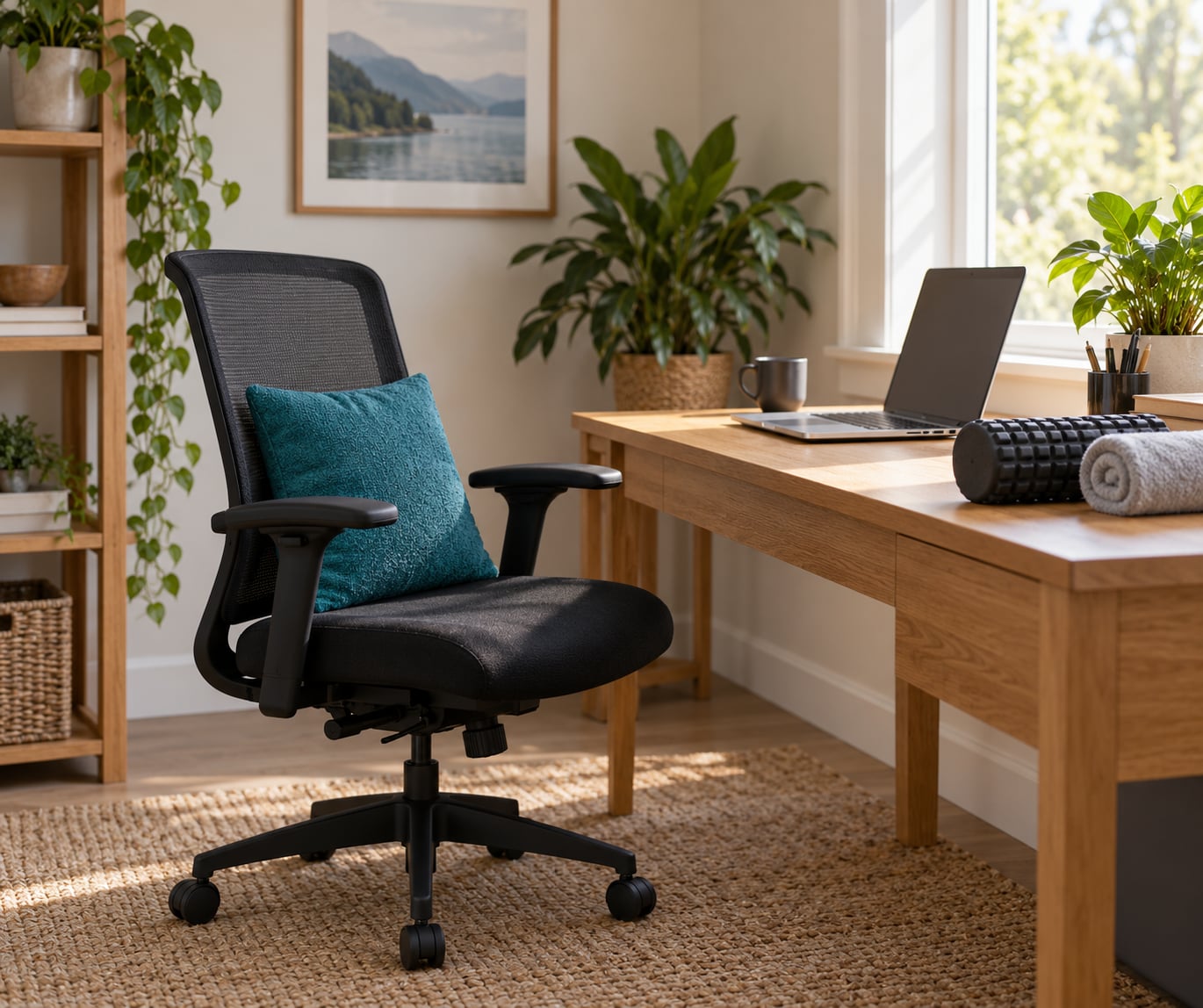
These stretches for lower back pain at your desk take three to five minutes, need no equipment, and can be done in your chair between meetings. The ten moves below target the lumbar spine, hips, glutes and hamstrings, which is where prolonged sitting actually tightens up. They should feel like a gentle release, never a sharp or worsening pain.
Most of us spend more hours seated than standing, and the lower back pays for it. The muscles at the front of the hips shorten, the glutes go quiet, and the lumbar spine spends the day in a slightly slumped position. That combination is why the ache often shows up in the early afternoon and settles once you get up and walk.
Stretching helps, but only within limits. Nothing on this page is medical advice, and if you have a diagnosed disc problem, spinal stenosis, recent surgery, are pregnant, or feel pain that shoots down a leg, talk to a doctor or physiotherapist before you start. This guide is general workplace information for people who want to feel better at their desk, not a treatment plan.
Table of Contents
- Stretches for Lower Back Pain at Your Desk at a Glance
- 1. Seated Knee-to-Chest Stretch
- 2. Seated Spinal Twist
- 3. Standing Hip Flexor Stretch
- 4. Chair-Supported Hamstring Stretch
- 5. Standing Side-Back Bend
- 6. Seated Pelvic Tilt
- 7. Standing Forward Fold with Bent Knees
- 8. Figure-Four Glute Stretch
- 9. Wall-Supported Back Extension
- 10. Seated Cat-Cow Mobility Flow
- How to Build a Comfortable Desk Stretch Routine
- Frequently Asked Questions
- How often should I stretch my lower back at work?
- Should I stretch if my lower back hurts?
- Which desk stretches are best for stiffness after sitting?
- How long should I hold each lower-back stretch?
- When should I stop stretching and see a doctor?
- How do I tell if my lower back pain is muscle tightness or a disc problem?
- What to Do First
Stretches for Lower Back Pain at Your Desk at a Glance
Here is the whole routine on one page. The table lists each move, the area it mainly addresses, a typical hold time, and when it works best during a working day.
| Stretch | Main area addressed | Typical hold | Best time |
|---|---|---|---|
| 1. Seated knee-to-chest | Low back and glutes | 20-30 seconds per side | Mid-morning slump |
| 2. Seated spinal twist | Mid-back and spine mobility | 15-20 seconds per side | After a long call |
| 3. Standing hip flexor | Front of the hip and thigh | 20-30 seconds per side | Start of the day |
| 4. Chair-supported hamstring | Back of the thigh | 20-30 seconds per side | Mid-morning slump |
| 5. Standing side-back bend | Side waist and back | 15-20 seconds per side | Midday |
| 6. Seated pelvic tilt | Lower back and core | 8-10 small reps | Any time, discreet |
| 7. Standing forward fold | Whole back and hamstrings | 20-30 seconds | End of day |
| 8. Figure-four | Glutes and hips | 20-30 seconds per side | Late afternoon |
| 9. Wall-supported extension | Lower back and chest | 10-15 seconds | Late afternoon |
| 10. Seated cat-cow | Full spinal mobility | 5-8 slow cycles | Any time, discreet |
1. Seated Knee-to-Chest Stretch
This is the one most people picture when they think of a lower back stretch, and it is the easiest to do without leaving your chair. It gently lengthens the muscles along the back of your hip and lower spine.
How to do the seated knee-to-chest stretch
Sit tall with both feet flat on the floor and your back away from the chair back. Draw one knee toward your chest, then clasp your hands just below it, around the shin or the back of the thigh. Keep your shoulders down and relaxed.
Keep the other knee pointing at the floor. Breathe in as you set up, and breathe out as you gently pull the knee a little closer. Hold for 20 to 30 seconds, breathing normally the whole time, then release slowly and switch sides.
The common mistake here is rounding hard and hauling the knee toward your chest. If you have a diagnosed disc problem, keep the range small and skip any version that curls you up off the chair.
2. Seated Spinal Twist
A seated twist restores rotation through the mid-back, which is the part of the spine that stops moving first when you sit still for hours. Done well, most of the rotation comes from your ribs and upper back rather than your lower back.
Sit sideways on your chair if you can, feet flat, or face forward and move your knees slightly to one side. Sit up tall, place your right hand on the outside of your left thigh, and turn your chest and shoulders to the left, using your left hand on the chair back for light support.
Look over your left shoulder rather than down. Hold for 15 to 20 seconds, breathing out as you rotate, then come back to center and repeat on the other side. Stop before you feel anything pinching in the lower back.
3. Standing Hip Flexor Stretch
Hip flexors are the muscles that shorten most from sitting, and when they tighten they pull the pelvis forward, which rounds the lower back. This is the stretch that targets the cause rather than the symptom.
Stand up and step one foot about half a pace forward from the other. Keep both feet pointing forward, soften the back knee, and tuck your pelvis under you by squeezing the glute of the back leg. You should feel a stretch in the front of the back thigh and hip.
Keep your torso upright instead of leaning forward, and hold on to your desk edge if you need the balance. Hold 20 to 30 seconds per side, then swap legs. A wall or chair back is a legitimate prop here; nobody is watching your balance over a conference call.
4. Chair-Supported Hamstring Stretch
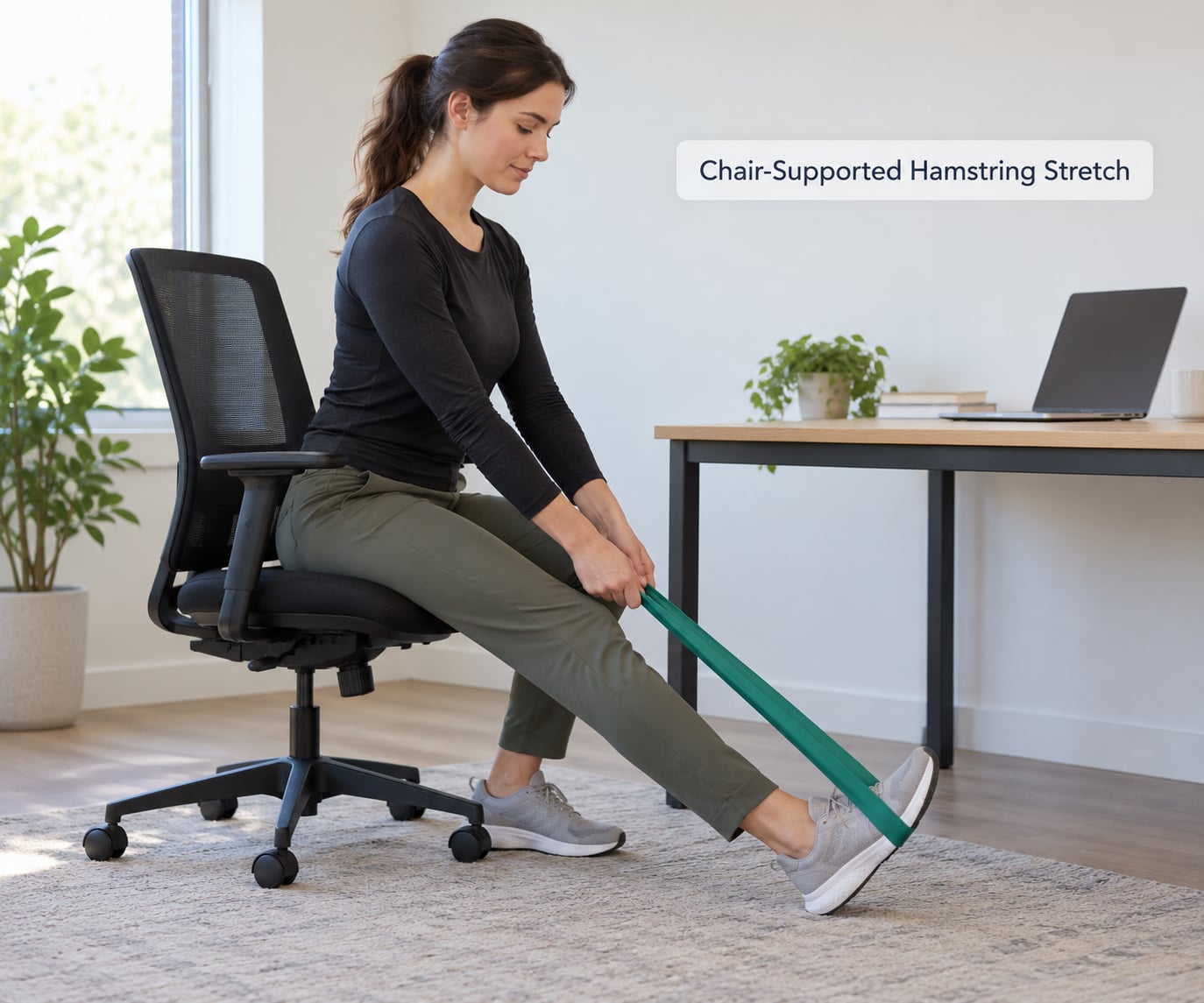
Hamstrings that have been shortened all day pull on the pelvis and add to the feeling of a tight lower back. The trick is to stretch the back of the thigh, not the spine, which is why this version keeps you upright and supported.
Sit on the front half of your chair, one heel on the floor and leg straight out in front of you. Flex your foot so the toes point up toward the ceiling, and hinge forward slightly from the hip until you feel a gentle pull in the back of the thigh. A resistance band looped around the foot gives you more reach without rounding your back.
Hold 20 to 30 seconds, change legs, and repeat. If you feel anything sharp behind the knee, reduce the reach rather than pushing further, and check with a clinician if it keeps happening.
5. Standing Side-Back Bend
This one reaches the side waist and the muscles between your ribs, which tighten when you reach sideways for things all day or lean on one elbow. It is fast, standing, and easy to do near a desk.
Stand with your feet about hip-width apart. Reach your right arm straight up, then let your left hand slide down the outside of your left thigh as you lean your body gently to the left.
Keep both feet planted and your chest facing forward rather than twisting. Breathe out as you lean, hold 15 to 20 seconds, then come up slowly and repeat on the other side. If you feel a pinching sensation in the shoulder, lower the raised arm to shoulder height.
6. Seated Pelvic Tilt
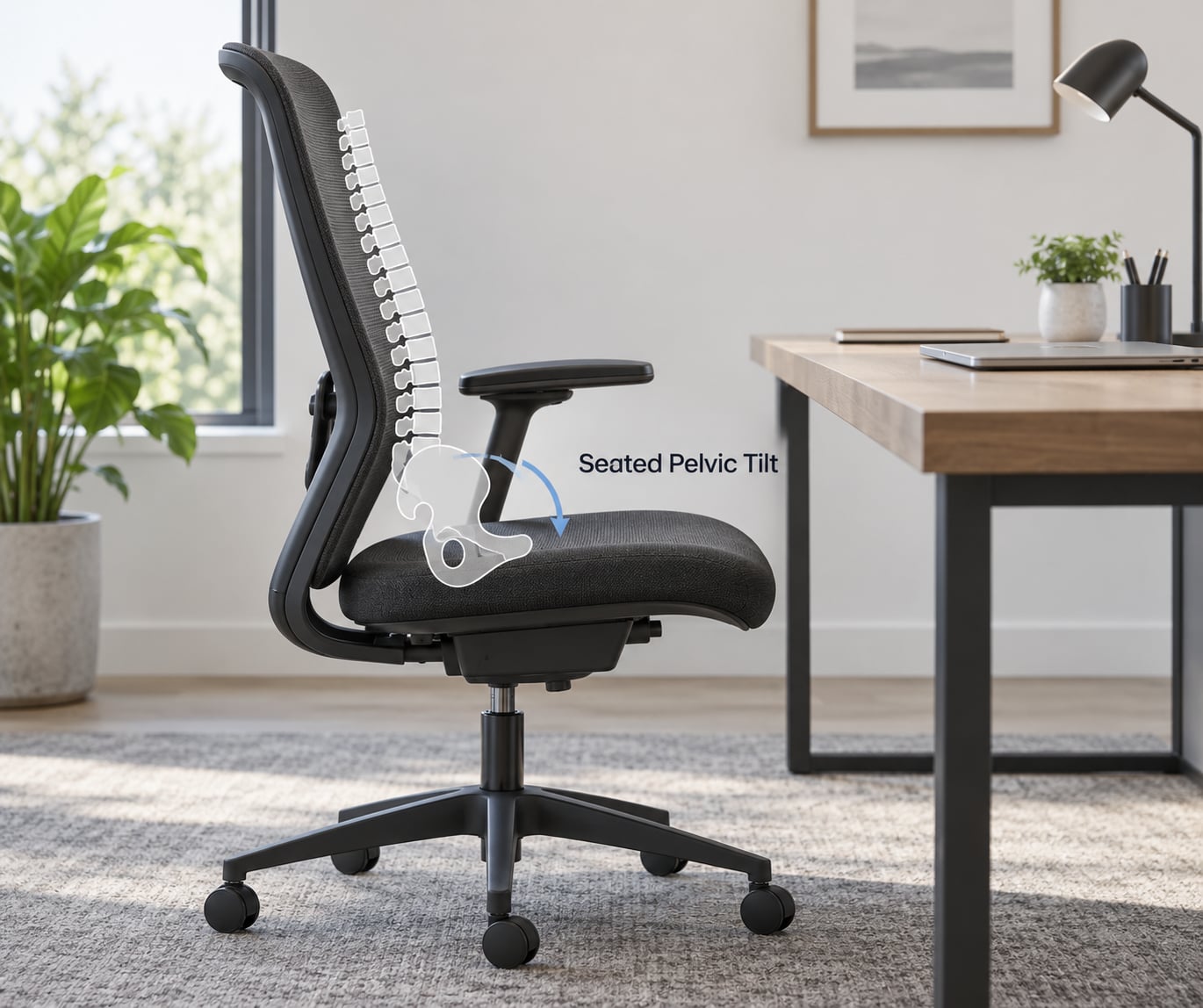
A pelvic tilt is the smallest stretch on this list and the easiest to do without anyone noticing. It is a movement rather than a held position, so it works well when you cannot leave your chair.
Sit with your feet flat and your hands resting on your thighs. Breathe in and let your back arch slightly, opening the front of your body. Then breathe out and draw your lower belly in, tipping your pelvis so your back flattens toward the chair.
Move slowly and only through a comfortable range, about 8 to 10 reps. The point is to notice how your posture changes, not to force a flat back. Treat it as a cue for sitting taller rather than a fix for pain.
7. Standing Forward Fold with Bent Knees
A relaxed forward fold gives you a whole-back stretch at the end of a long day. It suits readers who can stand comfortably without holding onto anything.
Stand with feet about hip-width apart, bend your knees generously, and let your upper body hang heavy. Hold your forearms loosely, or rest your hands on your shins. There is no pulling, no straightening of the legs, and no bouncing.
Breathing slowly, stay for 20 to 30 seconds, then roll up one vertebra at a time. Skip it entirely if you have dizziness, knee problems, or a recent spinal procedure, and stand up slowly at the end to avoid a rush of blood to the head.
8. Figure-Four Glute Stretch
Crossing a leg and hinging forward opens the glutes, which go dormant during long sitting and can leave the lower back doing their job. If your hips feel tight rather than your spine, this is usually the move that helps most. Our guide to desk exercises for stiff hips covers more variations of the same idea.
Sit on the edge of your chair, cross your right ankle over your left thigh so the right knee points out to the side, and keep your foot flexed. Sit tall first, then hinge forward from the hips with a long back until you feel a stretch in the right glute.
Hold 20 to 30 seconds, uncross, and switch sides. A rounded back usually means you have gone too far forward; shorten the reach instead. If you have knee or hip replacement surgery or a hip condition, ask a clinician first.
9. Wall-Supported Back Extension
After hours of forward-leaning work, the front of the body shortens and the back lengthens. A gentle wall-supported extension restores some of that.
Stand facing away from a wall with your feet about a step back from it. Press the backs of your hands, knuckles pointing out, lightly into the wall at waist height. Lean back until the wall supports you and your chest opens, then let your head tilt back slightly, staying in your neck’s normal range.
Breathe out as you lean. Stay for 10 to 15 seconds, come back to vertical, and repeat two or three times. Stop the moment it feels uncomfortable, and do not force the movement if you have been diagnosed with spinal stenosis, which is one of the cases where extension is not appropriate.
10. Seated Cat-Cow Mobility Flow
This is a seated version of the classic cat-cow movement, and it is the best single move for restoring movement through the whole spine after a morning of stillness. Like the pelvic tilt, it is small enough to do between calls.
Sit on the front of your chair, feet flat, hands on your knees. Breathe in and arch your back, lifting your chest and letting your shoulders drop. Breathe out and round your back, drawing your chin toward your chest and pushing your hands gently into your knees.
Move through 5 to 8 slow cycles, leading each movement with your breath. It should stay small, slow and pain-free, and it should not be sharp anywhere. If bending over brings on pain, do the arching half on its own.
How to Build a Comfortable Desk Stretch Routine
When to fit stretches for lower back pain at your desk into your day
Two or three minutes at three set points beats a long session you skip. Most desk workers report the worst stiffness in the middle of the working day, so a short routine at 11am and again at 3pm tends to help more than one long stretch at the end of the day.
A practical rhythm: a two-minute standing sequence in the morning, a three-minute seated set in the middle of the day, and a two-minute standing set before you log off. Between those, stand up and walk for a minute or two. Users on workplace health forums repeatedly describe mixing sitting, standing and walking with brief stretches as what finally held up for them over months, rather than any single stretch.
Build these into existing habits rather than relying on willpower. Set the first one next to your first coffee, the second before your first afternoon call, and the third before you close your laptop. If your employer has an occupational health program, ask whether your team has a stretch or movement break scheduled.
Pause the routine and reassess if you feel sharp pain, tingling, numbness, or anything that radiates down a leg. Temporary comfort from moving is not the same as treating an injury, and stretching is not a substitute for assessment when pain persists beyond a couple of weeks or wakes you at night.
Stretching also does not replace workstation setup. If your feet do not reach the floor, your knees do not form roughly a 90-degree angle, or your lower back has no support, you will undo the stretches within an hour. Our walkthrough of how to set up your desk to prevent back pain covers the adjustments that make the rest of the day easier, and the office ergonomics checklist for desk workers is worth a slow pass once a year or after any move.
One more thing that people miss: strength matters as much as flexibility. Muscles that support the spine get weaker during prolonged sitting, and a stronger back tolerates desk work better than a loose one. A physiotherapist can add a short, spine-friendly strengthening set to this routine if your pain keeps coming back.
Frequently Asked Questions
How often should I stretch my lower back at work?
Two or three short sessions a day beats one long one. Most desk workers notice the most stiffness in the middle of the day, so try a two-minute standing set in the morning, a three-minute seated set at midday, and a short set before you finish. In between, stand and walk for a minute or two. Consistency over weeks matters much more than doing a long session once.
Should I stretch if my lower back hurts?
Usually yes, as long as the movement feels like a gentle release. Gentle mobility is commonly recommended as a way to ease stiffness from prolonged sitting. Stop and do not push through if the pain is sharp, if it radiates down a leg, or if you feel numbness or tingling. If you have a diagnosed disc problem, spinal stenosis, recent surgery, or are pregnant, ask a doctor or physiotherapist first.
Which desk stretches are best for stiffness after sitting?
For general stiffness, start with the seated knee-to-chest stretch and the standing hip flexor stretch, since sitting shortens both the glutes and the front of the hips. The standing forward fold and the figure-four stretch cover the back of the legs. If the stiffness is a sharp, local ache, keep the range small and use the seated pelvic tilt and cat-cow flow instead of deep folds.
How long should I hold each lower-back stretch?
Hold most stretches for 20 to 30 seconds and repeat two or three times per side. Twists and side bends need less, around 15 to 20 seconds, because they work on range rather than a held stretch. Movements like the pelvic tilt and cat-cow flow are not held at all, so repeat them for 8 to 10 slow reps. Stop at mild tension, never at pain.
When should I stop stretching and see a doctor?
Stop and seek medical advice if pain is severe, comes on suddenly, or radiates down a leg. The same applies with numbness, tingling, weakness in a leg, difficulty controlling the bladder or bowel, fever, or unexplained weight loss, which need prompt assessment. Also book a consultation if the pain persists beyond a couple of weeks, worsens over time, or regularly wakes you at night.
How do I tell if my lower back pain is muscle tightness or a disc problem?
Muscle-related pain usually comes on after a long or unusual day, feels broad and achy across the lower back or buttocks, eases with gentle movement, and settles within a few days. Disc or nerve-related pain tends to shoot down the leg, is worse on coughing or sneezing, and can bring numbness, tingling or weakness. Only a clinician can tell you which you have, so get checked before you guess.
What to Do First
Stand up right now, change your position, and try two moves: a seated knee-to-chest stretch on each side, then a standing hip flexor stretch. Do not force either one. If the pain is mild and eases with the movement, add the rest of the routine a few stretches at a time over the coming days.
If the pain is severe, radiates down a leg, comes with numbness or weakness, or has lasted more than a couple of weeks, book an appointment with a doctor or physiotherapist before adding anything else. For anyone working at a desk eight hours a day, adjusting the workstation and moving more often through the day is what keeps the stretches working. General information only, not medical advice.