
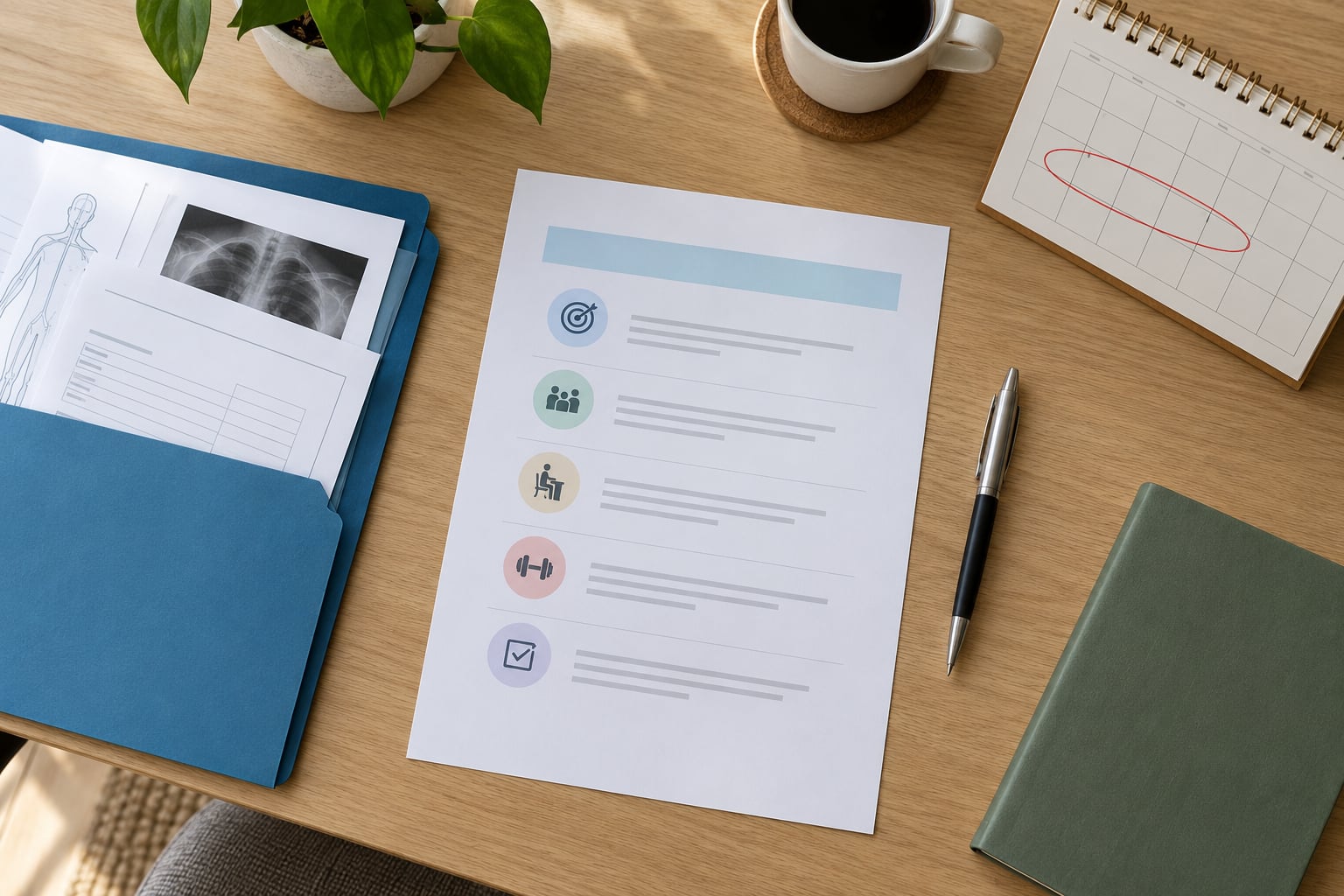
The safest way to return to work after a long illness is slowly: confirm with your clinician that you are ready, match your duties to any written restrictions, and agree a schedule that builds up over weeks rather than days. Most people who relapse after a big illness do it because they went back at full pace too soon, not because they were weak.
Getting back to a workplace you have not seen in months is genuinely disorienting. Different colleagues, different systems, and a desk job that once felt easy now costs three times as much. The good news is that a phased return is a normal, well-understood arrangement that employers already handle, and most of the work is preparation you can do before your first day.
This guide covers the practical side of that process: what to gather, who does what, and how to know each step worked. It covers general workplace process, not medical decisions. Everything about your health belongs with your doctor or another qualified clinician, and every restriction discussed here should come from them rather than from an employer or from this page.
If you are returning after mental health leave, cancer treatment, major surgery, a stroke, Long Covid or another long-term condition, the same framework applies. Only your clinician can say when you are medically ready, and only your employer can say what the job requires of you. Everything between those two is process, and process is what this article is for.
Table of Contents
- What You Need Before You Plan the Return
- Step-by-Step: A Gradual Return to Work Plan
- 1. Confirm when you are medically ready
- 2. Identify the physical and mental demands of your job
- 3. Discuss a realistic return-to-work date
- 4. Ask about a gradual or modified schedule
- 5. Put accommodations in writing
- 6. Prepare your workplace and daily routine
- 7. Start carefully and track how work affects recovery
- 8. Review and adjust the return plan
- Common Mistakes That End the Return Early
- Going back before you are ready because the date has arrived
- Treating the first week as a permanent arrangement
- Leaving the accommodations verbal
- Increasing hours too fast
- Ignoring the commute and everything outside work
- Pushing through warning signs
- Working through illness because presence seems to matter more than health
- Frequently Asked Questions
- How long should I wait before returning to work after a long illness?
- Can I return to work part-time after a long illness?
- What if my doctor gives work restrictions I cannot follow?
- Should a gradual return-to-work schedule include remote work?
- What should I do if symptoms get worse after returning to work?
- Start With a Safe, Written Plan
What You Need Before You Plan the Return
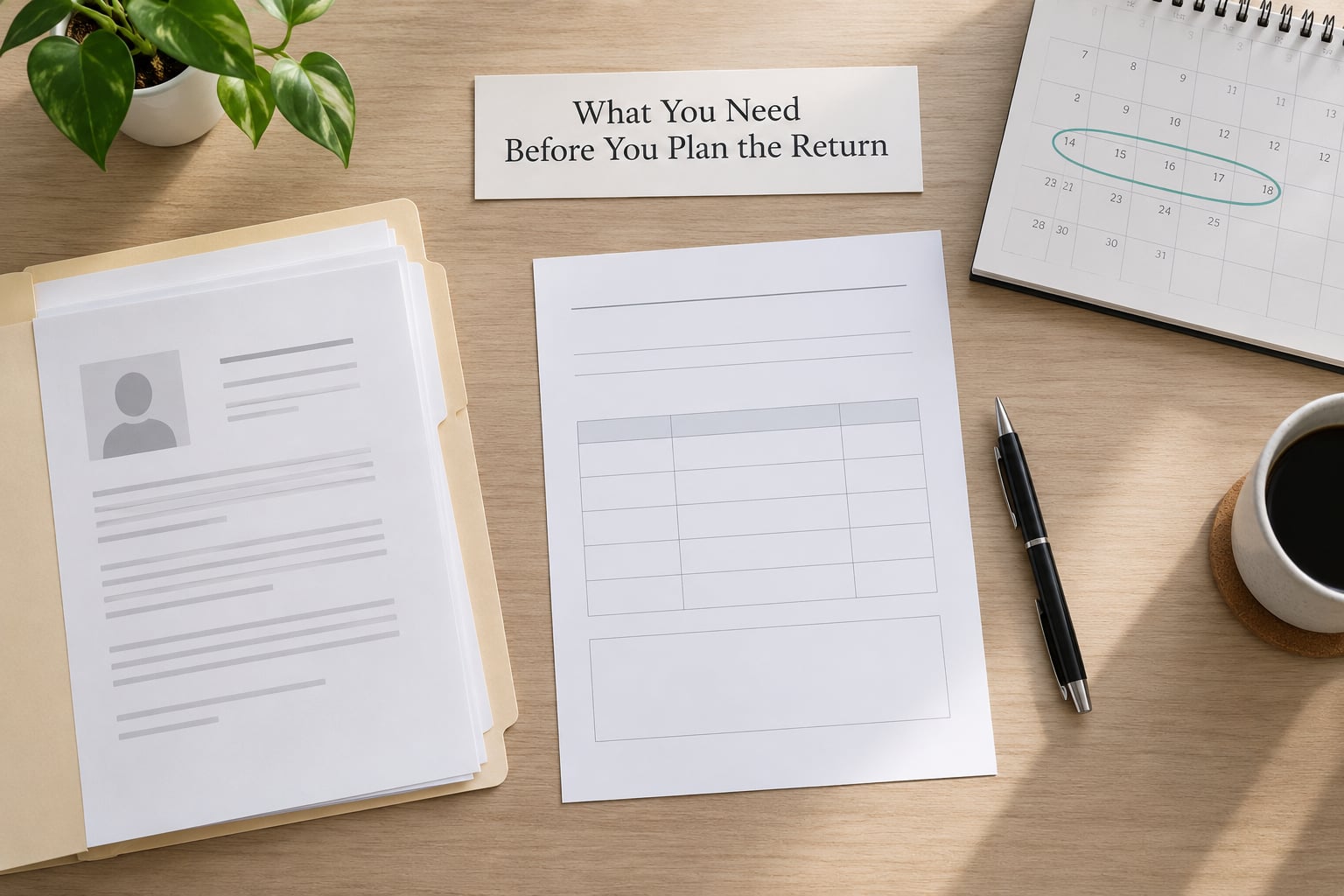
The conversation with your manager goes much better when you arrive with information rather than requests. Gather these five things before you send a single email.
Your medical documentation and restrictions
Ask your doctor or occupational health clinician for a written statement that says what you can and cannot do at work. Depending on your country, this may be called a fit note, a statement of fitness for work, a fitness-for-duty certificate or a return-to-work note. Ask for specifics: no lifting above a certain weight, no standing beyond a set time, no night shifts, breaks at set intervals, or reduced hours.
A vague note that says “not fit for work” without detail helps nobody. The useful version names the tasks to avoid and, ideally, a timeframe. If you work in the UK, a fit note can say you may be able to return to work with certain adjustments, which opens the conversation early.
Your job description and real demands
Pull your job description and a typical week’s tasks from memory, because it is probably out of date. Note the physical demands, the mental load, the technology you will need to relearn and the people you depend on. You may also want to see how long your employer can go without you before it starts to matter commercially, since that quietly shapes how flexible the phased return can be.
Workplace contacts and paperwork
Identify three people: your line manager, whoever handles HR or absence, and the occupational health service if your employer has one. Ask whether your employer runs a return-to-work interview or support programme. In some organisations this is referred to as a return-to-work interview, a health and work assessment, or an occupational health referral, and it is normal to be asked to attend one.
Your recovery information
Write a short summary of your illness, treatment and expected recovery trajectory, as your clinician described it to you. Write down the expected duration of any restrictions and the date of your next review. Bring a realistic estimate of your availability, including appointments you know about in the coming weeks.
Your financial and practical constraints
Note how you will manage the transition financially if you are returning on reduced hours for a few weeks, and check what your employer pays during a phased return before you assume anything. Rules on sick pay, phased return pay and self-certification vary by country and by employer, so ask your HR team rather than relying on general guidance online.
Step-by-Step: A Gradual Return to Work Plan
Eight steps, roughly in the order they usually happen. The employee and the manager share most of them, and clinical input sits underneath all of them.
1. Confirm when you are medically ready
Your clinician decides when you can return, not a calendar and not your employer. Ask them to review how you actually function now: energy through the day, sleep, concentration, and any symptoms that come and go. Ask for an expected duration for the restrictions and a review date, so the plan has an end point rather than running indefinitely.
Do not treat a set number of days as clearance. Recovery from illness is rarely linear, and readiness for one role differs from another. How to return to work after a long illness starts here, and everything else is downstream of this conversation.
How you know it worked: you have written confirmation that you are fit to return, with the conditions attached.
2. Identify the physical and mental demands of your job
List the tasks that actually eat your energy, not the ones on the job description. For a warehouse role that is lifting, standing and driving. For a teaching role it might be managing a full class, being on your feet all day and dealing with conflict. For a desk role it is often sustained concentration, screen time and back-to-back meetings.
Also list what is not sustainable yet. Post-viral fatigue and long-term illness often make sensory load the real limit rather than physical effort, so note noise, crowds, night driving or rapid task switching if those affect you.
How you know it worked: you have a task-by-task picture that maps against your restrictions rather than a generic job description.
3. Discuss a realistic return-to-work date
Suggest a date that gives you a real first day, not a token half-day squeezed between appointments. Managers mostly worry about two things at this stage: whether you will actually be there on the day, and whether they can cover your work in the meantime. Answer both.
Agree in advance who tells your team, and what they say. A short message from you, or from the manager with your agreement, prevents a hundred small awkward conversations on day one.
How you know it worked: you have a date on a calendar and a named contact for questions that come up before it.
4. Ask about a gradual or modified schedule
This is the part people find hardest to ask for, so say it plainly: could I start with four hours on Tuesday and Thursday rather than five full days? Options usually include reduced hours, fewer days, remote work where the role allows, amended duties, additional breaks, and a gradual increase in workload. Some employers also offer compressed hours or a trial period on a team with lighter demands.
Which option suits you depends on your condition and your job. Someone recovering from hand surgery needs modified duties; someone rebuilding stamina after Long Covid usually needs fewer hours; someone returning from depression may do better with a quieter desk and predictable tasks. If your employer already has a formal phased return or workplace adjustment policy, this is simply how that policy is used.
How you know it worked: you leave the meeting with the hours and duties written down, not just agreed verbally.
5. Put accommodations in writing
A one-page plan prevents almost every dispute later. It should cover the start date and hours, the tasks you are and are not doing, the equipment or ergonomic changes needed, the temporary adjustments with an end date, the review point, and who is responsible for each action.
Treat it as temporary unless your clinician says otherwise. Adjustments made “for now” with no review date tend to quietly become permanent or quietly disappear. If your adjustments relate to a disability or long-term condition, our guide to how to accommodate workers with disabilities at work goes deeper on the legal framing.
How you know it worked: both you and your manager hold the same written version.
6. Prepare your workplace and daily routine
Before your first day, sort the physical setup: chair, screen height, anything you need within easy reach, and a route to breaks that does not involve stairs. If you are working from home, set a boundary so you can actually stop at the end of the day. Learning how to set boundaries at work matters more here than usual.
Then sort the commute, childcare and any appointments that compete for the same hours. Fatigue often shows up in the shoulders and lower back first, so the ergonomic setup is not a nicety. Build your day’s tasks around one demanding piece of work rather than five, and put the recovery time around it in the schedule where colleagues can see it.
How you know it worked: you can get through a normal day without improvising a workaround.
7. Start carefully and track how work affects recovery
Work inside your agreed limitations even on a good day. The pattern people describe on workplace forums is consistent: a decent week gets followed by an attempt to catch up, then a crash and a second absence. Knowing how to return to work after a long illness means pacing to the plan rather than to how you happen to feel on Wednesday.
Keep a short daily note for the first two weeks. Record your hours, how you felt in the morning and mid-afternoon, any symptoms, and whether sleep that night was normal. It sounds fussy and it is not, because six weeks later you will not remember. Patterns show up fast on paper and stay invisible in memory.
Know your escalation route before you need it: who you contact when symptoms worsen, and whether your employer has an occupational health service you can self-refer to. Most employers would far rather hear from you early than read about it later.
How you know it worked: you can point to a daily record showing steady, manageable weeks.
8. Review and adjust the return plan
Book two check-ins rather than one. The first sits a few days in and is about the mechanics: what actually happened, what broke, what nobody told you. The second sits a few weeks in and is about whether the adjustments are working.
Use both to adjust hours, duties or support, and to set a clear endpoint. A plan with a review date and a target gives everyone something to work towards. A plan with neither tends to drift until either the person is fully back or they have broken down.
How you know it worked: each review produces a small written change, or a decision that no change is needed.
Common Mistakes That End the Return Early
Going back before you are ready because the date has arrived
A planned return date is a target, not a deadline that overrides your clinician. If your review says you are not ready, ask to move it rather than attempting it and hoping.
Treating the first week as a permanent arrangement
Plenty of returns stall because nobody ever says the phased part is temporary. Put an end date on it in week one.
Leaving the accommodations verbal
Agreeing reduced hours in a meeting and never writing them down produces a slow drift back to full duties with nobody deciding it. One page, signed by both of you.
Increasing hours too fast
Moving from four days to five in week one is the most common trigger for a second absence. Build up in steps you could sustain for a month, not a day.
Ignoring the commute and everything outside work
A forty-minute journey plus a full day is a full day plus. Count the whole day, not the hours at the desk.
Pushing through warning signs
Chest pain, severe breathlessness, fainting, or a sudden and clear worsening of your condition are reasons to stop and get urgent medical help, not reasons to finish the week. If anything like that happens, contact your healthcare provider promptly, or emergency services if it is severe.
Working through illness because presence seems to matter more than health
Turning up unwell often lowers output for longer than taking the time off would have. Our article on how to address presenteeism at work covers why that trade-off is rarely worth it.
A few habits that help more than anything else: keep the daily record, keep the review dates in the diary, and keep the plan short enough that your manager can actually hold it in their head.
Frequently Asked Questions
How long should I wait before returning to work after a long illness?
There is no fixed waiting period. Readiness depends on your condition, its treatment and how you actually function day to day, so ask your doctor or occupational health clinician rather than counting days on a calendar. They can also estimate how long any restrictions are likely to last, which is what you use to plan a phased schedule and a review date with your employer.
Can I return to work part-time after a long illness?
Often yes, and many employers treat reduced hours as a normal part of a phased return rather than a favour. Ask whether you can start with shorter days, fewer days in the week, or remote work where the role allows, then agree a review date and a target for building hours back up. What you are paid during that period depends on your contract and on sick pay rules where you live, so check with HR.
What if my doctor gives work restrictions I cannot follow?
Say so early rather than on the first day. Restrictions are usually about task type, hours or pace, and many jobs can be rearranged around them, so take them to your manager in writing and ask which duties need changing. If a specific restriction cannot be accommodated in your role, ask about alternative duties, remote working or a later start date, and raise it with HR or a trade union representative if needed.
Should a gradual return-to-work schedule include remote work?
It depends on whether the job can be done remotely. Working from home removes the commute, which is often the hardest part of early recovery, and it makes shorter days easier to schedule. But if your role needs to be on site, or you recover better with structure and company, a phased return on site works just as well. Ask what is genuinely possible, then judge it against your own pattern of energy through the day.
What should I do if symptoms get worse after returning to work?
Do not wait for the next scheduled check-in. Tell your manager and your occupational health or HR contact, and contact your healthcare provider, because a worsening of your condition may mean the plan is set at the wrong pace rather than that you are failing. If you have chest pain, severe breathlessness, fainting or a sudden sharp worsening, seek urgent medical help instead of waiting for a workplace response.
Start With a Safe, Written Plan
If you take three actions this week, make them these. Get written confirmation from your clinician that you are ready, and what the conditions are. Map your real tasks against those conditions and bring the list to your manager. Then put the hours, duties, adjustments and review dates on one page that both of you keep.
Everything after that is adjustment: check in early, check in again a few weeks later, and change the plan when the evidence says to. Building the return to work after a long illness around what your body can actually sustain is what keeps you in the role rather than back on sick leave.