
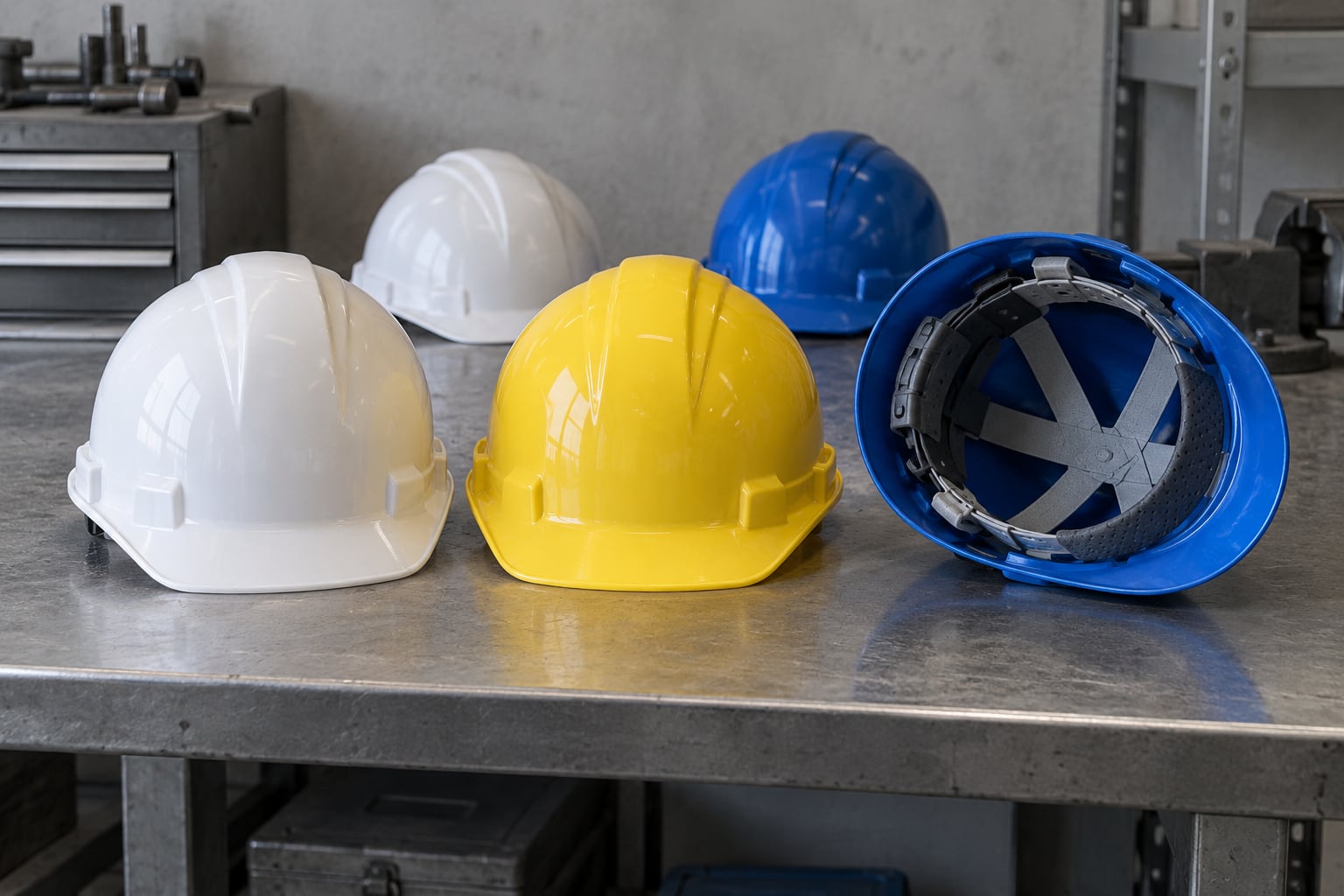
A hard hat’s Type tells you which direction an impact can come from, and its Class tells you how much electrical voltage the shell is rated to withstand. Type I protects the top of the head only; Type II adds lateral protection. Class G is rated to 2,200 volts, Class E to 20,000 volts phase to ground, and Class C carries no electrical insulation rating at all.
Those two systems get mixed up constantly, on job sites and in the supply closet alike. Getting hard hat types and classes explained clearly takes about two minutes and clears up most of that confusion. Get them backwards and you end up with a helmet that is comfortable, well-fitted, and completely wrong for the hazard in front of you. This guide walks through what each marking means, where to find it, and how to match it to the work.
Table of Contents
- Hard Hat Types and Classes Explained at a Glance
- What Are the Different Types of Hard Hats?
- What Do Hard Hat Electrical Classes Mean?
- Can a Hard Hat Be Both Type II and Class G?
- Hard Hat Types and Classes: ANSI, CSA, and EN Standards
- How Do You Choose the Right Hard Hat for a Job?
- What Is the Difference Between Hard Hats and Safety Helmets?
- How Are Hard Hats Inspected, Cleaned, and Replaced?
- Frequently Asked Questions
- What does Type II Class G mean on a hard hat?
- Is a hard hat with a Class E rating safe around all electrical hazards?
- Do all OSHA-compliant hard hats have the same impact protection?
- Can employers require workers to use their own hard hats?
- How often should hard hats be replaced?
- Are vented hard hats appropriate for every workplace?
- Conclusion
Hard Hat Types and Classes Explained at a Glance
ANSI/ISEA Z89.1, the US standard for industrial head protection, classifies helmets on two independent axes. Neither one tells you anything about the other, and markings vary by model and manufacturer, so always read the full label rather than assuming.
| Marking | Category | What it covers | Typical voltage rating |
|---|---|---|---|
| Type I | Impact | Top of the head only | Not applicable |
| Type II | Impact | Top plus lateral front, back and side | Not applicable |
| Class G | Electrical | General use, limited incidental contact | 2,200 volts |
| Class E | Electrical | High-voltage work, dielectric rated | 20,000 volts phase to ground |
| Class C | Electrical | Conductive, no insulation claim | None |
A single helmet can carry one Type marking and one Class marking at the same time. You will see combinations like Type II Class G, which means lateral impact protection plus general electrical protection.
What Are the Different Types of Hard Hats?
Type I helmets are tested for impact absorption and penetration resistance from above, aimed at the crown of the head. That is the classic scenario: a dropped tool, a falling conduit, a brick off a scaffold. Most construction and general industry sites run on Type I.
Type II helmets add lateral impact testing on the front, back and sides of the shell. Branches, ladder rails, swinging loads and vehicle overhangs all come in from the side, which is why Type II has spread through forestry, utility line work, oil and gas and rigging.
Two things Type II is not. It is not twice as protective, and it does not authorize you to climb, fight fire or work an arc flash boundary. It is a broader impact test, not a licence to enter hazards that require separate standards and separate equipment.
How Do I Read the Markings Inside a Hard Hat?
Turn the shell over. Almost everything you need is moulded or printed under the brim or on the rear of the interior crown. Look for these in order:
- Manufacturer or brand name. Useful later for replacement parts and retirement criteria.
- Model and size. Often a size range such as 6 1/2 to 8, moulded into the crown.
- Standard and certification mark. ANSI/ISEA Z89.1, CSA Z259.1, or an EN standard with a year number.
- Manufacture date code. Usually a moulded year and month, sometimes a lot number instead.
- Type marking. Type I or Type II, usually inside a shield-shaped logo or moulded letters.
- Class marking. Class G, E or C, often as a letter stamped into the shell.
If a helmet has no standard mark, no Type or Class, or a date code you cannot read, treat it as unverified until the manufacturer confirms it in writing. Manufacturers set their own retirement criteria in the instructions for use, and an undamaged shell can still be past its service life under those instructions.
What Do Hard Hat Electrical Classes Mean?
Electrical classes describe dielectric performance, meaning how the shell behaves when it meets an energized conductor. They say nothing about impact protection, and a Class E helmet is never automatically a Type II helmet.
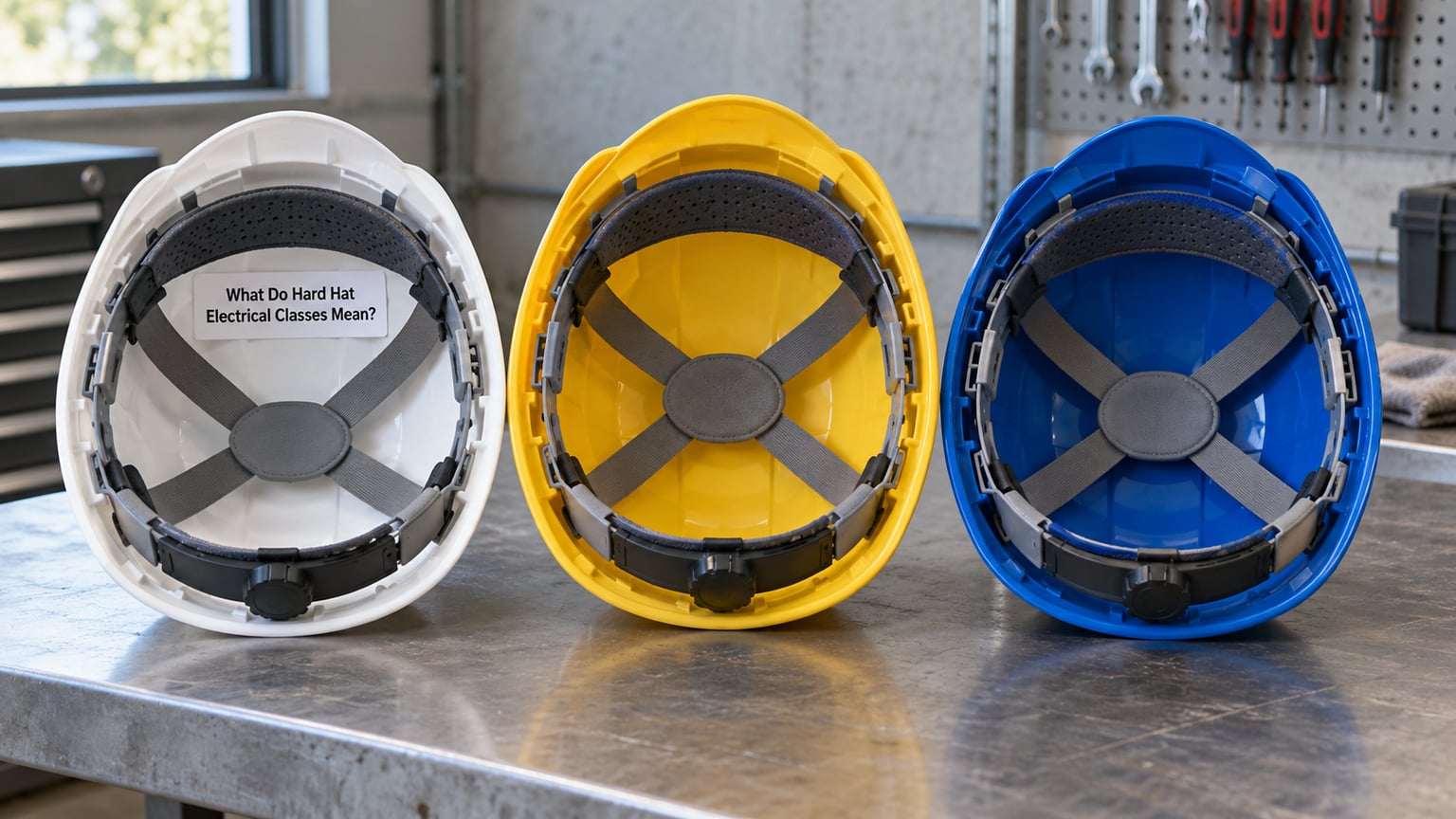
The three ANSI classes break down like this:
| Class | Meaning | Voltage | Where it fits |
|---|---|---|---|
| Class G | General purpose | 2,200 volts | Construction, general industry, most sites with incidental electrical contact |
| Class E | Electrical | 20,000 volts phase to ground | Utility line work, substations, power generation, high-voltage environments |
| Class C | Conductive | None | Confined space entry, furnace and foundry work, areas with conductive contaminants |
Class G and Class E shells are nonconductive, built from materials that do not carry current. Class C is the opposite: it is a conductive shell, typically metal or a conductive composite, chosen precisely so accumulated static can drain away rather than build up and spark. Wearing a Class C helmet near energized equipment is the wrong call.
Class E does not make you safe to touch a 20 kV conductor. It certifies dielectric withstand under test conditions, not permission to work de-energized or without proper approach boundaries. Under NFPA 70E and OSHA’s electrical safety rules, arc flash and shock protection still come down to energized work permits, boundaries and the correct PPE category. Our Lockout Tagout Procedure Explained: OSHA Guide covers that process in detail.
Can a Hard Hat Be Both Type II and Class G?
Yes, and it is common. Type and Class describe two different performance characteristics, so a shell can be tested for lateral impact and for dielectric protection at the same time. Those helmets usually carry both markings inside the shell.
What a dual rating does not mean is that the model can stand in for any helmet. A Type II Class G helmet still does not replace a Class E helmet on line work, and it does not replace a full brim helmet where falling objects are a hazard. Read the complete label, then match it to the specific hazard rather than to a general idea of the job.
Hard Hat Types and Classes: ANSI, CSA, and EN Standards
US crews work under ANSI/ISEA Z89.1, published with ISEA. Canada uses CSA Z259.1, which has its own Type I and Type II equivalents but its own certification process. Europe uses EN standards, and those terms do not map cleanly onto the ANSI system.
| Standard | Scope | Key point |
|---|---|---|
| ANSI/ISEA Z89.1 | Industrial head protection, United States | Type I and Type II impact, Class G, E and C electrical |
| CSA Z259.1 | Industrial head protection, Canada | Parallels ANSI types and classes with its own certification body |
| EN 397 | Industrial safety helmets, Europe | Shock absorption and penetration, optional 440 V AC electrical test |
| EN 12492 | Work at height helmets, Europe | Includes chinstrap retention for working at height |
| NFPA 70E | Arc flash and shock protection, United States | Separate PPE category system, not a hard hat classification |
Labels are not interchangeable. A helmet marked to EN 397 has not been tested to ANSI lateral impact requirements, and an ANSI Class E helmet has not been tested to EN electrical test conditions. For multinational crews buying equipment in another standards system, ask for dual-certified models and keep the conformity documentation on file.
One more correction worth making: OSHA does not approve hard hats. There is no list of OSHA-approved helmets, and a product claiming OSHA approval is telling you it has no recognized certification behind it. OSHA 29 CFR 1910.135 requires head protection meeting a consensus standard, and that means the ANSI or CSA mark on the shell, not a government seal.
How Do You Choose the Right Hard Hat for a Job?
Start with the hazard assessment, not with the price tag or the colour everyone else wears. A written assessment is the fastest way to catch what a walk-through misses, and our Health Risk Assessment for Employees Explained walks through building one.
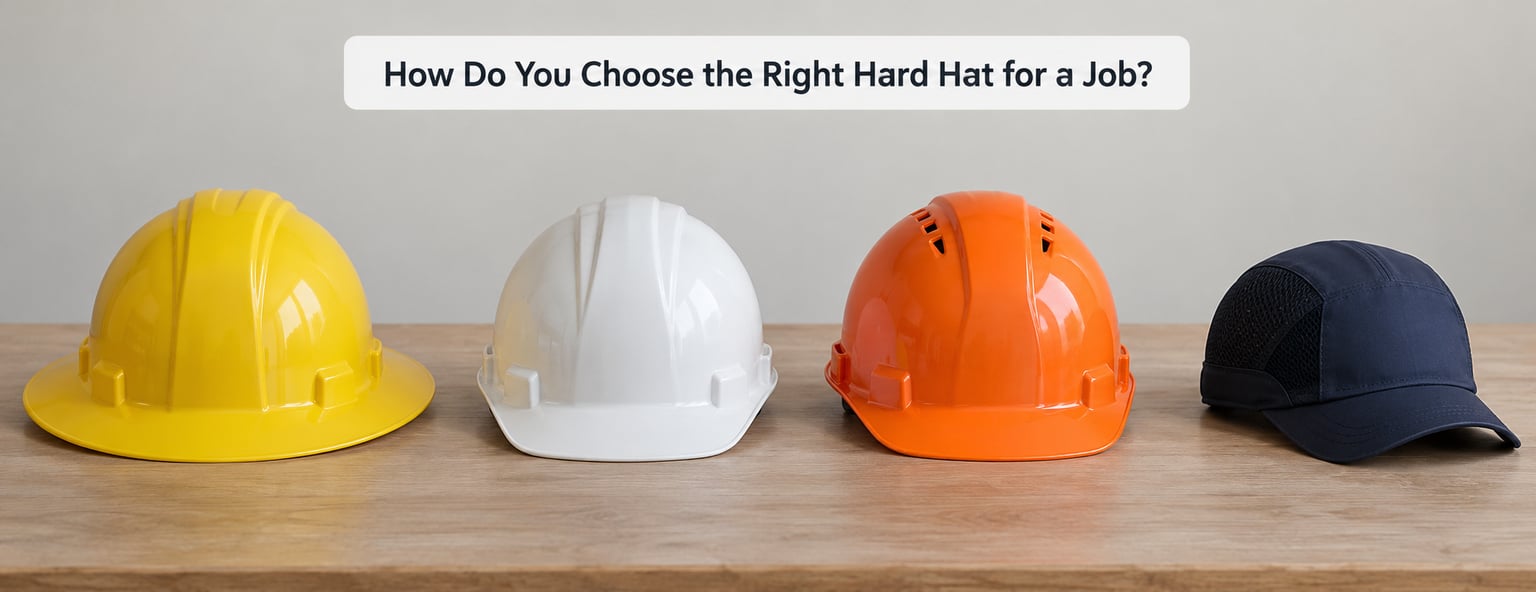
- Map the impact hazards. Mostly overhead hazards such as tools and materials point to Type I. Sideways hazards from branches, rigging, equipment or vehicles point to Type II.
- Map the electrical exposure. No energized work and only incidental contact means Class G. Line work and substations mean Class E. Conductive dust or confined space entry means Class C.
- Check heat and fire exposure. Welding spatter, hot work and foundry radiant heat call for flame-resistant models or a dedicated welding helmet, not a standard hard hat.
- Look at head clearance. Where workers crouch under steel or equipment, a bump cap addresses low-clearance impacts, but it is a supplement and not a substitute where a full helmet is required.
- Decide on ventilation. Vented shells improve comfort in heat. Check that the vents do not compromise the electrical class you need and that no contaminant can enter through the vents.
- Check PPE compatibility. Earmuffs, face shields, hats and chinstraps attach through accessory slots or ratchet systems. Mixing components from different manufacturers can take the assembly outside its certified configuration.
- Read the manufacturer’s instructions. Fit, service life, cleaning agents and accessory rules all live there, and they override anything general you have read online.
Comfort deserves more weight than it usually gets. A helmet that gets worn properly, all shift, is worth more than a marginally better shell nobody wants to put on. Fit and accessory compatibility end up deciding more purchases than the label does, especially where crews are weighing Type 2 Class E models for line work.
What Is the Difference Between Hard Hats and Safety Helmets?
They are not two different products. In US usage a hard hat is a safety helmet; the terms describe the same shell, suspension and brim arrangement. What differs is shell material and shell design, not safety category.
Shell materials fall into three families. HDPE is lightweight and inexpensive, which makes it the default for general construction work. Fiberglass shells are heavier but resist heat and chemicals better, and riggers and signalmen often choose them for durability and craft identity. Polycarbonate shells are lighter than fiberglass with good impact performance, though they cost more and scratch more readily.
By design, a full brim helmet shades the neck and shoulders from sun and falling debris. A cap style helmet has a short front peak instead and suits work where a brim would catch on something or interfere with hearing protection. A bump cap is a low-profile shell that covers the crown only, intended for low head clearance.
Colour is convention, not standard. White for supervisors, yellow for labourers, red for fire marshals, green for safety staff and pink for new hires are widely used site customs in North America, but they carry no ANSI meaning and differ from company to company. Use colour to identify roles, never to identify protection.
How Are Hard Hats Inspected, Cleaned, and Replaced?
Inspection happens before every use and formally on a schedule your employer sets. The pre-use check takes under a minute:
- Shell. Look for cracks, punctures, dents, deformation, scuffs that expose the liner and any sign of UV fading or chemical attack.
- Suspension. Check the crown straps, ratchet and cradle for cuts, stretched webbing, broken stitching and cracked plastic.
- Sweatband and accessories. Replace a soaked or degraded sweatband, and confirm attached accessories are undamaged and correctly seated.
- Markings. Confirm the standard, Type, Class and date code are still legible.
- Condition after contact. Any helmet struck, dropped hard, exposed to chemicals above its rating, or involved in an electrical event comes out of service immediately, no inspection needed.
Clean with mild soap and lukewarm water, or the detergent the manufacturer recommends. Solvents, paints, fuels and aggressive cleaners attack shell materials and can quietly reduce both impact and dielectric performance. Dry it away from direct heat.
On retirement: OSHA sets no universal expiry date for hard hats, and the widely repeated five-year rule is not an OSHA requirement. Age limits come from the manufacturer, who knows how each shell material degrades. Follow those instructions, replace immediately after any significant impact, and keep records where your site requires them. Fit and long-shift comfort issues are worth taking seriously too, and our Total Worker Health Approach Explained covers why comfort affects protective equipment use.
Frequently Asked Questions
What does Type II Class G mean on a hard hat?
It means the helmet passes both US impact and electrical tests: Type II covers top plus lateral impacts from the front, back and sides, while Class G provides dielectric protection up to 2,200 volts. The two ratings are independent, and the combination is common on construction and industrial sites. It still does not authorize high-voltage line work, which needs a Class E helmet.
Is a hard hat with a Class E rating safe around all electrical hazards?
No. Class E certifies the shell to withstand 20,000 volts phase to ground under test conditions, but it does not let you contact energized parts or substitute for shock and arc flash protection. Approach boundaries, energized work permits, insulating gloves and the correct arc flash PPE category still apply. Treat Class E as one layer in a system, not the system itself.
Do all OSHA-compliant hard hats have the same impact protection?
No, and OSHA does not approve hard hats as products. The rule requires head protection meeting a consensus standard, which means the shell must carry an ANSI Z89.1 or CSA Z259.1 mark. Within that standard, Type I and Type II provide different impact coverage, so two compliant helmets can protect very different parts of the head.
Can employers require workers to use their own hard hats?
Employers can require personal head protection, but they remain responsible for providing a safe system of work, including making sure helmets in use are certified, undamaged and within the manufacturer service life. Many sites require issued helmets for exactly that reason. If personal helmets are allowed, ask for proof of the standard marking and inspect them like any other PPE.
How often should hard hats be replaced?
OSHA sets no fixed replacement interval, and the common claim that hard hats must be replaced every five years is not an OSHA rule. Replacement timing comes from the manufacturer’s instructions for use, which vary by shell material and use. Replace immediately after any significant impact, any chemical exposure beyond the rating, or any electrical contact, regardless of age.
Are vented hard hats appropriate for every workplace?
No. Vents improve airflow in heat, but they add openings to the shell. In areas with airborne contaminants, or where sparks, molten metal or conductive debris are present, vents can let material reach the head. Confirm that the vented model keeps the electrical class you need and check the manufacturer’s guidance before specifying it.
Conclusion
Once hard hat types and classes explained makes sense, it comes down to three habits: name the hazards in front of you, read every marking inside the shell rather than guessing from the outside, then pick a model rated for those hazards and your workplace requirements.
Start with the written hazard assessment, confirm the Type and Class on each helmet your crew is using, and check the manufacturer’s retirement criteria before anyone worries about a replacement date. Two minutes of that work removes the most common head protection failure on site, which is a good-looking helmet that was never rated for the job.