
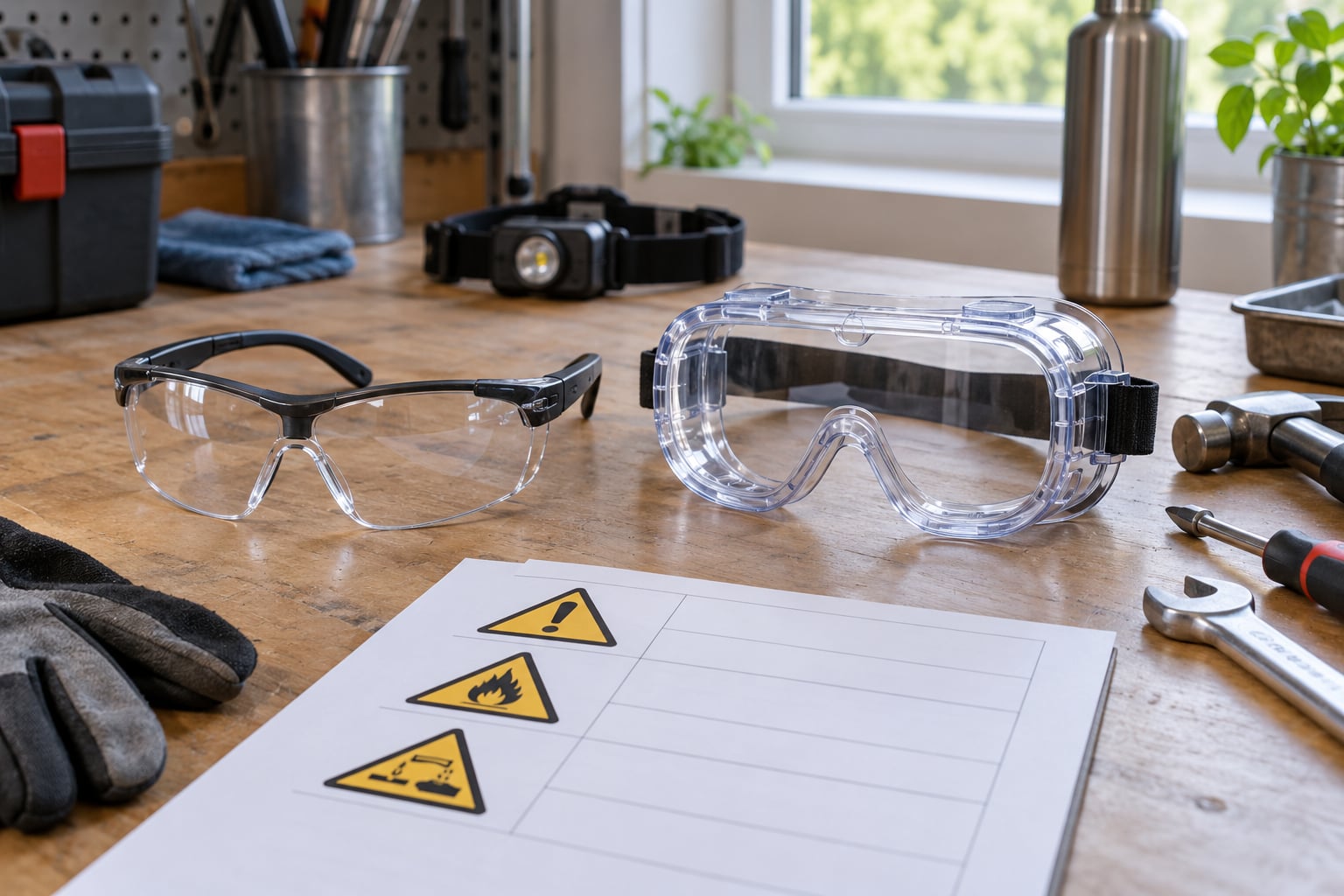
Working out safety glasses vs goggles and when to use each? The honest answer is short. Safety glasses handle impact and flying debris, and they are what most workers wear all shift. Goggles add a flexible seal around the eyes, which is what you need for chemical splash, heavy dust, and high-amount flying debris. Pick based on the hazard in front of you, not on what looks more protective.
I’ve sat through enough toolbox talks and eyewear fittings to know where people get it wrong. Most sites hand out one box of glasses to everyone, then the concrete cutter gets a sunburn of dust in his eyes because nobody assessed the hazard. That is the gap this guide closes.
Below is the straight comparison, the markings that tell you what a lens can actually do, and a step-by-step way to run your own assessment.
Table of Contents
- Safety Glasses vs Goggles: At a Glance
- What Are Safety Glasses?
- How do I know a pair is impact rated?
- What Are Safety Goggles?
- What do direct and indirect venting mean?
- Safety Glasses vs Goggles: Protection and Coverage
- Do safety glasses protect against chemical splashes?
- Safety Glasses vs Goggles: Comfort, Durability, and Use
- When to Use Safety Glasses
- When to Use Safety Goggles
- How to Choose the Right Eye Protection
- Which Should You Choose?
- Frequently Asked Questions
- Conclusion: Start With the Hazard
Safety Glasses vs Goggles: At a Glance
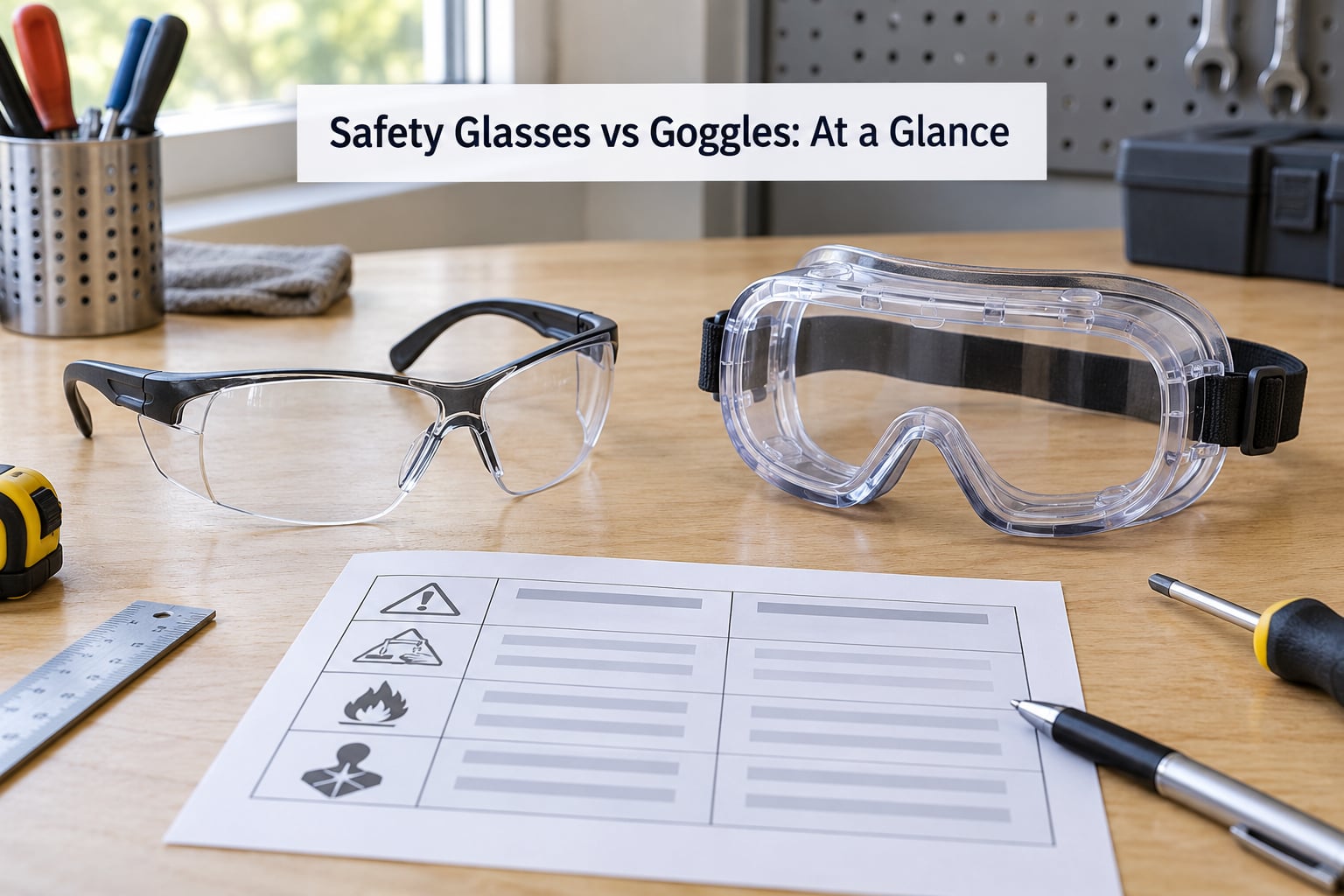
Both products are built to the ANSI Z87.1 standard, so both will stop a flying fragment. What separates them is coverage, sealing, and how they handle air, liquid, and dust. Here is the honest side-by-side.
| Criterion | Safety glasses | Safety goggles |
|---|---|---|
| Protection type | Impact, flying particles, UV | Impact plus splash, vapor and heavy dust |
| Coverage | Eyes and partial temples | Eyes, brow, upper cheeks, full seal |
| Impact resistance | High velocity and high mass impact at Z87+ | Same ratings, plus containment after impact |
| Chemical splash | Not rated for splash | Indirect vented for splash, non-vented for vapor |
| Dust | Good for coarse dust and fragments | D4 for general dust, D5 for fine dust |
| Ventilation | Open or side-shield airflow | Direct, indirect, or fully sealed |
| Comfort over a full shift | High | Moderate, improves with fit and strap |
| Typical uses | Cutting, grinding, drilling, fabrication, construction | Mixing chemicals, lab work, spray, foundry, severe dust |
| Main limitation | Nothing enters from the side or below | Heavier, fogs more, harder to wear all day |
One row in that table is worth pausing on. Non-vented goggles seal completely, which protects against vapor but traps your own breath and heat. That is a trade you only make when the chemical on the label says you have to.
What Are Safety Glasses?
Safety glasses are open-frame eyewear built around an impact-resistant lens, usually polycarbonate or Trivex, held in a frame with side shields. The lens is thicker than a standard prescription lens and is tested to pass high velocity and high mass impact at the Z87+ level.
Side protection is where a lot of cheap eyewear fails quietly. Look for wraparound or brow-guard designs where a fragment could arrive from the side, and check that the marking is on the frame as well as the lens. A lens alone cannot protect your temple.
How do I know a pair is impact rated?
Look for the Z87 mark stamped or printed inside the temple, along with the manufacturer’s name. A Z87+ mark means the lens passed the higher energy impact test. If you cannot find any marking, treat the pair as ordinary sunglasses and retire it.
Prescription wearers have three routes. Prescription safety glasses are made with your prescription behind a protective lens. Over-the-glasses, or OTG, models are built with extra internal space to slide over frames you already own. Recessed or prescription inserts can be fitted into some goggle bodies. The insert route usually wins on fogging and comfort because nothing sits between your eyes and the outer lens.
What Are Safety Goggles?
Safety goggles wrap a single lens around the entire eye area and seal it to the face with a flexible skirt, usually soft rubber, silicone, or foam. That seal is the whole point. It is why goggles keep dust, mist, and droplets out from every direction, including from below and behind.
Most goggle bodies carry an adjustable elastic strap rather than temples, which keeps them on during movement and lets the seal do its job. The trade is heat and weight. The recurring complaint from experienced trades is consistent: goggles work well as a short-task tool for concrete cutting or a lathe run, and they grate on people who need them for a full shift.
What do direct and indirect venting mean?
Direct vented goggles have open holes, usually covered by a foam ring, so air passes straight through. They are comfortable and fine for dust, but the holes will not stop a splash or vapor. Indirect vented goggles route air through a baffled path that resists droplets, and a non-vented goggle has no ventilation at all. Choose indirect or non-vented for liquids, direct venting for particles.
Sealed goggles, often called unvented chemical goggles, are the only correct answer for vapors from solvents, acids, and reactive chemicals. Pair them with a face shield when the splash volume is high. If you work in a lab, our ergonomics guide for lab workers covers the rest of the setup.
Safety Glasses vs Goggles: Protection and Coverage
On eye and face coverage, goggles win outright. They cover the brow, the sides of the face, and the upper cheek. Safety glasses cover the eyes and stop at the frame line, so anything travelling upward or from the side at a low angle can reach the eye.
Do safety glasses protect against chemical splashes?
No. An open pair of safety glasses has no rating for liquid splash or vapor, and a droplet hitting the brow will run straight to the eye. If a task involves liquids, use chemical splash goggles marked for that purpose. A face shield does not replace either one. It covers the face, but a shield alone leaves the eyes open to side spray.
On impact, both products carry the same rating system, so a Z87+ lens in glasses and a Z87+ lens in goggles will both pass the high velocity and high mass tests. The difference shows up after the impact. A goggle retains fragments that pass the lens, while an open frame lets anything past the lens simply fall away.
On dust, vent type decides the outcome. Coarse sawdust, concrete chips, and metal fragments are handled by glasses with side shields. Fine dust, cement, grain, and grinding swarf need goggles rated D4 for general dust or D5 for fine dust, because particles that small follow the air and slip around a side shield.
Peripheral vision favors glasses. You keep near-total side awareness, which matters when you are working around moving equipment or moving through a site. Goggles narrow the field, and a worn strap or a face that is not seated properly pushes the frame into that narrow view.
Safety Glasses vs Goggles: Comfort, Durability, and Use
Comfort over a shift is the biggest practical difference. Safety glasses weigh very little, have adjustable nose pads, and never fog the way a sealed goggle can. That is why most crews leave glasses on from the morning toolbox talk to the end of the day and reach for goggles only for the specific task that needs them.
Goggles put pressure on the brow, temples, and cheekbones, and the foam or rubber presses harder the longer it stays on. A poor seal turns a comfort complaint into a compliance problem, because the easiest response to uncomfortable PPE is to take it off. Fit goggles by adjusting the strap until the seal sits evenly with no gaps, and check the seal with a tissue held against the frame: no air should pass when you breathe in.
Fogging comes from warm moist air hitting a cooler lens, and it gets worse with humidity, temperature swings, exertion, and a poor vent design. Coatings help but wear through with washing. The reliable fixes are the boring ones: adjust the strap so more airflow reaches the vents, keep the lens clean so a proper airflow pattern is not broken, and apply anti-fog wipes only after a rinse.
On durability, both are fine when cared for. Polycarbonate lenses scratch, so rinse before wiping and use a soft cloth. Do not use the same rag that has been on a machine. Goggles need a bit more attention because the seal, foam, and strap all wear out, and replaceable parts cost far less than a new unit.
Both fit with other PPE. Glasses usually sit under or over a respirator half mask with a strap tucked in the right order. Goggles have more adjustment range for a hard hat, but a poorly sized goggle will not seal under a hood, so match the goggle to the headgear rather than the other way around.
When to Use Safety Glasses
Choose safety glasses when the hazard is impact, fragments, and airborne particles without a splash or heavy fine dust. These are the most common tasks on a typical site, and the pair will stay on all day.
Cutting and grinding
Angle grinders, cut-off wheels, and bench grinders throw high-speed fragments toward the face. Z87+ glasses with side shields are the standard answer, and a face shield is worth adding for high-amount grinding.
Drilling, driving, and fastener work
Drilling into concrete or masonry throws dust and chips. Drilling into steel throws swarf. Either way, a vented pair handles it, and the light weight means the worker keeps them on.
Woodworking and light fabrication
Planing, routing, and sawing produce chips and fine sawdust. A pair of glasses with side shields is usually enough, and you avoid the heat of a sealed goggle for a full morning of sanding.
Construction, general site work
Nailing, hammering, handling materials, and moving around an active site is impact exposure. Glasses are the practical default because they are comfortable enough for continuous wear.
Any prescription or OTG need
If you wear glasses already, the simplest fit is prescription safety eyewear or a well-sized OTG pair. Build that into the site PPE list early, because it removes the main reason workers take protection off.
When to Use Safety Goggles
Choose safety goggles when the hazard needs a seal. That means splash, vapor, heavy fine dust, or a high volume of flying debris. The cost is heat and fogging, so keep the task short and the fit right.
Mixing and handling chemicals
Decanting acids, cleaners, solvents, and reagents requires indirect or non-vented chemical splash goggles. Check the goggles for a splash or vapor marking and match it to the product label.
Laboratory work
Lab goggles are almost always non-vented or indirectly vented because the hazard list runs from reagents to spills. Pair them with a lab coat and check that the strap is adjusted for long hair and a respirator.
Paint spraying, coatings, and solvent work
Spray guns and aerosol coatings put mist directly into the face. Non-vented goggles with an anti-fog lens are the practical answer, and a face shield adds coverage for the overspray.
Foundry, grinding swarf, and heavy dust
Foundry work, cement handling, grain dust, and heavy grinding produce the fine particles that a side shield will not stop. D4 goggles handle general dust, and D5 for fine dust, and vented designs keep the heat down.
Concrete cutting, coring, and demolition
When a high-amount flying-debris hazard is possible, a goggle and a face shield together is the correct combination. This is the classic example safety managers use when glasses are not enough.
Electronics and conformal coating work
Soldering is fine in glasses, but spraying conformal coating or solvents moves the task into chemical territory. A switch from glasses to goggles partway through is normal practice, and so is keeping both within reach. The same applies to changing a blade or a bit on a saw, which is a good moment to check the tool safety inspection checklist while the guard is off.
How to Choose the Right Eye Protection
Work through these five steps in order. Most wrong choices happen when a worker picks the eyewear first and looks for a task that fits it.
1. Identify the actual hazard
Write down what can reach the eye: fragments, dust, liquid, vapor, radiation, or a combination. Note the amount too, since high-amount flying debris changes the answer even when the material does not.
2. Check the standard and the markings
Eyewear must carry the ANSI Z87 mark from an accredited laboratory, stamped on the frame, the lens, or both. The Z87+ mark means high velocity and high mass impact rating. Here is how the common codes read.
| Marking | What it means | Use it for |
|---|---|---|
| Z87 | Meets the base safety eyewear standard | General impact protection |
| Z87+ | High velocity and high mass impact | Grinding, cutting, chipping, high debris |
| Z87-2 | Prescription and over-the-glasses eyewear | Wearers who need a correction |
| D3 | Droplet splash protection | Dilute liquid handling |
| D4 | General dust protection | Sanding, cement, grain, swarf |
| D5 | Fine dust protection | Very fine airborne particulate |
3. Match the venting to the hazard
Direct venting for dust and impact. Indirect venting for splash. No venting for vapor. If you find yourself choosing a vented goggle for a solvent, stop and re-read the label on the chemical.
4. Test the fit and the compatibility
Try the eyewear with the respirator, hard hat, and hearing protection you actually use. Then check the seal on goggles and the temple pressure on glasses. Write the model and size into the site PPE record so replacements match.
5. Verify training and replacement rules
Employees need to know which tasks require which eyewear, how to clean it, and when to replace it. Replace any eyewear with a cracked, deeply scratched, or pitted lens, and replace goggle seals and foam that no longer hold. Hand-washing with mild soap and a lint-free cloth is enough; solvents and paper towels cause the haze that leads people to take protection off.
Which Should You Choose?
Use this as the decision rule, and it covers most cases:
Choose safety glasses when the task is cutting, grinding, drilling, hammering, nailing, general construction, woodworking, or fabrication, and the hazard is impact and flying fragments with coarse dust. They stay on all shift, which is worth more than any marginal extra protection.
Choose safety goggles when the task involves chemicals, liquids, spray, vapors, fine dust, or a high-amount flying-debris hazard, and you need a seal around the eyes. Match the vent type to the material and the D-rating to the dust.
Add a face shield when the volume of splash or debris is high enough that the front of the body is also exposed. A shield supplements eye protection, it never replaces it. Workers frequently ask whether the shield alone counts, and the answer is no.
Add a respirator when the airborne concentration of a hazard exceeds what eye protection addresses. Goggles stop the liquid reaching the face, not the vapour reaching the lungs. Gloves belong in the same conversation as the eyewear, and we cover that in how to choose the right safety gloves for a job.
Frequently Asked Questions
What does ANSI Z87.1 mean on safety glasses?
ANSI Z87.1 is the US standard for occupational eye and face protection. The Z87 mark means the product met the standard for impact protection, and Z87+ means it passed the higher high velocity and high mass impact tests. Look for the mark stamped on the frame, the lens, or both. Letter and number codes after it, such as D3 for splash or D4 for dust, tell you what else the lens was tested against.
Can you wear safety glasses over prescription glasses?
Yes, using a pair marked Z87-2 and designed for it, usually called over-the-glasses or OTG eyewear. It has extra internal clearance at the temples and nose so it fits over a frame without pressing. If OTG feels tight or the arms press on your temples, prescription safety glasses or prescription inserts in a goggle body are more comfortable and fog far less.
How do I stop safety goggles from fogging?
Start with the fit and the vent path. Adjust the strap so more air reaches the vents, and a seated seal often clears fog on its own. Keep the lens clean, because dirt breaks the airflow pattern that keeps fog off. Anti-fog wipes help and should be reapplied after every wash, since coatings wear off. For a full shift, vented goggles with a good strap beat sealed goggles every time.
Are vented goggles safe to use around chemicals?
Only for some chemicals. Direct vented goggles have open holes, so they will not block liquid splash or vapour. Use indirectly vented goggles for splash and non-vented chemical goggles for vapour. Read the goggles marking and the chemical safety data sheet, and match the splash rating to the product. When in doubt, go sealed and add a face shield for volume.
Is it against the rules to work without eye protection?
Where a hazard assessment identifies an eye hazard and the employer has not provided suitable protection, yes, that is a violation in the US. Rules vary by country and state, so check your local requirements. Worn-out, scratched, or poorly fitting eyewear does not satisfy the requirement either. Report a damaged or inadequate pair and get it replaced rather than working without it.
Conclusion: Start With the Hazard
If you are still weighing safety glasses vs goggles when to use each, it is not a preference question, it is a hazard question. Glasses cover impact, fragments, and coarse dust, and the worker will keep them on for a full shift. Goggles cover splash, vapour, fine dust, and heavy debris, and they earn their keep when the air or the liquid can reach the eye from the side.
Write down the hazard, check the marking and the vent type, test the fit against your other PPE, and then write the model into the PPE record. If the assessment says splash or heavy dust, seal the face. If it says impact and fragments, hand out a comfortable pair of glasses and let people wear them all day. That is the whole decision in 2026, and it has not changed.