
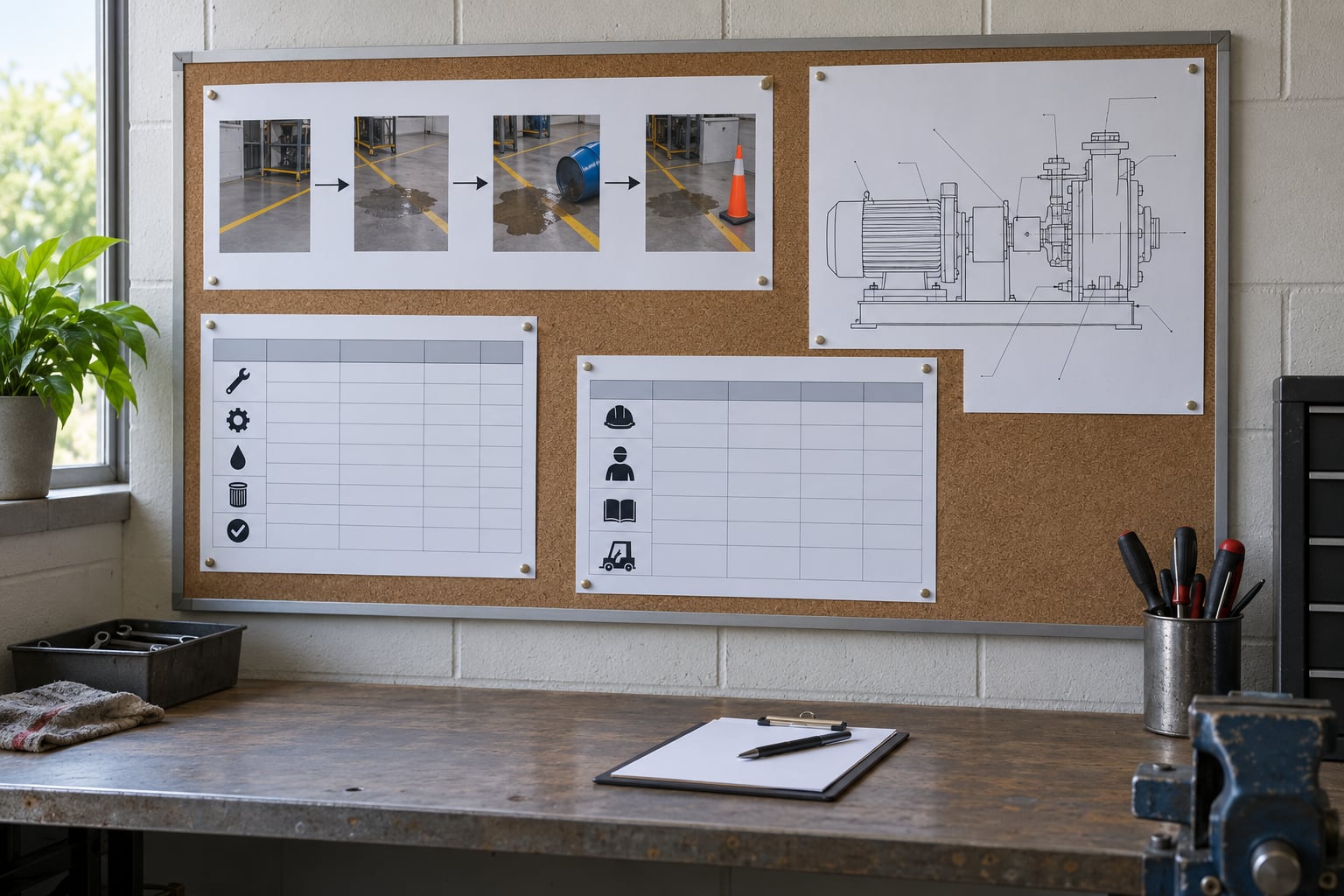
Root cause analysis for workplace incidents is a structured investigation that moves past the immediate cause of an accident, injury or near miss to find the conditions that allowed it: training gaps, supervision failures, equipment defects, procedural flaws and organisational decisions. It is blameless by design, and it produces assigned corrective actions rather than a closed file.
Most investigations stop at the first answer that sounds plausible. The forklift clipped a rack, the operator misjudged, so the file closes on a retraining note. Six months later the same thing happens in a different aisle, and the investigation runs again from scratch because nothing in the system actually changed.
The fix is not more paperwork. It is a disciplined sequence, run the same way every time, that separates what happened from why it was possible.
Table of Contents
- What You Need
- Step-by-Step Root Cause Analysis Process
- 1. Secure the Scene and Provide Immediate Care
- 2. Define the Incident and Its Scope
- 3. Gather Timelines, Records and Other Evidence
- 4. Build a Root Cause Analysis Timeline
- 5. Identify Why the Event Was Possible
- 6. Test the Root Cause Analysis Findings
- 7. Select and Implement Corrective Actions
- 8. Verify Effectiveness and Close the Investigation
- Common Mistakes
- Frequently Asked Questions
- What is the difference between root cause analysis and blame?
- How do you perform root cause analysis after a workplace incident?
- Is the 5 Whys method suitable for workplace incident investigations?
- Should a root cause analysis report identify the employee who made the error?
- When does a workplace incident require regulatory or legal review?
- How should employers verify that corrective actions worked?
- Conclusion
What You Need
Most weak investigations fail before analysis even starts, because the evidence was never secured or the right people were never in the room.
- Preserved evidence — scene photographs, CCTV footage, equipment data logs, permit-to-work records, chemical safety data sheets, and the physical items involved. Video and machine data often overwrite on a retention cycle, so pull those first.
- Records — training and competency certificates, maintenance history, prior inspection reports, risk assessments, procedure versions in force on the day, and previous incident reports for the same area or equipment.
- People, not just paperwork — the people who were there, the supervisor who ran the shift, the worker who did the task, and someone with genuine subject-matter expertise in the equipment or process involved.
- Clear regulatory and legal ground rules — who must be notified, in what timeframe, and what the site must preserve for an external reviewer. In the US that usually means OSHA recordkeeping under 29 CFR 1904; in the UK it means RIDDOR reporting.
- A team without a stake in the outcome — the supervisor whose shift produced the incident should not chair the investigation. Practitioners raise this constantly, and it is the single most common reason a report goes nowhere.
Our guide to how to conduct a workplace hazard assessment is worth reading before you start, because most root causes trace back to a hazard that was known and never controlled.
Step-by-Step Root Cause Analysis Process
Eight stages, in order. The sequence runs from immediate response and fact collection, through to underlying system causes, then tested corrective actions and closure. Skipping a stage does not save time; it moves the gap somewhere later in the process where it costs more.
1. Secure the Scene and Provide Immediate Care
Put people first, then evidence. Stop the work, make the area safe, get first aid or emergency response moving, and only then think about documentation.
Nobody should enter the area until you confirm it is safe to do so, and nobody should be told what happened before you have spoken to them. If you have not already read our guide to the first steps after a workplace injury, do that in parallel, not afterwards.
At this stage, notify whoever your plan requires: management, the safety team, workers’ representatives, and the regulator if the incident meets a reporting threshold. Do not diagnose injuries, do not speculate on fault, and do not let anyone move equipment that has not been photographed in place.
2. Define the Incident and Its Scope
Write one paragraph that states what happened, where, when, and which work system it touched. Confine yourself to facts you can support later.
A weak version reads: “There was an accident in the warehouse.” A usable version reads: “At approximately 06:40, a forklift reversed into the racking of aisle 12 during put-away, and the racking collapsed. The operator was uninjured. The work system involved was night-shift put-away using handheld RF scanners.”
Defining scope early keeps the investigation from drifting into unrelated problems, and it tells you which people to interview.
3. Gather Timelines, Records and Other Evidence
Collect evidence in the order that decays fastest: CCTV and photographs first, then machine and system logs, then permits and training records, then witness accounts, which are the least reliable and should be taken while memories are still specific.
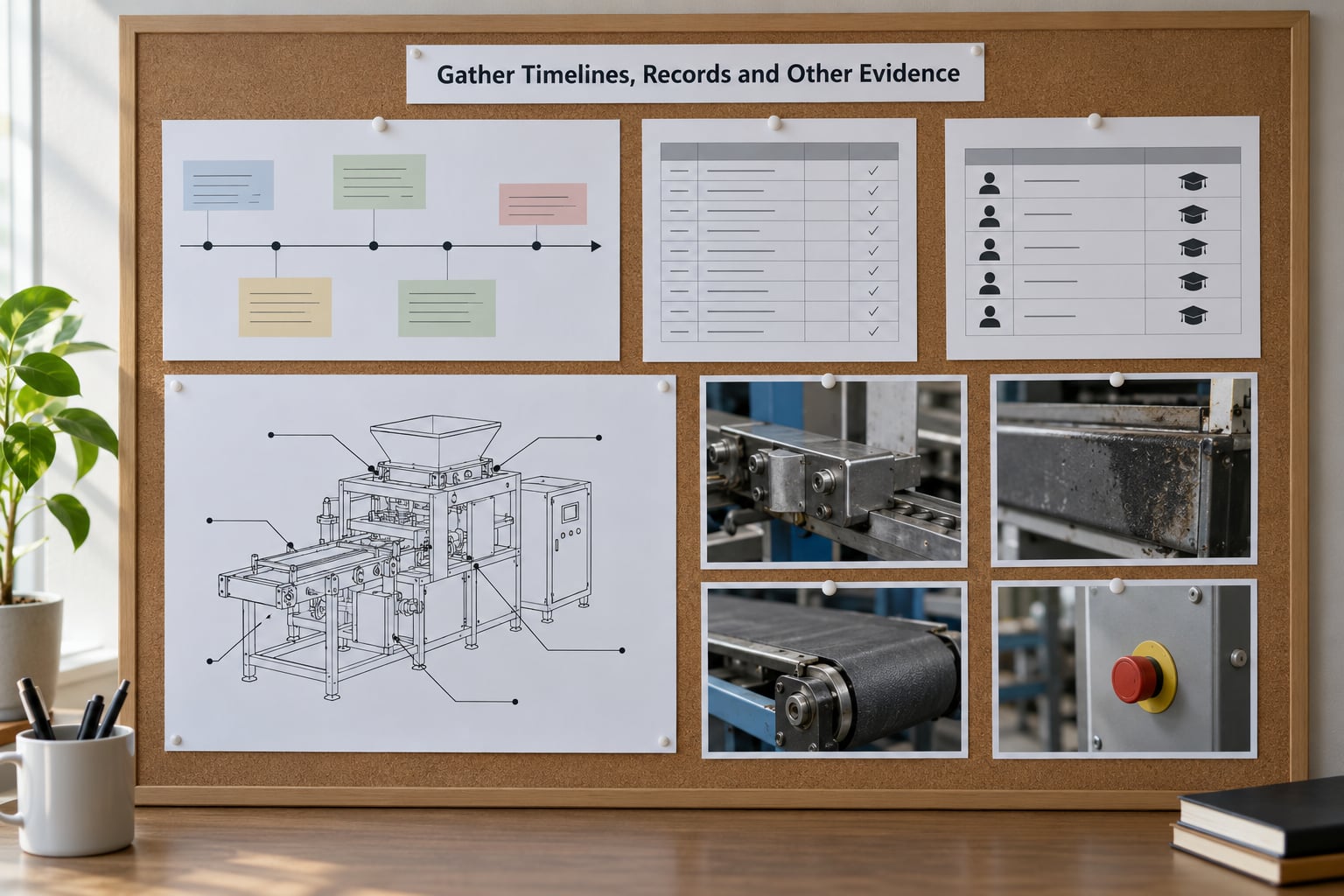
Two rules matter here. Interview people separately rather than in a group, because a group converges on the first explanation and everyone agrees with it afterwards. And record what you do not know as explicitly as what you do, because a report that quietly fills gaps with assumptions will collapse when someone outside the organisation reads it six months later.
Handle medical and personnel information carefully. Keep health details out of the investigation file, and protect the confidentiality of anyone who reports a near miss anonymously.
4. Build a Root Cause Analysis Timeline
Reconstruct the sequence of events on one timeline, going back far enough to show the conditions leading up to the incident, not just the ninety seconds around it.
Mark each entry as confirmed fact, disputed account, or assumption. If witnesses disagree about whether a guard was in place, that disagreement is data — it usually points at a real condition, such as a guard that is easy to remove.
Look for gaps in the timeline as well as content. An unexplained twenty-minute gap before the incident often turns out to be shift change, a briefing that got cut short, or a production push.
5. Identify Why the Event Was Possible
This is where root cause analysis earns its keep. Move past the immediate cause and examine the whole system: work design, policies and procedures, staffing levels, training quality, supervision, equipment design, environment, maintenance, and the decisions management made months earlier that shaped all of it.
Several structured techniques help here. The 5 Whys asks “why” repeatedly until you reach something you can act on. The fishbone diagram, or Ishikawa diagram, sorts contributing factors into categories such as people, machine, method, material, measurement and environment. Barrier analysis asks which controls were supposed to stop the event and which ones did not.
Worked example, warehouse aisle collapse. Why did the racking collapse? Because a leg was struck at 400 mm. Why was a leg at that height? Because the bottom beam had been removed for picking and replaced at the wrong position. Why was it replaced incorrectly? Because the replacement was not checked and the written instruction was ambiguous. Why was the instruction ambiguous? Because the racking modification had been added by three different teams over four years with no single owner. The root cause is an uncontrolled change process, and the fix is a design and approval control, not a forklift licence refresher.
Five is a rule of thumb, not a limit. Some chains stop at three. Others run to eight. Stop when you reach a cause within your control, not when you reach a number.
6. Test the Root Cause Analysis Findings
Every candidate cause has to survive three checks before it goes in the report. If it fails one, discard it.
- It explains all the material facts. If a cause cannot explain the timing, the location, or why this equipment and not the identical unit two aisles over, it is incomplete.
- It shows how it contributed, rather than merely coexisting with the incident.
- It is supported by the evidence you collected, not by the confidence of the person who first suggested it.
“Operator error” almost always fails the first test. It explains nothing about why the error was possible on this occasion, in this task, by this person, with this equipment. When a cause fails, go back to the timeline rather than defending it.
7. Select and Implement Corrective Actions
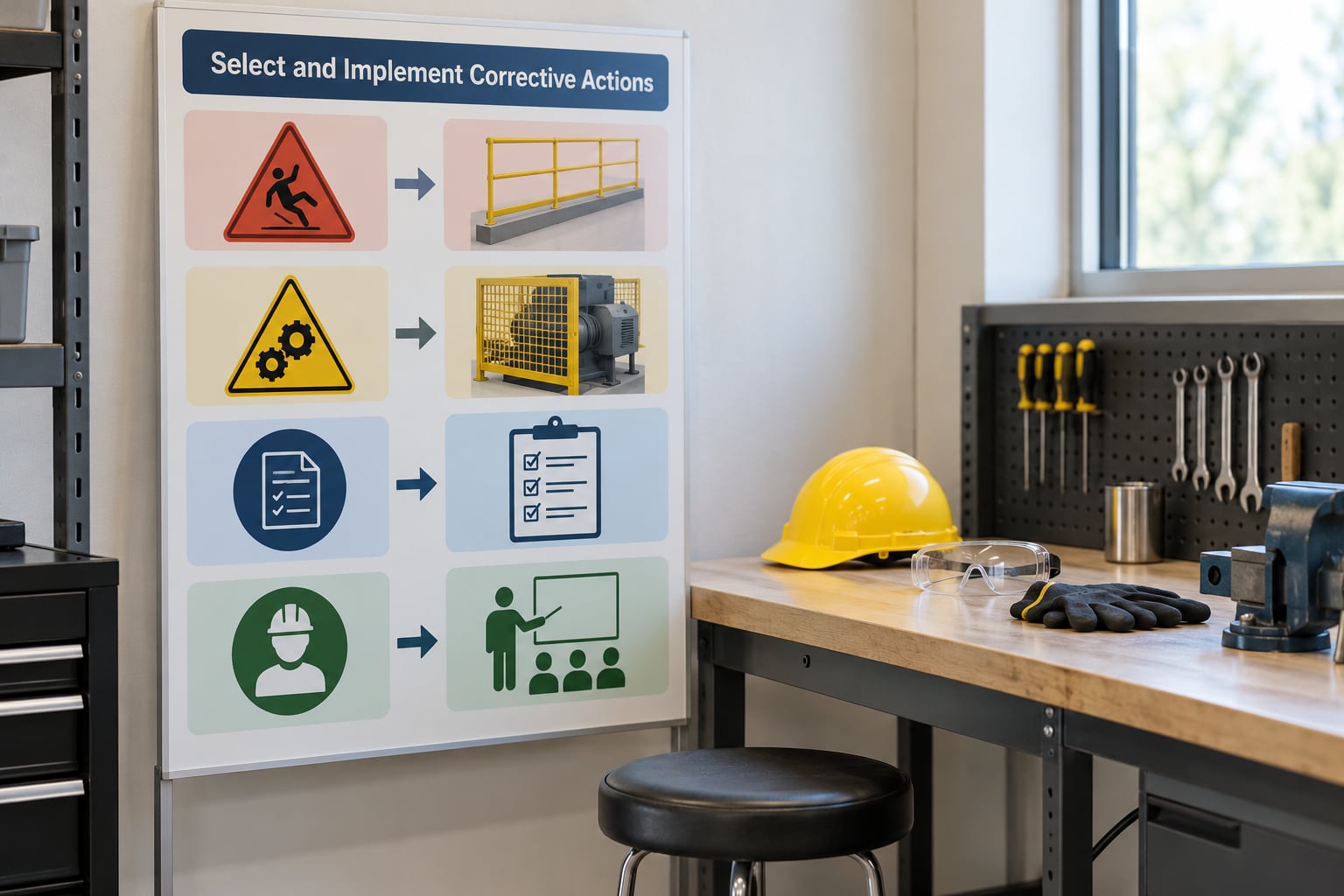
Rank corrective actions by the hierarchy of controls: eliminate the hazard first, then substitute and engineer physical safeguards, then administrative controls, then personal protective equipment. A control further up the list does not depend on a person remembering something.
Reject any action whose entire content is a reminder, a retraining session, or a request for greater vigilance. Those measures sit at the bottom of the hierarchy and they are the reason investigations feel pointless: the hazard is still there and the same conditions will recur.
Give every action an owner, a due date and a completion evidence type. Write the changes into the actual system, which means amending the procedure and the risk assessment rather than only telling people about it. Our article on writing a workplace health and safety policy covers how documented controls hold up over time.
One caution for multi-site and contractor work: when the causal chain crosses an organisational boundary, document the handover point explicitly. Shared causation is where investigations stall, and writing down where responsibility moved stops that stalling.
8. Verify Effectiveness and Close the Investigation
An investigation is not finished when the report is filed. Set a verification date, confirm the actions were actually completed rather than marked complete, and then check whether the exposure has actually changed.
Verification methods that work: observe the task on the floor a few weeks later, review new near-miss reports for the same area, ask the people who do the work what changed, and look at whether the recurrence rate for that incident type has fallen over the following quarter.
Three measures tell you whether your investigation process itself is healthy: how long investigations take from event to closed action, what share of actions are verified rather than assumed complete, and whether similar incidents recur. If cycle time is climbing, teams are usually being pushed to stop asking why before they reach a systemic cause.
Common Mistakes
These six failures account for most weak workplace root cause analysis. Each one has a practical correction.
Stopping at a person. “The worker did not follow procedure” ends the thinking and fixes nothing. Correction: ask why following the procedure was hard, unclear, or impossible at that moment.
Stopping at the immediate cause. Three whys often lands on the proximate event, which is a description, not a cause. Correction: keep asking until the answer describes a condition the organisation can change.
Investigating too late. CCTV overwritten, witnesses dispersed, equipment already repaired. Evidence quality drops sharply within days. Correction: preserve immediately, even before you know whether the event is reportable.
Changing several things at once with no owner. Three actions with no named owner means one action. Correction: assign one accountable person and one date per action, and cut the rest.
Relying on weak evidence. A single confident account, treated as fact. Correction: corroborate each material claim against at least one independent source, and flag what stays unverified.
Closing without verification. The report is filed and nobody checks whether anything improved. Correction: hold a verification review at a set date with named metrics, as in step 8.
Underreporting sits underneath all six. If workers expect punishment or lost hours when they report a near miss, your investigation team is working from the worst possible evidence base, and no technique will compensate for that.
Frequently Asked Questions
What is the difference between root cause analysis and blame?
Blame asks who deserves consequences. Root cause analysis asks what conditions made the event possible, so the system can be changed. Blame produces a person named in a report and usually a retraining note. Root cause analysis produces owned, dated actions that alter equipment, procedures or supervision. The two also behave differently around evidence: blame rewards the simplest defensible story, while analysis rewards the most complete one.
How do you perform root cause analysis after a workplace incident?
Secure the scene and provide care, define the incident and its scope in one written paragraph, then gather evidence in order of decay: CCTV and photographs, equipment logs, permits and training records, and separate witness interviews. Build a timeline that separates confirmed fact from assumption. Identify contributing system causes with a technique such as 5 Whys, fishbone diagram or barrier analysis. Test each candidate cause, assign corrective actions with owners and dates, and verify effectiveness before closing.
Is the 5 Whys method suitable for workplace incident investigations?
Yes, for straightforward incidents with a clear causal chain, which covers most slips, trips, falls and near misses. It is fast, needs no specialist software, and works well in a facilitated team session with people who know the work. Its weakness is that it can follow a single linear path and miss parallel contributing factors, so pair it with a fishbone diagram when several systems are involved. Five whys is a rule of thumb rather than a limit.
Should a root cause analysis report identify the employee who made the error?
The report should describe what people were doing and what conditions shaped their actions, without turning the individual into the finding. Naming a person as the root cause ends the analysis, since a person is not a controllable variable. Where an individual does need support, record it separately from the causal findings and route it through the normal performance or welfare process. Keeping those two streams apart is what makes the report defensible later.
When does a workplace incident require regulatory or legal review?
Whenever the incident meets a statutory reporting threshold, involves a fatality or serious injury, or the organisation is a covered employer under the relevant recordkeeping rules. In the US, OSHA recordkeeping under 29 CFR 1904 determines which injuries are recordable and sets the timeframe for the 301 form; in the UK, RIDDOR sets the reporting duty and the 10-day timeframe for reporting. Where there is any doubt, notify rather than wait, because late reporting creates its own exposure.
How should employers verify that corrective actions worked?
Check three things at a set date. First, that the actions were genuinely completed and can be evidenced on the floor. Second, that work practice changed, observed by watching the task a few weeks later and asking the people doing it what is different. Third, that the exposure fell, using near-miss reports for the same area and the recurrence rate for that incident type over the following quarter. If none of the three have moved, the root cause was probably wrong.
Conclusion
Root cause analysis for workplace incidents works when the sequence is followed in order: secure and preserve, define scope, gather decaying evidence, build an honest timeline, find the system causes, test them, act on what you can control, then verify before closing. The point is not a longer report. It is a workplace where the same failure stops happening because something actually changed.
Start with the next event. Secure the area, preserve the footage and the equipment, and write the incident statement before anyone starts offering explanations. Everything after that is easier.