

A safety committee meeting agenda template is a pre-structured, fill-in-the-blanks document that lists the standing items your committee works through every meeting: meeting details, attendance, previous minutes and action-item status, incident and near-miss review, hazard inspections, training updates and next-meeting scheduling. Give each item a number of minutes, and a 60-minute meeting starts producing closed corrective actions instead of long to-do lists.
The full copy-ready template is below, with no email gate and no sign-up. Copy it into Word or Google Docs, replace the bracketed fields, and you are ready. Budget about 30 minutes to prepare a routine month and closer to 90 minutes the first time you build one from scratch.
Last reviewed October 2026. Requirements differ by country, so check your own regulator before treating the template as a compliance standard.
Table of Contents
- What You Need
- Step-by-Step
- 1. Set the Meeting Purpose and Required Attendees
- 2. Choose a Safety Committee Meeting Agenda Template Format
- 3. Add Timed Agenda Items in Priority Order
- 4. Assign an Owner and Desired Outcome to Each Item
- 5. Bring Evidence and Supporting Documents
- 6. Build the Action Log and Decisions Section
- 7. Finalize and Distribute the Agenda
- 8. Use the Agenda to Run and Document the Meeting
- Common Mistakes
- Frequently Asked Questions
- How long should a safety committee meeting agenda be?
- How far in advance should the agenda be sent to attendees?
- Who should attend a workplace safety committee meeting?
- What should be included in safety committee meeting minutes?
- How do you add an urgent safety issue to a published agenda?
- Does a safety committee meeting agenda have legal requirements?
- Conclusion
What You Need
Before you draft the agenda, gather the material that each section will draw on. Skipping this is how meetings wander into general business instead of safety. Most of it already exists as a document; the work is finding it, not writing it.
- Meeting details. Date, start and end time, location or call-in link, chair, note-taker, and the quorum rule your committee operates under.
- Approved minutes from the last meeting. You need them to note approval or corrections, and to know what was left unresolved.
- The open action log. Every outstanding corrective action with its owner, due date and current status. This is the single most skipped item on real agendas, and skipping it is why actions never close.
- Incident, near-miss and inspection reports that happened since the last meeting, including investigation status and any regulatory reporting already made.
- Current safety metrics. Days since the last lost-time injury, first-aid case count, near-miss count, open corrective actions, training completion rate. If you have no metrics yet, how to track safety metrics in a small company covers a simple starting set.
- Proposed items from members. Collect these a few days ahead so the chair can sequence them instead of fielding them live.
- Required attendees and their roles. In most workplaces that is a manager chair, worker representatives, the safety officer, and anyone owning an open action.
- The governing policy, procedure or regulation that defines the committee’s functions. Every committee member should have seen it at least once.
Step-by-Step
1. Set the Meeting Purpose and Required Attendees
Write one sentence describing what this specific meeting must achieve. “Review two open corrective actions and approve the revised lone-working procedure” is a purpose. “Monthly safety meeting” is not.
Then name the chair and the note-taker, and mark who is required versus optional. A typical committee runs 5 to 10 members, which is small enough for everyone to speak and large enough to cover the work. The chair holds the agenda and the clock, the note-taker records decisions and actions, worker representatives bring operational reality, and the safety officer supplies data and regulatory context.
Attach a one-page terms of reference if you do not have one. Practitioners who review committees for a living point to the same failure repeatedly: members disengage because nobody told them what the committee is for, so the meeting drifts into wages, rosters and social events.
If this is your first meeting, tell members what the committee is not for. It is not a disciplinary forum and not a place to raise personal grievances. Setting that boundary early saves the chair from being handed a problem that belongs to HR, and it gives members a clear route for the safety concerns they would otherwise raise at the wrong moment.
2. Choose a Safety Committee Meeting Agenda Template Format
Pick a format that fits how your committee actually runs. Three work well.
A numbered, time-boxed agenda suits a monthly committee of five to ten people. Every section gets a fixed number of minutes, which is the strongest defence against a meeting that runs long and rushes the decisions.
A table format with columns for owner and due date suits committees that carry a heavy corrective-action load, because the action log lives on the same page as the agenda.
A standing plus new business format keeps the routine six sections identical month to month and adds a variable block at the end. Continuity is what stops recurring problems from quietly rolling forward.
Whatever you pick, include meeting details, previous minutes, open actions, incident reports, inspections, safety metrics, new business, decisions, action items, next meeting and adjournment. Anything less and the committee has no record to point at later. If you are starting from scratch, the safety committee meeting agenda template in the next section is built on exactly this list, so you can lift the structure rather than rebuild it.
Frequency is a separate decision from format, and it is the one people get wrong most often. Monthly is the sensible default for an active workplace: frequent enough that incidents are reviewed while the memory is fresh and corrective actions do not drift, rare enough that attendance holds. Quarterly works only when nothing significant happens between meetings, which in practice means very little site.
There is no universal rule that sets your cadence, and anyone who tells you otherwise is guessing. In the United States, OSHA’s framework expects workers and management to act together on safety matters, and many state-plan states carry their own committee expectations. The UK Health and Safety Executive expects a joint safety committee with an agreed meeting frequency where consultation arrangements call for one. Australia and New Zealand take different routes: health and safety representative structures and committee duties sit under the respective national acts, and New Zealand’s Health and Safety at Work Act places specific duties on a worker engagement committee in higher-risk workplaces. Check your own regulator rather than copying a frequency from a template, and write the cadence into your terms of reference so it does not drift.
3. Add Timed Agenda Items in Priority Order
Order the items so the meeting flows from housekeeping to substance to decisions. Routine updates go first while attention is high. Urgent safety concerns go near the top, not at the end. Anything needing a vote or a signature goes into the final third, when people are still sharp and there is time to record it properly.
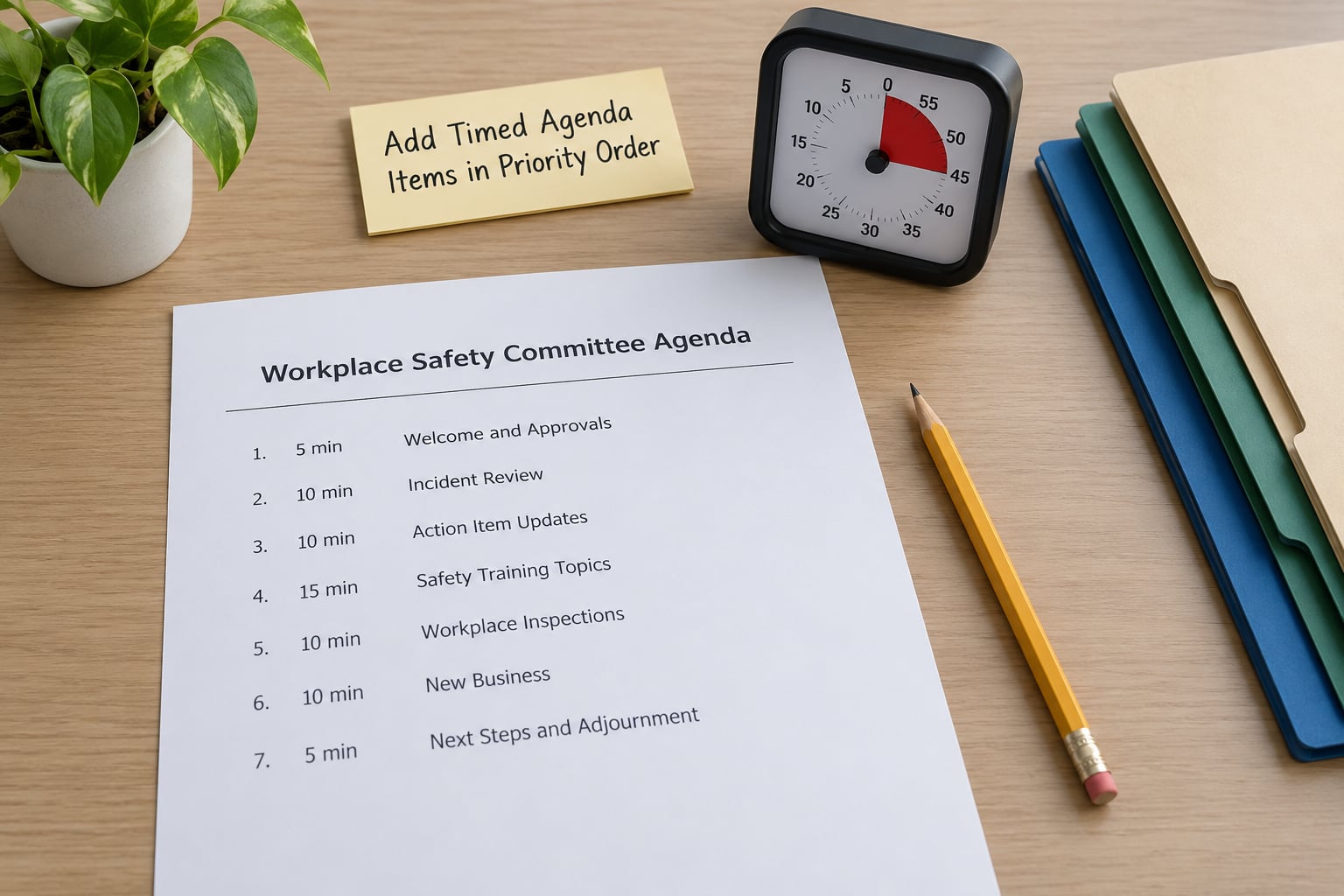
Here is the full template. Copy everything between the lines.
SAFETY COMMITTEE MEETING AGENDA

MEETING DETAILS
Organization: [Company / site name]
Date: [Day, Month Year]
Time: [Start] - [End]  |  Duration: [e.g. 60 minutes]
Location: [Room / site / video call link]
Chairperson: [Name, role]
Note-taker: [Name, role]
Quorum required: [e.g. 4 of 8 members]
Agenda circulated: [Date]
Attachments: [Previous minutes / incident reports / inspection report / metrics]

1. OPENING AND ATTENDANCE (5 mins)
- Confirm quorum is met; record apologies
- Approve the previous meeting minutes
- Safety success of the period: [name one good thing]
- Safety moment or toolbox topic: [topic]

2. OLD BUSINESS AND ACTION ITEMS (10 mins)
- Review each open action: status, owner, due date
- Close out actions with evidence of completion
- Carry unresolved actions forward with a new date
- Report any action now overdue and the escalation

3. INCIDENT, NEAR-MISS AND ACCIDENT REVIEW (15 mins)
- List incidents and near-misses since the last meeting
- Note investigation status and root cause for each
- Confirm any required notification has been made
- Agree corrective actions and prevention measures
- Note lessons learned for wider distribution

4. INSPECTIONS AND HAZARD REPORTS (10 mins)
- Report findings from walk-around inspections
- Update the risk assessment register
- Review hazard reports raised by staff
- Agree control measures, owners and dates

5. TRAINING, POLICIES AND NEW BUSINESS (10 mins)
- Training completion and overdue attendees
- Policy or procedure changes awaiting approval
- New business raised by members
- Safety performance trends against targets
- Audit findings and external or regulatory updates

6. DECISIONS AND ACTION ITEMS (8 mins)
- Record each decision, the owner, the due date, resources
  needed and how completion will be verified

7. NEXT MEETING AND ADJOURNMENT (2 mins)
- Confirm date, time and location of the next meeting
- Agree any items to be carried to that agenda
- Safety concern raised after adjournment
- Chair sign-off: ______________________

ACTION LOG
Ref | Task or corrective action | Owner | Due date | Status | Verified by
A1  | [                     ] | [    ] | [      ] | [     ] | [          ]
A2  | [                     ] | [    ] | [      ] | [     ] | [          ]
A3  | [                     ] | [    ] | [      ] | [     ] | [          ]
For a shorter meeting, cut whole sections rather than shaving minutes off everything. The table below shows how the same six sections compress and expand, so you can pick the version that fits the slot you actually have.
| Section | 30 minutes | 60 minutes | 90 minutes |
|---|---|---|---|
| Opening and attendance | 3 | 5 | 5 |
| Old business and action items | 7 | 10 | 15 |
| Incident and near-miss review | 7 | 15 | 20 |
| Inspections and hazard reports | 5 | 10 | 15 |
| Training, policies and new business | 3 | 10 | 15 |
| Decisions and action items | 4 | 8 | 15 |
| Next meeting and adjournment | 1 | 2 | 5 |
A 30-minute version works when nothing serious is outstanding and the committee keeps a separate schedule for inspection detail. Drop the trend discussion, keep the metrics on one line, and move any proposal that needs real debate to a dedicated session.
If nothing has gone wrong this month, do not pad the agenda with invented concerns. Use the standing blocks for toolbox topics, refresher training, emergency preparedness checks, PPE compliance, manual handling review, fire risk assessment refresh and safety metric trends.
Quiet months are also when members get to raise things they would not raise in front of an incident. A prepared list makes that easier rather than relying on someone speaking up. 15 safety meeting topics for monthly meetings gives you a ready set to rotate through, which also keeps the standing sections stable from one month to the next.
Industry barely changes the six standing sections; it changes what sits inside them. A construction site adds plant and equipment checks, excavation and working-at-height permits, welfare and temporary works, and competency certificates for operators. A manufacturing plant focuses on machine guarding, lockout/tagout, changeover and cleaning-in-place hazards, noise exposure and chemical handling.
A hospital or clinical laboratory adds sharps and needlestick prevention, medication safety, biological hazards, waste handling and evacuation of patients. A warehouse adds forklift and pedestrian segregation, manual handling loads, racking condition and exit route clearance. A campus adds emergency drills, contractor induction and student laboratory supervision.
Add two or three of these to the matching section rather than creating new numbered sections. The committee learns the shape of the agenda quickly, and a familiar structure is what lets members prepare properly.
4. Assign an Owner and Desired Outcome to Each Item
Every numbered item gets a name beside it and a stated outcome. Without both, the chair ends up doing all the work and the note-taker ends up writing all the minutes.
State the outcome type explicitly, because it changes how the item runs:
- Receive information only. The committee hears a report and notes it. Say so, or the discussion will sprawl.
- Discuss. The committee explores an issue and produces a position or recommendation, but decides nothing tonight.
- Decide or approve. A named person moves for a decision and another seconds it.
- Assign follow-up work. An action goes out with an owner and a date, and lands in the log.
Most agenda failures are this mistake wearing a different shirt. A section titled “Safety Update” invites fifteen minutes of general chat; a section titled “Approve revised permit-to-work procedure, owner: [name]” produces a signature.
Give the owner a choice too. Assigning an item to a person who can act on it beats assigning it to the person who only knows about it, and assigning it to the person who reported the hazard beats assigning it to the person who was affected by it. Where the two differ, say which role you mean.
5. Bring Evidence and Supporting Documents
Send reports ahead with the agenda rather than reading them out in the room. The people who need to decide cannot do that while someone is narrating a spreadsheet.
Attach the previous minutes, the open action log, incident and near-miss reports with investigation status, walk-around inspection findings, corrective-action closure records, the current risk assessment register, training completion data, relevant policy drafts, and external audit findings. If you are drafting or revising procedures, how to write a standard operating procedure for safety keeps the wording consistent with what the committee approved.
Check that every attachment opens, is readable on the devices people will use, and does not need a login. A remote member who cannot open the report simply stays quiet for that section.
If you are building the template from scratch in Word or Google Docs, keep it simple. Use one style for the section headings, one for the sub-bullets and a plain paragraph style for body text, then save it as a reusable file so next month you copy it and only replace the content. Building it as a table instead of a list gives you the action log for free at the bottom, at the cost of being fussier to edit later.
6. Build the Action Log and Decisions Section
The action log is where the meeting’s value shows up six weeks later. Keep it as its own block, and keep it live across meetings rather than reconstructing it from memory.
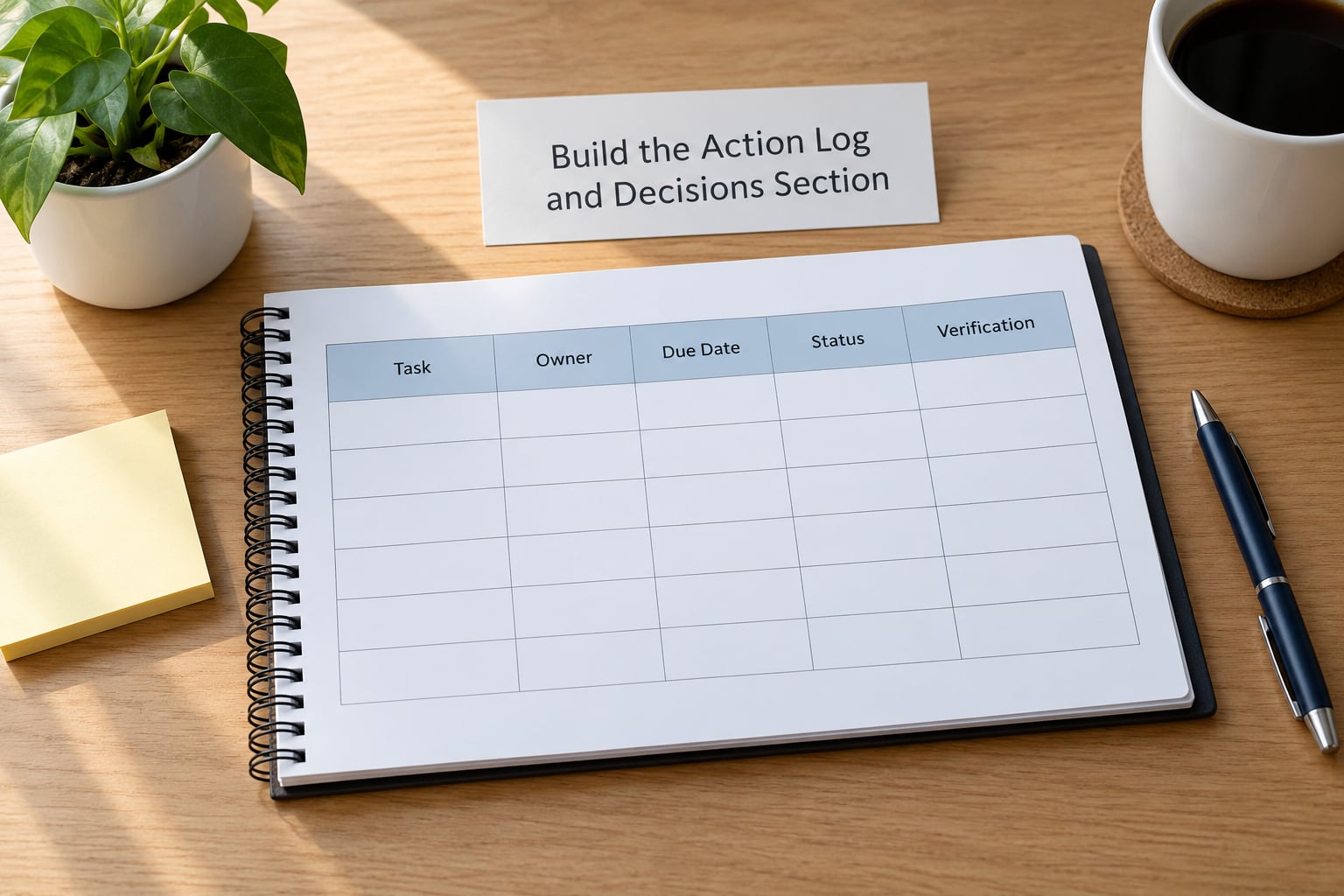
Each row needs six things: a reference number, the task or corrective action in plain language, one named owner, a due date, a status, and how completion will be verified. That last column is the one people skip, and it is the one auditors read first. “Poster replaced” is done. “Locker 4B re-racked to clear the exit route, confirmed on next walk-around” is verified.
Add a status field with simple values: open, in progress, overdue, closed, carried forward. Give each action a closure method: photo evidence, a revised document, a training record, a signed inspection sheet. Close actions in the meeting, not after it, so the chair can confirm them before anyone leaves the room.
Keep a separate decision record too, with the decision, who made it, the date, and any dissent. Committees that run quietly often have members who disagree but were never asked.
7. Finalize and Distribute the Agenda
Run a last check before it goes out: all required items present, timings that add up to the meeting length, every item has an owner, every attachment is attached, materials accessible to remote attendees, and nothing that conflicts with a declared conflict of interest.
Send it roughly a week ahead. That is the most common practice among committees that actually get things done, and it gives people time to read the reports, ask questions in advance and turn up prepared. Fewer than 48 hours leaves no room for pre-reading, and more than two weeks gets ignored.
Put the agenda in one shared location, not in individual inboxes. A committee member who missed the email should still be able to find it.
Running the meeting remotely or hybrid needs two small adjustments rather than a different document. Send materials as a single shared document so remote members are reading the same version as the room, and give remote members the floor on every section rather than waiting to be asked. If a decision needs a signature, capture it in the same meeting rather than chasing signatures for a week afterwards.
8. Use the Agenda to Run and Document the Meeting
Start on time even if someone has not arrived. Record attendance and apologies as you go, confirm quorum against the header field, and approve the previous minutes before any new business is discussed.
The whole meeting runs in five moves, in this order: open and confirm quorum; clear the previous minutes and the action log; review incidents and inspections; handle new business; then close with decisions, action items and the next meeting date. Committees that follow this sequence finish on time without anyone policing the clock, because the structure does the timekeeping.
Keep the visible order: housekeeping, open actions, incidents, inspections, training and new business, decisions. When a section overruns, note the item and move it rather than borrowing time from the decision block. Decisions rushed at minute 58 are the decisions that come back unapproved next month.
The note-taker captures, for each item: what was discussed, what was decided, any dissenting view, and every action with owner and date. Write decisions as sentences, not as bullets of nouns. “The committee approved permit-to-work PTW-07 for use from [date], with the revised isolation checklist attached” is a record. “PTW-07 discussed” is not.
Afterwards, send approved minutes to everyone on the distribution list within a few days, update the action log, and confirm each owner knows their date. Then set the next meeting before anyone leaves the room.
Minutes are not admin overhead. They are the evidence trail that shows a management system was actually operated rather than just documented, which is what an ISO 45001 certification audit or an OSHA inspection looks for: clause 5.4 worker consultation, clause 9.2 evaluation, and clause 10.2 incident and corrective action all surface as a trail of minutes showing decisions taken and actions closed.
Keep them for as long as your regulator, your certification scheme or your legal advisers require, and longer than that if there is any dispute history. If your committee reports to a risk committee or a board, the minutes are the source material, so write them for a reader who was not in the room.
Common Mistakes
Almost every stalled safety committee makes the same small set of errors. Each one has a straightforward fix.
- Prior actions are skipped. Fix: put old business second and read the action log line by line. Move it to the top if your closure rates are poor.
- Timings are fiction. Fix: add the minutes up before you send. If the total exceeds the meeting length, cut a section rather than compressing everything.
- Actions have no owner or date. Fix: refuse to leave the room with an unowned action. Write it into the log during the meeting.
- Background detail is read out loud. Fix: circulate reports with the agenda. Reading them aloud in the room is the single biggest time sink.
- Discussion and decisions are blurred. Fix: label each item as information, discussion, decision or assignment, as in step 4.
- Materials arrive too late. Fix: send a week ahead. Put a cut-off time for new items, normally 48 hours before, and hold firm on it.
- The agenda changes completely each month. Fix: keep the standing six sections identical and add variable items at the end. Continuity is what lets recurring problems get closed.
One more worth naming: senior management attends twice a year and nothing changes. If resources for corrective actions are not available, the meeting turns into a complaint session within three months. Escalate an unfunded action formally rather than raising it verbally every cycle.
Finally, be careful that this meeting is not doubling as a job safety analysis or a toolbox talk. Those are different records with different audiences: a JSA assesses a specific task before it starts, a toolbox talk delivers a short brief to a work crew, and the committee meeting reviews trends and decisions across the organisation. Running all three from one document produces records that satisfy none of them.
Frequently Asked Questions
How long should a safety committee meeting agenda be?
One page is the practical target for a routine monthly meeting. It should fit the meeting details, six numbered sections with time allocations, and the action log. Longer agendas are usually a sign that inspection reports and training records are being attached instead of circulated beforehand. If your committee regularly needs more, it probably needs a separate working group rather than a longer agenda.
How far in advance should the agenda be sent to attendees?
About one week is the standard that better-run committees use. It gives members time to read the incident and inspection reports, raise questions before the meeting and turn up prepared. Sending it 48 hours ahead or later usually means reports get read aloud in the room. Set a cut-off for new items at 48 hours before start and hold to it.
Who should attend a workplace safety committee meeting?
Most committees run with 5 to 10 members: a manager as chair, worker representatives from the areas most exposed to risk, the safety officer, and a note-taker. Anyone who owns an open corrective action should attend for that item at minimum. Include the executive sponsor periodically so resource constraints surface early rather than becoming a standing frustration.
What should be included in safety committee meeting minutes?
Record date, time, location, attendees, apologies and quorum; approval of the previous minutes; each item discussed; every decision with the date made and any dissent; every action with one named owner, a due date and how completion will be verified; and the next meeting details. Write decisions as full sentences so the record makes sense to an auditor a year later.
How do you add an urgent safety issue to a published agenda?
Notify members as soon as the issue is confirmed and add an urgent item at the top of the agenda, ahead of routine business, with the extra time needed. A serious hazard does not wait for the next scheduled cycle. Circulate any supporting evidence separately if the meeting is days away, and record the issue and decision in the minutes with the usual detail.
Does a safety committee meeting agenda have legal requirements?
There is no single template that satisfies every jurisdiction, but most regimes expect a functioning consultation structure with regular meetings, minuted decisions and tracked actions. In the UK, HSE guidance on worker consultation sets the expectation of a joint committee meeting at agreed intervals. In Australia and New Zealand, health and safety representatives or a committee structure is expected under the respective acts. Check your own regulator’s guidance before relying on any template, including this one.
Conclusion
Start now rather than planning a perfect document. Copy the safety committee meeting agenda template above, drop in the date, the chair, the note-taker and the required attendees, and set the minutes for each numbered section so the total matches your meeting length.
Then do the three things that make the difference at the next meeting: read the open action log line by line, give every action one named owner and one due date, and reserve the final minutes for decisions written as sentences. Send it out a week ahead, and keep the standing sections identical from month to month.
One last note on scope. This template is a working document, not a compliance certificate. Requirements for meeting frequency, quorum and record retention differ by country and change over time, so confirm the specifics with your own regulator before you treat the agenda as meeting a legal standard.