

A wellness program communication plan template is a ready-made planning grid that pairs every message about your program with an audience, an owner, an approver, a channel, a date and a measure of success. Fill it in once and you get a schedule you can actually run, instead of a blank form that collects dust. Most teams can build a working version in an afternoon, and the first useful version is deliberately rough.
I’ve watched plenty of workplace wellness launches get quiet after month three. The program itself is fine. What’s missing is usually a plan that says who says what, to whom, through which channel, and when. This guide walks through the seven steps that turn a wellness initiative into a communicated program, then gives you a copy-ready template with a filled example.
Table of Contents
- What You Need Before You Fill In the Template
- Step-by-Step: Build Your Wellness Program Communication Plan
- Step 1: Set Clear Communication Goals
- Step 2: Identify Audiences and Barriers
- Step 3: Build the Message and Approval Matrix for Your Wellness Program Communication Plan Template
- Step 4: Choose Channels and Schedule Touchpoints
- Step 5: Write Accessible, Actionable Messages
- Step 6: Assign Roles and Prepare for Questions
- Step 7: Launch, Measure, and Improve
- Wellness Program Communication Plan Template
- Common Mistakes
- Frequently Asked Questions
- How often should we send wellness program communications?
- What should a wellness program communication plan include?
- How do we reach frontline and remote employees?
- How do we measure whether wellness communication worked?
- How do we get leadership buy-in for the wellness communication plan?
- How do we discuss sensitive health topics without breaking privacy rules?
- Conclusion
What You Need Before You Fill In the Template
Gather these items first. Without them, every row in the plan ends up as vague filler like “communicate more about wellness.”
- Program objectives. The specific outcome you are trying to produce, such as higher enrollment in the mental health support line or stronger participation in the fall screening event.
- Audience segments. The groups you will actually communicate to, not one blended “all employees” row.
- Channel inventory. What your people can genuinely open: email, intranet, team chat, a newsletter, virtual meetings, printed signage, a break room board, SMS if they opted in.
- Decision-makers and approvers. Who signs off on messaging, who owns the budget, and who answers legal questions.
- Subject-matter experts. The benefits manager who knows eligibility rules and the clinician or counselor who reviews mental health wording.
- Budget. Even a small line for printing, translation, signage or a platform subscription.
- Timeline. Launch date, campaign windows, and the moments that already exist on the company calendar.
- Measures. The two or three numbers you will look at a month later to know whether the communication landed.
If you cannot name your approver, stop there and find one. Approval delays are the most common reason a launch announcement slips by a month.
Step-by-Step: Build Your Wellness Program Communication Plan
Seven steps turn a program into a communication effort. They run in order, and each one produces an output that becomes an input to the next: goals feed audiences, audiences shape the matrix, the matrix sets the schedule, and the schedule tells you what to measure.
Step 1: Set Clear Communication Goals
Write down what employees should understand, do and feel at each stage of the program. Most plans fail here because they only track the “do” and ignore the other two. People need to know the program exists before they can act on it, and they need to feel it is safe and worth their time before they take part.
A useful goal has four parts:
- Awareness. The share of your priority audience who can correctly say what the program is and when it starts.
- Participation. Enrollment or attendance, expressed as a number and a percentage, not a vague “increase engagement.”
- Access. Whether people who need accommodations can actually use the program, from sign-up through delivery.
- Feedback. The volume and usefulness of questions and comments you get, and how fast you answer them.
Anchor the participation number in something you already track. If last year’s screening had 180 sign-ups out of 640 eligible people, a goal of 250 sign-ups this year is measurable and defensible. A goal of “boost engagement” is neither.
Step 2: Identify Audiences and Barriers
Segment by the things that actually stop someone from taking part, not by department for the sake of tidiness. The useful segments are work arrangement, role type, language, accessibility needs, shift pattern and likely participation.
Remote employees are a segment of their own, because the manager relay that works on a shop floor does nothing through a kitchen television. Frontline and deskless workers are another, and they are the group digital-only plans miss almost completely. Third-shift crews, part-time staff and workers without company devices need rows too.
For each segment, write the barrier in one line. Examples: “No company laptop, reads email on a phone during a break.” “Works nights, misses daytime meetings.” “Prefers materials in Spanish, reads English at an intermediate level.” “Screen reader user, cannot use the PDF flyer.” Once barriers are written, channel choice stops being a matter of taste.
Step 3: Build the Message and Approval Matrix for Your Wellness Program Communication Plan Template
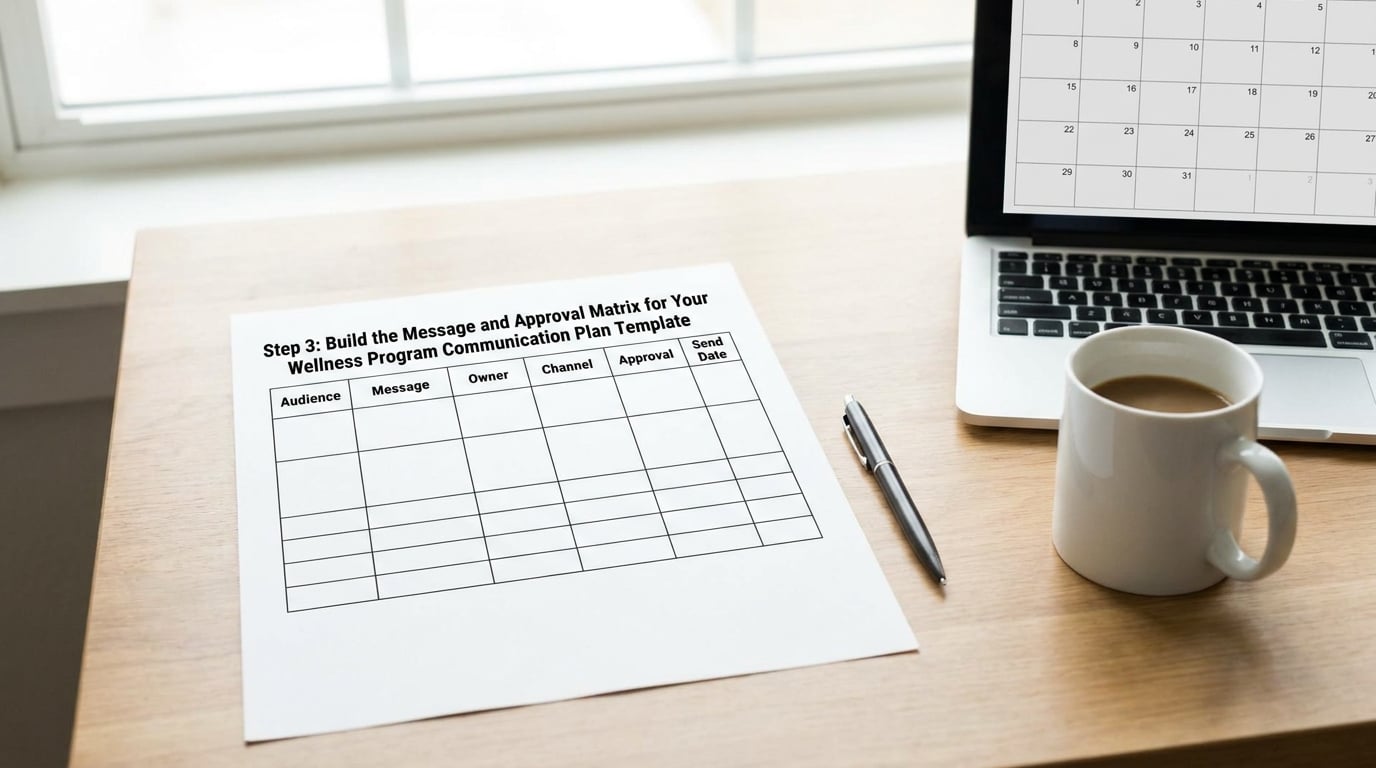
The matrix is the heart of the plan. Each row is one message aimed at one audience, and the columns force the decisions that usually get skipped. Build it in a shared spreadsheet so approvers can comment in place, and keep a version number at the top of the file.
Use these columns:
- Objective. The goal from Step 1 this row supports.
- Audience. A specific segment, not “everyone.”
- Key message. One sentence, in plain language.
- Call to action. The single next step, and roughly how long it takes.
- Owner. The named person who writes and sends it.
- Approver. The named person who signs it off, with the date they did.
- Channel and date. Where it goes and when.
- Accessibility requirement. Captioned, plain-language, translated, large-print or screen-reader compatible.
- Metric. What you will look at afterward.
One row per message keeps the plan honest. When a campaign needs twelve rows, that is a twelve-touch campaign, and you can see the cost of it in the plan instead of discovering it in month two.
Step 4: Choose Channels and Schedule Touchpoints
Assign channels to segments using the barriers you wrote in Step 2, then lay the touchpoints out on a calendar so they support each other rather than compete. A single email is a single chance; a teaser, a launch, a reminder and a results message is a sequence people can actually follow.
A quick way to sort channels:
- Email reaches people who check email on their own schedule, which suits shifts and remote staff. Wellness email open rates are often modest, so treat email as the record and the reference link rather than the only path to action.
- Team chat and an app notification is fast and cheap, but it competes with everything else on the screen. Use it for the reminder, not the announcement.
- The manager relay carries more weight than an HR broadcast because a manager’s words land with a real deadline attached. Managers need a script, not a bullet list.
- Intranet pages and a newsletter are the durable home for anything with detail: eligibility rules, the FAQ, the schedule.
- Signage, break room boards and printed cards reach people who rarely open a screen during a shift, and they cost very little.
- Virtual or in-person sessions carry the parts that need a voice: a Q&A with the benefits manager, a ten-minute guided break, a live demonstration.
Also plan the rows nobody expects. Add a crisis line to the plan: who sends a short message when a program, a service or a workplace situation changes quickly, and what the message says. Wellness communications that improvise during an urgent week are the ones people remember badly. And put the follow-up touchpoints on the calendar before you send anything, because a results message is what turns one participation spike into a habit.
Step 5: Write Accessible, Actionable Messages
Every message in the matrix should follow one formula, so employees learn your pattern instead of decoding a new format every time. Write the benefit in one sentence, the process in two or three, then the confidentiality note, the accessibility note, and one next action.
Here are three examples written for three different segments, all using the same structure.
For office staff considering a mental health support line: “Confidential support for you and your household, at no cost to you. You call or text, and a counselor responds within two business days. Nothing you discuss goes into your performance file or your medical record, and the service is available in the language you choose. Sign up takes about four minutes. Set it up before the fall deadline using the link below.”
For front-line employees who rarely open email: “New on the wellness board this week: a ten-minute guided stretch break every Wednesday at 2:15pm, led by the same coach each time, no signup and no cost. Your supervisor does not track who joins. It runs in the break room and on the team chat. Come to one session or none. The schedule is on the board and the poster has the same dates.”
For remote employees using a screen reader: “Ergonomic assessment sessions, bookable in 30-minute slots through October. A specialist reviews your desk, chair and screen setup at home, then sends a written summary. The booking page works with a screen reader, and we can arrange a phone-based session on request. Booking takes two minutes. Choose a slot on the calendar page.”
Notice what is missing from all three: pressure, body talk, and anything that requires a specific outcome. Plain language, a clear action, and a stated boundary about privacy is the whole formula. Keep sentences short, put the action in the first two lines where a preview will show it, and have the accessibility line written before the send date rather than after a complaint.
Step 6: Assign Roles and Prepare for Questions
Plans stall when nobody owns a row, and they collapse when the only person who can answer a question is on vacation. Name the roles and the people in them, then write the answers you expect to need.
Five roles cover most organizations:
- Program owner, accountable for the plan itself and for keeping the calendar current.
- Subject-matter experts for benefits, mental health, ergonomics or nutrition, who review claims and rules.
- Managers, who deliver the message verbally and in team meetings with the script you provide.
- Communication staff, who build and send the emails, pages and posts, and check accessibility.
- Escalation contact, a named person reachable on a given day for urgent or sensitive questions.
Then write a one-page FAQ before launch day, not after. The questions you will get are predictable: how much time does this take, is this confidential, does it cost anything, am I eligible, will this affect my performance review, is there a deadline, what if I cannot attend in person. Drafting answers in advance also exposes gaps: if the benefits manager cannot answer an eligibility question in plain language, the program is not ready to announce.
Step 7: Launch, Measure, and Improve
Run a preflight check the day before the first send. Every row has an owner, an approver and a date. Links open. Files are accessible. The FAQ answers the questions in the announcement. Managers have the script. The escalation contact knows they are on duty.
Then track two kinds of number. Reach tells you whether the message arrived: sign-ups, meeting attendance, views on the intranet page, responses in the chat, questions received per channel. Action tells you whether it changed behavior: completed sessions, benefit elections, assessments finished, repeat use at week six. A message with strong reach and weak action usually has a call-to-action problem, not a channel problem.
Collect feedback on a fixed cadence, not constantly. A short pulse question after each campaign plus a quarterly review works well. Then close the loop visibly: publish what you heard and what you changed. Employees notice that loop, and it is what keeps a wellness communication plan alive past the first quarter when novelty wears off and the calendar is competing with everything else.
Wellness Program Communication Plan Template
Here is the template itself. Copy this header row into a spreadsheet, one tab per month, and fill it in as a working document rather than a document you finish once. Every field is deliberately plain so that a new communications coordinator can pick it up without a handover meeting.
| Objective | Audience | Key message | Call to action | Owner | Approver and date | Channel | Send date | Accessibility | Metric | Follow-up |
|---|---|---|---|---|---|---|---|---|---|---|
| Awareness | All employees | Fill in | Fill in | Fill in | Fill in | Fill in | Fill in | Fill in | Fill in | Fill in |
| Awareness | Front-line and shift teams | Fill in | Fill in | Fill in | Fill in | Fill in | Fill in | Fill in | Fill in | Fill in |
| Awareness | Remote employees | Fill in | Fill in | Fill in | Fill in | Fill in | Fill in | Fill in | Fill in | Fill in |
| Participation | Fill in | Fill in | Fill in | Fill in | Fill in | Fill in | Fill in | Fill in | Fill in | Fill in |
| Access | Employees requesting accommodations | Fill in | Fill in | Fill in | Fill in | Fill in | Fill in | Fill in | Fill in | Fill in |
| Feedback | All audiences | Fill in | Fill in | Fill in | Fill in | Fill in | Fill in | Fill in | Fill in | Fill in |
A worked example of one completed row, for a fall screening campaign:
Objective: Participation. Audience: Employees aged 40 and over who opted into the health risk assessment last year. Key message: “The fall health risk assessment takes 20 minutes, is done privately, and your results go only to you.” Call to action: Book a 20-minute slot. Owner: wellness coordinator. Approver and date: benefits manager, approved on the 12th. Channel: Email plus a two-minute manager script in team meetings. Send date: the 22nd, with a reminder on the 29th. Accessibility: Plain-language, phone booking option, Spanish version, large-print copies at reception. Metric: bookings completed by the 45th day. Follow-up: Results summary sent on day 60, with the next campaign row already drafted.
Three rules keep the template useful. Add a row for every message, never a batch. Keep the approver and date column populated, since an unapproved row is a row you will discover is wrong. And at the end of each month, archive the month and copy the tab forward, so the plan shows history and next steps in one place rather than two disconnected files.
Common Mistakes
These are the failures I see most often, along with the fix for each.
Announcing too often
Ten emails in a month about wellness trains people to filter you. Put a monthly ceiling on the wellness row count, and protect it by batching small items into one message. If something does not fit the month, it waits.
Communicating only from the top
When every message comes from leadership, it reads as a directive. A manager relay plus a peer or ambassador voice usually reaches more people, and a short leadership message still does the job of setting the tone.
Inconsistent messages across teams
If the manager script says one thing and the email says another, employees pick the version that is less effort. Route every message through the matrix, and give managers the exact wording to read.
Materials nobody can use
Uncaptioned videos, image-only PDFs and unexplained jargon are the usual offenders. Write the accessibility requirement in the row, then check the file against it before the send date rather than after a complaint.
Unclear ownership
“Marketing will handle it” is not an owner. A named person plus a named approver means a stalled message gets chased by a human, not filed away.
Collecting more health data than the program needs
Every data request should have a purpose you can say out loud, and health information collected through a wellness program should stay out of personnel files and performance decisions. Say that plainly in the message, because the promise is what makes participation honest.
Announcing without following through
One announcement is a spike, not a program. Schedule the reminder, the results message and the next campaign before the first send, and set a review date at the end of every plan so the plan gets read even when nothing is broken.
Frequently Asked Questions
How often should we send wellness program communications?
Aim for one substantial wellness message a month, plus a reminder for anything with a deadline, and a short results message after each campaign. Weekly notes work only if they contain something new, such as a specific session or a new resource. Track opens, questions and sign-ups for a few months, then cut anything that consistently produces no questions and no action. A steady monthly rhythm is easier for employees to recognize than bursts of activity followed by silence.
What should a wellness program communication plan include?
Nine things: objectives tied to the program, audience segments, one key message per segment, a single call to action, a named owner, a named approver, channel and send dates, an accessibility requirement, and a metric with a follow-up date. Add a one-page FAQ and an escalation contact for sensitive topics. If a plan omits owners and dates, the messages will be written twice and sent by whoever remembers them last.
How do we reach frontline and remote employees?
Give each group its own rows in the plan. Front-line and shift teams respond to channels they touch during a shift, such as break room boards, printed cards, signage and short team huddles, plus text messaging for people who opted in. Remote employees respond to email, team chat and a calendar link, and they need a manager script for virtual meetings. Test each channel with a small group first, because a channel that works for office staff often does nothing for someone with no company device.
How do we measure whether wellness communication worked?
Track reach and action separately. Reach covers email opens, intranet page views, questions received and attendance at shared sessions. Action covers completed assessments, benefit elections, sessions attended and repeat use at six weeks. Strong reach with weak action usually points to a weak call to action rather than the wrong channel. Add one feedback question per campaign and review the numbers monthly against the objectives you set at the start of the plan.
How do we get leadership buy-in for the wellness communication plan?
Lead with the operational cost, not the wellness benefit. Bring a filled version of the plan, a one-year touchpoint count, the named owners, and a small channel budget. Show what happens without a plan: a well-designed program that most people never hear about, repeated design work each campaign, and no way to answer a simple question about participation. Ask for a decision on ownership and a monthly ceiling on messages, which is a much easier yes than a full year of funding.
How do we discuss sensitive health topics without breaking privacy rules?
Keep health information out of personnel files, performance discussions and manager conversations, and have a benefits or legal reviewer check wording before any send. Use a short privacy note in plain language rather than a policy link, and route individual questions to the program team instead of answering them in a group channel. Publish aggregate program numbers rather than names or health details, and keep emergency and crisis messages to a small set of pre-approved wording with one named escalation contact.
Conclusion
Start with one objective you can actually count, list the three audiences most likely to be missed, and fill in the first row of the wellness program communication plan template. Then assign the remaining owners and approvers and put the dates on a shared calendar. A plan with twelve rows and real names beats a perfect framework nobody owns, and you can always add rows once the first month shows you what people are responding to.