
Telehealth for occupational injuries means an injured employee is assessed by a licensed clinician over secure video or phone instead of waiting in an urgent care lobby. It works well for the large share of workplace injuries that are minor, stable and easy to describe — most strains, sprains, contusions, small cuts and repetitive-use flares. It does not work for severe trauma, head and neck injury, breathing trouble, or anything that needs hands-on examination or imaging. The rest of this guide covers where the line sits and how to build a program that respects it.
Most HR and safety teams meet telehealth for occupational injuries the same way: a worker hurts their shoulder on a Tuesday, waits two days for a clinic appointment, and ends up in an emergency department that nobody wanted to pay for. Virtual occupational medicine exists to catch that worker in hours instead of days, and to sort them quickly into the small group who actually needs to be seen in person.
Table of Contents
- What Is Telehealth for Occupational Injuries?
- How Does Occupational Telehealth Work?
- Which Occupational Injuries May Benefit From Telehealth?
- What Are the Benefits for Workers and Employers?
- What Are the Limitations and Safety Risks?
- How Can Employers Set Up a Telehealth Injury Program?
- What Should an Employer Look for in a Telehealth Provider?
- How Does Telehealth Fit With Workers’ Compensation?
- How Can Employers Measure Whether a Program Works?
- Frequently Asked Questions
- Conclusion
What Is Telehealth for Occupational Injuries?
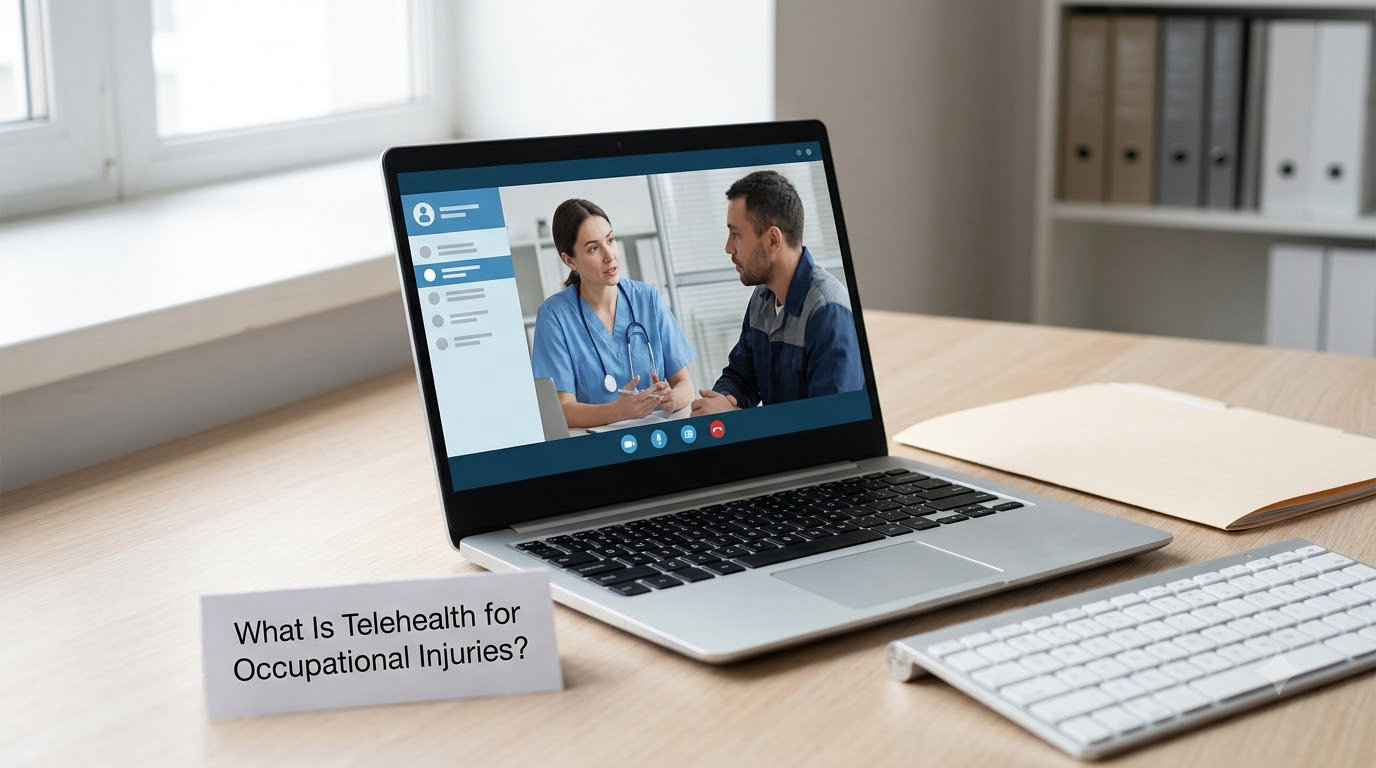
Telehealth for occupational injuries is the delivery of clinical care for work-related injuries and illnesses through secure video, phone or messaging instead of in-person clinic visits. It covers initial assessment, injury rechecks, triage guidance, work restrictions, return-to-work decisions, and referral into a workers’ compensation claim file.
The terminology gets muddled fast, and the confusion is why some employers assume a virtual visit is just a video call with a nurse. Three terms get used interchangeably in vendor material, and only one of them is precise.
| Term | What it means | Example in an injury program |
|---|---|---|
| Telehealth | The broad category: any clinical or health service delivered over distance using telecommunications | Virtual care platform, remote monitoring, messaging with a nurse |
| Telemedicine | Medicine delivered by a licensed clinician, usually a physician or nurse practitioner, using synchronous video or phone | Video assessment of a low back strain and a written work restriction |
| Telecare | Non-clinical support — reminders, monitoring, check-in calls, adherence support | A day-three call asking whether ice and rest are helping the wrist |
What matters for a program is not the label but what sits behind it. Occupational telemedicine specifically means a clinician who is trained in work-related injury, familiar with workers’ compensation paperwork, and able to write restrictions an employer can act on. A general urgent-care telehealth line can assess a sprained ankle; it is much less useful for deciding whether someone can safely work a forklift shift on Monday.
Positioned correctly, virtual care sits inside an existing injury-response sequence rather than beside it. The employer still controls who is authorized to use the service, still runs first report and accident investigation, and still files the paperwork the state requires. Telehealth is the clinical front door, not a parallel system. We reviewed the current vendor and agency guidance for this guide in 2026, and the same framing holds across the platforms we looked at.
How Does Occupational Telehealth Work?
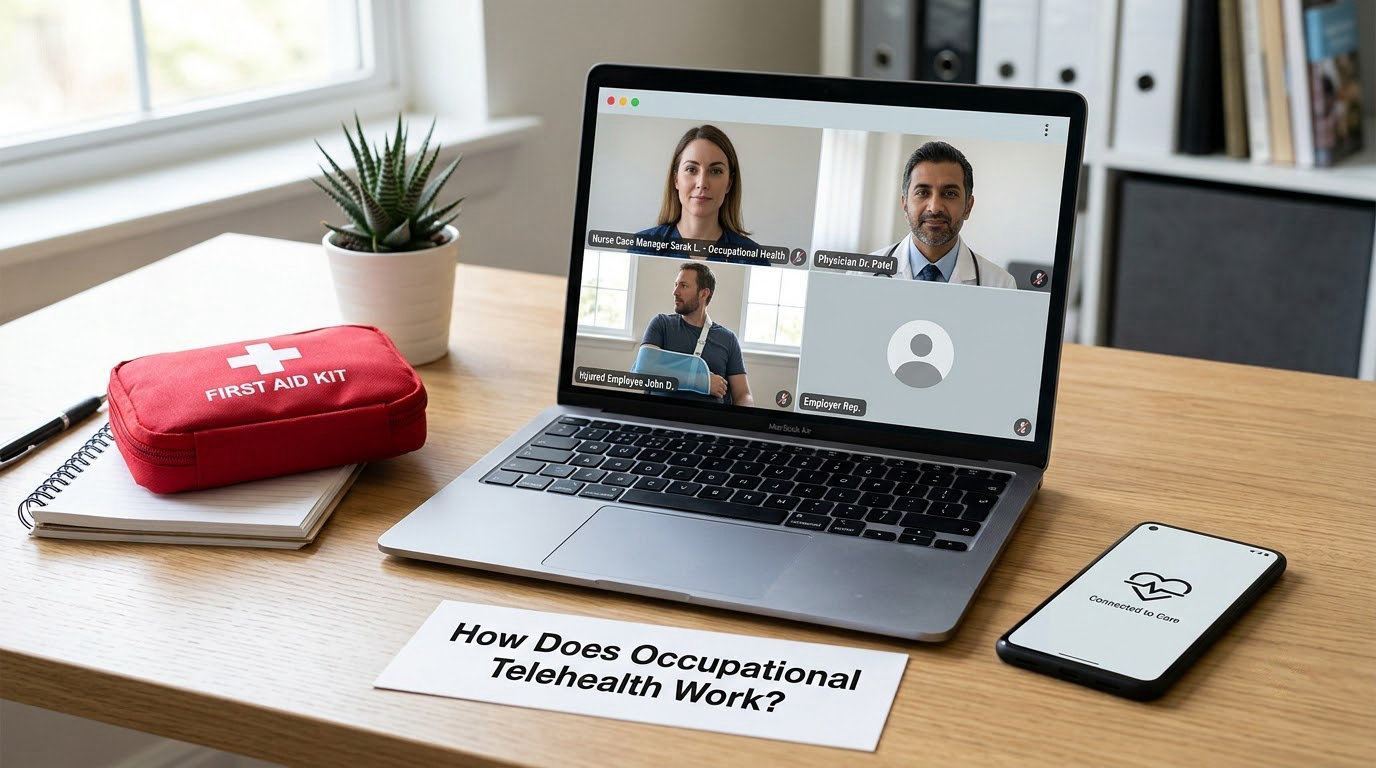
A virtual occupational injury visit runs in six steps, and most of them take less time than the drive to a clinic would.
- Report. The worker tells a supervisor right away, and the employer logs the first report. This step matters even when no medical care has happened yet, because most state reporting clocks start at the incident, not at the appointment.
- Authorize. The employer confirms the worker is covered and opens the visit, either through a platform account or a phone number. A supervisor who doesn’t know the process is the single most common reason a good program goes unused.
- Launch. The worker gets a link or app instruction, checks device and connection, and enters a virtual waiting room. Audio-only fallback is a must for warehouse floor, plant and rural crews.
- Check-in. A nurse or care coordinator confirms the mechanism of injury, the body part, when it happened, current symptoms, prior history and any urgent warning signs. This is the triage gate — the point where the visit either stays virtual or becomes an in-person referral.
- Clinician evaluation. The occupational health physician or nurse practitioner reviews history, asks the worker to demonstrate limited movement or show the injury on camera, and decides the pathway. A written treatment plan and specific work restrictions come out of this step.
- Documentation and referral. A clinical note is generated and routed to the employer, the claim file and the treating provider, along with any referrals for physical therapy, imaging or an in-person clinic visit. A scheduled recheck is booked before the worker leaves the call.
That last step is where programs succeed or quietly fail. A virtual visit that produces a vague note saying “avoid heavy lifting” gives the supervisor nothing to schedule around. Useful restrictions name the body part, the limit in plain language, and a review date. If your vendor’s notes don’t do that, ask why before you roll the program out.
One more thing employers should plan for: most virtual injury visits resolve in a single consultation, but the ones that end in referral often end in a shorter claim than the ones that went straight to the emergency department. Industry material has put the treatable share of initial injuries at around 30% and the treatable share of rechecks considerably higher, though treat that as directional rather than settled science. The peer-reviewed literature is still small in this niche — a 2022 study in PMC looking at telehealth-integrated occupational therapy for hand and upper limb injuries reported encouraging outcomes on a limited sample.
Which Occupational Injuries May Benefit From Telehealth?
Most low-severity musculoskeletal complaints and minor skin injuries are reasonable candidates, and the deciding factor is usually whether the worker is stable and whether the clinician can see enough on camera. Anything that needs palpation, range-of-motion testing, a wound that needs closure, or a diagnosis that depends on imaging should go in person.
Our reading of the vendor and clinical guidance lines up on a four-way split, which is worth writing into your own program as a decision rule rather than a vague judgment call.
| Pathway | Typical presentations | What happens | Watch for |
|---|---|---|---|
| Appropriate for a virtual visit | Minor strains and sprains, contusions and bruises, tendonitis and repetitive-use flares, work-related rashes, minor burns, small cuts and scrapes, low back and neck pain without red-flag symptoms, second and third shift injuries far from a clinic | Full assessment, treatment plan, work restrictions, follow-up recheck booked | Worker cannot describe the mechanism clearly, or symptoms are worsening between calls |
| Treat virtually, recheck by telehealth | Sprains and strains at days 5 to 10, healing lacerations, improving symptoms, repeat pain assessments, work restriction reviews | Progress check, adjusted restrictions, escalation decision | No measurable improvement at recheck — that is an in-person signal |
| Refer in person | Symptoms lasting beyond a few weeks, possible disc or nerve involvement, suspected fracture or joint injury, abdominal or inguinal pain, skin wounds needing closure, hand or wrist injuries that limit grip, anything needing imaging or lab work | Same-day or next-day clinic appointment, transport or accompaniment arranged | Worker has been cycling virtual visits without a diagnosis |
| Emergency, no telehealth | Severe trauma, uncontrolled bleeding, difficulty breathing, suspected head or neck injury, neurologic symptoms such as confusion, weakness or loss of sensation, eye injury with vision change, chemical or smoke inhalation with respiratory symptoms | Call emergency services, then follow up with the employer on the incident | Any delay. Virtual care is never the first call for these |
One useful comparison while you build your own list: prevention work on the tasks that generate most of these claims usually pays better than treating them. Repetitive strain on an assembly line and back injuries from lifting are both largely design problems, and a virtual care channel is the treatment half, not the fix. Our guide to reducing repetitive strain injuries on an assembly line covers that side of the problem in more detail.
What Are the Benefits for Workers and Employers?
The value shows up on both sides, and it is mostly about time and access rather than cheaper medicine. Here is how the same visit reads to each party.
| For the worker | For the employer |
|---|---|
| Seen the same shift instead of the same week | Faster first contact, so early intervention starts sooner |
| No waiting room and no travel after a shift | Fewer unnecessary emergency department visits |
| Access to a clinician who understands work injuries | Less lost duty time, which is usually the biggest cost on the claim |
| Clear written restrictions they can show a supervisor | Restrictions that can actually be matched to modified duty |
| Follow-up without a second trip across town | Cleaner documentation for the claim file and the adjuster |
| A clinician for behavioral health after a nonphysical incident | Consistent response for rural, shift and distributed workforces |
What workers report valuing is the avoidance of a waiting room, not the technology. The adoption barrier in practice is usually platform confusion — nobody wants to argue with an app at 2am — so a phone number that works gets used and a portal that sits on an intranet gets ignored.
Be careful with the framing, though. Telehealth does not produce better clinical outcomes than in-person care across the board. It produces earlier access and less friction. Those two things correlate with better outcomes for this kind of low-acuity injury, which is not the same claim.
What Are the Limitations and Safety Risks?
The main risk is mis-triage: a serious injury that stays on the virtual channel too long. That risk is manageable, but only if the boundaries are published and the escalation path is real.
Situations that should never be handled by telehealth alone include severe trauma, difficulty breathing, uncontrolled bleeding, suspected head or neck injury, neurologic symptoms, eye injury affecting vision, and chemical or smoke inhalation with respiratory symptoms. So do injuries where the diagnosis depends on imaging, a nerve block, a wound closure, or a physical exam the camera cannot replace.
Four failure modes show up repeatedly in practice:
- Repeat virtual visits without progress. A worker who re-checks twice with no measurable improvement needs a person, not another video.
- Undocumented mechanism. If the worker cannot say how it happened, the visit stalls. A supervisor can fix that at the point of report with three questions.
- Connectivity and language access. Low-bandwidth sites and workers with limited English get excluded quietly. Audio-only visits and interpreter access are not extras.
- Documentation gaps. Vague restrictions, missing review dates and no follow-up booking generate rework for supervisors and push claims longer.
One related exposure deserves a specific mention: bloodborne pathogen contact after a needlestick or splash. It needs a clinician and a time window, and it also needs to be reported to OSHA within the applicable timeline. We cover the reporting chain in how to prevent needle stick injuries at work, and the same escalation discipline applies whether or not the visit is virtual.
How Can Employers Set Up a Telehealth Injury Program?
A workable program takes about a quarter to stand up if you treat it as a workflow change rather than a purchase. Eight steps cover most employers.
- Map your claims. Pull the last two years of first reports and claims. The top few mechanisms will tell you what the program actually needs to handle, and how many visits you are talking about.
- Write a one-page scope. What is eligible, what is excluded, what happens in an emergency. Everyone who touches an injury report needs this page, including supervisors who will never use the platform.
- Choose a provider. Verify that the clinicians hold licenses in every state your workers are in, that they bill workers’ compensation, and that a written escalation path exists. Section below covers the rest of the checklist.
- Set escalation rules in advance. Emergency symptoms, no improvement at recheck, need for imaging — each has a defined next step and a defined time window.
- Train supervisors. They own the first report. Give them a script, not a link.
- Protect privacy. HIPAA-compliant platform, a Business Associate Agreement with the vendor, no video recording, a defined retention period, and a rule that supervisors receive only the restrictions they need — not the full clinical note.
- Integrate with the claim workflow. The visit note, the restrictions and the recheck date should land in the same place the rest of the file does, or the claim will stall waiting on information nobody knew was missing.
- Tell workers before they need it. Post the phone number in the break room, put it in the handbook, and repeat it during onboarding. A program nobody knows about is not a program.
Small employers without an on-site clinic get more out of this than most. There is no clinic to route a two-hour minor injury through, and the alternative is a long drive that pushes workers toward the emergency department anyway.
What Should an Employer Look for in a Telehealth Provider?
Evaluate providers on boundaries and paperwork as much as on technology. Buyers tend to trust a vendor who states plainly what they will not treat, because that vendor is describing a real safety process rather than a sales position.
- Multi-state licensure. Clinicians must be licensed where your workers physically are. Ask for the license list, not a general claim of national coverage.
- Workers’ compensation experience. Can they bill a work injury, and do their notes satisfy an adjuster? Ask to see a de-identified sample note.
- Occupational health expertise. Work restrictions, modified duty vocabulary, functional capacity framing — not just urgent care with a different logo.
- Written exclusion list. Head, eye, inhalation, life-threatening. A provider without one is guessing.
- Escalation path. A named in-person clinic, a same-day appointment guarantee, and someone who owns the handoff.
- Security posture in plain language. HIPAA compliance, Business Associate Agreement, no video recording, breach monitoring, and where records actually live.
- Reporting capability. Can the vendor send a report to you, to the claims administrator, and to the treating provider, on a schedule you choose?
- Accessibility. Audio-only visits, interpreter access, low-bandwidth performance, and a phone number as a full alternative to the app.
- Transparent pricing. Per-visit and subscription structures stated plainly, with any pass-through imaging or referral costs identified separately.
Two questions decide more contracts than the rest: what happens when a visit turns out to be the wrong channel, and who is responsible for the follow-up appointment that results. Get the answers in writing.
How Does Telehealth Fit With Workers’ Compensation?
Telehealth works inside the workers’ comp system rather than outside it, and the mechanics are jurisdiction-specific. Rules differ by state and by whether a claim has been filed yet, so treat any general statement as a starting point and check your own state agency.
A few practical points hold nearly everywhere:
Reporting clocks start early. The requirement to report an injury to the employer — commonly within one working day — and the deadline to file a workers’ compensation claim, which in many states falls around the 7-day mark, run independently of any appointment. A worker who waits two weeks to open a telehealth visit may already have forfeited something. The “7 day rule” that shows up in search results refers to these early notice and filing deadlines, not to anything telehealth-specific. Here is a good place to prevent back injuries from lifting in the first place.
Does a virtual visit count as a provider visit? Generally yes, when the clinician is licensed in the worker’s state and the service falls within the scope of the claim. A virtual evaluation produces a real medical record with the same legal weight as an office visit.
Will the adjuster accept the note? In practice, the note has to document mechanism of injury, subjective history, objective findings, diagnosis, treatment plan, and specific restrictions with a review date. A thin note gets sent back, and a sent-back note costs the worker a week of claim duration.
What about authorizations? Some states and some plans require prior authorization for specific services, and a virtual visit may need to be authorized as such rather than billed as an office visit. Confirm the billing pathway with the claims administrator before launch.
Reimbursement for telehealth itself has matured — a large majority of states plus the District of Columbia require private insurers to cover it, and many also require payment parity — but that applies to health insurance, not to workers’ comp, which is governed separately. A state can cover telehealth clinically while treating it differently on a comp claim. Check with your state department of workers’ compensation or industrial commission directly.
How Can Employers Measure Whether a Program Works?
Track a small set of numbers for the first 90 days, and pair every efficiency metric with a safety metric so one cannot improve at the other’s expense.
- Time to first clinical contact, measured from the reported incident.
- Appropriate referral rate, the share of virtual visits that correctly became in-person appointments. A very low number here is a warning, not a win.
- Emergency department visits per claim, before and after launch.
- Average claim duration and lost duty days, which is where the real money moves.
- Recheck completion rate, and the share of rechecks showing measurable improvement.
- Restrictions that supervisors could act on, measured by how many required a clarifying phone call.
- Worker take-up rate by shift and location, so you catch the crews the program is quietly failing.
- Delayed or missed care reports, counted openly and reviewed individually.
The last one is the one most programs skip, and it is the one that tells you whether your escalation rules are working. Review every case where a worker was told to be seen in person and then wasn’t seen within the promised window.
Frequently Asked Questions
Is telehealth covered by workers’ compensation?
In most states, yes, when a licensed clinician delivers the visit to a worker in that state and the service falls within an open claim. Rules vary by jurisdiction, and some states or plans require the virtual service to be authorized differently than an office visit. Confirm the billing pathway with your claims administrator and your state workers’ compensation agency before you launch a program.
What is the 7 day rule for telehealth?
The 7 day rule is not a telehealth rule. It refers to the early notice and claim filing deadlines that apply to workplace injuries in many states, commonly the requirement to report the injury to your employer within one working day and to file a workers’ compensation claim within about a week. Opening a telehealth visit does not pause either clock, and deadlines vary by state.
Can I return to work while on workers’ comp?
Often yes, because a treating clinician can release you to work with restrictions rather than fully off duty. Light duty with specific limits is usually easier on a claim and on your recovery than complete work stoppage. The restrictions have to come from a provider in writing and be specific about body part, limit and review date so your employer can actually match you to a modified role.
Can you return to work too soon after an injury?
Yes, and it happens more often than employers expect. A return that is too fast, or that ignores the written restrictions, tends to reinjure the same body part and lengthen the claim. Two safeguards help: make sure restrictions reach the supervisor in writing before the first shift back, and set a planned recheck before the return rather than assuming the person is fine.
When an accident happens, do I have to tell my supervisor right away?
Usually yes. Most employers require immediate notice of a workplace injury, and most states impose their own short deadline to report, commonly within one working day. Notice is not the same as filing a claim, but it starts the clock. Report first, then open a virtual visit the same day if the service fits the injury.
I injured myself outside of work. What should I do?
Tell your employer anyway, and say clearly that it happened off the clock. A private injury can still affect your ability to work, and an unreported limitation tends to surface as a missed deadline or a workplace accident later. Do not frame it as a work injury, and do not use a company telehealth visit for a claim that is not a claim. Your own insurance or an urgent care is the normal route.
Conclusion
Start with the pathway, not the platform. Write down which injuries go virtual, publish the exclusions so every supervisor can recite them, name the in-person clinic a visit escalates to, and put the number where workers will actually see it. Get those four things right and the vendor choice becomes a much easier conversation. Get one of them wrong and the fastest channel in occupational medicine becomes a way to delay care.