
The ideal office temperature for productivity is 20-24°C (68-75°F) for typical sedentary desk work, with roughly 21-22°C (70-72°F) the most commonly cited target. That is a range, not a magic number, because comfort depends on humidity, clothing, air movement and who is sitting in the room. Updated for 2026, this guide covers what the studies actually measured, what the standards recommend, and how to settle the argument when the thermostat is wrong.
For most employers the useful question is not “what is the perfect number” but “what range keeps the most people comfortable without burning through energy to get there”. Overcooling a floor to 62°F (17°C) so a handful of people stop complaining is the expensive way to lose that argument. Our guide to office worker health risks covers the wider picture of what a badly controlled indoor environment does to staff.
Table of Contents
- What Is the Ideal Office Temperature for Productivity?
- How Temperature Affects Concentration and Work Performance
- Recommended Temperature Ranges by Workplace Type
- Why Individual and Environmental Factors Matter
- How to Set and Maintain a Comfortable Office Temperature
- Simple Ways to Reduce Heat, Cold, and Temperature Discomfort
- Frequently Asked Questions
- Conclusion
What Is the Ideal Office Temperature for Productivity?
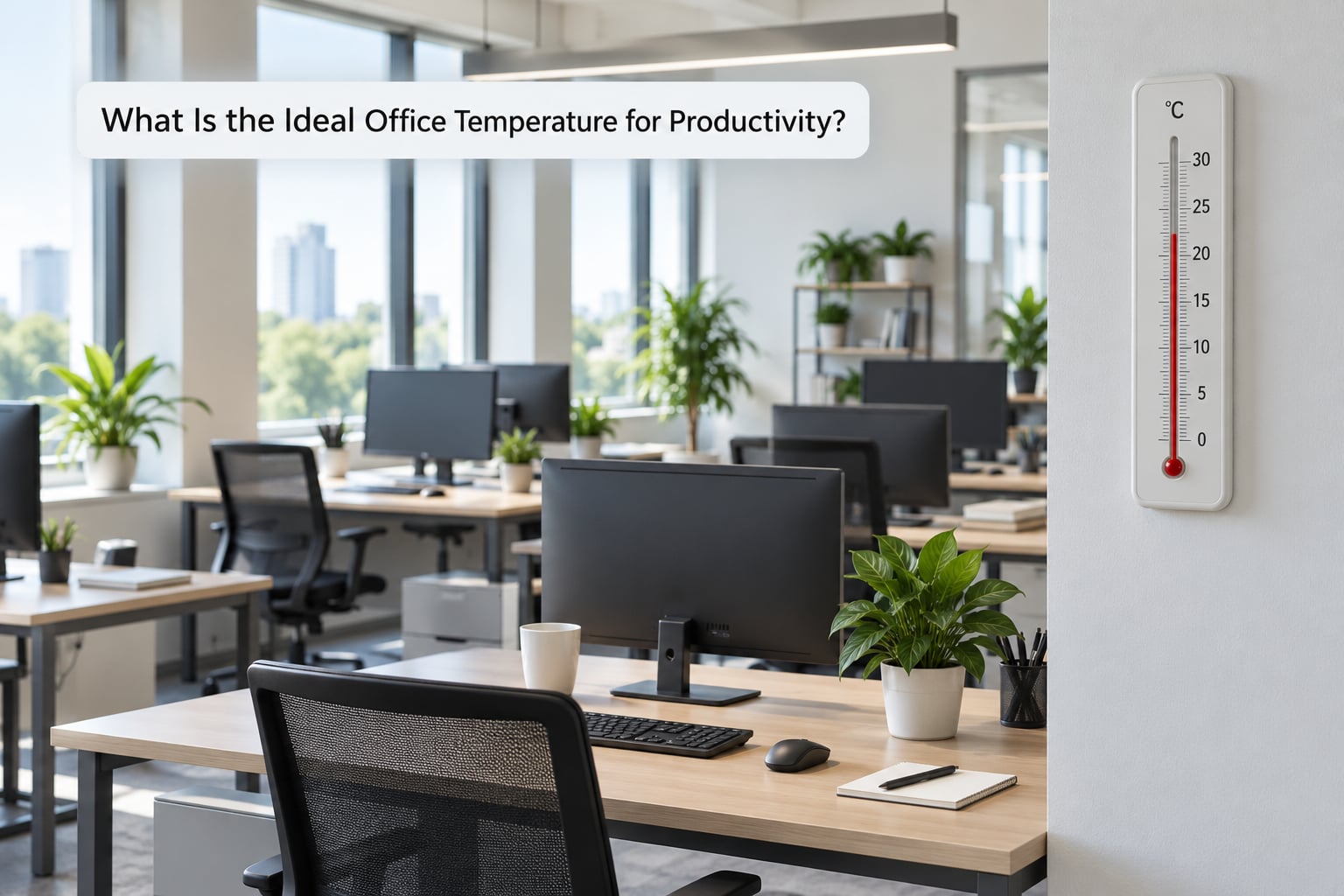
Most professional guidance lands on 20-24°C (68-75°F), with 21-22°C (70-72°F) as a practical default for seated office work. The band matters more than the figure, because ASHRAE Standard 55 and ISO 7730 both describe a range of acceptable conditions rather than a single set point.
Two terms explain why. Thermal comfort is the subjective state of feeling neither too warm nor too cold, and it depends on more than air temperature. Operative temperature is the blended figure combining air temperature, the temperature of surrounding surfaces and the speed of the air, which is why a sunny desk with a cold window can feel colder than the thermostat says.
| What it feels like | Celsius | Fahrenheit | Where it is commonly set |
|---|---|---|---|
| Too cold for sedentary work | Below 19°C | Below 66°F | Overcooled meeting rooms, empty floors cooled all day |
| Lower edge of comfort | 20°C | 68°F | Thermostat night setback, early morning start-up |
| Common target | 21-22°C | 70-72°F | General office and call centre set points |
| Upper edge of comfort | 24°C | 75°F | Warmer climates, humid summers, high activity areas |
| Too warm for sustained desk work | 26°C and above | 79°F and above | Complaint zone, especially with high humidity |
| Working from home guidance | 22-25°C | 72-77°F | Home-working comfort band from indoor environmental guidance |
Cornell researcher Professor Alan Hedge puts the ceiling on precision nicely: a fixed standard cannot satisfy everyone, so the practical target is a setting that keeps dissatisfaction under roughly a fifth of occupants. Any number sold as the single correct answer for every office, every person and every climate is overselling it.
How Temperature Affects Concentration and Work Performance
When a body is thermally uncomfortable it spends energy on regulating core temperature and shifting blood flow between skin and core. That energy is not available for thinking, and the effect shows up as shorter attention spans, more errors and slower work on demanding tasks rather than as any dramatic drop in everything.
What the individual studies measured varies a lot, which is why they appear to contradict each other. They use different tasks, different climates and different definitions of “performance”.
| Study | Year | Temperature tested | Task and outcome | Published in |
|---|---|---|---|---|
| Chang and Kajackaite, 543 German university students | 2019 | 61°F to 91°F (16-33°C) | Maths and verbal performance; performance worsened as conditions moved away from a moderate band, with different patterns for men and women | PLOS ONE |
| Ajman University EEG study, 64 men in their 20s | 2024 | 20.5°C versus 24°C | EEG readings and attention; the cooler room was associated with cognitive fatigue and poorer attention | Architectural Science Review |
| Freezing from the heat, University of Bath and Qatar | 2024 | 24.9°C | Task performance peaked near 24.9°C for the conditions tested | Building Services Engineering Research and Technology |
| Thermal comfort standards | Current | Comfort band rather than a point | ASHRAE Standard 55 and ISO 7730 describe acceptable ranges for sedentary office work | ASHRAE / ISO |
Two caveats belong next to those results. The 2019 study is frequently quoted as though it settled the question; the researchers were explicit that it does not identify a single ideal temperature. And the 2024 Qatar work flags a confound that offices ignore: cooling people down too far can raise stress, which then drags on performance.
The most defensible summary is that moderate, stable conditions support better work than either extreme. Fluctuations matter as much as the average, so a room that swings from 19°C to 24°C over the course of the afternoon will frustrate people more than one that holds a slightly imperfect 22°C all day.
Recommended Temperature Ranges by Workplace Type
Start points, not guarantees. Adjust each one using the survey and monitoring method later in this guide.
| Workplace type | Starting point | Why it differs |
|---|---|---|
| Conventional open-plan office | 21-23°C (70-73°F) | Mixed activity levels and no individual control, so the middle of the comfort band works best |
| Call centre or headset-based work | 21-22°C (70-72°F) | Continuous speech and limited movement, so people feel colder over a long shift |
| Office with heavy computer use | 22-24°C (72-75°F) | Heat from monitors, servers and dense equipment loads the space, and staff are sedentary |
| Variable occupancy (hot desk, shared meeting rooms) | 22-24°C (72-75°F) | Empty rooms overcool down and swing when a group arrives, so stability matters more than a low target |
| Summer, hot or humid climate | 24-26°C (75-79°F) | Humidity slows sweat evaporation, so the same air temperature feels warmer; outdoor thermal memory also shifts expectations upward |
| Winter, temperate or cold climate | 21-22°C (70-72°F) | People arrive from cold streets and under-heated cars and prefer the warmer end |
| Deep focus or individual work | 21-22°C (70-72°F) | Desk work is sedentary, so a slight warm bias beats a cold room |
| Working from home | 22-25°C (72-77°F) | Home comfort guidance allows a slightly warmer band, but watch solar gain in a sunny room |
If you are weighing other parts of the desk setup alongside this, our office ergonomics checklist for desk workers is a good companion. Temperature is one lever among several, and a fixed chair or a monitor at the wrong height will undo a perfect thermostat setting.
Why Individual and Environmental Factors Matter
The same room produces different comfort reports from people sitting a metre apart. These are the factors that move the ideal number:
- Sex and body size. People differ in body composition and surface-area-to-mass ratio, so they lose and gain heat differently at rest.
- Clothing. A summer shirt and a cardigan is a difference of several degrees of perceived warmth in the same room.
- Age and health. Older workers and people with circulatory or respiratory conditions feel temperature changes more sharply.
- Workload and posture. Sedentary work with no movement generates little heat, so a room that suits someone walking around feels cold to someone sitting still for nine hours.
- Desk location. Direct air from a diffuser, a cold window wall or a hot ceiling light changes operative temperature at the desk without changing the thermostat at all.
- Relative humidity and air speed. High humidity blocks sweat evaporation and a draught of 0.2 m/s makes a 22°C room feel several degrees colder.
- Sunlight and solar gain. A west-facing window can add a surprising amount of radiant heat in the late afternoon.
- Thermal memory. People acclimatised to a hot climate genuinely tolerate and even prefer warmer settings, which is part of why a globally uniform standard frustrates staff.
What the gender-differentiated evidence actually shows
The 2019 PLOS ONE study, widely covered in the news, tested 543 participants across 61°F to 91°F and found performance patterns that differed between men and women. That result is frequently reduced to a slogan about turning the thermostat up. The researchers themselves said the study does not identify an ideal temperature, and Professor Hedge has argued that most standard-setting bodies accept some level of unmet preference is unavoidable.
The practical read is narrower and more useful: a setting tuned entirely around one group’s preference is likely to leave another group uncomfortable, so the fix is giving people control rather than picking the right side of an argument.
When the problem is air quality, not temperature
Headaches, dry throat, itchy eyes and end-of-day fatigue are often blamed on the air conditioning when the real causes are humidity, ventilation rate or carbon dioxide. Surveys of occupants in poorly performing buildings report these symptoms at high rates, with dry or itchy eyes and dry throat among the most common and headaches and chronic fatigue close behind.
The term sick building syndrome describes the pattern: symptoms that appear while you are in the building and ease once you leave. Because it overlaps with a bad temperature setting, it is worth checking relative humidity, outdoor air supply and CO2 levels before anyone moves the thermostat. If you are dealing with persistent symptoms, speak to a doctor rather than treating a building problem as a health diagnosis.
How to Set and Maintain a Comfortable Office Temperature
Most failed temperature policies are made by picking a number and enforcing it. This method builds the policy around evidence you collect yourself.
- Pick a defensible baseline. Start at 22°C (72°F) for a mixed office and 21-22°C for a call centre. A number with a standard behind it ends arguments faster than a manager’s preference.
- Survey staff before you change anything. Ask people to rate the room at three times of day and note desk location, not just floor. Separate preferences from symptoms so air quality problems do not get misfiled as temperature problems.
- Run a two-week trial band. Move the set point in 1°C steps and log complaints and feedback weekly. Hold the change long enough for people to adapt; a two-day trial tells you nothing about acclimatisation.
- Zone the space. Perimeter offices lose heat in winter and gain solar heat in summer. Separate control for core and perimeter zones usually solves more complaints than moving the main set point.
- Give people local control. A small local override at each desk zone prevents the twenty-minute negotiation that happens every afternoon at the shared thermostat.
- Monitor real conditions. Place a few temperature monitors at desk height in occupied zones, plus a humidity reading, and review them alongside the feedback log rather than trusting the plant room reading.
- Review quarterly and after change. A new fit-out, a layout change or a hot summer can move the answer. Treat the set point as something you check, not something you set once.
Employer duty of care: when heat or cold becomes a hazard
In the US there is no single federal number prescribing an office temperature. OSHA does not set a fixed set point for offices, and many states have no specific standard either, but employers still carry a general duty to provide a workplace free from recognised serious hazards, and heat illness, cold stress and the symptoms of poor indoor air quality can fall under it.
For indoor work, federal heat illness prevention rules apply to specific high-risk settings such as warehouses, kitchens and laundries. For everyone else, the practical triggers are heat stress symptoms in colleagues and a documented attempt to fix the problem. If a worker raises unsafe heat or cold, document it, act on it and check your state plan. This is general information, not legal advice; rules vary by state and change, so confirm the current position with a workplace safety professional before relying on it.
Separately, watch overcooling from an energy and carbon angle. Cooling a building to 20°C when occupants are comfortable at 23°C wastes a large amount of power for no measured gain in output, and a thermostat that swings 4°C across the day costs more than one that holds steady.
Simple Ways to Reduce Heat, Cold, and Temperature Discomfort
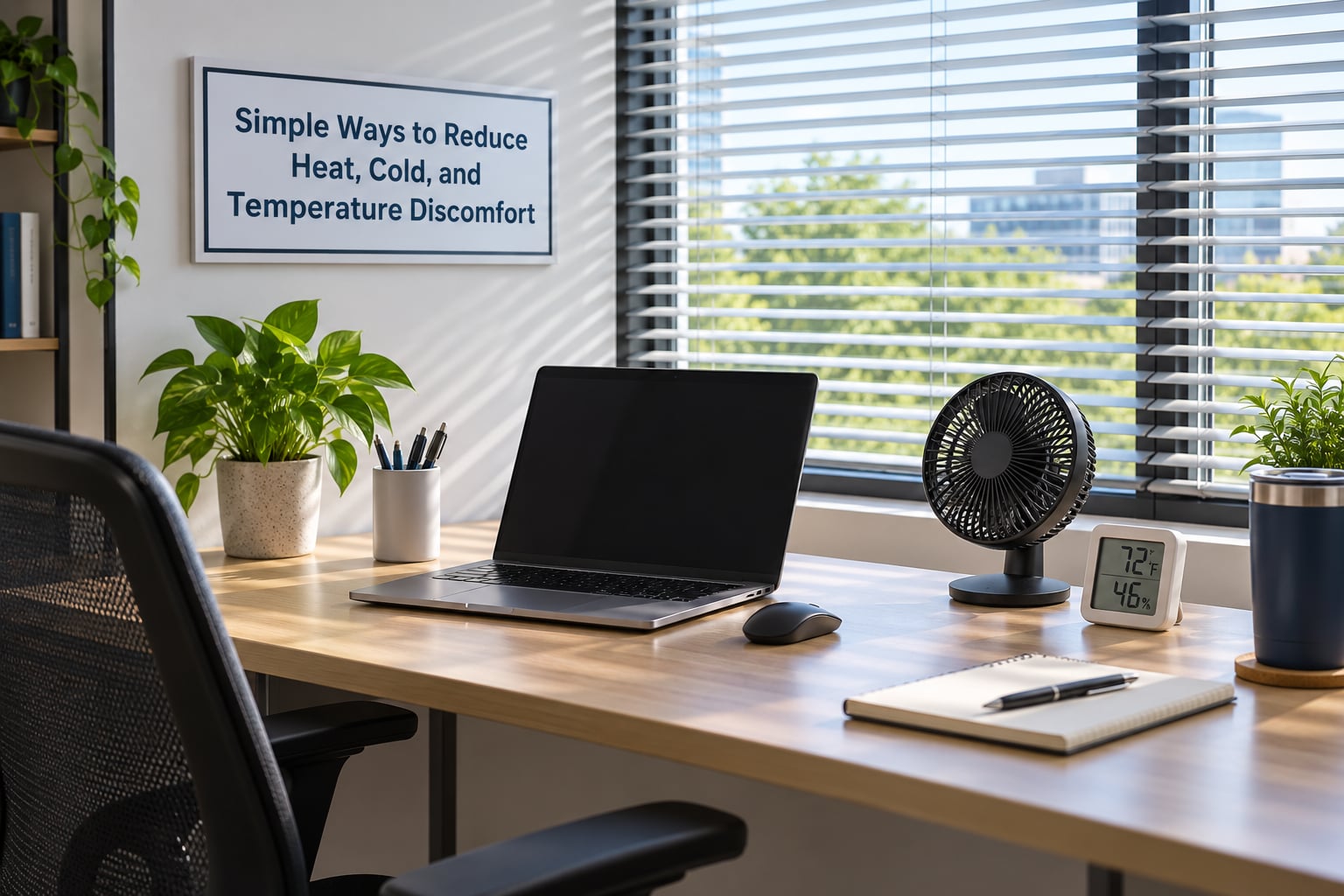
Most of these cost very little and can be done this week:
- Close blinds on sun-facing glass. Aiming at reducing solar gain before noon is more effective than fighting it with cooling in the afternoon.
- Move desks out of direct air. A diffuser aimed at one seat creates a cold desk in an otherwise fine office; redirecting the vane or relocating beats a thermostat fight.
- Provide local fans and heaters. A desk fan adjusts perceived temperature far more efficiently than changing the whole room.
- Make layering normal. Allow a cardigan or sweatshirt without treating it as a complaint to be managed.
- Check humidity. Below about 30% relative humidity, dry throat and irritated eyes get worse; above about 60%, warm rooms feel much hotter than the number suggests.
- Have the air conditioning serviced. Dirty filters and poorly set schedules are a common cause of both discomfort and the temperature swings people complain about most.
- Keep outside air flowing. A slightly cooler room with high CO2 feels worse than a warmer room with fresh air; check the ventilation rate along with the temperature.
- Give employees a say at the set point. People who are consulted adjust faster and complain less, and our guide to adjusting an office chair covers the same principle for another part of the desk.
Frequently Asked Questions
What is the ideal office temperature for productivity?
Most guidance puts it at 20-24°C (68-75°F) for sedentary desk work, with 21-22°C (70-72°F) as the most commonly cited target. ASHRAE Standard 55 and ISO 7730 describe a comfort band rather than a single set point, and published studies test from 20.5°C to 24.9°C. Start at the middle of the band, then adjust for humidity, clothing and who is in the room.
Is 79 degrees too hot for an office?
79°F (26°C) sits above the comfort band most standards describe for sedentary office work, especially once humidity is added. It is not dangerous for an hour in a dry, ventilated room, but it is the point at which concentration, typing accuracy and comfort all tend to fall. Sustained work above roughly 26°C in humid conditions is when heat stress becomes a genuine occupational health concern.
Is 67 degrees cold for an office?
67°F (19.4°C) is at the cold edge of acceptable for sedentary desk work. It suits people in active clothing near a warm window, but most seated workers find it uncomfortable after an hour or two, and the 2019 PLOS ONE study found performance deteriorating as conditions moved toward that end of the range. Women generally report discomfort at these settings at higher rates than men.
What is the OSHA recommended office temperature?
There is no single OSHA office temperature number. OSHA does not set a fixed set point for offices, but employers carry a general duty to provide a workplace free from recognised serious hazards, and heat illness, cold stress and poor indoor air quality can fall under it. Specific heat illness prevention rules apply to indoor high-risk settings such as warehouses and kitchens. Check your state plan for local requirements.
Can I refuse to work in unsafe heat or cold?
It depends on where you are and how extreme the conditions are. Employment at will means many US workers have limited protection, but documented extreme heat, cold stress symptoms or a serious indoor air quality problem can engage the general duty to provide a safe workplace, and state rules vary. Report the problem in writing, keep a record of conditions, ask for the fix and take your state plan or a workplace safety professional before refusing work.
Why is my office air conditioner making me sick?
Dry air and direct cold air are the usual culprits, particularly when relative humidity drops below about 30%. Symptoms include dry throat, itchy eyes, headaches and fatigue, and the pattern of improving once you leave the building is known as sick building syndrome. Check the filter service schedule, the humidity reading and the outdoor air supply before changing the thermostat, and see a doctor if symptoms persist.
Conclusion
Start at 22°C (72°F) for a mixed office and 21-22°C (70-72°F) for a call centre, then let the room tell you what to do next. Ask staff when they feel uncomfortable, adjust in 1°C steps over a couple of weeks, and watch the results. The ideal office temperature for productivity is the band that satisfies the most people in your building, not a number that happened to win an argument.